Jobright: Revenue, team and how it was built
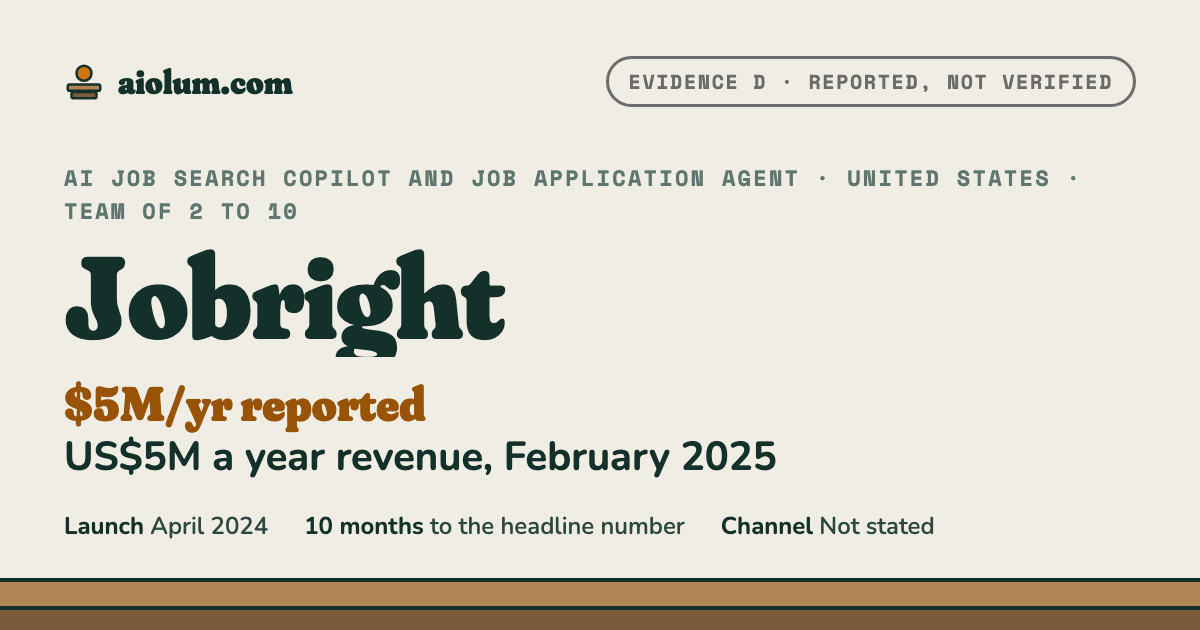
Jobright (AI job search copilot and job application agent, United States): US$5M a year revenue, February 2025. Evidence grade D: reported, not verified. Team: 2 co-founders in 2023; 9 employees at the February 2025 figure (leaderboard); 78 people on LinkedIn in September 2025 (Latka). Launched April 2024; still running.Added 5 November 2026 · updated 6 November 2026
- Outcome
- US$5M a year revenue, February 2025
- Evidence
- D reported, not verified
- Launch
- April 2024
- Status
- Still running
- Team
- 2 co-founders in 2023; 9 employees at the February 2025 figure (leaderboard); 78 people on LinkedIn in September 2025 (Latka)
- Outside funding
- US$7.7M: US$4.5M seed in mid-2023 and US$3.2M in June 2025 (company)
- Main channel
- Not stated
What is not verified
The headline of US$5 million a year rests on one source: the Lean AI Leaderboard row with snapshot February 2025, which cites a LinkedIn post by co-founder Ethan Zheng's account that this page could not read. The post's own number decodes to 10 February 2026, so the date may be wrong. Latka reported only US$1 million in annual recurring revenue in September 2025, from a newsletter this page could not read. No payment processor, filing or press report confirms either figure. A reader could look for a funding announcement or an interview in which a founder gives revenue with a date. The headline number is grade D: one claim or one estimate, with no second source. Aiolum shows it because the story is useful, and marks it so that it is not mistaken for a verified figure.
Jobright is an AI job search copilot: a program that works next to a job seeker and does the slow parts of a job search with a large language model, a model trained on very much text that can read and write. It reads the user's resume, ranks millions of job openings by fit, rewrites the resume for each opening so that an applicant tracking system (ATS), the software that employers use to receive and filter applications, finds the right words in it, and fills in the ATS forms with one click. In June 2025 the company added Jobright Agent, which finds openings, tailors the resume and submits the applications for the user.
Eric Cheng (co-founder and CEO, earlier an engineer at Box and co-founder of the Chinese file-sharing company Fangcloud) and Ethan Zheng (co-founder and CTO, a PhD in AI and databases who led machine-learning teams at Newsbreak and Twitter) started it in 2023. The company says it raised a US$4.5 million seed round in mid-2023, opened a public beta in April 2024, and raised US$3.2 million more in June 2025, in total US$7.7 million. It reported 520,000 users in June 2025; its home page showed 3,000,000 in November 2026.
The money figure is weak. The Lean AI Leaderboard listed annual revenue of US$5 million with 9 employees, snapshot February 2025, and gives a co-founder's LinkedIn post as its source; this page could not read that post. Latka reported a much lower figure, US$1 million in annual recurring revenue in September 2025, and 78 people on LinkedIn. No payment processor, filing or journalist has confirmed either number.
How much revenue does Jobright make?
Each row shows the evidence grade and the source numbers from the list at the end of this page. The grades are explained in How Aiolum verifies.
| Fact | Value | Grade | How we know | Sources |
|---|---|---|---|---|
| Annual revenue, leaderboard snapshot February 2025 | US$5,000,000 | D | Lean AI Leaderboard row: Annual Revenue $5,000,000, 9 employees, Revenue/Employee $555,556, Total Funding $7,700,000, Founded 2023, Snapshot Time Feb 2025. Its source is a LinkedIn post by co-founder Ethan Zheng's account, which this page did not fetch. | [1] |
| Date of the cited LinkedIn post | 10 February 2026 | calc | Calculated: a LinkedIn activity number holds its creation time in milliseconds in its upper bits; 7427094193283678208 shifted right by 22 bits gives 10 February 2026. The leaderboard's snapshot label says February 2025, so one of the two dates is likely wrong. | [1] |
| Monthly equivalent of the leaderboard figure | about US$416,667 a month | calc | Calculated: US$5,000,000 divided by 12. | [1] |
| Annual recurring revenue, September 2025 | US$1,000,000 | D | Latka: "annual recurring revenue passed $1M in September 2025", citing a newsletter (signalhub.substack.com) whose robots.txt blocks Claude agents, so it was not read. Latka also lists the company as founded in 2025, which disagrees with the company's own date of 2023. | [2] |
| People on LinkedIn, September 2025 | 78 | D | Latka, from LinkedIn. LinkedIn counts may include contractors and interns. It disagrees with the 9 employees on the leaderboard. | [2] |
| Founders | Eric Cheng (CEO) and Ethan Zheng (CTO) | C | About page and the company's blog. Founded and launched in 2023. | [3, 6] |
| Funding to date | US$7.7 million | C | Company blog, 18 June 2025: a US$4.5 million seed round in mid-2023 led by Lanchi Ventures with UpHonest Ventures, and a US$3.2 million round in 2025 led by Translink Capital with HR Tech Investments, an affiliate of Indeed. | [3, 4] |
| Public beta | April 2024 | C | Company blog: "Since the public beta launch in April 2024". | [3] |
| Users | 50,000 by June 2024; more than 520,000 by June 2025 | C | Company blog and press release, "all without any paid advertising". About 60% use it every day, the company says. | [3, 4] |
| User growth, June 2024 to June 2025 | about 10.4 times | calc | Calculated: 520,000 divided by 50,000. | [3] |
| Users shown on the home page, November 2026 | 3,000,000 | C | Home page counter "3,000,000 trusted users", read 5 November 2026. Not checked by anyone outside. | [7] |
| Job openings in the index | more than 8,000,000, about 400,000 new a day | C | Home page and blog. The blog says listings are aggregated from LinkedIn, Indeed, company career pages and more. | [3, 7] |
| Product Hunt | 4.8 from 12 reviews, 2,200 followers | C | Product page read 5 November 2026. The company says it was #1 Product of the Week in July 2024. | [10, 3] |
| Months from the public beta to the leaderboard snapshot | 10 | calc | Calculated: April 2024 to February 2025, using the snapshot label as the source gives it. | [1, 3] |
| Premium price, June 2025 | US$30 a month | C | Company blog: "Premium plans ($30/month)". | [3] |
| Employer AI Recruiter price | US$499 per recruiter per month | C | Employer pricing page, read 5 November 2026. | [9] |
How to read this table: a grade D value is reported by one source that did not check it (a leaderboard that retells a founder post, or a directory). A grade C value comes from the company's own pages or press release. A "calc" value was computed on this page. No value is grade A or B.
| Plan | Per month, billed yearly (US$) | Per month, billed monthly (US$) | Limit |
|---|---|---|---|
| Free (job seekers) | 0 | 0 | basic job matching, autofill and resume tools |
| Premium (job seekers) | 30 | company blog, June 2025; full resume AI, coaching and networking tools | |
| AI Recruiter (employers) | 499 | per recruiter per active role; free trial first | |
| Employer annual plans | quote | several active recruiters |
The job-seeker pricing page (jobright.ai/pricing) answered 404 on 5 November 2026, and the current Premium price is shown only inside the app, so the US$30 figure comes from the company's blog post of 18 June 2025 and may have changed. The employer product, Jobright AI Recruiter, is priced per active role and starts with a free trial of two weeks; annual plans are by quote.
When did Jobright launch, and how did it grow?
From a founder's gap-year trip in 2021 to an AI agent that sends job applications, in about four years. Each entry carries its grade.
- 2021CDuring a gap year, Eric Cheng travels through small and medium-sized cities, meets more than 100 young people and helps 10 of them find jobs. He discusses the idea with Ethan Zheng. [6]
- Mid-2023CThe two co-founders start Jobright. The company says it raised a US$4.5 million seed round led by Lanchi Ventures. [3]
- April 2024CPublic beta. 50,000 users within two months, by the company's count. [3]
- July 2024CProduct Hunt launch; the company says it was #1 Product of the Week. [3, 10]
- February 2025DSnapshot date of the leaderboard row: US$5 million in annual revenue, 9 employees. The cited post's number decodes to February 2026. [1]
- 24 June 2025CJobright Agent launches, an AI agent that finds, tailors and submits applications. The company reports 520,000 users and a US$3.2 million round led by Translink Capital, with HR Tech Investments, an affiliate of Indeed. [4, 5]
- September 2025DLatka reports US$1 million in annual recurring revenue and 78 people on LinkedIn. [2]
- November 2026CThe home page shows 3,000,000 users. The company also sells Jobright AI Recruiter to employers at US$499 per recruiter per month. [7, 9]
Why did Jobright work?
Four causes, in the order they mattered. Each one is a reusable lesson.
Founders who had done it before
Both founders came with years of work on the same kind of problem: Ethan Zheng built ranking and personalization models for ads at Twitter and for a news feed at Newsbreak; Eric Cheng had built and run a business software company. Matching a resume to a job opening is a ranking problem of the same kind.
Automate the boring steps
The product removes the repetitive parts of a job search: reading listings, rewriting a resume for each one, and typing the same details into every employer's form. The company says users can apply to hundreds of jobs a day with autofill, and the June 2025 agent submits applications on its own.
A niche that the large sites served badly
An H-1B filter shows openings at employers that sponsor work visas, which international job seekers cannot easily find on the general job sites. TechCrunch wrote about this feature in June 2024, according to the company.
Free first, paid for depth
Matching and autofill are free; the company said in June 2025 that the Premium plan for full resume AI, coaching and networking tools costs US$30 a month. Growth came without paid advertising, the company says.
How it was built
The company has published little about its technology. These points come from its own pages and press release, grade C. [3, 4, 7, 8, 9, 11]
- A web app with job matching, Resume AI, an insider-connections finder, an AI chat coach named Orion, and an H-1B job filter.
- A browser extension fills in application forms on the main applicant tracking systems; the autofill page starts with "Install the Autofill Extension".
- Jobright Agent (June 2025) chains the steps: it matches roles, tailors the resume, fills the forms and tracks each submission.
- The job index is built from listings that the company says are aggregated from LinkedIn, Indeed, company career pages and more.
- The press release of June 2025 said an employer product was being built; by November 2026 the pricing page sold Jobright AI Recruiter per active role.
Tools named in the sources
Each one opens its page in the Tools tab, with every story that uses it.
Who tried this before Jobright, and why did they fail?
Four companies in a database of failed startups tried to make job search or hiring easier with a new interface or with AI, and lost to the large job sites or to slow buyers. The values below are from that database and are not independently verified.
Jobr
The promiseSwipe through jobs on a phone, as in a dating app, and apply in one step.
Why it diedLinkedIn and Indeed added similar mobile features; the swipe idea did not become a lasting advantage and it struggled to make money.
Jobspice
The promiseMake a professional resume quickly from templates.
Why it diedFree resume tools spread, and it never added job matching or networking to become a broader career service.
Snaptalent
The promiseShow job ads to passive job seekers on the websites they already read.
Why it diedLinkedIn dominated professional hiring, and the 2008 recession cut hiring budgets.
Ansaro
The promiseAI that automates recruiting: tracking candidates, parsing resumes and scheduling interviews.
Why it diedRecruiters saw it as nice to have, the change to their work was large, and the return was not clear.
The failed startups come from our database of 1,749 dead startups, retold here in our own words. Its entries are AI-assisted summaries of public sources, so these cards carry no evidence grade.
What changed
Jobr, Jobspice and Snaptalent each improved one step of the job search, and the large job sites either copied the step or made it free. Ansaro sold AI to recruiters, who did not want to change how they hire. Jobright works on the job seeker's side and does many steps at once, which the large sites have less reason to build because their money comes from employers.
Two things are different now. Large language models can rewrite a resume and fill a form well enough that a small team can offer it to millions of people at low cost. And applicant tracking systems put most employers' application forms into a few standard formats, so one extension can fill them all. The open question is the same one that ended Jobr: the job sites that supply listings and the employers that receive the applications can change their rules.
Can one person copy Jobright now?
Not by one person. The pattern, partly.
Jobright had two experienced founders, US$7.7 million in funding by the company's account, and 78 people on LinkedIn in September 2025, according to Latka. A solo founder cannot copy the full job index and agent. A narrow part of it is within reach of one person: a tool for one group of job seekers whom the large sites serve badly, such as visa holders or one profession.
Where it is still open: Job search for groups the general sites serve badly: visa holders, licensed trades, career changers, job seekers outside the United States.
- 1Pick one group of job seekers with a filter the large sites do not offer (visa sponsorship, a license, a language).
- 2Build the one step that costs them the most time, for example tailoring a resume or filling forms on one applicant tracking system.
- 3Keep a free plan for that step and charge for depth, as Jobright says it does.
- 4Read the terms of every job site and applicant tracking system you touch before you automate anything on them.
What could go wrong for Jobright?
The risks are the mirror image of the causes above.
What is not verified
The headline of US$5 million a year rests on one source: the Lean AI Leaderboard row with snapshot February 2025, which cites a LinkedIn post by co-founder Ethan Zheng's account that this page could not read. The post's own number decodes to 10 February 2026, so the date may be wrong. Latka reported only US$1 million in annual recurring revenue in September 2025, from a newsletter this page could not read. No payment processor, filing or press report confirms either figure. A reader could look for a funding announcement or an interview in which a founder gives revenue with a date.
Automated applications and job sites' terms
The company says its autofill lets users "apply to hundreds of jobs each day" and that Jobright Agent submits applications for the user, and its blog says its job listings are aggregated from LinkedIn, Indeed and company career pages. Some job sites and employers restrict automated access or bulk applications in their terms. The sources do not say whether any site has objected; an affiliate of Indeed invested in the June 2025 round.
Testimonials
The testimonials on the home page show first names and initials only. The same quote, "Thanks to this platform I've landed a few interviews and accepted an offer within 1 week of interviewing!!", is signed "Tracy C." on the home page and "Gabriella B., LinkedIn Strategist" on the company's June 2025 blog post.
Team size
The leaderboard listed 9 employees at the headline figure; Latka counted 78 people on LinkedIn in September 2025. The team was started by two co-founders and raised venture money twice. This is a funded company, not a one-person business.
Platform risk
The product depends on job listings from other sites and on the forms of applicant tracking systems. A change of terms or of form layout at LinkedIn, Indeed, Workday or a similar system could break matching or autofill.
Sources
The grade next to each source is the best grade that the source can support. "Read in full" means that the text of the page was downloaded and the numbers were checked in it.
- D Lean AI Leaderboard, published Google Sheet (CSV export), downloaded 5 November 2026Read the row for Jobright (snapshot Feb 2025). Its source column is a LinkedIn post (linkedin.com/posts/zhengyudian_...activity-7427094193283678208), which was not fetched.
- D Latka: Jobright AI Revenue 2025, $1M ARRRead in full. A directory page; the ARR figure cites signalhub.substack.com, which blocks Claude agents and was not read.
- C Jobright Blog, 18 June 2025: Is Jobright Legit?Read in full. The company's own account of its founders, funding, beta date, user counts and Premium price.
- C Jobright Blog, 24 June 2025: Jobright Launches First AI Agent to Put Job Search on AutopilotRead in full. Press release on the agent launch, the US$3.2 million round and 520,000 users.
- C HR Tech Feed, 24 June 2025: Indeed Venture Arm Invests in AI Career Agent TechnologyRead in full. A trade site's retelling of the press release, with the investor quote.
- C Jobright: About UsRead in full, 5 November 2026. Source for the founding story and the founders' backgrounds.
- C Jobright home pageRead in full, 5 November 2026. Source for the features, the user counter and the testimonials.
- C Jobright: Job AutofillRead in full. Source for the autofill extension and the "hundreds of jobs each day" claim.
- C Jobright: Employer pricingRead in full, 5 November 2026. Source for the AI Recruiter price.
- C Product Hunt: Jobright AIRead the rating, reviews, followers and launch year.
- C Jobright: AI AgentRead in full. Source for what the agent does.
Run this company? Send corrections or a verified figure to aiolum@livyden.com