PDF Vector: Revenue, team and how it was built
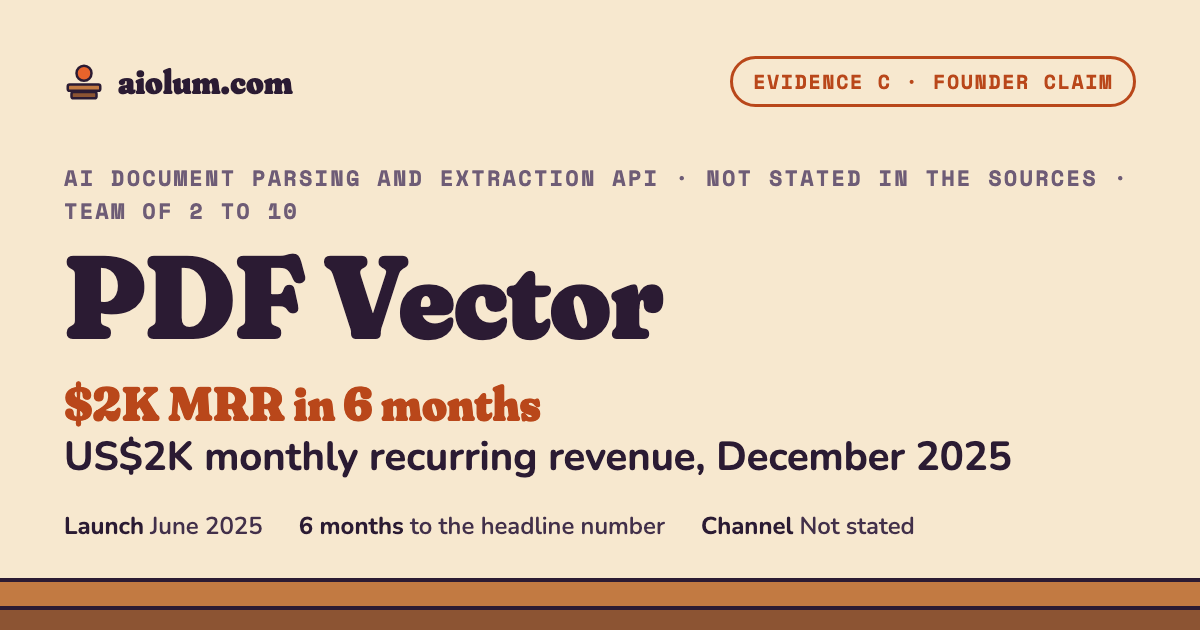
PDF Vector (AI document parsing and extraction API, Not stated in the sources): US$2K monthly recurring revenue, December 2025. Evidence grade C: the founder's own figures, not verified by anyone else. Team: Founder Minh-Phuc Tran, who wrote "It took us 4 months"; the June 2025 site called the company "an independent team"; headcount not published. Launched June 2025; still running, revenue growing.Added 27 October 2026
- Outcome
- US$2K monthly recurring revenue, December 2025Revenue growing
- Evidence
- C the founder's own figures, not verified by anyone else
- Launch
- June 2025
- Status
- Still running
- Team
- Founder Minh-Phuc Tran, who wrote "It took us 4 months"; the June 2025 site called the company "an independent team"; headcount not published
- Outside funding
- None stated (the June 2025 site: "an independent team that doesn't need thousands of customers")
- Main channel
- Not stated
PDF Vector is an API, an interface that lets one program call another over the internet; here a developer sends a document or its web address and gets the result back as data. Document parsing turns a PDF, a Word file or a scanned image into clean markdown, plain text with simple marks for headings and tables that language models read well. Extraction returns the fields that a developer describes in a JSON Schema, a standard format that lists field names and types, for example an invoice number and a total. A third endpoint answers questions about a document, and an academic set searches and fetches papers from PubMed, arXiv, OpenAlex, Semantic Scholar and other indexes. The privacy policy names the models behind it: Claude on AWS Bedrock, Gemini on Google Vertex, and Microsoft's Azure Document Intelligence.
Minh-Phuc Tran is the founder named with the product. The oldest archived copy of the site, from 26 June 2025, sells a PDF and Word parser API from US$16 a month and calls the company "an independent team". On 15 October 2025 he wrote on X that PDF Vector had passed US$1,000 in monthly recurring revenue (MRR, the subscription revenue of one month), "4 months since launch"; the Tiny Startups newsletter repeated it the next day. On 5 December 2025 he posted that it had reached US$2,000 MRR, two months after US$1,000.
Both revenue figures are the founder's own statements, grade C: they agree with each other, but no payment processor has confirmed them, and no later figure was found. The US$2,000 figure sits exactly on this site's money floor of US$2,000 a month. The page also shows four failed companies that tried to turn messy web pages, documents and data into structured, searchable data before general language models could do most of the reading.
How much revenue does PDF Vector make?
Each row shows the evidence grade and the source numbers from the list at the end of this page. The grades are explained in How Aiolum verifies.
| Fact | Value | Grade | How we know | Sources |
|---|---|---|---|---|
| Monthly recurring revenue, 5 December 2025 | US$2,000 | C | Founder's post on X, quoted by Arrfounder: "PDF Vector reached $2K MRR", "$0 - $1K MRR: 4 months", "$1K - $2K MRR: 2 months". The figure is exactly at this site's money floor. | [1] |
| Run rate from the December 2025 figure | US$24,000 a year | calc | Calculated: 2,000 times 12. | [1] |
| Monthly recurring revenue, 15 October 2025 | more than US$1,000 | C | Founder's post, quoted in the Tiny Startups newsletter of 16 October 2025: "PDF Vector has finally passed what is probably the hardest milestone to achieve for a new SaaS: $1,000 MRR" and "It took us 4 months since launch". Arrfounder lists the same milestone on 15 October 2025. | [2, 3, 6] |
| Growth from October to December 2025 | doubled in about seven weeks | calc | Calculated: US$1,000 on 15 October to US$2,000 on 5 December 2025 is 51 days; the founder rounds it to 2 months. | [1, 2] |
| Launch | about June 2025 | calc | Calculated: 15 October 2025 minus the founder's "4 months since launch". The oldest archived copy of the site is from 26 June 2025. | [2, 4] |
| Later revenue figures | none found | C | Arrfounder's product page, read 27 October 2026, lists the US$2,000 milestone as the latest one. The founder's December post ends with "$2K - $3K MRR: … 👀". | [3] |
| Team | founder Minh-Phuc Tran; headcount not published | C | He writes "us" in the October post. The June 2025 site: "We're an independent team that doesn't need thousands of customers". The home page quotes a customer who thanks the "PDF Vector team". | [2, 4, 5] |
| AI models used | Claude on AWS Bedrock, Gemini on Google Vertex, Azure Document Intelligence | C | Privacy policy, read 27 October 2026: "AWS Bedrock (Claude): Used for AI-powered document understanding"; "Google Vertex (Gemini): Used for document analysis"; "Azure Document Intelligence: Used for document layout analysis". | [7] |
| Product in June 2025 | a PDF and Word parser to markdown, by URL | C | Archived home page of 26 June 2025: "Reliable & Accurate PDF Parser API", plans by pages from US$16 a month, and "PDF Vector powers Research Kick and ChatAcademia, processing hundreds of PDFs daily in production". | [4] |
| Product in October 2025 | parse, extract, ask and academic search | C | Archived home page of 17 October 2025: "AI-Powered PDF Processing That Scale" and "search 5M+ academic papers". The Tiny Startups newsletter calls it "an AI-powered PDF processor". | [8, 2] |
| Scale claimed on the site, October 2026 | 19 APIs, more than 1 million documents processed, more than 5 million papers indexed | C | Home page. Company claims, not checked. | [5] |
| Customers named | ChatAcademia, ReadBack and RabbitHoles | C | Home page, "Trusted by". The October 2025 copy also names Research Kick. | [5, 8] |
| Time from launch to the US$2,000 figure | 6 months | calc | Calculated: June to December 2025, and the founder's 4 plus 2 months. | [1, 2] |
How to read this table: a grade C value is a founder statement in a post on X, read through a page that quotes it (Arrfounder, the Tiny Startups newsletter), or a statement on the company's own site, now or in an archived copy. A "calc" value was computed on this page from the rows above it. No value is grade A or B.
| Plan | Per month, billed yearly (US$) | Per month, billed monthly (US$) | Limit |
|---|---|---|---|
| Free | 0 | 0 | 100 credits a month, no credit card |
| Basic | 23 | 25 | 3,000 credits a month |
| Pro | 89 | 97 | 100,000 credits a month |
| Enterprise | 274.08 | 299 | 200,000 credits per dedicated instance plus 100,000 shared credits |
All plans include every API; they differ by the number of credits a month, and each API call costs a set number of credits (an Academic Fetch request costs 2 credits for up to 100 papers). Billed yearly, a customer pays for 11 months and gets 12; the yearly Enterprise price is US$3,289 (274.08 a month, calculated). Enterprise includes one dedicated managed instance; each additional instance costs US$100 a month or US$1,100 a year. Earlier price models: on 26 June 2025, plans by pages (Basic US$16, Pro US$79 and Enterprise US$333 a month); on 14 December 2025, plans by credits (Basic US$23, Pro US$89 and Enterprise US$457 a month billed yearly).
When did PDF Vector launch, and how did it grow?
From a PDF-to-markdown parser in June 2025 to an AI document API at US$2,000 a month in December 2025. Each entry carries its grade.
- June 2025CLaunch of a PDF and Word parser API that returns markdown from a document URL, with plans by pages: Free, Basic US$16, Pro US$79 and Enterprise US$333 a month. The site calls the company "an independent team". [4]
- 15 October 2025CThe founder posts that PDF Vector passed US$1,000 MRR, four months after launch. The Tiny Startups newsletter repeats it on 16 October. [2, 3, 6]
- 17 October 2025CThe site now reads "AI-Powered PDF Processing": parse, extract structured data, ask AI questions, and search more than 5 million academic papers through one API. [8]
- 5 December 2025CHe posts US$2,000 MRR, two months after US$1,000. [1]
- 14 December 2025CPlans are now sold by credits: Basic US$23, Pro US$89 and Enterprise US$457 a month, billed yearly. The site promotes an n8n integration. [9]
- October 2026CThe home page lists 19 APIs, dedicated instances in more than 34 regions across 26 countries, an MCP server and Zapier, Make and n8n integrations. Basic costs US$25 a month, Pro US$97, Enterprise US$299. [5]
- October 2026CArrfounder still shows the December 2025 milestone as the latest one. No newer revenue figure was found. [3]
Why did PDF Vector work?
Four causes, in the order they mattered. Each one is a reusable lesson.
Sell the first step of every AI app
Most AI apps built on a company's own files must first turn PDFs, scans and spreadsheets into text and fields. PDF Vector sells that one step to developers, so they do not have to combine text recognition, layout analysis and language models themselves.
Rent the models, sell the plumbing
The privacy policy names Claude on AWS Bedrock, Gemini on Google Vertex and Azure Document Intelligence. The company's work is the API around them: one request format for many file types, schemas for extraction, special endpoints for invoices, bank statements and identity documents, and regional instances for customers with data rules.
A niche inside the niche: academic papers
Besides documents, the API searches and fetches papers from PubMed, arXiv, OpenAlex, Semantic Scholar, Europe PMC, ERIC and Google Scholar, and turns a paper's public PDF into markdown. In June 2025 the site said the parser already powered two research products, Research Kick and ChatAcademia.
Many small entry points
A free tier with 100 credits, free tools (a bank statement converter, a DOI-to-PDF finder, a JSON Schema editor), integrations for Zapier, Make and n8n, an MCP server and an agent skill. No source says which of these brought the paying customers.
How it was built
These details come from the company's home page, its privacy policy, its API pages and archived copies of the site. They are grade C. [7, 5, 4, 12, 10]
- AI models: Claude through AWS Bedrock for document understanding, Gemini through Google Vertex for document analysis, and Azure Document Intelligence for layout analysis. The policy says the company opted out of data training with each provider.
- A REST API with a TypeScript client library (@pdfvector/client) and examples in cURL and Python. The first version in June 2025 took only a document URL and returned markdown.
- Documents are processed in isolated instances in the region the customer chooses and, according to the terms, are not permanently stored.
- Academic search and fetch over PubMed, arXiv, OpenAlex, Semantic Scholar, Europe PMC, ERIC and Google Scholar.
- Integrations with Zapier, Make and n8n, an MCP endpoint for AI assistants, and an installable agent skill listed on skills.sh.
Tools named in the sources
Each one opens its page in the Tools tab, with every story that uses it.
Who tried this before PDF Vector, and why did they fail?
Four companies in the Loot Drop database tried to turn web pages, documents or scattered data into structured, searchable data with their own algorithms, before general language models could read most documents. The values below are from that database and are not independently verified.
Dashblock
The promiseTurn any web page into an API without writing code.
Why it diedIts technology could not keep up with constantly changing web pages, and AI tools overtook it, according to the database.
Omnity
The promiseSemantic search that connects related documents and data across fields.
Why it diedLarge technology companies offered stronger AI search, and Omnity could not pay for its own algorithm work without a large base of paying users.
jEugene
The promiseSoftware that finds errors and inconsistencies in contracts.
Why it diedRivals with better AI moved faster, law firms adopted slowly, and the company could not raise money, according to the database.
Canvas
The promiseReplace paper forms with digital forms and workflows.
Why it diedMicrosoft, Adobe and low-code platforms offered the same, and it fell behind on mobile, according to the database.
The failed startups come from Loot Drop, a free database of dead startups, retold here in our own words. Loot Drop describes its entries as AI-assisted summaries of public sources, so these cards carry no evidence grade.
What changed
Each predecessor built its own technology to read pages, contracts or data, and each lost when larger companies or better AI did the same reading. PDF Vector starts from the opposite position: it does not build the reading models. It rents Claude, Gemini and Azure Document Intelligence and sells a simple API, plans and regional hosting around them. That is why a small team could offer parsing, extraction, questions and academic search within four months of launch.
The predecessors' risk is still there, and it is closer. The same providers sell document reading directly: Azure Document Intelligence is itself a product, and Gemini and Claude accept PDFs as input. PDF Vector's room is in the work around the models: one format for many file types, schemas, academic sources, credits that a small customer can afford, and instances in the region that a regulated customer needs.
Can one person copy PDF Vector now?
Yes. Many already have.
Little here needs money: the models are rented, the API is a thin layer, and the first version only turned a PDF URL into markdown. The founder said that the first US$1,000 a month took four months and the next US$1,000 took two. The hard part is standing out among many document APIs, which is why PDF Vector added academic search and special endpoints for invoices, bank statements and identity documents.
Where it is still open: Document APIs for one industry or document type that general tools handle badly: medical records, customs forms, insurance claims, scanned historical archives.
- 1Pick one boring step that every AI app on documents must solve, and sell it as an API.
- 2Start with one input and one output (a PDF URL to markdown), and charge from the start.
- 3Add the endpoints that customers ask for: extraction with a schema, questions, special document types.
- 4Offer a free tier, free tools and integrations with Zapier, Make, n8n and MCP so developers can try it in minutes.
- 5Name your model providers and their data rules in the privacy policy; business customers check this first.
What could go wrong for PDF Vector?
The risks are the mirror image of the causes above.
Self-reported revenue, on the money floor
Both revenue figures are the founder's posts on X, read through Arrfounder and the Tiny Startups newsletter. They agree with each other, but no payment processor or buyer has confirmed them, and no TrustMRR profile was found. The headline of US$2,000 a month is exactly this site's minimum, and it is from December 2025; Arrfounder showed no newer milestone on 27 October 2026.
Team size not published
Only Minh-Phuc Tran is named. He writes "us", and the June 2025 site said "We're an independent team". No source gives the number of people or says whether the company took outside money.
Compliance claims not checked
The privacy policy says "We are compliant with GDPR, SOC 2, ISO 27001, and HIPAA requirements", and the home page says the service meets them "by design". SOC 2 and ISO 27001 are audits by outside firms; none of the pages read links an audit report or a certificate.
The free DOI-to-PDF tool
The tool converts paper IDs from "PubMed, arXiv, Semantic Scholar, ERIC, Europe PMC, Google Scholar, and OpenAlex to direct PDF download links", and the Academic Parse API works "from its public PDF". The pages read name only these public indexes and no unofficial libraries, but they do not say "open access" either, and Google Scholar also lists copies posted by others.
Built on the providers it competes with
The core reading is done by Claude, Gemini and Azure Document Intelligence. Each of these providers can lower its own prices or add the same features, which would leave less room for a layer in between.
Named customers
The site lists ChatAcademia, ReadBack and RabbitHoles as users, and in June 2025 it said the parser "powers Research Kick and ChatAcademia". The sources do not say whether these products are independent customers or belong to the same team.
Identity documents
The API has endpoints to parse and extract identity documents. The terms require users to be 18 or older and say documents are processed in isolated instances and "are not permanently stored"; this page could not check how that is enforced.
Sources
The grade next to each source is the best grade that the source can support. "Read in full" means that the text of the page was downloaded and the numbers were checked in it.
- C Arrfounder: Pdfvector Reaches $2K MRR, 5 December 2025, quoting Minh-Phuc Tran's post on XRead in full in the copy downloaded on 27 October 2026. Could not open the post on X (it needs a login); cited from Arrfounder's quotation of https://x.com/phuctm97/status/1996922421757333560. Source for the headline figure.
- C Tiny Startups newsletter, TWITS #82, 16 October 2025: Minh-Phuc hit $1k MRR with PDF VectorRead the section on PDF Vector in the copy downloaded on 27 October 2026 (the newsletter host allows agents). It quotes the founder's post of 15 October 2025.
- C Arrfounder: Pdfvector product page, revenue milestonesRead in full on 27 October 2026. Lists the US$1,000 milestone of 15 October 2025 and the US$2,000 milestone as the latest.
- C Wayback Machine copy of pdfvector.com, 26 June 2025Read in full. The oldest archived copy found. Source for the first product, the first prices and the "independent team" statement.
- C PDF Vector home page, read 27 October 2026Read in full in the copy downloaded on 27 October 2026. Source for the current product, the prices, the customer names and the integrations.
- C Arrfounder news listing, page 18Read the PDF Vector entry in the copy downloaded on 27 October 2026. Confirms the "Pdfvector Passes $1K MRR" item.
- C PDF Vector Privacy Policy, read 27 October 2026Read in full. Source for the AI providers and the compliance statement.
- C Wayback Machine copy of pdfvector.com, 17 October 2025Read in full. Source for the AI features at the time of the US$1,000 figure.
- C Wayback Machine copy of pdfvector.com, 14 December 2025Read in full. Source for the prices at the time of the US$2,000 figure.
- C PDF Vector: Academic Fetch API page, read 27 October 2026Read in full. Source for the academic sources and the credit cost.
- C PDF Vector: DOI to PDF Converter, read 27 October 2026Read in full. Source for the free tool and the indexes it uses.
- C PDF Vector Terms of Service, read 27 October 2026Read in full. Source for the age limit and the document storage rule.
- C Loot Drop database export, 1,749 failed startupsLocal export. AI-written summaries, not independently verified. Source for the failed predecessors.