SayWell: Product, team and how it was built
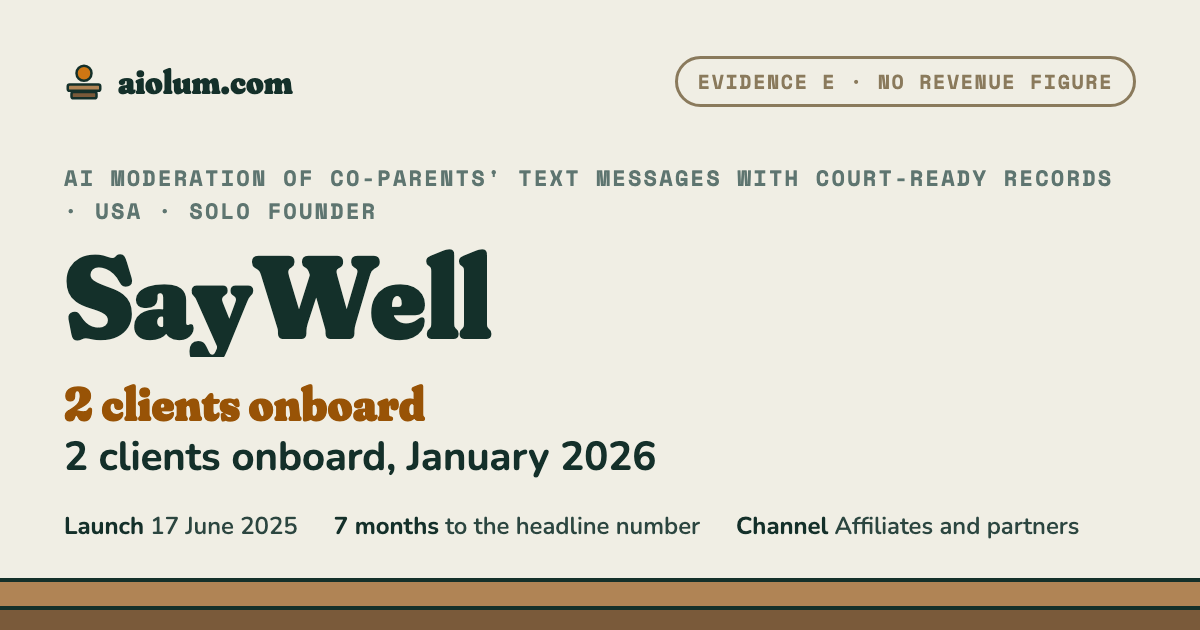
SayWell (AI moderation of co-parents' text messages with court-ready records, USA): 2 clients onboard, January 2026. Evidence grade E: no revenue figure was checked. Team: 1 founder ("it's really just me right now", company's contest entry, January 2026). Launched 17 June 2025; still running.Added 5 November 2026 · updated 6 November 2026
- Outcome
- 2 clients onboard, January 2026
- Evidence
- E no revenue figure was checked
- Launch
- 17 June 2025
- Status
- Still running
- Team
- 1 founder ("it's really just me right now", company's contest entry, January 2026)
- Outside funding
- Some outside funding, less than US$1M (company's contest entry; amount not stated)
- Group
- Legal and law firms
- Main channel
- Affiliates and partners
What is not verified
No revenue figure was found. The only traction figure is the company's own statement to LawNext, published on 12 January 2026, of "2 clients onboard" with a target of 10 in January and 50 in February; it does not say whether those clients pay. No payment-processor profile, filing, press interview or later count was found. The founder is not named in any source that was read. The landing page shows four testimonials with first names and initials only, one of them repeated, and the menu shows links such as "Get Template now", "About" and "Blog" that are not in the site map, which suggests parts of a website template were left in place. The landing page says studies show co-parenting conflict affects children but cites none ("Google it and see"). A reader could look for a state company record of SayWell, LLC, the ABA TECHSHOW 2026 results or a later interview. This story is grade E: the business is real and its product, price and customers are described from public pages, but no revenue figure was checked. Aiolum shows it as an idea worth studying, not as proof that it makes money.
SayWell is a moderated messaging service, a channel in which software reads each message before it is delivered and can stop it, for co-parents, parents who raise children together after a separation. It works over SMS, the standard text-message system of every phone: each parent texts the other parent's SayWell-assigned number, the company's AI catches "tone, topics, condescension, threats and more", and every delivered message is kept as a timestamped record that can be searched and exported for court.
The company's entry for the LawNext Startup Alley contest, published on 12 January 2026, says SayWell was founded on 17 June 2025 in Atlanta by one non-attorney founder with a product-management background, who wrote "it's really just me right now". The entry says the company charges "$20 per month per co-parent", had "2 clients onboard" and was "targeting 10 in January and 50 in February". In November 2026 the site still sells one Standard Plan at US$20 a month with 14 days free.
No revenue figure was found, so this story is grade E: the client count and the price are the company's own statements.
How much revenue does SayWell make?
Each row shows the evidence grade and the source numbers from the list at the end of this page. The grades are explained in How Aiolum verifies.
| Fact | Value | Grade | How we know | Sources |
|---|---|---|---|---|
| Founded | 17 June 2025, Atlanta, Georgia | C | Company's LawNext entry, January 2026. The site footer names SayWell, LLC at 3243 Piedmont Road, Atlanta. | [1, 2] |
| Clients, January 2026 | 2 clients onboard; target 10 in January and 50 in February | C | Company's LawNext entry, published 12 January 2026: "Just started working with attorneys 2 weeks ago for validation with initial users." The entry does not say whether the 2 clients are parents or attorneys, or whether they pay. | [1] |
| Revenue | no figure found | C | No revenue amount appears in the contest entry or on the site, so the story is grade E. | [1, 2] |
| Price | US$20 a month per co-parent, first 14 days free; attorney portal free | C | The company told LawNext "$20 per month per co-parent, no cost for attorney portal access"; the landing page shows the same price in November 2026. | [1, 3, 4] |
| Team | 1 founder | C | Company's LawNext entry: "Well it's really just me right now". The founder describes a 20-year corporate career with the last 15 years leading product management teams. The entry does not give the founder's name. | [1] |
| Outside funding | less than US$1M | C | Company's LawNext entry. The contest form also offered "No outside funding", which 10 other entrants chose; SayWell chose "Less than $1M in outside funding", so it raised some money, amount not stated. | [1] |
| What the AI does | blocks inflammatory messages or redrafts them; AI search of the archive by topic and tone | C | Attorneys page: "AI-based logic to catch tone, topics, condescension, threats and more". Home page FAQ: messages are "either blocked or blocked with a re-draft". | [2, 4] |
| Consent | two-sided opt-in; only messages to the assigned number are seen | C | Home page FAQ: "you both need to have the service" and SayWell sees only "the text messages sent to your ex's SayWell-assigned phone number". | [2] |
| Competitors named by the company | OurFamilyWizard, TalkingParents, AppClose | C | Company's LawNext entry and home page FAQ. | [1, 2] |
| Time from founding to the January 2026 count | 7 months | calc | Calculated: June 2025 to January 2026. | [1] |
How to read this table: grade C is a statement by the company in its own contest entry or on its own site. No row is grade A or B, and no revenue figure was found.
| Plan | Per month, billed yearly (US$) | Per month, billed monthly (US$) | Limit |
|---|---|---|---|
| Standard Plan | 20 | per co-parent; unlimited moderated texting, archive and search, attorney access, first 14 days free | |
| Attorney portal | 0 | 0 | free for legal professionals |
One plan. The price is per co-parent, and both co-parents need the service, so one family pays US$40 a month in total if each parent pays (calculated: 2 times US$20). Attorneys and other legal professionals use the portal for free. No yearly price is shown.
When did SayWell launch, and how did it grow?
From founding in June 2025 to a legal-tech contest entry with 2 clients in January 2026, 7 months. Each entry carries its grade.
- 17 June 2025CCompany founded, by the date it gave LawNext. [1]
- Late December 2025 or early January 2026CThe founder starts working with family law attorneys "for validation with initial users", two weeks before the contest entry. [1]
- 12 January 2026CLawNext lists SayWell among the Startup Alley semifinalists for ABA TECHSHOW 2026, with 2 clients onboard and a price of US$20 a month per co-parent. [1]
- 5 November 2026CThe site is live with one Standard Plan at US$20 a month, a 14-day free trial, an interactive demo bot and a free attorneys page. [2, 3, 4]
Why did SayWell work?
Four causes, in the order they mattered. Each one is a reusable lesson.
No new app
Court-ordered co-parenting apps need a login for every message. SayWell gives each parent a phone number for the other parent, so they keep texting from their normal messaging app, and the moderation and the records happen on SayWell's side.
Stop the message, not only record it
Older tools keep a record that can be shown in court later. SayWell's AI reads the message before delivery and blocks it, or offers a calmer redraft when the message also contains useful content, so the other parent never sees the angry version.
Attorneys as the sales channel
The paying customer is the parent, but the portal is free for attorneys, who get searchable, exportable transcripts instead of screenshot dumps. The founder's plan is to turn early-adopter family law attorneys into a referral source.
How it was built
These details come from the company's own pages and its contest entry. They are grade C. [1, 2, 4]
- The marketing site is built with Framer, by the page's generator tag, and carries Google Analytics and the Facebook pixel.
- Messaging runs over ordinary SMS through phone numbers that SayWell assigns; the founder's plan is to move to an SMS short code for reliability.
- AI checks each message for tone, topics, condescension and threats, redrafts blocked messages that contain useful content, and powers conceptual search of the archive. The site does not name the AI model or provider.
- Optional real-time alerts can notify professionals, such as attorneys, when an exchange gets out of control.
Tools named in the sources
Each one opens its page in the Tools tab, with every story that uses it.
Who tried this before SayWell, and why did they fail?
Three companies in our database of failed startups tried to move a hard conversation into a new messaging channel and failed. The values below are from that database and are not independently verified.
First Opinion
The promiseText a real doctor for quick medical advice instead of visiting a clinic.
Why it diedIt stayed with text messages while competitors moved to video calls and full medical records.
Shift Messenger
The promiseA messaging app for shift workers to settle schedule conflicts.
Why it diedBusinesses stayed with plain texts or moved to Slack, and the money ran out.
ExceptionALLY
The promiseOne platform for parents and schools to manage special-education plans and the communication around them.
Why it diedIt could not get through school buying processes and lost to larger education companies.
The failed startups come from our database of 1,749 dead startups, retold here in our own words. Its entries are AI-assisted summaries of public sources, so these cards carry no evidence grade.
What changed
Shift Messenger and ExceptionALLY asked people to adopt a new app for a difficult conversation, and the record says people stayed with plain texts or with tools they already had. SayWell takes the opposite route: it stays inside plain texts, which is the habit that defeated Shift Messenger.
Moderation that reads tone and rewrites a message was not practical for a one-person company before large language models. Now the founder can rent that ability from a model provider and spend his work on the SMS routing, the archive and the attorney portal.
Can one person copy SayWell now?
Yes, the method; the sale is slow.
One founder built it, by the company's own entry. The method, putting AI moderation and record keeping into a channel that people already use instead of a new app, repeats well. The founder also wrote that selling is hard because both sides of a case must agree to use it.
Where it is still open: Other two-party records that end up in court or at work: landlord and tenant messages, contractor and homeowner texts, and team chats that need a respectful-conduct record.
- 1Find a conversation that a court, school or employer wants on the record but people avoid in the official app.
- 2Put a number or address in the middle of the channel they already use, and log every message.
- 3Use a model to stop or redraft harmful messages before delivery, with settings the user controls.
- 4Give the professional who needs the records, here the attorney, free access, and sell through them.
What could go wrong for SayWell?
The risks are the mirror image of the causes above.
What is not verified
No revenue figure was found. The only traction figure is the company's own statement to LawNext, published on 12 January 2026, of "2 clients onboard" with a target of 10 in January and 50 in February; it does not say whether those clients pay. No payment-processor profile, filing, press interview or later count was found. The founder is not named in any source that was read. The landing page shows four testimonials with first names and initials only, one of them repeated, and the menu shows links such as "Get Template now", "About" and "Blog" that are not in the site map, which suggests parts of a website template were left in place. The landing page says studies show co-parenting conflict affects children but cites none ("Google it and see"). A reader could look for a state company record of SayWell, LLC, the ABA TECHSHOW 2026 results or a later interview.
Competition
The company names OurFamilyWizard, TalkingParents and AppClose, which are established co-parenting apps. LegalBridge, another Startup Alley semifinalist on this site, also sells to law firms, but SayWell is far earlier, with 2 clients against LegalBridge's stated 70+ firms in the same January 2026 list.
Dependence on model providers and SMS carriers
The site says the moderation and search are "AI-based" but does not name the model or provider, so the dependence cannot be checked. A change in a provider's price, terms or quality would reach the product directly. The service also depends on SMS delivery through assigned numbers; the founder plans a move to an SMS short code.
Consent and records
Both parents must opt in, and SayWell sees only messages sent to the assigned number, by its FAQ. Messages are stored, searchable and can be shown to attorneys, and optional alerts can notify professionals in real time. The sources read do not describe data retention or the legal weight of the records in court.
Sources
The grade next to each source is the best grade that the source can support. "Read in full" means that the text of the page was downloaded and the numbers were checked in it.
- C LawNext (Bob Ambrogi), 12 January 2026: Voting Is Now Open! Pick the 15 Finalists to Compete At Startup Alley at ABA TECHSHOW 2026 in MarchRead the section on SayWell and the funding answers of all entrants. The summaries are based on the startups' own applications, so these are company statements.
- C SayWell home page, read 5 November 2026Read in full. Source for the features, the FAQ on consent and competitors, and the company address.
- C SayWell landing page, read 5 November 2026Read in full. Source for the price, the free trial, the sign-up steps, the demo bot and the testimonials.
- C SayWell for Legal Professionals, read 5 November 2026Read in full. Source for the AI moderation, AI search, free attorney access and optional alerts.
- C Database of failed startups, local exportLocal export. AI-written summaries, not independently verified. Source for the failed predecessors.
Run this company? Send corrections or a verified figure to aiolum@livyden.com