Simple AI: Product, team and how it was built
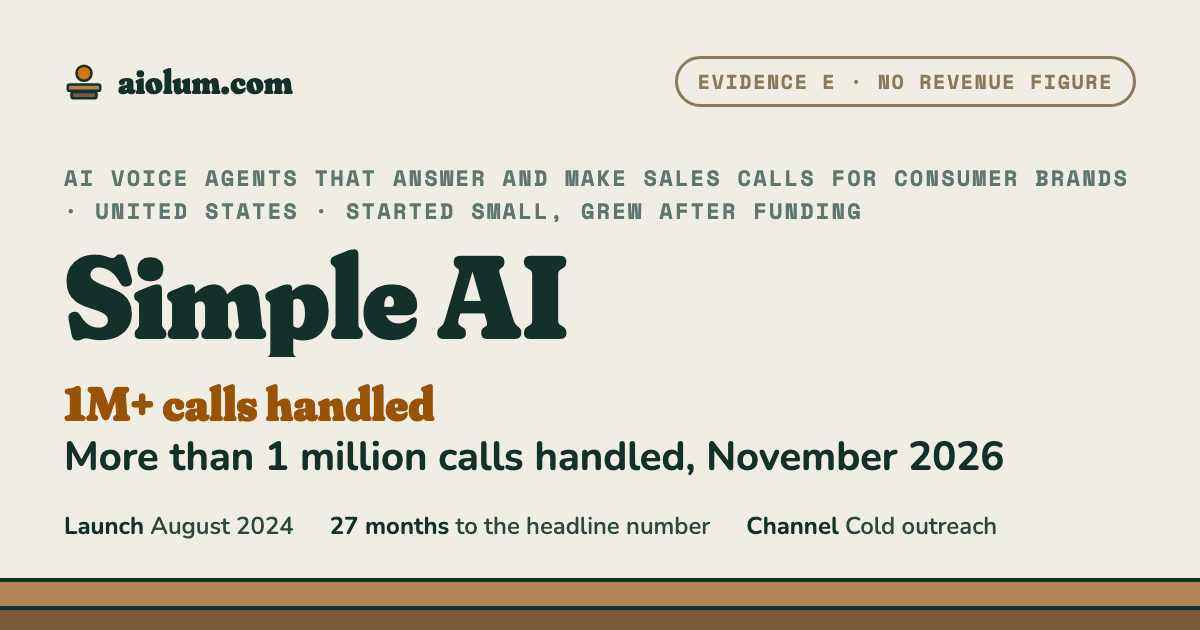
Simple AI (AI voice agents that answer and make sales calls for consumer brands, United States): More than 1 million calls handled, November 2026. Evidence grade E: no revenue figure was checked. Team: 2 co-founders at the start in 2024 (Y Combinator Summer 2024 batch); 11 people on the Y Combinator company page read in November 2026, after a US$14M seed round announced in February 2026. Launched August 2024; still running.Added 6 November 2026
- Outcome
- More than 1 million calls handled, November 2026
- Evidence
- E no revenue figure was checked
- Launch
- August 2024
- Status
- Still running
- Team
- 2 co-founders at the start in 2024 (Y Combinator Summer 2024 batch); 11 people on the Y Combinator company page read in November 2026, after a US$14M seed round announced in February 2026
- Outside funding
- US$14M seed round led by First Harmonic, announced by the company on 10 February 2026; Y Combinator also invested
- Main channel
- Cold outreach
What is not verified
No revenue figure was found. The company's site, its Y Combinator pages and its blog give no revenue, number of paying customers or price. The '+1M' calls figure, the 30% conversion claim and the Omaha Steaks results are the company's own statements; the Omaha Steaks numbers are the customer's outcomes, not Simple AI's revenue. A reader could look for a funding-round article by a journalist, a customer statement outside the company's blog, or a payment-processor profile. This story is grade E: the business is real and its product, price and customers are described from public pages, but no revenue figure was checked. Aiolum shows it as an idea worth studying, not as proof that it makes money.
Simple AI sells voice agents: programs that hold a phone conversation on their own, using speech recognition, a large language model and speech synthesis. Its agents answer and make sales calls for consumer brands. A company's contact center (the team and phone system that handle customer calls) connects the agent to its phone lines, and the agent takes orders, suggests extra products and passes harder calls to people. The company's About page says the agents have handled more than 1 million calls.
Catheryn Li and Zach Kamran met at Y Combinator, where they built its software for founders, and went through its Summer 2024 batch themselves. Their first product, launched in August and December 2024, was a consumer iPhone app that made calls for its users; their launch post says it was tested with 1,000 beta users. They then moved to agents for businesses. The company's case study says Omaha Steaks put its agent on all of its inbound sales traffic, and in February 2026 the company announced a US$14 million seed round.
No revenue figure was found, so this story has evidence grade E. The call count, the customer results and the funding are the company's own statements on its website.
How much revenue does Simple AI make?
Each row shows the evidence grade and the source numbers from the list at the end of this page. The grades are explained in How Aiolum verifies.
| Fact | Value | Grade | How we know | Sources |
|---|---|---|---|---|
| Calls handled | more than 1 million | C | About page, read 6 November 2026: '+1M Of calls handled.' Undated on the page; the date here is the reading date. | [1] |
| Founders | Catheryn Li (CEO) and Zach Kamran (CTO) | C | About page and Y Combinator launch posts. Both worked on Y Combinator's own software (Startup School, Bookface, co-founder matching) before the batch. | [1, 5] |
| Founded | 2024, San Francisco; Y Combinator Summer 2024 | C | About page ('2024 Founded in San Francisco') and the Y Combinator company page (batch 'Summer 2024', year founded 2024). | [1, 3] |
| First product | Consumer phone assistant app for iPhone | C | Y Combinator launch of 13 August 2024 ('a better Siri') and of 5 December 2024 ('available on the App Store'): the app waits on hold, navigates phone menus and calls in 33 countries in 15 languages. | [5, 4] |
| Beta users of the consumer app | 1,000 | C | Founders' launch post, 5 December 2024: 'We tested a beta version of the app extensively with our initial set of 1000 users.' | [4] |
| Team | 2 founders in 2024; 11 people in November 2026 | C | Y Combinator company page, team size 11, read 6 November 2026. The careers page lists seven open roles in San Francisco. | [3, 10] |
| Funding | US$14 million seed round | C | Company blog, 10 February 2026: led by First Harmonic, with Y Combinator, Massive Tech Ventures, Samsung Next, True Ventures, Conviction Capital, HNVR and 70 angel investors. The company's own announcement. | [6] |
| Named customer | Omaha Steaks | C | Case study of 7 July 2026 by the CEO: proof of concept signed 2 June, first live calls 10 June, all traffic in September. Customer results, not revenue of Simple AI: 60% of calls handled without a person, abandonment down from 16% to 3%, upsell rate 28% to 30%. | [7] |
| Prices | not published | C | The footer link 'Pricing' opens the demo form. | [2] |
| Own model | Tango, an end-of-turn and interruption model | C | Company blog, 29 September 2026: the company trained its own model to decide from the audio when a caller has finished speaking. | [8] |
| Time from first launch to the call count | 27 months | calc | Calculated: August 2024 to November 2026. | [5, 1] |
How to read this table: a grade C value is the company's own statement on its website or in its Y Combinator posts. A "calc" value was computed on this page. No revenue figure was found.
| Plan | Per month, billed yearly (US$) | Per month, billed monthly (US$) | Limit |
|---|---|---|---|
| Business plan | custom | custom | quote after a demo; no prices on the site |
The Pricing link in the site footer opens the demo request form, and the address /pricing returns a page-not-found error. Every buyer books a demo and receives a quote. The company's comparison page with ElevenLabs says 'Simple charges a platform fee plus per-minute usage', without amounts. The consumer app of 2024 was joined through an invite link; its prices, if any, were not found.
When did Simple AI launch, and how did it grow?
From a consumer phone assistant in a Y Combinator batch in 2024 to sales agents in contact centers in 2026. Each entry carries its grade.
- 2024CCatheryn Li and Zach Kamran leave their software jobs at Y Combinator and enter its Summer 2024 batch as founders. [1, 3]
- 13 August 2024CY Combinator launch post 'Simple AI - a better Siri': a consumer assistant for iPhone, with a waitlist. [5]
- 5 December 2024CThe Simple AI Phone Assistant opens on the App Store after a beta with 1,000 users. It makes calls for its users, waits on hold and navigates phone menus. [4]
- June 2025COmaha Steaks signs a proof of concept on 2 June; the first live calls run on 10 June. The case study, published in July 2026, reports the results 'after one year'. [7]
- 10 February 2026CThe company announces a US$14 million seed round led by First Harmonic and says its agents sell 'everything from steak to self storage to home insurance'. [6]
- 29 September 2026CThe company releases Tango, its own model for end-of-turn and interruption detection on phone audio. [8]
- November 2026CThe About page states more than 1 million calls handled; the Y Combinator page lists 11 people. [1, 3]
Why did Simple AI work?
Four causes, in the order they mattered. Each one is a reusable lesson.
Pivot to the side that pays
The consumer app called businesses for people. The About page says businesses kept asking for the other side of that call: the agent that picks up. Businesses pay for the agent: the company's comparison page with ElevenLabs says 'Simple charges a platform fee plus per-minute usage.'
Sell revenue, not fewer calls
Most support bots are sold on deflection, the share of calls that never reach a person. Simple AI sells its agent on orders and upsells. The Omaha Steaks case study puts its main point as framing the project 'around revenue rather than deflection'.
Start with one narrow line, then expand
At Omaha Steaks the first use case was the phone numbers printed on mail catalogues, where callers order one known package. The team spent two weeks on site, went live in eight days and then added about 100 products and all call traffic over the following months.
How it was built
These details come from the company's own pages. They are grade C. [1, 8, 2, 7, 12]
- The About page says the founders built 'the entire voice stack from the ground up rather than assembling someone else's parts', to control latency and tone.
- Tango, released in September 2026, reads end-of-turn and interruptions directly from the audio instead of waiting for a transcript; the company reports a median decision 300 milliseconds earlier than a conventional voice-activity detector.
- The agent reads a customer's website and product list to learn its catalogue, prices and rules, and pulls them live.
- Integrations listed on the site include Genesys, NICE CXone, Five9, Amazon Connect, Twilio Flex, Salesforce, Zendesk, Shopify and Snowflake.
- Deployment is hands-on: the case study describes dedicated agent engineers on the account and meetings two to three times a week a year into the project.
Tools named in the sources
Each one opens its page in the Tools tab, with every story that uses it.
Who tried this before Simple AI, and why did they fail?
Three companies in our database of failed startups tried to make talking to computers, or buying through a conversation, work before large language models. The values below are from that database and are not independently verified.
Tellme
The promiseInformation and transactions over the phone by voice command, with speech recognition for customer calls.
Why it diedPhone voice menus lost ground to apps and smartphone assistants.
VocalIQ
The promiseA voice interface that learned from context, so that talking to a computer felt like a conversation.
Why it diedIt could not compete with the large technology companies' assistants and ended inside Apple.
Vanti
The promiseAI chat bots that would give each shopper a personal buying conversation for brands.
Why it diedNo product-market fit in a crowded conversational AI market; high customer acquisition cost and hard integrations.
The failed startups come from our database of 1,749 dead startups, retold here in our own words. Its entries are AI-assisted summaries of public sources, so these cards carry no evidence grade.
What changed
Tellme and VocalIQ worked with speech recognition and dialog systems that needed every path written by hand, the same limit that the case study says Omaha Steaks hit with its own in-house virtual agent: 20% of calls handled on one use case after six months. Large language models remove most of that hand mapping.
Vanti sold conversational shopping as a new channel. Simple AI attaches to the phone line that consumer brands already staff and measures itself against their human sales reps, so the buyer compares it with a known cost.
Can one person copy Simple AI now?
Not by one person today.
The company built its own voice stack and its own audio model, sells to large contact centers with long integrations, and raised a seed round to do it. What a small team can copy is the approach: begin with one narrow call type that ends in a sale, and grow from there.
Where it is still open: Smaller businesses with seasonal phone sales (gift food, home services, storage) that cannot run months-long contact-center projects.
- 1Pick one call type that ends in money, such as orders from a printed catalogue's phone number.
- 2Measure the agent against human reps on conversion and upsell, not only on calls avoided.
- 3Deploy next to the customer's existing phone platform instead of replacing it.
- 4Expand to the next call type only after the first one meets an agreed target.
What could go wrong for Simple AI?
The risks are the mirror image of the causes above.
What is not verified
No revenue figure was found. The company's site, its Y Combinator pages and its blog give no revenue, number of paying customers or price. The '+1M' calls figure, the 30% conversion claim and the Omaha Steaks results are the company's own statements; the Omaha Steaks numbers are the customer's outcomes, not Simple AI's revenue. A reader could look for a funding-round article by a journalist, a customer statement outside the company's blog, or a payment-processor profile.
AI calls that may not say they are AI
The home page says: 'Phone calls so natural, customers won't know it's AI.' The pages read do not say whether the agent tells callers that it is an AI; the debt-collection page says the customer's own team defines 'disclosures, consent and opt-out handling'. The agents also place outbound calls to consumers: the seed announcement says they 'handle inbound and outbound consumer calls'. Outbound calls are subject to consent and do-not-call rules, and the company's Terms of Use forbid using the service to contact anyone who has not given 'express written consent' or whose number is on the National Do-Not-Call Registry. Business buyers sign a separate agreement with the company, which is not public.
Debt collection among the use cases
One use-case page sells the agent for overdue balances: it verifies the right party, explains balances, takes payment actions and passes disputes and hardship cases to a person under 'your approved outreach policy'. Collections calls are a regulated activity; the page leaves compliance to the customer's own policy.
Logo wall and deployment work
The home page shows logos (DoorDash, SpaceX, Empire Today, Speedway Motors and others) under 'Trusted by teams at'; only Omaha Steaks has a case study among the pages read. The case study describes engineers on site for two weeks and meetings several times a week, so each sale carries a large amount of service work around the software. The home page also says 'We maintain SOC 2 Type II certification and HIPAA compliance'; the pages read name no auditor and link no report.
Competition and model providers
On this site, Simple AI is close to Setter AI, ConnectLoop and DeltaGen AI, which sell AI sales agents to smaller buyers by chat or for live calls; the company's own comparison pages name larger voice-agent firms such as Sierra, Decagon, PolyAI, Bland and Retell. The pages read do not name the language model or speech provider behind the agent; the company says it built its voice stack itself and trained its own Tango model, which lowers but does not show the end of dependence on outside model providers.
Sources
The grade next to each source is the best grade that the source can support. "Read in full" means that the text of the page was downloaded and the numbers were checked in it.
- C Simple AI: About Us, read 6 November 2026Read in full. Source for the founders, the founding year, the pivot, the call count and the funding total.
- C Simple AI home page, read 6 November 2026Read in full. Source for the product, the channels, the logo wall, the 'won't know it's AI' line and the footer Pricing link that opens the demo form.
- C Y Combinator company page: Simple AIRead the page data: batch Summer 2024, year founded 2024, team size 11, one-liner 'AI voice that sells'.
- C Y Combinator launch, 5 December 2024: Simple AI - AI phone assistant for consumersRead in full. Founders' post. Source for the App Store launch and the 1,000 beta users.
- C Y Combinator launch, 13 August 2024: Simple AI - a better SiriRead in full. Founders' first launch post and their background at Y Combinator.
- C Simple AI blog, 10 February 2026: Simple AI Raises $14M to Transform Sales with Voice AIRead in full. The company's funding announcement.
- C Simple AI blog, 7 July 2026: How Omaha Steaks turned its inbound line into a sales engineRead in full. A case study written by the CEO; source for the deployment dates and the customer's results.
- C Simple AI blog, 29 September 2026: Introducing Tango: Simple AI's Conversational Awareness ModelRead in full. Source for the company's own audio model.
- C Simple AI: AI Voice Agents for Debt Collection, read 6 November 2026Read in full. Source for the collections use case and its compliance wording.
- C Simple AI: Careers, read 6 November 2026Read in full. Seven open roles in San Francisco, including sales roles.
- C Database of failed startups, local exportLocal export. AI-written summaries, not independently verified. Source for the failed predecessors.
- C Simple AI: Integrations, read 8 November 2026Read the integration list: Amazon Connect, Five9, Genesys, NiCE CXone, Salesforce, Shopify, Snowflake, Twilio Flex, Zendesk and others.
- C Simple AI: Terms of Use, last updated 2 July 2026Read the sections on prohibited uses (consent, Do-Not-Call Registry, voicemail identity) and on the separate agreement (MSA) for business buyers.
- C Simple AI: ElevenLabs vs. Simple, read 8 November 2026Read the section 'How pricing behaves': platform fee plus per-minute usage.
Run this company? Send corrections or a verified figure to aiolum@livyden.com