Base44
Base44 is a vibe coding platform. Vibe coding means that you describe software in plain language and an AI model writes the code. Base44 goes one step further than most tools. The generated app comes with its own database, user login, file storage and hosting. So a person who cannot program never touches a server.
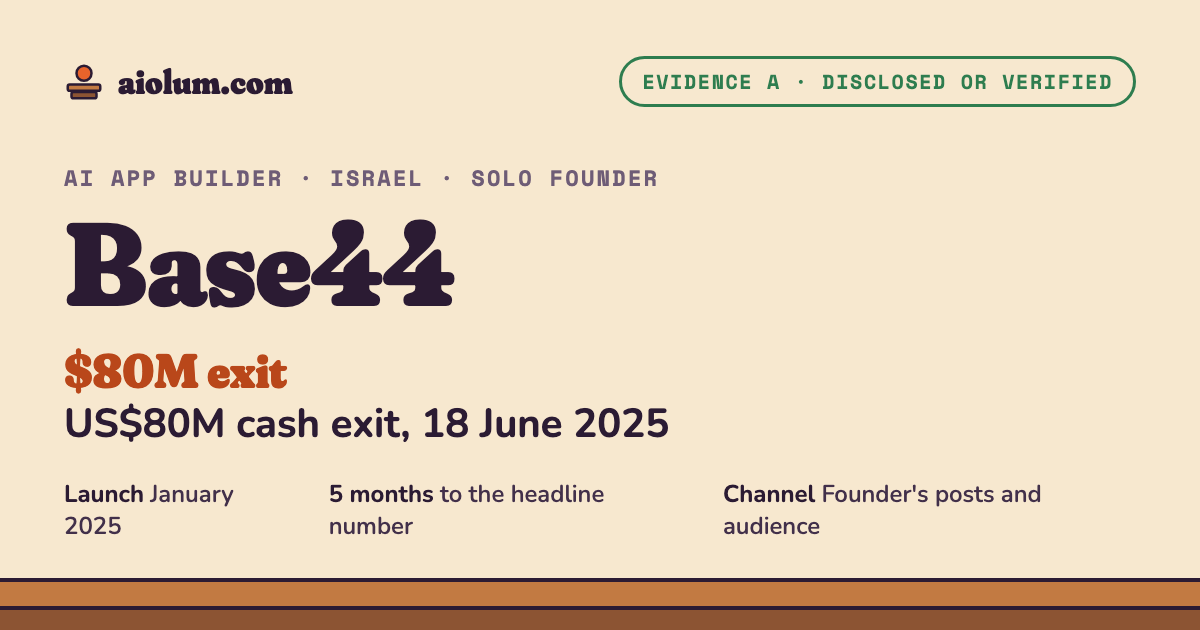
Maor Shlomo built it alone as a side project from the end of 2024. He launched it in January 2025 and sold it to Wix for about US$80 million in cash on 18 June 2025. Base44 took no outside investment. Under Wix it reached US$150 million in annual recurring revenue by May 2026. Annual recurring revenue (ARR) is the current monthly subscription revenue multiplied by twelve.
This page grades every number by its evidence. It also shows the failed startups that promised the same thing before AI models made it work.
The numbers, graded
Each row shows the evidence grade and the source numbers from the list at the end of this page. The grades are explained in How Aiolum verifies.
| Fact | Value | Grade | How we know | Sources |
|---|---|---|---|---|
| Initial payment from Wix, 18 June 2025 | about US$80 million, in cash | A | Wix press release. TechCrunch confirmed the cash form with Wix. | [1, 2] |
| Retention bonuses for employees, inside that US$80 million | about US$25 million | A | The press release says the bonuses are part of the initial payment, not an addition to it. | [1, 2] |
| Founder's share of the initial payment | about US$55 million | calc | Calculated: 80 minus 25 equals 55. Shlomo was the sole shareholder. | [1, 2, 3] |
| Earn-out period | 2025 through 2029 | A | An earn-out is a later payment that is paid only if the business reaches agreed targets. | [1] |
| Earn-out payment disclosed in May 2026 | US$38 million | A | Disclosed by Wix with its results, reported by Calcalist. | [4] |
| Earn-out payment disclosed in August 2026 | US$41 million | A | Disclosed in Wix's second-quarter 2026 earnings, reported by Calcalist. | [5] |
| Total disclosed payments by August 2026 | US$159 million | calc | Calculated: 80 plus 38 plus 41 equals 159. Calcalist writes "above 150 million". One report mentions a further 90 million payment, but the reports do not reconcile, so it is not counted here. | [4, 5] |
| Users at the sale | 250,000 | C | Founder posts, reported by TechCrunch. | [2] |
| Users in the first three weeks | 10,000 | C | Founder posts, reported by TechCrunch. | [2] |
| Profit in May 2025, the month before the sale | US$189,000 | C | Founder posts. Stated as profit after model costs. | [2] |
| Annual recurring revenue at the sale | about US$3.5 million | C | Unofficial estimate compiled by Latka. Wix did not disclose it. | [6] |
| Price paid divided by revenue at the sale | about 23 times ARR | calc | Calculated: 80 divided by 3.5 equals 22.9, using the unofficial estimate above. | [6] |
| Annual recurring revenue, August 2025 | US$15 million | C | Founder on LinkedIn, recorded by Latka. | [6] |
| Annual recurring revenue, March 2026 | US$100 million | A | Disclosed with Wix's fourth-quarter 2025 results. | [4, 6] |
| Annual recurring revenue, May 2026 | US$150 million | A | Reported by Calcalist from Wix's disclosures. | [4, 6] |
| Revenue growth in the eleven months after the sale | about 43 times | calc | Calculated: 150 divided by 3.5 equals 42.9. The starting value is the unofficial estimate, so this is an approximation. | [4, 6] |
| Employees at the sale | 6 to 8 | B | Calcalist reports six. TechCrunch reports that Wix confirmed eight. | [2, 3] |
| Founder's age at the sale | 31 | B | [2, 3] | |
| Outside funding | none | B | [2, 3] |
How to read this table: a grade A value was disclosed by Wix, a public company. A grade C value is a founder claim. A "calc" value was computed on this page from the rows above it.
| Plan | Per month, billed yearly (US$) | Per month, billed monthly (US$) | Limit |
|---|---|---|---|
| Free | 0 | 0 | 25 credits, at most 5 a day |
| Starter | 16 | 20 | |
| Builder | 40 | 50 | |
| Pro | 80 | 100 | |
| Highest tier | about 160 | about 200 |
A credit is one request to the AI. A complex change can use several credits. Reviewers report users who pay about US$300 a month after they spend all the credits of their plan. Yearly billing is about 20% cheaper than monthly billing.
The timeline
From a side project to US$150 million in annual recurring revenue in about 18 months. Each entry carries its grade.
- 2017BShlomo co-founds Explorium, a data company, at age 24 and becomes its chief executive (CEO). Explorium later raises about US$125 million. [3]
- End of 2024BAfter army reserve duty, he does not return to Explorium. He starts Base44 as a side project. [3]
- January 2025BPublic launch. [6]
- First three weeksC10,000 users. The founder reports about US$1 million in annual recurring revenue. [2, 6]
- January to June 2025BHe posts user numbers, revenue and profit publicly on LinkedIn and X. The product spreads through user recommendations. [2, 3]
- May 2025CProfit of US$189,000 for the month, after model costs. [2]
- 18 June 2025AWix buys Base44 for about US$80 million in cash plus earn-outs. The company has 6 to 8 employees. [1, 2]
- 9 July 2025BThe security company Wiz reports an authentication bypass. Wix fixes it within 24 hours. [7]
- August 2025CUS$15 million in annual recurring revenue, founder on LinkedIn. [6]
- March 2026AUS$100 million in annual recurring revenue, disclosed with Wix's results. [4, 6]
- May 2026AUS$150 million in annual recurring revenue. Wix discloses a US$38 million milestone payment to the founder. [4]
- 29 June 2026BBase44 launches Base1, its own AI model, trained on its users' interactions. [8]
- 4 August 2026AWix discloses a further US$41 million payment to the founder. [5]
Why it worked
Four causes, in the order they mattered. Each one is a reusable lesson.
Timing
In late 2024, AI models crossed a threshold: a generated full-stack app mostly ran on the first try. Every earlier attempt at this product was built before that threshold existed. Base44 launched within weeks of it.
The buyer
Early 2025 competitors such as Lovable, Bolt and v0 produced code that the user still had to connect to a database and deploy. Base44 hid all of that. Its customer was an operations manager or a small-business owner, not an engineer.
Cash from day one
Users paid for credits before they built anything. Model costs were passed through to users in the price of the credits. So the company was profitable while it was still one person.
Sold to distribution
Wix had millions of website customers and needed an AI app builder. After the sale, annual recurring revenue grew from about US$3.5 million to US$150 million in eleven months. The product did not change that much. The sales channel did.
How it was built
These details come from a newsletter that summarizes the founder's talks and posts. They are grade C. [9]
- Plain JavaScript with JSX (a syntax for writing HTML-like markup inside JavaScript) instead of TypeScript, because the models wrote it with fewer errors.
- MongoDB as the database, because the data model changed often. MongoDB is a document database, so it does not need a fixed table structure.
- Model routing: larger models (Claude, Gemini) for app logic and design, and smaller models for small fixes. Routing means that each request goes to the cheapest model that can do the job.
- Growth tactics: a staged onboarding of the first 10 users, then a relaunch on Product Hunt. Later, free credits for users who invited others, and a large hackathon event.
- The first employee was hired about six weeks before the sale.
Tools named in the sources
Each one opens its page in the Tools tab, with every story that uses it.
The dead that came before
Five companies in the Loot Drop database promised the same thing: software without programming. The values below are from that database and are not independently verified.
Builder.ai
The promiseCustom apps for US$20,000, assembled by AI.
Why it diedThe apps cost US$35,000 to build. Offshore developers did the work behind the AI label. It collapsed in May 2025, one month before Base44 was sold.
Koji
The promiseNo-code app builder for creators.
Why it diedFree users did not become paying users. It was squeezed between Webflow and Bubble.
Press reports put Koji's end in December 2023, when Linktree bought it. The dates in the database may be wrong.
Light Table / Eve
The promiseLet anyone build apps without code.
Why it diedUsers had to learn a new way to program. Developers stayed with the editors they already knew.
Appcubator
The promiseDrag-and-drop app creation, no coding degree required.
Why it diedThe market was not ready. It lost to the more flexible Bubble.
Sosh
The promiseDrag-and-drop website builder, before Webflow existed.
Why it diedToo complex for beginners, too rigid for professionals, and the generated code was messy.
What changed
All five companies failed for one shared reason. Before 2024, no-code meant that the user replaced typed code with a visual tool, and the user still had to learn that tool. The database entry for Sosh says it exactly: too complex for beginners, too rigid for professionals.
AI models removed the tool. Plain language became the interface, and real code became the output. Builder.ai is the sharpest contrast. It sold the same promise with people hidden behind an AI label, and it collapsed in May 2025. Base44 sold the same promise with a real model, and Wix bought it one month later.
Can one person copy it now?
Not as it is. The pattern, yes.
The general-purpose market closed within about a year. Lovable reported US$500 million in annual recurring revenue in June 2026. Base44 is inside Wix. Replit, Bolt, v0 and the model companies compete with large budgets. A new general-purpose app builder from one person has no opening.
Where it is still open: The vertical version is still open. That means app generation for one profession where data rules and compliance matter. Examples: clinics, law firms, property managers.
- 1Watch for a capability threshold: a model that newly does one thing reliably.
- 2Build the all-in-one version for a buyer who cannot program, while competitors serve developers.
- 3Charge from the first day, with usage pricing, and publish your numbers.
- 4Sell to whoever owns distribution before funded competitors arrive.
What to watch
The risks are the mirror image of the causes above.
Model dependence
Base44 rents its intelligence from model providers. Base1, its own model trained on tens of millions of user interactions, is the answer. The company says that owning the model will cut inference cost and improve margins.
Bundling by a giant
Shlomo has said that the competitor to fear is Google, not Replit or Lovable. A free app builder inside a large software suite would remove Base44's pricing power.
Credit pricing
Reviewers report users who pay about US$300 a month after they spend all their plan credits. Price complaints are the most common criticism in reviews.
Security liability
The July 2025 flaw let anyone register inside private apps by using a public app identifier, which also bypassed single sign-on. The platform owns security for apps whose builders cannot audit them.
Cost to the parent
Calcalist reported that Wix's quarterly loss widened to US$76.4 million in 2026, partly because of the Base44 payouts.
Sources
The grade next to each source is the best grade that the source can support. "Read in full" means that the text of the page was downloaded and the numbers were checked in it.
- A Wix press release, 18 June 2025: Wix Further Expands into Vibe Coding with Acquisition of Base44Read in full. Primary source for the deal terms, the retention bonuses and the earn-out period.
- A TechCrunch, 18 June 2025: 6-month-old, solo-owned vibe coder Base44 sells to Wix for $80M cashRead in full. Wix confirmed the cash form and the headcount to TechCrunch. The user and profit numbers inside it are founder posts, grade C.
- B Calcalist, 18 June 2025: Vibe coding fever: Solo entrepreneur's Base44 acquired by Wix for $80 millionRead in full. Source for the founder's background and the six-employee count.
- A Calcalist, May 2026: Base44 milestone unlocks $38 million payout for founder Maor ShlomoRead in full. Reports numbers that Wix disclosed.
- A Calcalist, 4 August 2026: Maor Shlomo's Base44 payday climbs to $150 million after latest Wix payoutRead in full. Reports numbers from Wix's second-quarter 2026 earnings.
- B Latka, updated 31 August 2026: Base44 Revenue: $80M Wix Deal, Then $150M ARRRead in full. A secondary compilation that dates and attributes each revenue figure.
- B The Hacker News, July 2025: Wiz Uncovers Critical Access Bypass Flaw in AI-Powered Vibe Coding Platform Base44Read in full. Based on the Wiz research report.
- B TechCrunch, 29 June 2026: Vibe-coding platform Base44 launches own model as AI startups seek defensibilityRead in full. Also the source for Lovable's US$500 million ARR claim.
- C AI & No-Code Exits newsletter, 16 January 2026: How Maor Shlomo sold Base44 for $80MRead in full. Summarizes founder talks. Source for the technical and growth details.
- C Base44 reviews with 2026 pricing: flowstep.ai and justinmckelvey.comRead as summaries. Source for the plan prices and the credit complaints.
- C Loot Drop database export, 1,749 failed startupsLocal export. AI-written summaries, not independently verified. Source for the failed predecessors.