Sleek
Sleek is an AI app designer, a web tool that draws the screens of a mobile app from a written description. The user types an idea, for example a finance app, or attaches a reference image, and Sleek returns every screen in one style for iOS or Android. The work is done by a large language model, a program trained on very large amounts of text and images that can produce a design from a request; Sleek has announced Google's Gemini 3.0 and Gemini 3.1 Pro as live in the product. The designs paste into Figma, a design program, as editable layers, or export as HTML or React code. Prices go from free to US$99 per seat a month and are counted in credits, units of AI work: about 30 credits for each new screen.
Three friends built it: Mattia Pomelli, who had been coding for about eight years, Stefano and Niccolò Diana. In one year they built four design tools together, and Sleek is the last of them. They built it in three weeks, posted its designs on X, and launched it on Product Hunt on 17 November 2025. In January 2026 Pomelli told Indie Hackers that it reached US$10,000 in MRR, monthly recurring revenue, the amount that subscriptions bring in each month, within a month of launch and without spending money on marketing. The service is operated by 140g Labs LLC, a company registered in Wyoming in the United States. Two of the founders show an Italian flag on their X profiles, and two describe themselves as nomads.
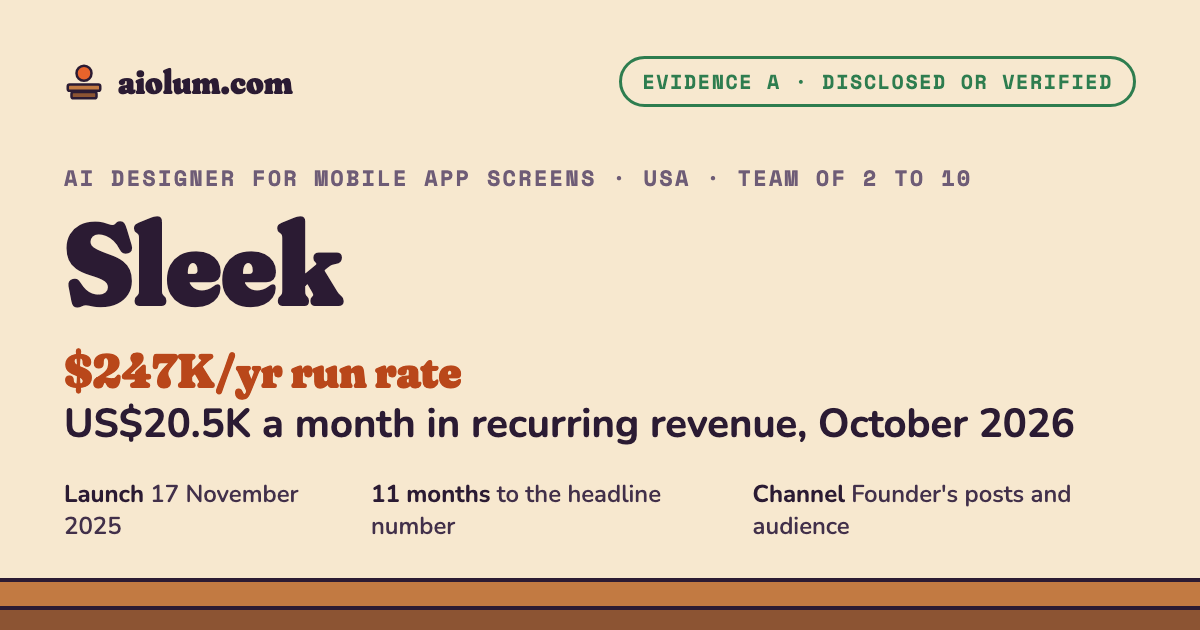
The later numbers are verified. Sleek's Stripe account is connected to TrustMRR, a site that reads revenue directly from the payment processor, the company that charges the customers' cards, so those figures are grade A. Revenue was highest in April 2026, at US$32,436, and was US$20,456 in September. On 15 October 2026 MRR was US$20,543 from 589 subscriptions, a run rate, the current monthly figure times twelve, of about US$246,516 a year. The business has been listed for sale since May 2026, and the asking price in October 2026 is US$500,000. The page also shows earlier companies that promised to design software for people and lost to larger platforms.
The numbers, graded
Each row shows the evidence grade and the source numbers from the list at the end of this page. The grades are explained in How Aiolum verifies.
| Fact | Value | Grade | How we know | Sources |
|---|---|---|---|---|
| Recurring revenue per month (MRR), 15 October 2026 | US$20,543 | A | TrustMRR, from Stripe through an API key. 589 active subscriptions. MRR fell 11.6% in the last 30 days. | [1] |
| Run rate from the October 2026 MRR | about US$246,516 a year | calc | Calculated: US$20,543 times 12. This is the headline number on this page. | [1] |
| Best verified month | US$32,436, April 2026 | A | TrustMRR monthly revenue from Stripe. May: US$27,865. June: US$24,425. July: US$25,159. August: US$24,908. | [1] |
| Revenue in September 2026 | US$20,456 | A | TrustMRR monthly revenue from Stripe. | [1] |
| Fall from the best month | 36.9% below April, 17.6% below the June to August average | calc | Calculated from the monthly Stripe figures in the rows above. | [1] |
| Revenue in the 30 days to 15 October 2026 | US$17,640 | A | TrustMRR. 15.4% less than in the 30 days before. | [1] |
| Revenue in the connected Stripe account, March to 15 October 2026 | US$177,396 | A | TrustMRR's all-time figure. The account shows no revenue before March 2026, so the first four months after the launch are not in it. | [1] |
| MRR per active subscription, October 2026 | about US$34.88 | calc | Calculated: US$20,543 divided by 589. It lies between the monthly prices of Starter (US$29) and Pro (US$69). | [1, 5] |
| MRR within a month of launch | US$10,000 | C | Founder in the Indie Hackers interview of 13 January 2026, reached without spending money on marketing. The article's title says six weeks and its introduction says two months. | [2] |
| MRR after six months, May 2026 | US$25,000 | C | Post by the podcast host Florian Darroman on 28 May 2026 about his interview with the founders. It agrees with the Stripe months of April and May. | [4, 1] |
| MRR in a co-founder's X profile, October 2026 | US$21,000 | C | Stefano's profile, read on 15 October 2026, next to a target of US$100,000. It agrees with the Stripe figure. | [8] |
| Users | more than 60,000 app makers | C | Company's pricing page, October 2026. The 589 active subscriptions are about 1% of that number (calculated). | [5, 1] |
| Product Hunt launch | 17 November 2025, 210 points | C | Product Hunt page. 245 followers in October 2026. | [9] |
| Founder's followers on X | about 8,000 at launch, 16,446 in October 2026 | C | Founder's reply on Indie Hackers, 14 January 2026, and his X profile. | [2, 8] |
| Team | 3 co-founders, no employees named | C | Mattia Pomelli, Stefano (X handle stefanofa) and Niccolò Diana. The founder says he built four design tools with two friends in one year. | [1, 2, 8] |
| Operating company | 140g Labs LLC, Wyoming | C | Terms of service and privacy policy. The company does business as Sleek, with an address in Sheridan, Wyoming. | [6] |
| Outside funding | none found | C | No downloaded source mentions an investor, a funding round or an accelerator. | [1, 2] |
| For sale | listed since 20 May 2026, asking US$500,000 in October 2026, 7 offers | C | TrustMRR listing, written by the founders. TrustMRR shows it as 2.4 times revenue; it is 2.0 times the run rate above (calculated). | [1] |
| Profit margin, last 30 days | 90.0% | C | TrustMRR profile. It is outside the Stripe-verified section of the profile, so the costs behind it are not verified. | [1] |
| Time to build | three weeks | C | Indie Hackers interview, 13 January 2026. The article has a section called Reusing code. | [2] |
| Time from launch to the October 2026 figure | 11 months | calc | Calculated: November 2025 to October 2026. | [9, 1] |
How to read this table: a grade A value comes from Sleek's Stripe account through TrustMRR. A grade C value is a statement by the founders, by the company's own pages or by a third party. A "calc" value was computed on this page from the rows above it.
| Plan | Per month, billed yearly (US$) | Per month, billed monthly (US$) | Limit |
|---|---|---|---|
| Free | 0 | 0 | 60 one-time credits, 1 project, 3 screens |
| Starter | 20 | 29 | 3,000 credits a month |
| Pro | 30 | 69 | 20,000 credits a month; API and agent skill |
| Team | 40.83 per seat | 99 per seat | 30,000 credits per seat a month |
| Extra credits, Pro and Team | 15 one-time | 5,000 credits that do not expire |
Yearly plans are paid at once: US$240, US$360 and US$490 per seat a year; the per-month numbers here are those amounts divided by 12. A new screen uses about 30 credits and an edit 5 to 30, so Starter's 3,000 credits make about 100 new screens a month. Every plan includes export to Figma and to code, limited on the free plan. Pro and Team include the API for AI coding agents. Payments go through Stripe, and there are no refunds.
The timeline
From the first post about AI designs for mobile apps in October 2025 to US$20,543 a month in October 2026. Each entry carries its grade.
- 27 February 2025Csleek.design is a waitlist page, "Made by Reweb", for a tool that builds landing pages and exports React and Tailwind code. The Sleek account on X is created the same day. [10, 3]
- 31 October 2025CMattia Pomelli posts that he has been working on design generation for mobile apps and asks people to reply to try it. [3]
- 3 to 10 November 2025CFive posts of app designs made with one prompt each: a sleep tracker, a language-learning app, an expense tracker, a meditation app and a book-summaries app. [3]
- 12 November 2025CEarly-access post on X: people comment the word "sleek" to get access. [3]
- 17 November 2025CPublic launch on Product Hunt, 210 points. The founder has about 8,000 followers on X. [9, 2]
- 20 November 2025CGemini 3.0 is live on Sleek. [3]
- 24 November 2025CThe founder offers to design, with Sleek, the app idea of anyone who comments on his post. [3]
- 16 December 2025 and 8 January 2026COne-click export to two app builders: Anything, then a0. [3]
- 13 January 2026CIndie Hackers interview: US$10,000 a month in recurring revenue within a month of launch, with no money spent on marketing. [2]
- 23 and 25 February 2026CGemini 3.1 Pro goes live on Sleek. An API lets AI agents such as Cursor and Claude make designs in Sleek. [3]
- 14 March 2026CThe privacy policy is updated and names 140g Labs LLC, a Wyoming company, as the operator. [6]
- March 2026ARevenue starts in the Stripe account that TrustMRR verifies: US$14,316 in the first month. [1]
- 25 March 2026CA Sleek Design Skill for Claude Code, Codex and other AI agents. [3]
- April 2026ABest verified month: US$32,436. [1]
- 20 May 2026CListed for sale on TrustMRR. The asking price in October 2026 is US$500,000. [1]
- 28 May 2026CPodcast with the co-founders, announced as zero to US$25,000 in MRR in six months. [4]
- September 2026AUS$20,456 in the month, 36.9% below April. [1]
- 15 October 2026AMRR of US$20,543 from 589 active subscriptions. Still for sale, with 7 offers received. [1]
Why it worked
Four causes, in the order they mattered. Each one is a reusable lesson.
Niche
The founder saw fewer design and coding tools for mobile apps than for the web, and built only for that: app founders and developers who cannot design and do not have the time or money to hire a designer. Every screen of an app comes out in one style, for iOS or Android.
Reuse
The three founders had built four design tools in the year before. In February 2025 the same domain held a waitlist for a landing-page builder that exported React and Tailwind code. Sleek took three weeks to build.
Show the output before the launch
In the two weeks before launch the founder posted app designs made with one prompt each on X, then asked people to comment the word "sleek" to get early access. After the launch he designed commenters' app ideas for free. He says no money was spent on marketing to reach US$10,000 a month.
A new demo with each new model
Sleek announced Gemini 3.0 three days after its launch and Gemini 3.1 Pro in February 2026, each with a demo design made with one prompt. The founders also post the same prompt run on several models, which gives them regular content to post.
Connect to the tools builders already use
Designs paste into Figma as editable layers, export as HTML or React with Tailwind CSS, and go to the app builders Anything and a0 in one click. Since February 2026 AI coding agents can make designs in Sleek through an API.
How it was built
These details come from the founders' own pages and posts: the TrustMRR profile text, the privacy policy, the pricing page and their X posts. They are grade C. [1, 3, 5, 6, 7, 2]
- Models: Google's Gemini. Sleek announced Gemini 3.0 on 20 November 2025 and Gemini 3.1 Pro on 23 February 2026. The founders also post tests of GPT 5.4 and Grok 4.1, without saying that Sleek uses them.
- The TrustMRR profile lists Next.js, React, TypeScript and Tailwind CSS for the frontend, and Supabase, PostgreSQL, Vercel, Cloudflare, GitHub Actions, Resend, Stripe, Anthropic and OpenAI for the backend.
- The privacy policy names four service providers: PostHog for analytics and session recording, Supabase for login and the database, Stripe for payments and Resend for email. Users sign in with Google or GitHub.
- Use is counted in credits: about 30 for a new screen and 5 to 30 for an edit, more when images are generated. Customers who make more designs need a larger plan or extra credits.
- Exports: one click copies a design into Figma as native, editable layers, with no plugin. Code export gives HTML or React with Tailwind CSS.
- Since February 2026 a REST API, and since March 2026 an agent skill, let Claude Code, Cursor, Codex and other agents make designs in Sleek, on the Pro and Team plans.
- A blog with comparison posts, guides and use cases, started for search traffic by January 2026, and an affiliate program run on Tolt, linked from the home page.
Tools named in the sources
Each one opens its page in the Tools tab, with every story that uses it.
The dead that came before
Four companies in the Loot Drop database promised to design apps or websites for people, or to carry designs into code, and failed: one because its AI was not ready, three because Figma or another larger design platform added the same features. The values below are from that database and are not independently verified.
The Grid
The promiseA website that AI designs by itself from your content, with no designer.
Why it diedIt bet on AI before the AI was ready: the designs were clumsy and inconsistent, and Wix and Squarespace offered polished templates.
Pixate
The promiseNative mobile app prototypes, with animations, without writing code.
Why it diedGoogle bought it and did not develop it further. Figma and Sketch took the market with web-based tools for teams.
Invision
The promiseInteractive prototypes and a smooth handoff from designers to developers.
Why it diedFigma offered real-time collaboration in the browser, and InVision could not change fast enough.
Haiku
The promiseHigh-fidelity animations and prototypes that go straight into the code.
Why it diedFigma and Adobe XD added more prototyping features, which reduced the need for a separate tool. The 2020 downturn ended it.
What changed
The Grid promised in 2014 that AI would design a website from your content, and its designs were not good enough. By 2025 the models were good enough for a narrow job: Sleek's founder posted app screens made with one prompt before the launch, and customers paid within weeks. Pixate, InVision and Haiku show the other danger. Each made one step of app design easier, and each lost when Figma, a larger platform, added that step.
Sleek faces both sides at once. It does not make its own models: it runs on Google's Gemini, and Google offers Stitch, which also pastes designs into Figma and exports code. Figma has First Draft and Figma Make inside the program that designers already use, and Anthropic, which is in Sleek's tech stack list, launched Claude Design in April 2026. Sleek's answer so far is the narrow focus on mobile apps, fast releases, and connections to app builders and AI coding agents. Its verified revenue fell 36.9% from April to September 2026. AppAlchemy, another AI app designer on this site, fell 66.4% from November 2025 to September 2026, and Sleek still makes about 3.5 times as much a month.
Can one person copy it now?
The launch method, yes. The niche is getting crowded.
The method costs no money: a clear buyer, finished designs posted in public before the launch, an early-access list made from comments, and a Product Hunt launch. But designing mobile screens from a prompt is now also a feature of products from Figma, Google and Anthropic, so a new tool in the same niche starts against them.
Where it is still open: Narrow design jobs around a mobile app that the large tools do not target yet, such as App Store screenshots and app icons, which Sleek itself has added, and design work done for AI coding agents through an API.
- 1Choose a narrow design job that the general tools do less well, and name the buyer: here, app founders who cannot design.
- 2Before the launch, post real output made with your tool, and ask people to comment to get early access.
- 3Export into the tools the buyer already uses: Figma layers, React code, app builders and coding agents.
- 4Post a demo on the day each new model arrives.
What to watch
The risks are the mirror image of the causes above.
Revenue has fallen since April 2026
Verified monthly revenue went from US$32,436 in April 2026 to US$20,456 in September, and MRR fell 11.6% in the last 30 days. No source gives the reason. The founders listed the business for sale in May 2026, a month after the best month.
Figma builds the same feature into its own program
Figma announced Make Designs, an app-design generator, at its Config 2024 conference, disabled it when its mockups looked too much like existing apps, and brought it back as First Draft in limited beta on 24 September 2024, using OpenAI's GPT-4 and Amazon Titan. On 7 May 2025 it launched Figma Make, a prompt-to-app tool. Figma is also the main place that Sleek's designs go.
Google offers a competitor on the model Sleek uses
Sleek runs on Gemini. On 20 May 2025 Google introduced Stitch, which designs user interfaces from a plain-English description with Gemini 2.5 Pro, pastes the result into Figma and exports front-end code: the same two exports that Sleek offers.
Anthropic has a design product too
On 17 April 2026 Anthropic launched Claude Design, powered by Claude Opus 4.7, for designs, prototypes and other visual work, in research preview for paying Claude subscribers. Anthropic is in the tech stack list of Sleek's own profile.
A crowded field
Sleek's own site keeps comparison pages against seven other tools: Claude Design, Google Stitch, Uizard, Visily, Figma Make, ScreensDesign and App Alchemy. Against more than 60,000 users claimed on the site, 589 active subscriptions are about 1%.
Dependence on model providers
Sleek does not make its own models, so the quality of its designs, and the cost of each credit, depend on Google and the other providers. When a provider improves its own design product, Sleek's lead becomes smaller. The founders' public tests of Gemini, GPT and Grok show that they can change models, and so can every competitor.
The early figures are founder statements
The connected Stripe account starts in March 2026. The US$10,000 a month after the first month and the US$25,000 after six months are founder statements, and the Indie Hackers article gives three different times for the first: one month, six weeks and two months.
Sources
The grade next to each source is the best grade that the source can support. "Read in full" means that the text of the page was downloaded and the numbers were checked in it.
- A TrustMRR: Sleek, Stripe-verified revenue and sale listingRead the markdown profile (https://trustmrr.com/startup/sleek.md) on 15 October 2026, data as of October 2026. Revenue, MRR and subscriptions come from Stripe through an API key and are grade A. The description, founded date, country, tech stack, marketing channels, profit margin and sale listing are written by the founders, grade C.
- C Indie Hackers, 13 January 2026: Hitting $10k MRR in six weeks with an AI design tool, by James FleischmannRead the free part: the title, the introduction, the table of contents and the founder's first section. The rest is for signed-in members and was not read. Read the comments, including the founder's replies of 14 and 16 January 2026.
- C Sleek on X (@sleekdotdesign): account and posts, 31 October 2025 to 7 July 2026, with the founders' posts that it repostsRead the account data and all 34 posts that the fxtwitter API returns (api.fxtwitter.com/2/profile/sleekdotdesign/statuses, two pages). Source for the launch posts, the model updates, the API and the integrations.
- C Florian Darroman on X, 28 May 2026: new podcast with the Sleek founders, 0 to $25K MRR in 6 monthsRead the post through api.fxtwitter.com. The podcast itself was not found and not heard.
- C Sleek pricing page, read 15 October 2026Read in full. Source for the plans, the credits, the exports, the API and the user count.
- C Sleek terms of service (last updated 8 September 2026) and privacy policy (last updated 14 March 2026)Read the sections on the operating company and the affiliate program, and the service providers in the privacy policy at https://sleek.design/privacy.
- C Sleek home page, read 15 October 2026Read in full. Source for the comparison pages, the affiliate link and the exports.
- C X profiles of the three co-founders, read 15 October 2026: mattiapomelli, stefanofa and NiccoloDianaRead the three profiles through api.fxtwitter.com. Source for their roles, follower counts and the MRR in Stefano's profile.
- C Product Hunt: sleek.design, Idea to mobile app designs in minutesRead the launch date, the points and the follower count.
- C Wayback Machine, 27 February 2025: sleek.designRead the archived page in full, and the list of captures for the date of the first one in 2025.
- C Figma blog, 24 September 2024: Building a better First Draft for designersRead in full. Source for Make Designs, its removal and its return as First Draft.
- C Figma blog, 7 May 2025: Introducing Figma Make: A new way to test, edit, and prompt designsRead in full.
- C Google Developers Blog, 20 May 2025: From idea to app: Introducing Stitch, a new way to design UIsRead in full.
- C Anthropic news, 17 April 2026: Claude Design, a new Anthropic Labs productRead in full.
- A TrustMRR: AppAlchemy, Stripe-verified monthly revenueRead the markdown profile, local copy synced 12 October 2026. Used only for the comparison with AppAlchemy.
- C Loot Drop database export, 1,749 failed startupsLocal export. AI-written summaries, not independently verified. Source for the failed predecessors.