GlowUp
GlowUp, first released as Glam AI, is an iPhone app for virtual makeup try-on: software that shows how a makeup look would appear on a person's own face before the person buys or applies anything. The user uploads a selfie without makeup and a photo of a look, for example from TikTok or Instagram. The app's AI applies that look to the user's face, then gives a step-by-step routine and a list of products to buy. The app is free to download and is paid for with subscriptions sold through the App Store.
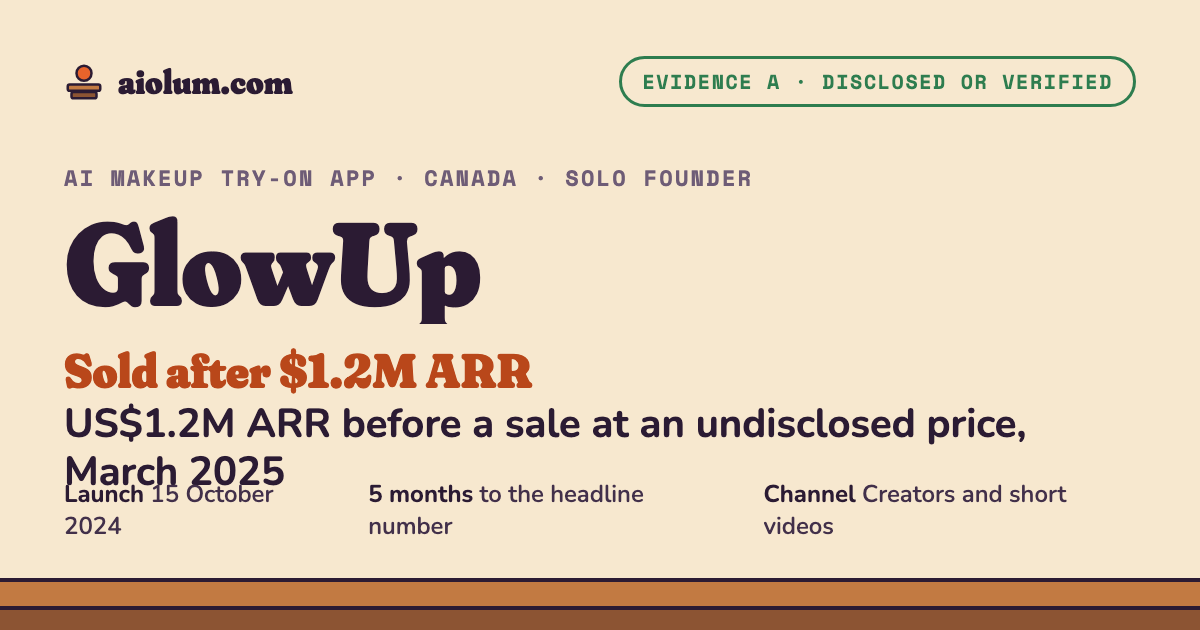
Louis-David Paul-Hus, a Canadian founder based in Montreal, built it after about ten apps that failed, according to the case-study site aidevcases, which gives 15 October 2024 as the release date. He posted short videos on TikTok with no advertising budget, and aidevcases reports that he later paid TikTok and Instagram creators with equity instead of cash. In March 2025 Adapty, the company whose software runs the app's subscriptions, published that the app's monthly recurring revenue (MRR, the subscription revenue of one month) had grown from US$30,000 in December 2024 to nearly US$100,000, and its annual recurring revenue (ARR, MRR multiplied by twelve) from US$400,000 to US$1.2 million, with almost the same number of installs. The founder's own website now lists GlowUp as sold, and since May 2026 at the latest Apple names Zipo Apps Ltd., a company that buys apps, as the seller. No source gives the price or the date of the sale.
This page grades the US$1.2 million A, as it graded the Wave AI and Letterly stories. Adapty is not the payment processor, the company that moves the money, because for App Store purchases that is Apple. But every purchase passes through Adapty's software, and Adapty states the figures under its own name. A stricter reader can grade them B: the case study is a marketing page for Adapty's product, its "today" has no exact date, it does not say whether Apple's fee is deducted, and some of its other numbers do not agree with each other. The founder's figure of US$800,000 in 365 days is grade C. The page also shows four failed startups that sold beauty products, try-before-you-buy shopping or camera effects for selfies.
The numbers, graded
Each row shows the evidence grade and the source numbers from the list at the end of this page. The grades are explained in How Aiolum verifies.
| Fact | Value | Grade | How we know | Sources |
|---|---|---|---|---|
| Annual recurring revenue, March 2025 | US$1.2 million | A | Adapty: "ARR grew from $400K in December to $1.2M today". In the first version of the case study, published on 11 March 2025 and archived on 24 March 2025, and unchanged on the live page, last modified on 24 April 2026. The page does not date "today"; this page uses March 2025, the month of publication. | [1, 2] |
| Monthly recurring revenue, December 2024 and March 2025 | US$30,000, then nearly US$100,000 | A | Adapty: "MRR jumped from $30K to nearly $100K." and "It all happened with almost the same number of installs." | [1, 2] |
| Growth from December 2024 to March 2025 | about 3.3 times in MRR, 3 times in ARR | calc | Calculated: 100,000 divided by 30,000 equals 3.33; 1,200,000 divided by 400,000 equals 3. US$400,000 of ARR equals about US$33,333 a month, a little more than the US$30,000 of MRR that Adapty gives for the same month. | [1] |
| Users who saw the paywall before the tests | 20% | B | Adapty: "only 20% of users even saw the paywall". The founder: "We tripled our daily revenue just by repositioning the paywall." A share of users is not a payment figure, so it is graded B. | [1] |
| Paywall and price tests, December 2024 to March 2025 | more than 17 A/B tests | B | Adapty: "Over three months, GlowUp ran 17+ A/B tests" of price points, free trials and paywall placement. An A/B test shows two versions to different users and keeps the one that sells better. A single weekly price won. | [1, 2] |
| Lifetime value per user, over the three months | +36.4% | A | Adapty's highlights. Lifetime value (LTV) is the revenue that one user brings over the whole time they pay. Adapty ties it to a small price increase that did not lower purchases. | [1, 2] |
| Revenue kept by declining refund requests | US$25,872 | A | Adapty: "Saved nearly $26K ($25,872 to be exact)" with its Refund Saver tool. The live page also says "$1,165 in refunds won back" and that 55 of 64 requests were declined, and the two versions give 70%, 75%, 77% and 86% as the share won. These numbers do not agree with each other. | [1, 2] |
| Revenue in the first 365 days | US$800,000 | C | The title of the founder's Starter Story video: "My mobile app made $800K in 365 days". The page does not date the video or say which 365 days. | [7, 6] |
| Average revenue per month in that year | about US$66,667 | calc | Calculated: 800,000 divided by 12. | [7] |
| Countries | 130 | B | Adapty: "expanding to 130 countries". | [1, 2] |
| Users | more than 500,000 | C | The developer's text on Apple's page in July 2025 and October 2026: "Join over 500,000 users!". The app's 2025 website claimed "2M+ Users and 400M TikTok Views". No one outside has checked either figure. | [3, 4, 8] |
| Ratings on the App Store | 12,700 in July 2025; 13,000 at 4.4 out of 5 in October 2026 | B | Apple's page. Some reviewers wrote that the AI changed their facial features. | [3, 4] |
| Release on the App Store | 15 October 2024 | C | aidevcases, from Apple's record; Apple's page today does not show the date. The oldest version in Apple's history list is 1.0.19 of 12 December 2024. | [6, 3] |
| Time from release to US$1.2 million ARR | about 5 months | calc | Calculated: 15 October 2024 to March 2025; 147 days to the publication of the case study on 11 March 2025. | [1, 6] |
| Team at the US$1.2 million figure | 1 founder; a "small team" in Adapty's words | B | Adapty's live page: "For a small team striving to scale its subscription system", with no number. aidevcases calls him a solo builder, from his X post of 12 September 2025 to "the Canadian solopreneur community". No source names an employee. | [1, 6] |
| Outside funding | none reported | C | No source mentions investors. aidevcases reports that TikTok and Instagram creators were paid with equity instead of cash; no source says how many creators or how much equity. | [6] |
| Advertising budget at launch | US$0 | C | Starter Story: "he did it all by posting on TikTok for $0." aidevcases: "no paid ads". | [7, 6] |
| Company that ran the app until 2025 | Viral Tech Inc. | B | Apple's page in July 2025 names Viral Tech Inc. as the seller and the copyright holder. The app's 2025 terms: "operated by Viral Tech Inc." The founder's website gives a contact address at viraltech.ca. | [4, 9, 5] |
| Sale | sold; price and date not published | C | The founder's website: "2024-2025 · sold" and "was successfully acquired". It does not name the buyer. Apple's page names Zipo Apps Ltd. as the seller by 19 May 2026, and ZipoApps writes: "we acquire the best apps and take them to the next level." | [5, 4, 10] |
| Change of seller on Apple's page | between 23 July 2025 and 19 May 2026 | B | Wayback Machine copies of Apple's page: Viral Tech Inc. on 23 July 2025, Zipo Apps Ltd. on 19 May 2026. The founder dates his work on GlowUp 2024 to 2025. | [4, 5] |
| In-app purchase prices, October 2026 | US$3.99 to US$13.99 | B | Apple's page lists ten prices, mostly under the old name Glam AI Pro, without the billing period. The new owner's terms name weekly, monthly and yearly subscriptions. | [3, 11] |
| Age rating | 4+ | B | Apple's page in July 2025 and October 2026. The 2025 terms: "Users must be at least 4 years old to use the App." | [3, 4, 9] |
How to read this table: a grade A value is stated by Adapty, the company whose software records the app's subscriptions, in its case study under its own name. A grade B value is a record in Apple's App Store, or a count or statement by Adapty that is not a payment figure. A grade C value comes from the founder, his website, the app's own pages, the buyer's website or a case-study site. A "calc" value was computed on this page from the rows above it.
| Plan | Per month, billed yearly (US$) | Per month, billed monthly (US$) | Limit |
|---|---|---|---|
| Glam AI Pro | listed 7 times at 3.99, 6.99, 7.99, 9.99 and 13.99; period not shown | ||
| GlowUp Pro | 9.99; period not shown | ||
| Glamly AI Pro | 13.99; also 6.99 in the list of July 2025 | ||
| Unlimited Access | 8.99; not in the list of July 2025 |
The app is free to download. Apple shows ten in-app purchases and does not say whether each one is weekly, monthly, yearly or one-time; most still carry the old names Glam AI Pro and Glamly AI Pro. The new owner's terms say that premium features are sold as weekly, monthly or yearly subscriptions or as a one-time payment, with a possible free trial that renews automatically. In March 2025 the founder told Adapty that a single weekly price sold better than several prices, a three-week price and a yearly plan with a free trial.
The timeline
From about ten failed apps to US$1.2 million in annual recurring revenue in five months, and then a sale. Each entry carries its grade.
- Before 2024CPaul-Hus ships about ten apps, and all fail. He decides to choose the channel, TikTok, before he builds the next product. [6]
- 15 October 2024CGlam AI appears on the App Store, published by Viral Tech Inc. He promotes it with his own TikTok posts and no advertising budget. [6, 7, 4]
- Late 2024CIn the founder's words to Adapty, the marketing worked before the app was ready: "It kept crashing, and the payment system wasn't integrated." He fixes the app and adds payments. [1]
- December 2024AMRR is US$30,000 and ARR US$400,000. [1, 2]
- December 2024 to March 2025AThe subscriptions run on Adapty after RevenueCat could not run paywall tests in the FlutterFlow app. More than 17 A/B tests follow. Only 20% of users had seen the paywall; moving it tripled daily revenue. A single weekly price sells best. [1, 2]
- Early 2025BThree app updates carry the note "hii girls, invite 3 friends to reveal your results! ;)". [3]
- 11 March 2025AAdapty publishes its case study: ARR from US$400,000 in December to US$1.2 million, MRR from US$30,000 to nearly US$100,000, users in 130 countries. [1, 2]
- July 2025BUpdates with the note "New Design", and the listing carries the name GlowUp. On 23 July Apple's page shows Viral Tech Inc. as the seller, more than 500,000 users and 12,700 ratings. [3, 4]
- 12 September 2025COn his 24th birthday he writes on X that he wants to give back to "the Canadian solopreneur community", as quoted by aidevcases. [6]
- Between late July 2025 and May 2026CGlowUp is sold. The founder's website lists it as "2024-2025 · sold". By 19 May 2026 Apple's page names Zipo Apps Ltd., which describes itself as a buyer of apps, as the seller. The price is not published. [5, 4, 10]
- April to May 2026BAdapty moves its case study to a new address under the name GlowUp. From 20 May 2026 its old address holds a case study about another app named Glam AI, which Adapty's menu lists separately, in the Photo & Video category. [1, 2]
- 16 October 2026BThe app is live under ZipoApps: last update 2.2.3 on 7 May 2026, 13,000 ratings at 4.4, age rating 4+, and a description that still says "previously GlamAI". [3]
Why it worked
Four causes, in the order they mattered. Each one is a reusable lesson.
The channel before the product
After about ten failed apps, the founder changed the order of his work, aidevcases writes: first the channel, TikTok, and an angle that spreads there, then the app. GlowUp's result is a before-and-after picture of the user's own face, which a short video shows in seconds. Starter Story writes that he did it all by posting on TikTok for US$0.
More revenue from the same installs
Adapty's data showed that only 20% of users ever reached the paywall, the screen that asks the user to pay. Moving it tripled daily revenue, in the founder's words, and MRR went from US$30,000 to nearly US$100,000 with almost the same installs. Tests also showed that several prices on one screen sold worse than one, and that a single weekly price sold best.
Creators paid with equity
aidevcases reports that to grow beyond his own posts, he partnered with TikTok and Instagram creators and paid them with equity, a share of the business, instead of cash. That let him enlist creators without an advertising budget. No source says how many creators or how much equity, and no creator is named.
Existing AI, no model of its own
aidevcases writes that he did not train a model but turned existing AI into a makeup product. His own website lists OpenAI for GlowUp. The 2025 privacy policy says that face photos go to "trusted third-party services" that generate the makeup looks.
How it was built
These details come from the founder's words in Adapty's case study, his own website, the app's 2025 website and privacy policy, and aidevcases. They are grade C. [1, 2, 5, 6, 8, 9]
- Built with FlutterFlow, a visual tool that produces apps in Flutter, Google's framework for iPhone and Android apps, mostly by placing components instead of writing code. In March 2025 the founder told Adapty: "we're using Flutterflow". His own website now lists Swift, Firebase and OpenAI for GlowUp; no source says whether the app was rewritten.
- Subscriptions: first RevenueCat, then Adapty, because the founder could not run paywall A/B tests with RevenueCat in a FlutterFlow app. Purchases go through Apple's in-app purchase system.
- AI: no model of its own. The app sends the face photo and the chosen look to outside AI services; the privacy policy does not name them, and the founder's website names OpenAI. No source names the model that draws the makeup.
- Data: the 2025 privacy policy treats face images as biometric data, processed with the user's consent.
- Products: the 2025 website said that the app recommends Sephora products matched to the user's skin tone and the uploaded look.
- Marketing: the founder's own TikTok posts with no advertising budget, then TikTok and Instagram creators paid with equity, according to aidevcases.
Tools named in the sources
Each one opens its page in the Tools tab, with every story that uses it.
The dead that came before
Four companies in the Loot Drop database promised help with beauty purchases, try-before-you-buy shopping or camera effects for selfies. The values below are from that database and are not independently verified.
Seerslab
The promiseAugmented-reality effects for selfies and stories.
Why it diedIt needed the big social networks to carry its effects, and Snapchat had its own filters.
Try.com
The promiseTry clothes at home before you buy them online.
Why it diedHigh costs, the pandemic's shift to essential purchases, and Amazon's return policies.
Hush
The promiseAffordable beauty products online for young buyers on a budget.
Why it diedA general beauty reseller that lost to brands selling directly, and COVID cut the demand for makeup.
Inporia
The promiseFashion and cosmetics shopping with friends' style tips.
Why it diedToo many competitors, and no revenue before the money ran out.
What changed
Each of the four needed something large to deliver its promise. Seerslab needed the social networks to carry its selfie effects and lost to Snapchat's own filters. Try.com shipped physical clothes for home try-on and paid for the returns. Hush bought and resold beauty products on thin margins. Inporia needed a social network of its own for shopping. Each raised between US$1.2 million and US$5 million and lost to larger companies.
GlowUp needed none of that. An AI model shows the look on the user's own photo, so there is nothing to ship and no stock to hold. FlutterFlow and Adapty supplied the app and the subscription system, Apple supplied the billing, and TikTok supplied the first customers at no cost. One founder could test the idea after ten failures. The risk is the one that ended Seerslab: the large companies of the field, such as L'Oréal and Perfect Corp, already offer virtual try-on themselves.
Can one person copy it now?
The method, yes. This niche, now crowded.
A result that a short video can show in seconds, posted on TikTok before the app was finished, and then paywall tests to earn more from each install: this method works for other consumer apps with a visual result. Makeup try-on itself is now offered by large beauty companies and by many apps.
Where it is still open: Other visual results shown on the user's own photo: hair color, nails, glasses or clothes, where a short video shows the before and after.
- 1Choose the channel first, and design the app's result so that it fits a short video.
- 2Post the before-and-after yourself, with no advertising budget, and keep the angle that spreads.
- 3Measure how many users reach the paywall; GlowUp found that only 20% did, and moving it tripled daily revenue.
- 4Test one price against several; GlowUp's best seller was a single weekly price.
- 5If you have no cash for creators, offer them a share of the business, as GlowUp reportedly did.
What to watch
The risks are the mirror image of the causes above.
Sold, on terms nobody published
The founder's website lists GlowUp as sold, and Apple names Zipo Apps Ltd. as the seller, but no source gives the price, the date or whether the founder kept any part. The revenue figures on this page describe his period, up to March 2025, not the app under its new owner.
A vendor's marketing page, with numbers that do not agree
The grade A figures come from Adapty's case study, a marketing page for its own product. Its "today" has no date, and it does not say whether Apple's commission is deducted. Its highlights call the US$1.2 million revenue earned in three months, while the text calls it ARR, and the 2025 page title said US$1M ARR. The refund numbers differ within the page: US$25,872 or US$1,165 saved, and 70%, 75%, 77% or 86% of requests won. A stricter reader can grade the figures B.
The beauty industry already sells try-on
L'Oréal bought ModiFace, whose 3D virtual makeup and skin diagnosis were "used by nearly all the major beauty brands", on 16 March 2018. Perfect Corp, a company listed in New York, reported US$69.2 million of revenue for 2025, 14.9% more than in 2024, mainly from subscriptions to its YouCam apps and web services; it had 908,000 active subscribers on 31 December 2025, 4.0% fewer than three months earlier.
Beauty filters and young users
A study by Dove, a beauty brand, reported on 8 February 2022, found that 75% of Australian girls had used filters on their photos before they turned 13, and that 62% of 10- to 17-year-olds wished the world cared more about who they are than what they look like. GlowUp is rated 4+ on the App Store, its 2025 terms required users to be "at least 4 years old", and three updates in early 2025 told "girls" to invite three friends to see their results. Some App Store reviewers wrote that the AI changed their facial features toward a narrow beauty standard. No source shows a face or attractiveness score; the 2025 website offered a "Beauty Score" for products.
Dependent on FlutterFlow, Adapty, Apple and the AI providers
The app was built in FlutterFlow, its subscriptions and tests ran on Adapty, its billing on Apple's in-app purchase system, and its images on outside AI services that receive the user's face photo. The founder had already left RevenueCat when it did not fit FlutterFlow. A price or policy change at any one of them changes the app's costs or its product, and the quality of the images depends on models that the business does not control.
Sources
The grade next to each source is the best grade that the source can support. "Read in full" means that the text of the page was downloaded and the numbers were checked in it.
- A Adapty case study: How GlowUp scaled to $1,2M ARR in 3 months with Adapty + FlutterFlow (published 11 March 2025, modified 24 April 2026)Read in full, live on 16 October 2026. Adapty runs the app's subscriptions. Source for the MRR and ARR figures, the paywall tests, the refund figures, the small team and the founder's quotes.
- A Adapty case study, first version: How Glam AI scaled to $1.2M ARR in 3 months with Adapty + FlutterFlow, Wayback Machine copy of 24 March 2025Read in full. The earliest archived copy, modified on 24 March 2025; it already gives the MRR from US$30,000 to nearly US$100,000 and the ARR from US$400,000 to US$1.2 million. Since 20 May 2026 this address holds a case study about a different app named Glam AI.
- B Apple App Store: GlowUp - Makeup & Beauty, id6736916284Read in full on 16 October 2026. Source for the seller Zipo Apps Ltd., the description, the in-app purchase prices, the age rating, the ratings, the reviews and the version history.
- B Apple App Store page, Wayback Machine copies of 23 July 2025 (seller Viral Tech Inc.) and 19 May 2026 (seller Zipo Apps Ltd.)Read both copies; the second is at https://web.archive.org/web/20260519172353/https://apps.apple.com/us/app/glowup-makeup-beauty/id6736916284. Source for the change of seller and the 2025 prices, users and ratings.
- C Louis-David Paul-Hus's website: home page and Digital Products pageRead both pages in full. The founder's own site. Source for GlowUp listed as sold, its stack, his base in Montreal and his contact address at viraltech.ca.
- C AI Dev Cases: From ~10 Failed Apps to GlowUp (published 27 June 2026, figures checked 15 August 2026)Read in full. A case-study site that cites the founder's X posts, the App Store, Adapty and Starter Story. Source for the ten failed apps, the release date, the creators paid with equity, the X post of 12 September 2025 and the change of publisher.
- C Starter Story video page: My mobile app made $800K in 365 daysRead the page; the video itself was not watched. Source for the US$800,000 and the TikTok launch for US$0. The page gives no date.
- C Glam AI website, Wayback Machine copy of 23 July 2025Read in full. The live site did not respond on 16 October 2026. Source for the Sephora recommendations, the claim of 2M+ users and 400M TikTok views, and the product score.
- C Glam AI terms of service and privacy policy, Wayback Machine copies of 23 July 2025Read both in full; the privacy policy is at https://web.archive.org/web/20250723101034/https://www.useglowup.app/privacy-policy. Source for the operator Viral Tech Inc., the minimum age of 4 and the face images sent to unnamed services.
- C ZipoApps home pageRead in full. The buyer's own description of its business: a company that acquires apps.
- C ZipoApps: GlowUp - Makeup & Beauty page and terms of useRead both in full; the terms are at https://zipoapps.com/glowupmakeupios/terms/. Source for the current description and the weekly, monthly or yearly subscriptions.
- A L'Oréal press release, 16 March 2018: L'Oréal acquires ModiFace further expanding its worldwide expertise in beauty techRead in full. The acquirer's own release.
- A Perfect Corp. results for the full year 2025, Business Wire release of 24 February 2026Read the sections on revenue and subscribers in the copy published by 01net.it; the company's own investor page did not open. A listed company's results release.
- C Marketing Mag, 8 February 2022: Dove Australia releases study revealing three in four Australian girls are using filters by the age of 13Read in full. A trade magazine's report of a study by Dove, a beauty brand of Unilever.
- C Loot Drop database export, 1,749 failed startupsLocal export. AI-written summaries, not independently verified. Source for the failed predecessors.