CounselPro: Product, team and how it was built
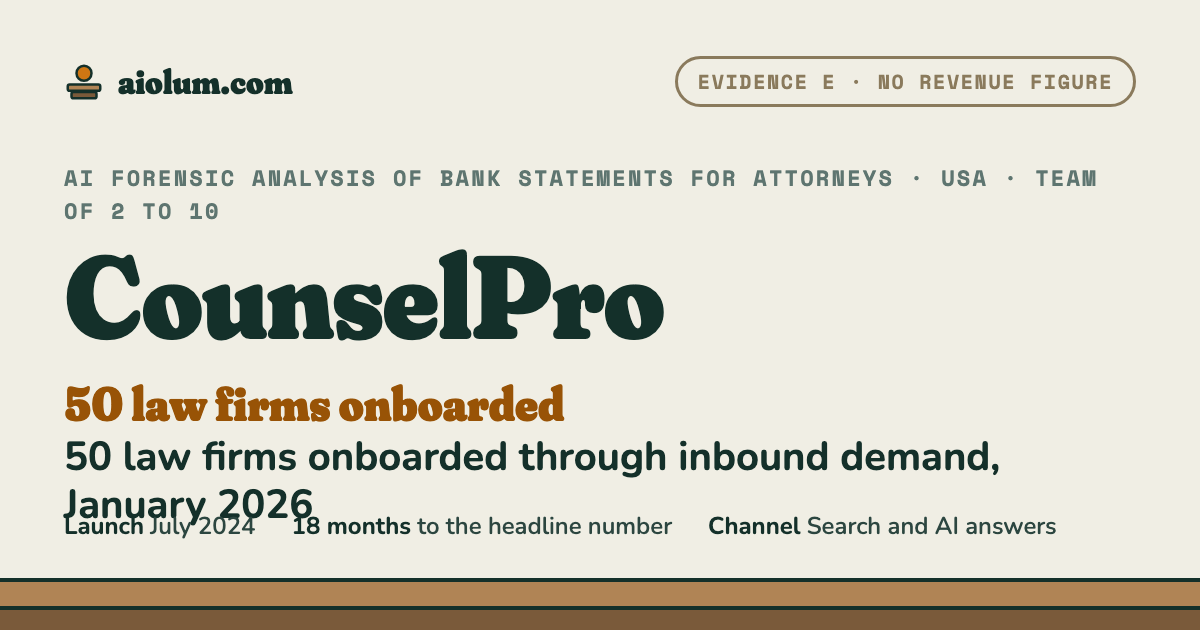
CounselPro (AI forensic analysis of bank statements for attorneys, USA): 50 law firms onboarded through inbound demand, January 2026. Evidence grade E: no revenue figure was checked. Team: 2 co-founders and a chief technology officer named on the company's page; headcount not published. Launched July 2024; still running.Added 5 November 2026 · updated 6 November 2026
- Outcome
- 50 law firms onboarded through inbound demand, January 2026
- Evidence
- E no revenue figure was checked
- Launch
- July 2024
- Status
- Still running
- Team
- 2 co-founders and a chief technology officer named on the company's page; headcount not published
- Outside funding
- No outside funding, as the company stated in its Startup Alley application, January 2026
- Group
- Legal and law firms
- Main channel
- Search and AI answers
What is not verified
No revenue figure was found. I looked for a payment-processor profile, a revenue figure in the Startup Alley application and on the company's pages, and a press interview. The count of 50 law firms and the US$10 billion in processed transactions are the company's own statements in its January 2026 application, which LawNext published as provided; the application did not say how many firms pay. A reader could look for a later interview with revenue, or for the Startup Alley result. This story is grade E: the business is real and its product, price and customers are described from public pages, but no revenue figure was checked. Aiolum shows it as an idea worth studying, not as proof that it makes money.
CounselPro does forensic accounting, the analysis of financial records to answer a legal question, such as where money went before a divorce filing or a bankruptcy petition. It reads PDF statements with AI models and checks each month by reconciliation: the extracted transactions must add up to the opening and ending balances the bank printed, and a month that does not match is read again or flagged.
The company was founded on 1 July 2024 in New York, as it told LawNext. Its page names two co-founders, Ian O'Brien (chief executive) and Dory Lord (chief revenue officer), and a chief technology officer, André Mendonça. In its January 2026 application to the Startup Alley competition at ABA TECHSHOW it said it had onboarded 50 law firms in its first six months of active selling, all through inbound demand, with no outside funding. It was voted one of 15 finalists in February 2026.
No revenue figure was found. The evidence is grade E: the company's own pages and its application text as published by LawNext.
How much revenue does CounselPro make?
Each row shows the evidence grade and the source numbers from the list at the end of this page. The grades are explained in How Aiolum verifies.
| Fact | Value | Grade | How we know | Sources |
|---|---|---|---|---|
| Law firms onboarded, January 2026 | 50, in the first six months of active selling | C | Company's application, published by LawNext on 12 January 2026: "onboarded 50 law firms entirely through inbound demand, with zero outbound sales". The application did not say whether all 50 pay. | [1] |
| How customers found it | referrals, search (SEO) and AI-assistant answers (GEO) | C | Same application: "All acquisition to date has come from referrals, SEO, and GEO-driven discovery". Adoption is self-service. | [1] |
| Founded and based | 1 July 2024, New York | C | Application text: "2024-07-01" and "New York, N.Y." | [1] |
| Leadership | Ian O'Brien, co-founder and CEO; Dory Lord, co-founder and CRO; André Mendonça, CTO | C | About page, read 5 November 2026. The company's blog calls it "a small but mighty team". No headcount is published. | [2, 5] |
| Funding | no outside funding | C | Application: "No outside funding." It calls itself bootstrapped. | [1] |
| Transactions processed | more than US$10 billion in value | C | The company's claim in the application, January 2026. This is the value of the transactions read, not revenue. | [1] |
| Prices, November 2026 | US$100, US$250 and US$500 a month, or US$499 for one case | C | Pricing page, read 5 November 2026. | [4] |
| AI model providers | Anthropic, OpenAI, Cohere and DeepInfra | C | Subprocessors page, read 5 November 2026. It lists "secondary AI models" behind a button that the downloaded page did not show. No source says which model does which task. | [7] |
| Startup Alley at ABA TECHSHOW 2026 | one of 15 finalists, by popular vote | C | Company blog, 17 February 2026, signed by Ian O'Brien. The pitch competition was on 25 March 2026; its result was not checked. | [5] |
| Time from founding to the headline fact | 18 months | calc | Calculated: July 2024 to January 2026. | [1] |
How to read this table: a grade C value is a statement by the company, on its own pages or in the application text that LawNext published. A "calc" value was computed on this page. No value is grade A or B, and no money figure exists.
| Plan | Per month, billed yearly (US$) | Per month, billed monthly (US$) | Limit |
|---|---|---|---|
| Core | 100 | 1,000 credits; extraction, categories, dashboard, Excel export | |
| Plus | 250 | 1,000 credits; adds Daystrom AI chat, money tracing, forensic report | |
| Premier | 500 | 1,000 credits; adds reconciliation of every month to bank totals | |
| Single Project | 499 one-time | one case, every feature, 1,000 credits, top up to 10,000 |
Every plan has unlimited users and 1,000 credits a month (12,000 up front on a yearly plan). A bank statement, card statement or check page costs one credit; a brokerage, investment or tax page costs two. The page says a typical matter has about 400 to 600 statement pages. Extra credits cost 10 to 40 cents each, depending on plan and pack size. The page shows monthly prices only and does not give a yearly price. Brokerage and tax documents are marked for Q4 2026. In its January 2026 application the company described pricing from US$100 a month to more than US$5,000 a month.
When did CounselPro launch, and how did it grow?
From a company founded in July 2024 to a Startup Alley finalist with published prices. Each entry carries its grade.
- 1 July 2024CCounselPro is founded in New York, as the company told LawNext. [1]
- 12 January 2026CLawNext publishes the 25 Startup Alley semifinalists. CounselPro's application reports 50 law firms in six months of selling, all inbound, and no outside funding. [1]
- February 2026CThe company publishes a statement on ICE and DHS. [8]
- 17 February 2026CVoted one of 15 finalists for the Startup Alley pitch competition in Chicago on 25 March 2026. [5]
- November 2026CThree monthly plans and a single-case price are live; brokerage and tax documents are announced for Q4 2026. [4]
Why did CounselPro work?
Four causes, in the order they mattered. Each one is a reusable lesson.
Focus on one legal task
The company does one thing: read financial statements for litigation. The work it replaces is manual data entry into spreadsheets or a forensic accountant; the application put the accountant's cost at more than US$30,000, as the company stated it.
Check the numbers against the bank
General AI chat tools can misread numbers. CounselPro balances each statement month to the bank's printed totals and links every figure to its page, so an attorney can defend the result in court.
Inbound customers through content
The company said all its first customers came from referrals and search. Its site has many comparison pages and state-by-state divorce guides that answer the questions attorneys search for.
Prices a firm can pass to the client
The single-case price of US$499 is meant to be billed to the client as a case expense, as the pricing page says.
How it was built
These details come from the company's own pages. They are grade C. [7, 6]
- AI models from Anthropic, OpenAI and Cohere, and model hosting by DeepInfra, according to the subprocessors page.
- Amazon Web Services for file storage, Supabase for the database, Modal for AI workloads and batch jobs, Railway for application hosting, and Datalab for data processing.
- Stripe for payments; PostHog, Google Analytics and Sentry for analytics and error tracking; Attio, Cal.com and Slack for sales and support.
- Encryption with AES-256 at rest and TLS 1.3 in transit, on providers audited to SOC 2 Type II; the company says that certification is the providers', not its own.
- Every provider is bound by an agreement that forbids training on client data, and all client data is hosted in the United States, as the company states.
Tools named in the sources
Each one opens its page in the Tools tab, with every story that uses it.
Who tried this before CounselPro, and why did they fail?
Three companies in our database of failed startups promised to automate legal or accounting work with software. The values below are from that database and are not independently verified.
Atrium
The promiseAutomate legal work for startups, faster and cheaper than large law firms.
Why it diedIn the database's words, its automation could not handle real legal complexity, so its costs stayed those of a law firm.
ScaleFactor
The promiseAutomated bookkeeping and financial analysis for small businesses.
Why it diedThe database says its marketing promised more automation than the product delivered, and QuickBooks outcompeted it.
Glider
The promiseOne place to draft, negotiate and track legal contracts.
Why it diedIt could not stand apart from DocuSign and Adobe Sign, and was too expensive for small businesses.
The failed startups come from our database of 1,749 dead startups, retold here in our own words. Its entries are AI-assisted summaries of public sources, so these cards carry no evidence grade.
What changed
Atrium and ScaleFactor promised automation that their software could not deliver, and covered the gap with people. Language models can now read scanned statements of any bank layout, and a reconciliation check shows where the reading failed, so a small team can sell the analysis as software.
What has not changed is the need for trust. Attorneys must be able to show where each number came from, and CounselPro's design rests on that: every figure links to its page, and a figure that does not balance is left open.
Can one person copy CounselPro now?
The method, yes. The trust, slowly.
The model is open to others: pick one document-heavy task in a profession, check the AI output against numbers printed in the documents, and price it so the professional can pass the cost to the client. The hard part is the trust that private records and court use demand.
Where it is still open: Similar checks for insurance claims, payroll audits, estate accounting and tax notices.
- 1Choose a task that professionals now pay an expert by the hour to do.
- 2Build a check that compares AI output with totals printed in the source, and flag what does not match.
- 3Link every output figure to its source page.
- 4Write pages that answer the exact questions the buyers search for.
What could go wrong for CounselPro?
The risks are the mirror image of the causes above.
What is not verified
No revenue figure was found. I looked for a payment-processor profile, a revenue figure in the Startup Alley application and on the company's pages, and a press interview. The count of 50 law firms and the US$10 billion in processed transactions are the company's own statements in its January 2026 application, which LawNext published as provided; the application did not say how many firms pay. A reader could look for a later interview with revenue, or for the Startup Alley result.
Private financial records
The product handles bank records of people in divorce, bankruptcy and fraud cases. The security page states AES-256 encryption at rest, TLS 1.3 in transit, deletion of a document or matter at any time, and no use of client data for model training. It says the SOC 2 Type II audits belong to its providers, "not CounselPro's own". The terms say CounselPro may be compelled to disclose customer data by law or a government authority, and will then give the customer prompt notice.
Statement on ICE and DHS
In February 2026 the company published a statement, linked at the top of every page, on two deaths in Minneapolis in January 2026 during encounters with federal immigration enforcement; it states support for due process, accountability and access to justice, lists legal-aid organizations, and does not describe a policy on government data requests.
Competition and dependence on model providers
The company named Valid8, DocuClipper and Lido as competitors in January 2026, and its own comparison pages also cover ChatGPT and Claude, which attorneys can use directly on statements. The analysis runs on models from Anthropic, OpenAI, Cohere and DeepInfra, so price or terms changes at those providers reach it directly; using several providers lowers the dependence on any one.
Sources
The grade next to each source is the best grade that the source can support. "Read in full" means that the text of the page was downloaded and the numbers were checked in it.
- C LawSites (LawNext), 12 January 2026, by Bob Ambrogi: Voting Is Now Open! Pick the 15 Finalists to Compete At Startup Alley at ABA TECHSHOW 2026 in MarchRead the section on CounselPro. The text is the company's application, which the article says is based on information the startups provided. Source for the founding date, the 50 firms, the channels, the competitors and the funding.
- C CounselPro: About, read 5 November 2026Read in full. Source for the leadership names and roles.
- C CounselPro home page, read 5 November 2026Read in full. Source for the product description and the practice areas.
- C CounselPro pricing and plans, read 5 November 2026Read in full. Source for the plans, credits and the single-case price.
- C CounselPro blog, 17 February 2026: CounselPro selected as a finalist for Startup Alley at ABA TECHSHOW 2026Read in full. Post signed by Ian O'Brien, co-founder. Source for the finalist selection.
- C CounselPro: Security, read 5 November 2026Read in full. Source for encryption, deletion, training and audit statements.
- C CounselPro: Subprocessors, read 5 November 2026Read in full as downloaded; the list of secondary AI models did not appear in the page text. Source for the AI providers and the infrastructure.
- C CounselPro: Our statement on ICE & DHS, published February 2026Read in full. Source for the neutral summary in "watch".
- C CounselPro: Terms of service, read 5 November 2026Read the section on compelled disclosure of customer data.
- C CounselPro vs Valid8 Financial, read 5 November 2026Read the opening sections. The company's own comparison with a competitor.
- C Database of failed startups, local exportLocal export. AI-written summaries, not independently verified. Source for the failed predecessors.
Run this company? Send corrections or a verified figure to aiolum@livyden.com