CoverDoc: Revenue, team and how it was built
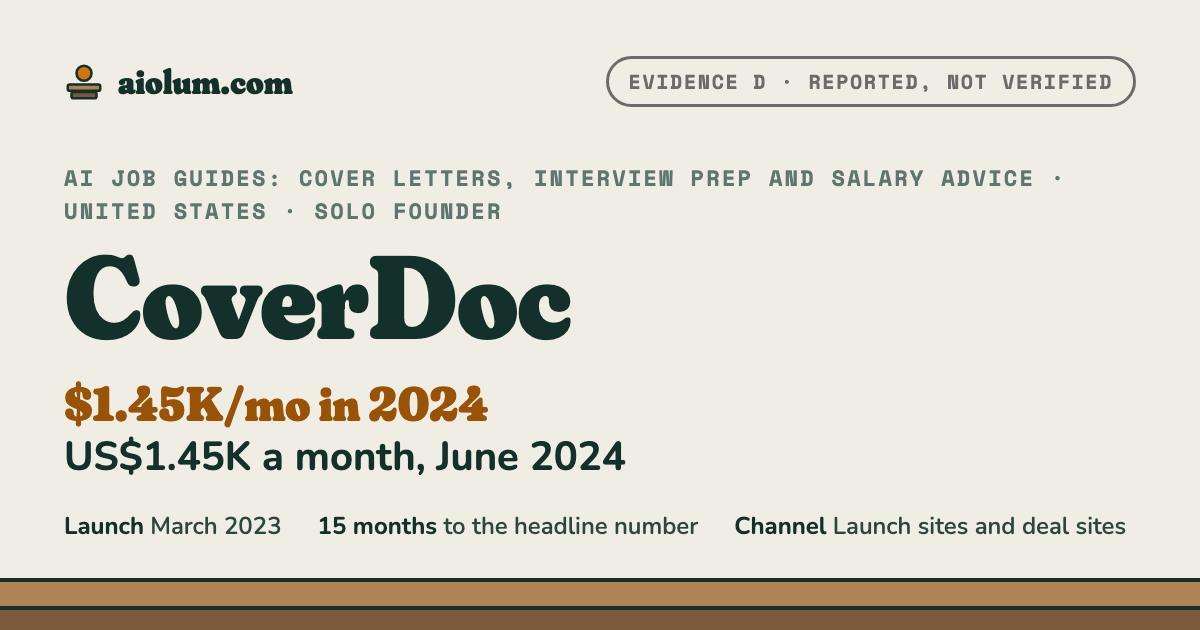
CoverDoc (AI job guides: cover letters, interview prep and salary advice, United States): US$1.45K a month, June 2024. Evidence grade D: reported, not verified. Team: 1 founder, Ambar Shrivastava, a laid-off head of product in Austin, Texas; no employees are named in any source. Launched March 2023; still running, revenue falling.Added 1 November 2026
- Outcome
- US$1.45K a month, June 2024Revenue falling
- Evidence
- D reported, not verified
- Launch
- March 2023
- Status
- Still running
- Team
- 1 founder, Ambar Shrivastava, a laid-off head of product in Austin, Texas; no employees are named in any source
- Outside funding
- No funding round disclosed; the founder wrote in 2026 that he spent too much time trying to get investors
- Main channel
- Launch sites and deal sites
What is not verified
The headline figure, US$1,250 a month in subscriptions plus about US$200 a month in pay-as-you-go sales as of June 2024, and the total of US$9,920, rest on one interview: the founder's answers in the No-Code Exits newsletter, published 5 July 2024. The same newsletter later restated it as "$1000 MRR"; that is not a second source. No payment processor, buyer or journalist has confirmed any revenue figure, and CoverDoc has no TrustMRR profile (the page trustmrr.com/startup/coverdoc answered 404 on 1 November 2026). A reader could look for a verified revenue profile or a later interview with a dated figure. The headline number is grade D: one claim or one estimate, with no second source. Aiolum shows it because the story is useful, and marks it so that it is not mistaken for a verified figure.
CoverDoc is a web app that turns a job post and a resume into a job guide, a Google Doc that holds everything a candidate prepares for one application: a short report on the company and its recent news, a draft cover letter, a job fit analysis (a list of the skills the post asks for that the resume does not show), expected interview questions with suggested answers in the STAR method (Situation, Task, Action, Result, a common way to structure an answer about past work), and ideas for small projects that address a real problem of the company. Paid plans add resume edits that explain each change, mock interviews and a salary comparison. A language model writes the text; the founder says that each prompt limits the model to the experience found in the user's resume and LinkedIn profile.
Ambar Shrivastava, a product manager in Austin, Texas, wrote that he was laid off from a head-of-product job at a startup in November 2022 and built the first version for himself: an Airtable form, a Zapier workflow that called OpenAI, and a Google Doc as the output. He opened an early access list in January 2023, launched publicly in March 2023, and told Zapier's blog in June 2023 that 1,600 people had signed up in two months. In an interview with the No-Code Exits newsletter published on 5 July 2024, he said that by June 2024 CoverDoc had 14,000 registrations, US$9,920 in total revenue, and MRR (monthly recurring revenue, the subscription revenue that repeats each month) of US$1,250 plus about US$200 a month in pay-as-you-go credits, bought one at a time. That US$1,450 a month is the headline of this page.
The figure did not hold. In a second No-Code Exits interview, published on 13 February 2026, the founder wrote that website traffic and MRR had declined over the last year because new customer growth had not offset churn (subscribers who cancel). He gave no new revenue figure. Every number on this page comes from the founder, mostly in one newsletter; no payment processor or buyer has confirmed it, so the evidence grade is D.
How much revenue does CoverDoc make?
Each row shows the evidence grade and the source numbers from the list at the end of this page. The grades are explained in How Aiolum verifies.
| Fact | Value | Grade | How we know | Sources |
|---|---|---|---|---|
| Revenue per month, June 2024 | US$1,250 in subscriptions plus about US$200 pay-as-you-go, US$1,450 in all | D | Founder in the No-Code Exits interview published 5 July 2024, under "As of June 2024": "$1,250 MRR for subscriptions + $200 in PAYG revenue per month". The sum is computed on this page. The interview lists ProfitWell as his revenue analysis tool, but it does not say that this figure was read from ProfitWell. One source, one date. | [1] |
| Run rate from the June 2024 figure | about US$17,400 a year | calc | Calculated: US$1,450 times 12. | [1] |
| Total revenue to June 2024 | US$9,920 | D | Founder, same interview: "Total revenue: $9,920". Fifteen months after the public launch. | [1] |
| Revenue trend, February 2026 | declined over the last year; no figure given | D | Founder in the No-Code Exits update of 13 February 2026: "Website traffic and MRR has declined over the last year as new customer growth has not offset churn." The newsletter's introduction says he had grown CoverDoc "to $1000 MRR" at the time of the first interview. | [2] |
| Subscriber churn and lifetime value, February 2026 | churn 3.7% (against 11% a year earlier); lifetime value US$189.46 per subscriber | D | Founder, same update: "Subscriber Churn Rate: 3.7% vs 11% YoY" and "Subscriber LTV: $189.46". The period of the churn rate is not stated; a monthly rate is the usual reading. | [2] |
| Registrations and documents, June 2024 | 14,000 registrations; more than 16,000 prep documents | D | Founder, interview of 5 July 2024. He also gave a 10.3% visitor-to-registration rate and a 64% trial-to-paid rate. | [1] |
| Users and job guides, 2026 | 17,000+ job seekers served and 21,000+ job guides on the about page; 19,000+ on the founder's site; 21,506 guides in February 2026 | C | The company's about page and home page ("15k+"), the founder's personal site, and the February 2026 update. The counts differ by page and none is dated more exactly. | [6, 5, 10, 2] |
| Profit margin on the subscription plan, June 2024 | 87% or more | D | Founder, interview of 5 July 2024. | [1] |
| Early users, June 2023 | more than 500 on the early access list in January 2023; more than 1,600 users within two months of the March 2023 launch | C | Zapier blog article by Maranda Borchert, 7 June 2023, from an interview with the founder. About 55% of users were outside the United States, he said. | [3] |
| Team | 1 person | C | The founder calls it his solopreneurship from November 2022 (No-Code Exits, 2024) and the about page is written by him in the first person. No source names an employee. | [1, 6] |
| Time from launch to the June 2024 figure | 15 months | calc | Calculated: March 2023 to June 2024. | [1] |
How to read this table: a grade D value is a founder statement that appears in one source on one date. A grade C value is a founder statement repeated elsewhere, or a statement in an article that quotes him. An "X" value was computed on this page. No value is grade A or B.
| Plan | Per month, billed yearly (US$) | Per month, billed monthly (US$) | Limit |
|---|---|---|---|
| Starter | 0 | 2 free credits | |
| Pro | 9.99 | 20 job guides, 5 resume revamps, 5 compensation evaluations a month | |
| Plus | 14.99 | 40 job guides, 10 resume revamps, 2 mock interviews, 10 compensation evaluations a month | |
| Pay As You Go | US$3.00 a credit, sold as 5 credits for US$15; no hiring team outreach or mock interviews |
The pricing page shows monthly prices only; no yearly price was listed. The free Starter plan gives 2 credits. A credit makes one job guide. Pay As You Go sells 5 credits for US$15. The founder said he raised the subscription price to US$9.99 a month in January 2024 without a drop in conversion.
When did CoverDoc launch, and how did it grow?
From a layoff and a ChatGPT prompt to a paid product in four months, then a decline. Each entry carries its grade.
- November 2022CAmbar Shrivastava is laid off from a head-of-product job at a startup in Austin. ChatGPT has just come out. He writes prompts that combine his LinkedIn profile with a job description to draft cover letters for himself. [1, 3, 6]
- Late 2022CFirst version, used only by him: an Airtable form starts a Zapier workflow that sends the job details to OpenAI and writes the result into a Google Doc. He says it took a few days to build. [1, 3]
- January 2023CAn early access program gets more than 500 sign-ups. [3]
- March 2023CPublic launch with a subscription and pay-as-you-go credits, a Softr front end and Stripe payments. The founder says CoverDoc won Zapier's 2023 No-Code Day Contest in the category "No-Code Featuring AI"; Zapier's announcement offered US$5,000 to each category winner. [1, 10, 11]
- June 2023CZapier's blog writes about CoverDoc: more than 1,600 users in two months without paid marketing, about 55% of them outside the United States. [3]
- January 2024DThe subscription price rises to US$9.99 a month; the founder says conversion did not drop. [1]
- June 2024DThe founder reports 14,000 registrations, US$9,920 in total revenue, and US$1,250 a month in subscriptions plus about US$200 a month in pay-as-you-go sales. Published by No-Code Exits on 5 July 2024. [1]
- 23 May 2025CA post on the company blog says some early cover letters included experience that users did not have, and that prompts now limit the model to the user's resume and LinkedIn profile. The company says it does not offer auto-apply. [7]
- 13 February 2026DSecond No-Code Exits interview: traffic and MRR have declined over the last year, subscriber churn is 3.7%, and the founder is moving the product from cover letters to skill showcases, job fit analysis and outreach to hiring teams. [2]
- 1 November 2026CThe site is live with Pro at US$9.99 and Plus at US$14.99 a month. [4, 5]
Why did CoverDoc work?
Four causes, in the order they mattered. Each one is a reusable lesson.
One guide instead of many prompts
The founder said a job seeker would need 14 different prompts to get the same material from a chat model (the home page now says 16). CoverDoc packs the company research, the cover letter, the interview questions and the salary check for one job into one Google Doc, which the user can edit and share.
Research that the user would not do
Each guide pulls recent news and a summary of the company website, and the cover letter mentions a news item. The founder, a former hiring manager, wrote that this is what he valued in candidates. It is also what a plain chat prompt does not do without browsing.
Two ways to pay
The founder said in July 2024 that subscriptions brought US$1,250 a month and pay-as-you-go credits about US$200 a month. He described the credits as the option for job seekers on a small budget, and the subscription as the option for senior people who apply to many jobs over a longer time.
Cheap distribution that faded
The founder said early users came from the Zapier contest and article, AI directories (Futurepedia, There's an AI for That, TopAI.tools), review articles, a referral program that gave both sides free credits, and about 50 affiliates. In February 2026 he wrote that irregular content work had cut organic search and social traffic.
How it was built
These details come from the founder's interviews and from Zapier's article. They are grade C and D. [1, 2, 3]
- Version one: an Airtable form, a Zapier workflow to OpenAI, and a generated Google Doc, built in a few days.
- Version two moved the OpenAI calls from Zapier into Airtable automation scripts written in JavaScript, and later to Google Cloud Platform for speed. Airtable, Zapier and Softr stayed in place.
- Front end and accounts on Softr.io, chosen over Bubble for its Airtable link; Stripe for payments because Softr had a native Stripe integration.
- Framer for the landing page, Hotjar exit surveys to see why visitors did not sign up, MrScraper for web scraping, ConvertKit for email, Prefinery for referrals, Rewardful for affiliates, Amplitude for product analytics and ProfitWell for revenue analysis.
- In 2026 the founder wrote that n8n workflows let him build features that used to take weeks, and that he would choose a more flexible stack if he started again.
Tools named in the sources
Each one opens its page in the Tools tab, with every story that uses it.
Who tried this before CoverDoc, and why did they fail?
Four companies in our database of failed startups sold job seekers a better way to apply or to find work, and lost to larger platforms. The values below are from that database and are not independently verified.
Jobspice
The promiseProfessional-looking resumes made quickly by people who cannot design.
Why it diedA single document tool while LinkedIn and free templates offered more; it did not grow into a wider career service.
Jobr
The promiseSwipe through jobs on a phone, the way dating apps show people.
Why it diedLinkedIn and Indeed offered more jobs and more reach, and the swiping idea did not keep users.
LearnUp
The promiseShort training modules that prepare a job seeker for a specific employer's job.
Why it diedLarger course platforms had more content and better links to professional networks.
Monster Worldwide
The promiseJob listings online instead of in newspaper classifieds.
Why it diedIt treated job search as a database of listings; LinkedIn's network and Indeed's search traffic took the job seekers.
The failed startups come from our database of 1,749 dead startups, retold here in our own words. Its entries are AI-assisted summaries of public sources, so these cards carry no evidence grade.
What changed
The four predecessors needed money to build a product and to reach job seekers, and they lost to platforms with more users. CoverDoc needed neither: a language model writes the documents, no-code tools hold the product together, and one founder built the first version in days. That is why a solo founder could reach paying users within four months of a layoff.
The same fact worked against it. The founder wrote in 2026 that there are now hundreds of AI tools for job seekers, that job seekers can build their own, and that hiring teams receive so many AI-written applications that cover letters matter less each month. He reported that revenue declined. The cost of building fell for everyone at once, so the predecessors' problem, a larger platform or a crowd of cheaper rivals, came back in a new form.
Can one person copy CoverDoc now?
The build, yes. The niche, with care.
Turning one's own repeated prompt work into a product with no-code tools is still a fast and cheap way to start: the founder built version one in days and charged from launch. But a tool that writes one kind of document is easy to copy, and the founder's own account shows a small business that peaked near US$1,450 a month, as he reported in 2024, and then shrank.
Where it is still open: Job-search help for groups with high need and willingness to pay that the founder names, immigrant professionals and senior career changers, and tools sold through career coaches and outplacement firms, which he says have shorter sales cycles than universities.
- 1Write down the prompts you use again and again for one task and the inputs they need.
- 2Build the first version with a form, an automation tool and a document as output; use it yourself before anyone else.
- 3Offer both a subscription and single credits, and measure which group stays.
- 4Spend at least as much time on distribution as on features; the founder said 80% features and 20% marketing was the wrong split.
- 5Add the parts a plain chat model does badly, such as fresh company research and checks against the user's real experience.
What could go wrong for CoverDoc?
The risks are the mirror image of the causes above.
What is not verified
The headline figure, US$1,250 a month in subscriptions plus about US$200 a month in pay-as-you-go sales as of June 2024, and the total of US$9,920, rest on one interview: the founder's answers in the No-Code Exits newsletter, published 5 July 2024. The same newsletter later restated it as "$1000 MRR"; that is not a second source. No payment processor, buyer or journalist has confirmed any revenue figure, and CoverDoc has no TrustMRR profile (the page trustmrr.com/startup/coverdoc answered 404 on 1 November 2026). A reader could look for a verified revenue profile or a later interview with a dated figure.
Revenue has fallen since the headline
In February 2026 the founder wrote that website traffic and MRR had declined over the previous year because new customers did not offset cancellations. He gave no new figure, so the current revenue may be below the US$1,000-a-month level. He also wrote that he is changing the product because cover letters and online applications work less well than before.
AI-written applications
Hiring teams increasingly receive AI-written applications, and the company's own blog says some large employers reject them. The company says it limits the model to the user's real experience, asks users to edit every draft, and has no auto-apply feature ("Intentionally not integrated with any ATS for auto-applying"). Its blog of May 2025 says early cover letters sometimes included experience the users did not have, before those limits were added. The pricing page also sells an "Originality Score", described as "The likelihood of AI vs. human-written content"; the blog says it shows how much editing is needed and "how likely the content will be flagged as AI-generated". The pages do not promise to beat AI detectors or applicant tracking systems.
Marketing to students and planned UGC ads
The FAQ names international students looking for their first job as users, and the site mentions internships; the product is for job applications, not school work. In February 2026 the founder wrote that he is "exploring UGC campaigns and short-form video"; no source shows such ads yet, or whether they would use real customers.
Funding is unclear
No source reports a funding round. In 2026 the founder wrote that he spent too much time trying to get investors "or working with the wrong type of investors", which does not say whether any investor put money in.
Sources
The grade next to each source is the best grade that the source can support. "Read in full" means that the text of the page was downloaded and the numbers were checked in it.
- D No-Code Exits, 5 July 2024: How Ambar built and grew a job seeker AI platform to $1000 MRRRead in full (free post, downloaded 1 November 2026). Founder interview. Source for the June 2024 revenue, total revenue, registrations, launch date, price change, tools and channels.
- D No-Code Exits, 13 February 2026: How Ambar Is Pivoting CoverDoc to Help Job Seekers Stand Out in the AI EraRead in full (free post, downloaded 1 November 2026). Founder update. Source for the decline in traffic and MRR, churn, lifetime value and the change of product.
- C Zapier blog, 7 June 2023, by Maranda Borchert: How CoverDoc uses AI to revolutionize cover letter writingRead in full. Article from an interview with the founder; gives his full name, the early access count, the user count two months after launch and the share of users outside the United States.
- C CoverDoc pricing pageRead in full on 1 November 2026. Source for the pricing table and the Originality Score description.
- C CoverDoc home pageRead in full on 1 November 2026. Source for the product description, the FAQ, the "15k+" user claim and the affiliate commission.
- C CoverDoc about pageRead in full on 1 November 2026. The founder's own story and the counts of job seekers served and guides created.
- C CoverDoc blog, 23 May 2025: Responsible AI Isn't Cheating: How Smart Job Seekers Use Tech Without Losing CredibilityRead in full. Source for the prompt limits, the early problem with invented experience, the absence of auto-apply and the purpose of the Originality Score.
- C CoverDoc product page: AI Resume RevampRead in full on 1 November 2026. Checked that the resume tool edits the user's existing resume and explains each change.
- C CoverDoc partner page: Career CoachesRead in full on 1 November 2026. Source for the quoted statement on auto-applying and the list of safeguards.
- C Ambar Shrivastava, personal websiteRead the home page on 1 November 2026 (linked from the 2026 newsletter). Source for his full name, Austin, the 19,000+ users and the Zapier contest win.
- C Zapier blog, 8 February 2023: National No-Code Day 2023 contest announcementRead in full. Source for the "No-Code Featuring AI" category and the US$5,000 prize per category winner; it does not name the winners.
- C Database of failed startups, local exportLocal export. AI-written summaries, not independently verified. Source for the failed predecessors.