Rezi: Revenue, team and how it was built
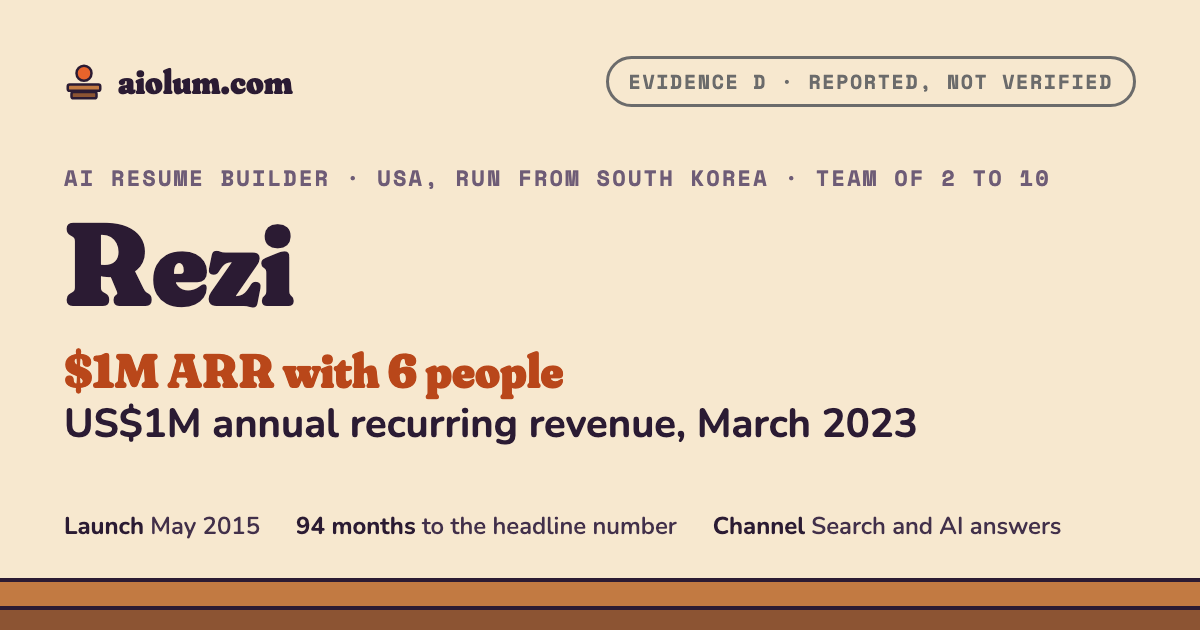
Rezi (AI resume builder, USA, run from South Korea): US$1M annual recurring revenue, March 2023. Evidence grade D: reported, not verified. Team: 1 founder; 2 people in 2020; 6 listed at the US$1M ARR figure in March 2023; 12 by the end of 2023, 18 by the end of 2024, 30 on LinkedIn by October 2024. Launched May 2015; still running, revenue falling.Added 26 October 2026
- Outcome
- US$1M annual recurring revenue, March 2023Revenue falling
- Evidence
- D reported, not verified
- Launch
- May 2015
- Status
- Still running
- Team
- 1 founder; 2 people in 2020; 6 listed at the US$1M ARR figure in March 2023; 12 by the end of 2023, 18 by the end of 2024, 30 on LinkedIn by October 2024
- Outside funding
- About US$150K pre-seed by October 2020 (Lotte Accelerator and Korean angels), seed from Strong Ventures in March 2021, amount not stated
- Main channel
- Search and AI answers
What is not verified
The headline, US$1 million in annual recurring revenue in March 2023, is one sentence in the company's own year review published on 17 January 2024. No payment processor, investor or journalist has confirmed it, and Latka's reading of US$1.2 million for November 2022 names no source and does not say whether it is a year of revenue or a run rate. The two-person figure of February 2020 is a forecast the founder gave a newspaper. A reader could look for a TrustMRR history that reaches back to 2023 (the public profile starts in November 2025), a second interview with 2023 figures, or the company's filings in Korea. The headline number is grade D: one claim or one estimate, with no second source. Aiolum shows it because the story is useful, and marks it so that it is not mistaken for a verified figure.
Rezi is a resume builder designed around applicant tracking systems (ATS), the software that most large companies use to receive, parse and filter job applications before a recruiter reads them. The user fills in a fixed layout that these systems can parse, and AI models write or rewrite the bullet points, the summary and the cover letter from the job description. A score grades the resume on 23 checks, a keyword scanner compares it with the job posting, and an interview trainer asks questions based on it. Organizations buy the same tool under their own brand.
Jacob Jacquet, an American economics graduate, started it in May 2015 as a Word template that he said he sold for about US$9.69 after a post on Reddit, moved to Seoul in 2016, and relaunched Rezi as SaaS (software as a service, a web application paid by subscription) in September 2019 after an agency built it. In February 2020 he told The Korea Times that revenue for 2020 was on track for 250 million won, about US$210,000, with two employees. In December 2020 the two-person team added GPT-3 to the builder, the first resume builder to do so according to the founder. The company's own year review, published in January 2024, states that Rezi reached US$1 million in annual recurring revenue (ARR, the monthly subscription revenue times twelve) in March 2023, and the about page archived that month lists six people. That figure is the headline of this page, because the site covers businesses of ten people or fewer, and Rezi grew past that size later in 2023.
The company kept publishing numbers: it wrote that ARR went from US$1,986,807 to US$2,249,233 in January 2024, and the founder told Starter Story in August 2024 that MRR (monthly recurring revenue) was US$215,000 with 11 employees. TrustMRR, which reads the company's Stripe account, reports a verified MRR of US$242,119 and US$2,959,725 of revenue in the twelve months to 26 October 2026, earned by a team that the company put at 18 at the end of 2024. The headline figure rests on one company statement, so it is grade D. The page also records two funding rounds, a borderline feature called ATS Hack Mode, and five earlier job-search companies that failed.
How much revenue does Rezi make?
Each row shows the evidence grade and the source numbers from the list at the end of this page. The grades are explained in How Aiolum verifies.
| Fact | Value | Grade | How we know | Sources |
|---|---|---|---|---|
| Annual recurring revenue, March 2023 | US$1,000,000 | D | Company blog, 17 January 2024: "We reached a significant company milestone: $1M ARR." One statement, no second source. This is the headline because it is the latest dated figure from the period when the team was ten people or fewer. | [1] |
| Team at that figure | 6 people listed | C | The about page archived on 24 March 2023 lists the founder, a lead developer, a marketing and operations person, two developers and a product manager; the snapshot of 29 November 2022 lists the same six. The year review says 7 of the 12 members at the end of 2023 joined during 2023. | [2, 19, 1] |
| Revenue forecast for 2020 | 250 million won, about US$210,000 | D | Founder's statement to The Korea Times, 6 February 2020: revenue for 2020 was on track for that amount, at a very high margin, with two employees. A forecast, not a result. | [4] |
| Team, 2020 to 2022 | 2 people | C | Founder to The Korea Times in February 2020 ("just two employees") and in his own post of July 2023 ("a small team of two" when GPT-3 was added in December 2020). | [4, 5] |
| Annual recurring revenue, January 2024 | from US$1,986,807 to US$2,249,233 in one month | D | Company blog, 28 January 2025. Called the highest growth in a single month. One source. | [6] |
| Monthly recurring revenue, August 2024 | US$215,000 | D | Founder interview with Starter Story, 8 August 2024. The text says 11 employees; the page header says 15. | [7] |
| Verified monthly recurring revenue, 26 October 2026 | US$242,119 | A | TrustMRR, read from the company's Stripe account. 10,049 active subscriptions; profit margin of 60% over the last 30 days. | [3] |
| Verified revenue, twelve months to 26 October 2026 | US$2,959,725; US$10,422,868 since the Stripe account began | A | TrustMRR. The last 30 days were US$210,433; the profile puts revenue growth over the last 30 days at -3.8% and MRR growth at -3.7%. | [3] |
| Verified monthly revenue, November 2025 to September 2026 | between US$217,472 and US$275,551 a month | A | TrustMRR monthly timeline. The peak was April 2026 at US$275,551; September 2026 was US$225,184. | [3] |
| Fall from the April 2026 peak to September 2026 | 18.3% | calc | Calculated: (275,551 - 225,184) / 275,551. | [3] |
| Team after the headline | 9 listed in July 2023, 12 at the end of 2023, 18 at the end of 2024, 30 on LinkedIn in October 2024 | C | About page snapshots, the company's year reviews ("Rezi is a team of 12"; "12 of our team members are based in Seoul, while the other 6 work internationally") and Latka's LinkedIn count. The Latka count is grade D. | [2, 1, 6, 12] |
| Outside funding | about US$150,000 by October 2020; a seed round in March 2021, amount not stated | C | Founder to KoreaTechDesk, October 2020: "approximately $150,000, with the most recent investment coming from Lotte Accelerator." Founder's own post, September 2024: seed round closed with StrongVC in Seoul at the end of March 2021, after pre-seed rounds with Lotte Accelerator and Korean angels. The TrustMRR profile says VC-backed. | [8, 9, 3] |
| Registered users | 50,000 on 26 June 2020; 1,000,000 in July 2023; 2,000,000 in February 2024; 3,000,000 in November 2024; 4,005,400 at the end of 2025 | C | Founder's posts and the company's year reviews. The home page says 4.5 million in October 2026. | [10, 5, 6, 16] |
| Profitability | profitable; staff about a fourth of expenses | C | Founder to KoreaTechDesk in May 2020 ("now we are profitable") and to Starter Story in August 2024 ("Rezi is profitable"; employee costs 24.9%). | [11, 7] |
| Paid advertising | about US$15,000 a month for a year, then stopped | D | Founder to Starter Story, August 2024: an agency ran the ads and never reached a positive return. | [7] |
| Latka's figures | US$3.2 million for 2024 (estimate); readings of US$93.4K for 2020, US$664.1K for November 2021, US$1.2 million for November 2022 and US$2.4 million for October 2023, with no source named | D | A directory. Its headcount of 15 for November 2022 does not match the six people on the company's own about page that month. | [12] |
| Revenue of the white-label business in one month, 2025 | US$37,600 | D | Company blog, February 2026: "Rezi Enterprise partners generated $37.6K in revenue in a single month." | [16] |
| First product and price | a Word template for about US$9.69 | C | Founder to Starter Story, and his own post of July 2023. | [7, 5] |
| Time from the first sale to the headline figure | 94 months | calc | Calculated: May 2015 to March 2023. From the SaaS relaunch in September 2019 it is 42 months. | [5, 1] |
| Verified twelve-month revenue divided by the headline | 2.96 | calc | Calculated: 2,959,725 / 1,000,000. The later figure was earned by a team of 18 or more. | [3, 1] |
How to read this table: a grade A value comes from TrustMRR, which reads Rezi's Stripe account through an API key. A grade C value is a statement that agrees across several dates or sources. A grade D value is a single company or founder statement, or a directory figure, with no second source; the headline row is grade D. A "calc" value was computed on this page from the rows above it.
| Plan | Per month, billed yearly (US$) | Per month, billed monthly (US$) | Limit |
|---|---|---|---|
| Free | 0 | 0 | 1 resume, 1 AI interview, 3 PDF downloads |
| Pro | 29 | unlimited resumes, AI interviews and downloads; 1 expert review a month | |
| Lifetime | 149 one-time | Pro features with no end date, no free monthly review | |
| Enterprise | 99 | per 200 users, white-label | |
| Expert resume review | from 8 one-time | a person reviews one resume |
No yearly billing is shown. Pro is US$29 a month and includes one review a month by a person. Lifetime is a one-time US$149 payment for the Pro features without the free monthly review. Enterprise is US$99 a month per 200 users for universities, agencies and career sites. A review by a resume expert is sold separately from US$8. All paid plans carry a 30-day money-back guarantee.
When did Rezi launch, and how did it grow?
From a Word template sold on Reddit in May 2015 to US$1 million in annual recurring revenue with six people in March 2023, 94 months, then to Stripe-verified revenue of about US$3 million a year with a larger team. Each entry carries its grade.
- May 2015CJacquet, a graduate with a 2.2 grade average who got interviews at Google and Goldman Sachs, posts his resume on Reddit and sells the Word template for about US$9.69. [7, 5]
- 2016CAt 23 he moves to Seoul, after six months of working on Rezi in the United States. [4, 11]
- July 2017CAccepted into the K-Startup Grand Challenge. Rezi is a side project while he teaches English. [11]
- September 2019CRelaunch as a web application built by an agency, with accounts, resume management and a Pro plan. Posted to Hacker News on 5 September. A first developer, Luc Lemerez, is hired to take over the code. [5, 17]
- November 2019CA Reddit post goes viral and brings a wave of users the site was not ready for. [10]
- January and April 2020CStackCommerce and AppSumo become distribution partners. AppSumo gives Rezi Lifetime away free during the pandemic; about 20% of users, 10,000 people, come from it. [10]
- 6 February 2020DThe founder tells The Korea Times that 2020 revenue is on track for 250 million won, about US$210,000, with two employees. [4]
- 26 June 2020C50,000 users, without a marketing budget. An SEO strategy, a rebuilt site and a dedicated writer started in April. [10]
- October 2020CAbout US$150,000 raised in total, the latest from Lotte Accelerator. 106,985 sign-ups in 13 months. Profitable. [8]
- December 2020CGPT-3 added to the builder by a team of two. The founder says it was the first resume builder to use the API. [5, 7]
- March 2021CSeed round closed with Strong Ventures in Seoul. Amount not stated. [9]
- 29 November 2022CThe about page lists six people. [19]
- January 2023DChatGPT changes how people write. New customers are 527.7% above January 2022. [1]
- March 2023DUS$1 million in annual recurring revenue, the headline of this page. The about page archived on 24 March lists the same six people. [1, 2]
- July 2023C1,000,000 users, 65% of them in the previous three months. The about page lists nine people. [5, 2]
- December 2023C2,000,000 users. A team of 12, of whom 7 joined during the year. [1]
- January 2024DAnnual recurring revenue goes from US$1,986,807 to US$2,249,233 in one month. [6]
- June 2024CATS Hack Mode: a switch that embeds invisible prompts and keywords in the PDF. The founder writes that recruiters attacked it and that he does not recommend it. [13, 14]
- 8 August 2024DStarter Story interview: US$215,000 in monthly recurring revenue, 11 employees, profitable, ads stopped. [7]
- December 2024C3 million users. Five people joined during the year; 18 in the team, 12 of them in Seoul. [6]
- 2025D4 million users. An AI Resume Agent, a job search tool and a mobile app. The white-label business makes US$37,600 in one month. [16]
- 26 October 2026ATrustMRR shows US$242,119 in verified monthly recurring revenue and US$2,959,725 in the last twelve months, below the April 2026 peak. [3]
Why did Rezi work?
Four causes, in the order they mattered. Each one is a reusable lesson.
Timing
Rezi added GPT-3 in December 2020, when the model was new and, according to the founder, no other resume builder used it. The two-person team spent two years tuning prompts and features for resume writing. When ChatGPT made AI writing a mass habit in January 2023, Rezi already had a tested product and three years of search rankings, and the company reports that new customers in that month were 527.7% above the year before.
A narrow product with a strong constraint
The founding idea was to make it impossible to build a resume incorrectly. The layout is fixed so that applicant tracking systems parse it, the score tells the user what is weak, and the AI fills the gaps. The founder's own words: product philosophy comes before anything else, and the company was lucky to get the product value exactly right from the first users.
Free distribution instead of ads
A Reddit post in November 2019, an AppSumo giveaway of the lifetime plan in April 2020, StackCommerce deals, Product Hunt launches and an SEO program from April 2020 brought the first hundreds of thousands of users. The company writes that search traffic grew consistently from October 2020. Later it repeated the giveaway: a day in October 2023 brought just under 70,000 sign-ups, and the founder said in 2025 that more than 93,000 lifetime accounts had been given away through the company's subreddit. Paid ads, about US$15,000 a month for a year according to the founder, did not pay back and were stopped.
Cheap engineering in Seoul and a small core
The first software was built by an agency, paid for with pre-seed money that took four years to raise. Then one engineer, hired in 2019, carried the product for years. The founder told Starter Story that staff were about a fourth of expenses and that Korean salaries kept development affordable, which is how two people could run a product with hundreds of thousands of users.
How it was built
These details come from the founder's posts and interviews and from the company's pages. They are grade C. [5, 7, 10, 18, 3]
- 2015 to 2019: a Word template sold from a WordPress site, then Rezi Instant, a free form that reformatted text into the template with no accounts or database.
- September 2019: the web application was built by an outside development agency, then taken over by the first hired developer. The company lists HTML, CSS, Bootstrap and Webflow for the marketing site.
- December 2020: OpenAI's GPT-3 API for the AI writer; later the AI editor, cover letter and resignation letter writers, the AI interview and, in 2025, a conversational AI Resume Agent. The company does not say which models it uses today.
- Stripe takes the payments; TrustMRR reads the account through an API key. Downloads go to PDF, Word or Google Drive.
- Distribution: Reddit, AppSumo, StackCommerce, Product Hunt, a Chrome extension that turns a LinkedIn profile into a resume, and search content written by an in-house content team.
- 2024 to 2026: a white-label version for universities and agencies, a mobile app, a job search tool and a resume MCP server for use inside AI assistants.
Tools named in the sources
Each one opens its page in the Tools tab, with every story that uses it.
Who tried this before Rezi, and why did they fail?
Five companies in the Loot Drop database promised to get people hired, from a resume builder to the first online job board. The values below are from that database and are not independently verified.
Jobspice
The promiseProfessional-looking resumes from templates for people who cannot design.
Why it diedFree templates spread across the web and LinkedIn became the career platform. A resume builder alone did not pay.
Jobr
The promiseSwipe through jobs on a phone like a dating app.
Why it diedLinkedIn and Indeed had the listings and the reach. The swiping did not become an advantage, and Monster's purchase did not save it.
Monster Worldwide
The promiseThe first large online job board, with a resume database for employers.
Why it diedLinkedIn turned hiring into a network and Indeed took the search traffic with free aggregated listings and pay-per-click prices.
Elpha
The promiseA career community and job platform for women.
Why it diedA community needs constant engagement; LinkedIn had the scale, and the post-pandemic funding market closed.
Ansaro
The promiseAI that automates recruiting from resume parsing to interview scheduling.
Why it diedEmployers saw it as nice to have, the change management was heavy, and the return was not clear.
The failed startups come from Loot Drop, a free database of dead startups, retold here in our own words. Loot Drop describes its entries as AI-assisted summaries of public sources, so these cards carry no evidence grade.
What changed
Four of the five sold to employers or built a marketplace that needed both sides at once, and LinkedIn or Indeed owned the side that mattered. Jobspice, the closest predecessor, sold the same thing as Rezi, a nicer resume, and lost to free templates. Rezi's difference is not the template but the system behind it: a layout tuned for the parsers, a score, keyword matching against the posting, and AI writing that a free template cannot do. The customer pays Rezi US$29 a month or US$149 once, the company says, and no employer has to adopt anything.
The second difference is cost. The founder says that two people ran the product for years from Seoul, that the first software was built by an agency for pre-seed money, and that the company was profitable from 2020, so it never needed the rounds that killed Jobr, Elpha and Ansaro when the money stopped. The risk that remains is the same as Jobspice's: the model makers and the job boards can add resume writing, and the company's 2025 review already reports fewer clicks from search as AI answers replace web results.
Can one person copy Rezi now?
The early move, yes. The scale, no longer.
Adding a new model's API to an old, well-understood document type before the incumbents do is repeatable, and Rezi did it with two people. The later stage, a team of 18 or more, a white-label business and Stripe-verified revenue of about US$3 million a year according to TrustMRR, is a company, not a small-team method.
Where it is still open: Other documents with hidden parsers and anxious writers: grant applications, visa and immigration forms, tenders, academic statements, and the white-label version of each for the institutions that help people write them.
- 1Pick a document that software already parses badly, learn the parser's rules, and build the fixed layout first.
- 2When a new model API appears, add it to that workflow within weeks and tune it for one document type.
- 3Give the lifetime plan away in waves on Reddit and deal sites, and let search content do the rest.
- 4Keep the core team tiny in a cheaper city and stay profitable, so that a seed round is optional.
What could go wrong for Rezi?
The risks are the mirror image of the causes above.
What is not verified
The headline, US$1 million in annual recurring revenue in March 2023, is one sentence in the company's own year review published on 17 January 2024. No payment processor, investor or journalist has confirmed it, and Latka's reading of US$1.2 million for November 2022 names no source and does not say whether it is a year of revenue or a run rate. The two-person figure of February 2020 is a forecast the founder gave a newspaper. A reader could look for a TrustMRR history that reaches back to 2023 (the public profile starts in November 2025), a second interview with 2023 figures, or the company's filings in Korea.
The company is no longer small
Six people at the headline, 12 at the end of 2023, 18 at the end of 2024 and 30 on LinkedIn according to Latka. The verified figures of October 2026, US$242,119 a month per TrustMRR, belong to that larger company, not to the six-person one. Two of the site's team rules disagree here: an older rule accepts a team of six to ten people only with grade A or B money evidence, while the rule of 23 October 2026 takes, for a company that grew past ten people, the last dated figure from the time it had ten or fewer, graded by its evidence. The user decided on 26 October 2026: "When two team rules disagree, the newer rule (23 October 2026) decides." So the headline is the grade D figure of March 2023, when the about page listed six people, and the later growth to 18 to 30 people is stated here and in the team label.
Revenue is below its 2026 peak
TrustMRR shows US$275,551 in April 2026 and US$225,184 in September 2026, a fall of 18.3%, and revenue growth of -3.8% over the last 30 days. The company's 2025 review says search engines send fewer clicks as AI answers replace results, and ChatGPT itself writes resumes.
ATS Hack Mode
In June 2024 the company shipped a switch that embeds invisible AI prompts, metadata and keywords in the resume PDF, to test whether the hidden-text trick from social media works. The founder wrote on Hacker News that recruiters attacked it on LinkedIn and that the company does not recommend using it. The pricing and home pages read in October 2026 do not mention it, and the home page says keyword targeting works without keyword stuffing. A reader should check whether the switch still exists in the app.
Funded, with conflicting headcounts
Rezi raised about US$150,000 by October 2020 according to the founder, and a seed round in March 2021 whose size is not stated; the TrustMRR profile calls it VC-backed. Headcounts disagree: Starter Story's header says 15 where the founder's text says 11, and Latka's 15 for November 2022 does not match the six on the company's own page.
Sources
The grade next to each source is the best grade that the source can support. "Read in full" means that the text of the page was downloaded and the numbers were checked in it.
- D Rezi blog, 17 January 2024: Rezi: Year in Review 2023Read in full. Company post. Source for the US$1M ARR in March 2023, the team of 12, the 527.7% customer growth and the SEO history.
- C Wayback Machine, rezi.ai/about as of 24 March 2023Read the team section. Lists six people. The snapshots of 12 July 2023 (nine people) and 1 January 2024 (twelve) were read the same way.
- A TrustMRR profile of Rezi, revenue synced 26 October 2026Read the markdown profile. Stripe-verified MRR, revenue totals and the monthly timeline from November 2025; the description and funding line are founder-written, grade C.
- D The Korea Times, 6 February 2020: American entrepreneur confident to revamp Korean resume market, by Lee Min-hyungRead in full. Founder quoted on the 2020 revenue forecast and the two employees.
- C Jacob Jacquet on the Rezi blog, 5 July 2023: the post on reaching 1,000,000 usersRead in full. Founder's history: the template, the agency build, the first developer, GPT-3 in December 2020 with a team of two.
- D Rezi blog, 28 January 2025: Rezi: Year in Review 2024Read in full. Source for the January 2024 ARR figures, the 3 million users and the team of 18.
- D Starter Story, 8 August 2024: I Created The Best Resume Builder In The World ($2.5M/Year)Read in full. Founder interview, not marked as an estimate. Source for the US$215K MRR, 11 employees, profitability, the ad spend and the tools.
- C KoreaTechDesk, 28 October 2020: Korean startup Rezi's founder Jacob Jacquet on successful resume serviceRead in full. Founder interview. Source for the US$150,000 raised, Lotte Accelerator and the 106,985 users.
- C Jacob Jacquet, 6 September 2024: The Pitch Deck We Used to Raise Our Seed Round in Korea, as a Global StartupRead in full. Founder's post. Source for the seed round with StrongVC at the end of March 2021 and the pre-seed investors.
- C Jacob Jacquet: 0 to 50,000 Users: A Candid Look Into Creative Growth (first published 2020, on his site dated 6 September 2024)Read in full. Founder's post. Source for the Reddit event, AppSumo, StackCommerce, Product Hunt and the SEO program.
- C KoreaTechDesk, 11 May 2020: K-Startup Grand Challenge: Jacob Jacquet, helping job seekers build optimized resumes with ReziRead in full. Founder interview. Source for the 2016 move, the 2017 program, the four years without funding and the profitability.
- D Latka company page: Rezi revenue 2024, estimate, and headcountRead in full. A directory with estimates and unsourced readings.
- C Rezi blog, 6 June 2024: New Feature - ATS Hack Mode, by Jacob Jacquet (Wayback copy of 25 June 2024)Read in full. The live address now redirects to the blog index, so the archived copy was read.
- C Hacker News, 12 June 2024: Show HN: ATS Hack Mode, with the founder's commentsRead through the Algolia API. Founder's comment on the recruiters' reaction and the recommendation not to use it.
- C Rezi pricing page, read 24 October 2026Read in full. Source for the pricing table.
- D Rezi blog, 4 February 2026: Year in Review 2025Read in full. Source for the 4 million users, the enterprise revenue month, the giveaways and the search comment.
- C Hacker News, 5 September 2019: Show HN: Rezi, Resumes for Large CompaniesRead through the Algolia API. Dates the SaaS launch.
- C Rezi: Official information about Rezi AIRead the company and product sections. Company page for AI assistants; source for the product list, the Seoul headquarters and the 2019 launch.
- C Wayback Machine, rezi.ai/about as of 29 November 2022Read the team section. Lists the same six people as March 2023.
- C Loot Drop database export, 1,749 failed startupsLocal export. AI-written summaries, not independently verified. Source for the failed predecessors.