Innsikt.AI
Innsikt.AI sells training for professionals who interview children in abuse and neglect cases. The user talks with an AI avatar, a computer-generated child, shown on screen, whose answers are produced by a language model, and the platform grades each question in real time: open questions are good, closed and leading questions are marked in red, following the interview methods that Norwegian police and child welfare services are supposed to use. The company's website says the platform runs in a web browser, in Norwegian and English, and is sold to teams and organizations with central administration and volume pricing; it publishes no prices.
The company is a spin-off, a business created to sell technology that a research institution developed, from OsloMet, the Oslo Metropolitan University, and SimulaMet, a research center for digital engineering. Gunn Astrid Baugerud, a psychologist and professor of social work at OsloMet, led the research project that started in 2018 and founded INNSIKT.AI. AS on 9 May 2023 with three academic co-founders. OsloMet wrote in November 2024 that it had licensed the technology to the company. The Norwegian company register lists Baugerud as general manager and board chair and 8 employees as of September 2026.
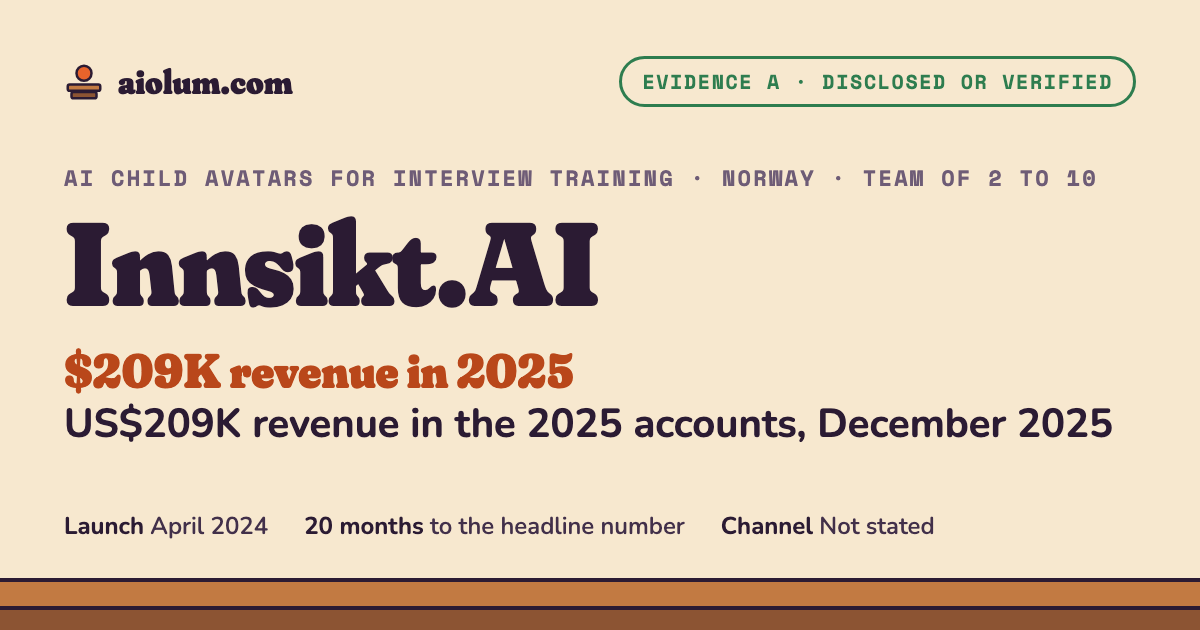
The headline figures come from the company's annual accounts, the yearly financial statements that every Norwegian limited company must file with the public Register of Company Accounts, which publishes them through an open interface. They show sales of NOK 816,000 in 2024 and NOK 2,176,042 in 2025, which this page converts to about US$76,000 and US$209,000 with the central bank's average exchange rates for each year. The 2025 accounts also show a net loss of NOK 1,659,862 and salary costs above revenue, so this is a growing but loss-making company financed by new share capital and grants. Latka, a directory, estimated revenue of US$770,000 a year in October 2025; the filed figure is 3.7 times lower, and this page uses the filed figure.
The numbers, graded
Each row shows the evidence grade and the source numbers from the list at the end of this page. The grades are explained in How Aiolum verifies.
| Fact | Value | Grade | How we know | Sources |
|---|---|---|---|---|
| Sales revenue, financial year 2025 | NOK 2,176,042 | A | Filed annual accounts for 1 January to 31 December 2025, journal number 2026581439, read from the Register of Company Accounts (Regnskapsregisteret) open interface. The accounts are audited (the audit opt-out field is false). | [1] |
| Sales revenue 2025 in US dollars | about US$209,000 | calc | Calculated: 2,176,042 divided by 10.3912, Norges Bank's average USD/NOK rate for 2025, equals 209,412. This is the headline figure of this page. | [1, 4] |
| Average revenue per month, 2025 | about US$17,500 | calc | Calculated: 209,412 divided by 12 equals 17,451. An average over the year, not a run rate at year end. | [1, 4] |
| Sales revenue, financial year 2024 | NOK 816,000, about US$76,000 | A | Filed annual accounts for 2024, journal number 2025640406. The dollar figure is calculated at Norges Bank's 2024 average rate of 10.7433 (816,000 divided by 10.7433 equals 75,954). | [1, 4] |
| Sales revenue, financial year 2023 | none | A | The 2023 accounts show no operating income and a loss of NOK 4,350. The company was founded in May 2023. | [1] |
| Growth from 2024 to 2025 | 2.67 times | calc | Calculated: 2,176,042 divided by 816,000 equals 2.67, an increase of 167%. | [1] |
| Net loss, 2025 | NOK 1,659,862, about US$160,000 | A | Filed accounts. Operating costs were NOK 3,886,139, of which salary costs NOK 2,750,135, against NOK 2,176,042 of sales. The 2024 net loss was NOK 370,572. | [1, 4] |
| Cash at the end of 2025 | NOK 1,982,230, about US$191,000 | A | Filed accounts. Total equity was NOK 1,495,017 and short-term debt NOK 714,137. | [1, 4] |
| New share capital, 2024 and 2025 | about NOK 2.0 million in 2024 and NOK 1.5 million in 2025, about US$330,000 in total | calc | Calculated: equity rose from NOK 25,651 to NOK 1,654,878 in 2024 while the company lost NOK 370,572, and fell only to NOK 1,495,017 in 2025 while it lost NOK 1,659,862. The accounts do not say who paid in the capital. | [1, 4] |
| Latka's revenue estimate | US$770,000 a year, October 2025 | D | Latka writes that the company has not published its revenue and that this is Latka's own estimate. It is 3.7 times the figure in the filed 2025 accounts (770,000 divided by 209,412 equals 3.68), so this page does not use it. | [9] |
| Employees | 8 in the company register, September 2026 | A | Reported through the employer register (NAV Aa-registeret) on 10 September 2026 and recorded in the Register of Legal Entities on 14 September 2026. Latka records 7 employees in October 2025 from LinkedIn (grade D). The company's team page lists 7 people and one advisory board member. | [2, 5, 9] |
| Revenue per employee, 2025 | about US$26,000 | calc | Calculated: 209,412 divided by 8 equals 26,177. Far below a software company's usual level; the salary costs in the accounts exceed revenue. | [1, 2] |
| Founder and management | Gunn Astrid Baugerud, general manager and board chair | A | Roles in the Register of Legal Entities. The register also lists a second board member, who is the CFO on the company's team page, and an auditor. The archived team page of July 2024 names Baugerud as CEO and co-founder with three other co-founders from OsloMet and SimulaMet. | [3, 5, 17] |
| Company founded | 9 May 2023, registered 2 June 2023 | A | INNSIKT.AI. AS, organization number 931507354, Oslo. Latka's page says founded in 2024, which the register contradicts. | [2, 9] |
| Technology licensed from the university | yes, OsloMet and SimulaMet | B | OsloMet wrote on 20 November 2024, when it gave Baugerud its 2024 innovation prize, that the technology is licensed to Innsikt.AI and is being tested in Norway, Europe and the USA. | [6] |
| Research behind the product | project started in 2018; 22 publications from 2021 to 2025 | C | The company's research page lists the papers. The 2021 OsloMet article describes the first chatbot, trained on transcripts of about 2,000 recorded mock interviews from Australian partners, with real anonymized interview transcripts planned as the next step. | [8, 17, 18] |
| Research funding | Research Council of Norway and the Wøyen foundation | C | The company writes that the ILMA research project was funded by Norges forskningsråd and Stiftelsen Wøyen. Amounts are not given. This money went to the research project, not to the company. | [12] |
| EU program | Women TechEU, selected July 2025, 40 of 1,038 applicants | C | The company's own announcement. The program's grant amount is not stated in any downloaded source. | [10] |
| Named customers and users | Asker municipality (2025 project); in use in Norway and Canada | B | The Asker project is from the company's site (grade C), with funding from Akershus county. The use in Norway and Canada, and interest from the USA and Ukraine, is from OsloMet's article of June 2025. | [7, 11] |
| Time from launch to the 2025 accounts | 20 months | calc | Calculated: April 2024, the first archived copy of the site that shows the platform, to December 2025, the end of the financial year. | [1, 16] |
How to read this table: a grade A value comes from the company's filed annual accounts, from the Norwegian company register, or from the central bank's exchange-rate data. A grade B value comes from OsloMet, the university that licensed the technology, or from an archived copy of the company's site. A grade C value is a statement on the company's own site. A grade D value is a directory estimate with no second source. A "calc" value was computed on this page from the rows above it.
| Plan | Per month, billed yearly (US$) | Per month, billed monthly (US$) | Limit |
|---|---|---|---|
| Team and organization plan | custom | custom | central administration, progress monitoring, volume pricing; price on request |
| Enterprise with custom scenarios | custom | custom | scenarios written for one organization's protocols; price on request |
The FAQ on the home page says that team plans include centralized administration, progress monitoring across the organization and volume pricing, that enterprise clients can order custom scenarios, and that prices are given on contact. The Asker municipality project of 2025 was supported by Akershus county, so at least part of that customer's cost was paid by a public grant.
The timeline
From a university research project in 2018 to a company with NOK 2.2 million of revenue in 2025, through a formation in May 2023 and a product launch in spring 2024. Each entry carries its grade.
- 2018CThe ILMA research project (Interactive Learning with Multi-modal Avatars) starts at OsloMet with SimulaMet, led by Baugerud, to train interviewers of children with an artificial child. [12, 17]
- 29 September 2021BOsloMet describes the first version: a text chatbot trained on transcripts of about 2,000 mock interviews recorded in Australia, with a visual avatar to be tested before Christmas 2021. [8]
- 9 May 2023AINNSIKT.AI. AS is founded in Oslo and registered on 2 June 2023. The 2023 accounts show no revenue. [1, 2]
- 27 January 2024BThe website shows one line, Interview Training using Virtual Avatars, and asks visitors to be the first to know when we launch. [15]
- 13 April 2024BThe website now presents the training platform with a sign-in link. [16]
- 15 July 2024BThe team page lists nine people: four co-founders from OsloMet and SimulaMet, a CTO, a CFO, a child psychologist and two developer-researchers. [17]
- 20 November 2024BOsloMet gives Baugerud its 2024 innovation prize and writes that the technology is licensed to Innsikt.AI and under test in Norway, Europe and the USA. [6]
- 31 December 2024AFirst year with revenue: NOK 816,000 of sales, a net loss of NOK 370,572, and about NOK 2.0 million of new share capital, calculated from the equity change. [1]
- 21 March 2025CKickoff of a training program with Asker municipality for child welfare and school health staff, supported by Akershus county. [11]
- 30 April 2025CA PhD on the avatar's effect on interview technique is defended at OsloMet; the candidate is the company's child psychologist. [13]
- 24 June 2025BOsloMet writes that the technology is in use in Norway and Canada and hosts a delegation of Ukrainian prosecutors who test the avatar. [7]
- 4 July 2025CSelected for the EU's Women TechEU program, 40 companies out of 1,038 applicants. [10]
- October 2025DLatka estimates revenue of US$770,000 a year and records 7 employees from LinkedIn. [9]
- 31 December 2025ASales of NOK 2,176,042 (about US$209,000), salary costs of NOK 2,750,135, a net loss of NOK 1,659,862, and about NOK 1.5 million of new share capital. [1, 4]
- September 2026AThe company register records 8 employees. [2]
Why it worked
Four causes, in the order they mattered. Each one is a reusable lesson.
The research came first, for seven years
The method (the dialogical interview model used by Norwegian police), the training data (about 2,000 mock-interview transcripts, with real transcripts planned) and the avatar were built inside a funded university project from 2018. OsloMet's 2021 article shows the chatbot before any company existed. The company was formed in May 2023 to sell what the project had built, and the university licensed the technology to it.
The founder is the domain expert, not a software person
Baugerud is a psychologist with a child welfare background and a professor of social work. The customers are police units, child welfare offices and school health services that she has studied and trained for years. The AI researchers from SimulaMet are co-founders, and the CTO comes from the same group.
A buyer that must train and cannot do it well today
Police and child welfare staff in Norway are trained in classrooms and lose the skill soon after, according to the founder's research. Practice with actors is expensive and hard to arrange. An avatar that is available at any time and grades every question replaces that practice. Public bodies pay for it, sometimes with county or EU money.
Evidence as the sales argument
Twenty-two papers, a PhD on the training effect, an innovation prize from the university and features by the Research Council give a public buyer the justification it needs. The company's news pages are conference talks and research results, not marketing.
How it was built
These details come from OsloMet's articles, the company's research and home pages, and the filed accounts. The grades are given in the facts table. [8, 18, 5, 1, 11]
- The first chatbot (2021) was trained on transcripts of about 2,000 recorded mock interviews from Australian partners; real anonymized transcripts of about 1,000 Norwegian interviews were the planned next step. OsloMet wrote in 2025 that the model behind the platform is trained on specific, real interview data.
- A 2025 pilot study listed on the company's research page used GPT-3 with one-shot prompting to simulate an eight-year-old girl, so at least the research versions ran on OpenAI's model.
- The platform runs in a web browser in Norwegian and English. Its code is served from a Next.js build. Questions are graded in real time and shown with color codes; managers get dashboards for their organization.
- The company employs its researchers: salary costs were NOK 2,750,135 in 2025, more than its sales. The money came from about NOK 3.5 million of new share capital over two years, research grants to the university project, and an EU program.
- Sales are by demo request to public organizations, often with a public grant attached, such as Akershus county for the Asker municipality project.
Tools named in the sources
Each one opens its page in the Tools tab, with every story that uses it.
The dead that came before
Four companies in the Loot Drop database sold training, chatbots or avatars to organizations and failed. The values below are from that database and are not independently verified.
Hickory
The promiseCorporate training personalized by AI for each employee.
Why it diedEnterprise buying took longer than the money lasted, and cheaper rivals had more content.
Answerly
The promiseChatbots that answer customer questions so people only handle the hard ones.
Why it diedNatural language processing in 2013 could not hold the conversation. Too early for the models, too late to beat Zendesk and Intercom.
Invact Metaversity
The promiseProfessional courses taught in 3D classrooms with avatars.
Why it diedStudents wanted jobs, not avatars. The 3D infrastructure cost US$5 million and nobody asked for it.
AllHere
The promiseAI chatbots sold to public school districts to reduce student absence.
Why it diedThe model could predict absence but not change it, and the founder was charged with fraud over the company's figures.
What changed
Answerly built a conversation product before language models could hold a conversation; Innsikt.AI's research versions ran on GPT-3, a model that can. Invact Metaversity built avatars that its students did not need; Innsikt.AI's avatar replaces a real expense, actors and classroom days, in a job where the law requires the skill. Hickory and AllHere sold to organizations with slow purchasing and could not wait; Innsikt.AI's founder came from inside those organizations, with the university's name and a prize behind her, and the first contracts arrived with county and EU grants attached.
What has not changed is the economics of selling to public bodies. The 2025 accounts show salary costs above revenue and a loss of NOK 1.66 million, covered by new share capital. The company is growing, 2.67 times from 2024 to 2025, but it is not yet a business that pays for itself, and the predecessors show that research credibility does not shorten a municipality's budget cycle.
Can one person copy it now?
The product, no. The pattern, in parts.
Nobody can copy seven years of funded research, a licensed dataset of real child interviews and a professor's standing with the police. What can be copied is the shape: find a profession that is legally required to practise a conversation skill, build an AI counterpart that plays the other side and grades the practice, and sell it to the employer with the evidence that it works.
Where it is still open: undefined
- 1Pick a conversation that professionals must train for and currently practise with actors or colleagues: interviews, consultations, negotiations, de-escalation.
- 2Build the counterpart on a language model with a prompt and data that make it behave like the real person on the other side, then grade the user's turns against a published method.
- 3Publish the evidence: a pilot study, a validation paper or a named organization's results, because institutional buyers justify purchases with documents.
- 4Expect losses for years: Innsikt.AI's filed accounts show a net loss of NOK 1.66 million on NOK 2.18 million of sales in 2025, financed by share capital and grants.
What to watch
The risks are the mirror image of the causes above.
Growing revenue, larger losses
The filed accounts show NOK 2,176,042 of sales in 2025 against NOK 3,886,139 of operating costs. Equity fell despite about NOK 1.5 million of new capital. Cash at the end of 2025 was NOK 1,982,230, which covers about one more year of the 2025 loss.
A team of eight, not a solo business
The register lists 8 employees in September 2026 and the site lists seven people plus an advisor. Revenue per employee in 2025 was about US$26,000. This is a research spin-off with a payroll, included here because the money evidence is grade A and the team is within the site's small-team limit.
The directory estimate is wrong by 3.7 times
Latka's US$770,000 a year for October 2025 is marked as its own estimate, and the audited accounts give NOK 2,176,042, about US$209,000, for the whole of 2025. Readers who meet the Latka figure elsewhere should prefer the filing.
Dependence on the university and on public money
The technology is licensed from OsloMet and SimulaMet; the license terms are not public. Customers are public bodies, and the Asker project and the EU program came with grants. A change in either relationship would matter more than for a consumer product.
Who paid in the capital is not public
The accounts show about NOK 3.5 million of new share capital in 2024 and 2025 but not who provided it. No venture round was found in any source, and the share capital of NOK 35,364 in the register is consistent with a small private company.
Sources
The grade next to each source is the best grade that the source can support. "Read in full" means that the text of the page was downloaded and the numbers were checked in it.
- A Brønnøysund Register Centre, Register of Company Accounts (Regnskapsregisteret) open interface: annual accounts of INNSIKT.AI. AS for 2023, 2024 and 2025Read in full as JSON on 23 October 2026. Source for sales, costs, losses, equity and cash. The 2024 and 2025 accounts are audited.
- A Brønnøysund Register Centre, Register of Legal Entities (Enhetsregisteret): INNSIKT.AI. AS, organization number 931507354Read in full as JSON. Source for the formation date, address, share capital and the employee count with its reporting dates.
- A Brønnøysund Register Centre, Register of Legal Entities: roles of INNSIKT.AI. ASRead in full as JSON. Source for the general manager, board chair, board member and auditor.
- A Norges Bank exchange rate data: annual average USD/NOK, 2023 to 2025Read in full as CSV. Rates used: 10.7433 for 2024 and 10.3912 for 2025, averages of daily observations.
- C Innsikt.AI home page: AI-Powered Child Interview Training PlatformRead in full on 23 October 2026. Source for the product description, the FAQ on plans, the team list and the founder's role. No pricing page exists.
- B OsloMet news, 20 November 2024: prize winners (Prisvinnere), including the 2024 innovation prize to Gunn Astrid BaugerudRead the section on the innovation prize. Source for the license to Innsikt.AI and the testing in Norway, Europe and the USA.
- B OsloMet news, 24 June 2025: AI solution can increase children's legal protection in Ukraine (KI-løysing kan auke barns rettstryggleik i Ukraina)Read in full. Source for the founder's background, the real-time grading with color codes, the training data, and use in Norway and Canada.
- B OsloMet research news, 29 September 2021: artificial intelligence for child interviews (Kunstig intelligens i avhør)Read in full. Source for the research project, the 2,000 mock-interview transcripts, the chatbot and the planned avatar.
- D Latka company page: Innsikt.AI revenue 2025, estimateRead in full. A third-party estimate marked as such, with a headcount from LinkedIn and a founding year that the register contradicts.
- C Innsikt.AI news, 4 July 2025: Innsikt.AI Selected for Women TechEU ProgramRead in full. Company announcement. Source for the EU program and the spin-off description.
- C Innsikt.AI news, 21 March 2025: Asker Kommune Project KickoffRead in full. Source for the municipal customer, the cohort structure and the county funding.
- C Innsikt.AI news, 9 April 2025: Featured by Norwegian Research CouncilRead in full. Source for the ILMA project, its leader, its institutions and its funders.
- C Innsikt.AI news, 30 April 2025: PhD Defense: AI Avatars for Interview TrainingRead in full. Source for the PhD on the training effect.
- C Innsikt.AI news, 25 March 2025: Founder Receives OsloMet Innovation AwardRead in full. The company's account of the prize and the research team.
- B Wayback Machine, 27 January 2024: innsikt.aiRead in full. A one-line page asking visitors to be the first to know when we launch.
- B Wayback Machine, 13 April 2024: innsikt.aiRead in full. The first archived copy that presents the training platform with a sign-in link; used as the launch month.
- B Wayback Machine, 15 July 2024: innsikt.ai, with the team pageRead in full. Source for the 2018 origin and the nine-person team with four co-founders.
- C Innsikt.AI research page: 22 publications, 2021 to 2025Read in full. Source for the publication count and the GPT-3 pilot study.
- C Loot Drop database export, 1,749 failed startupsLocal export. AI-written summaries, not independently verified. Source for the failed predecessors.