SnapTest
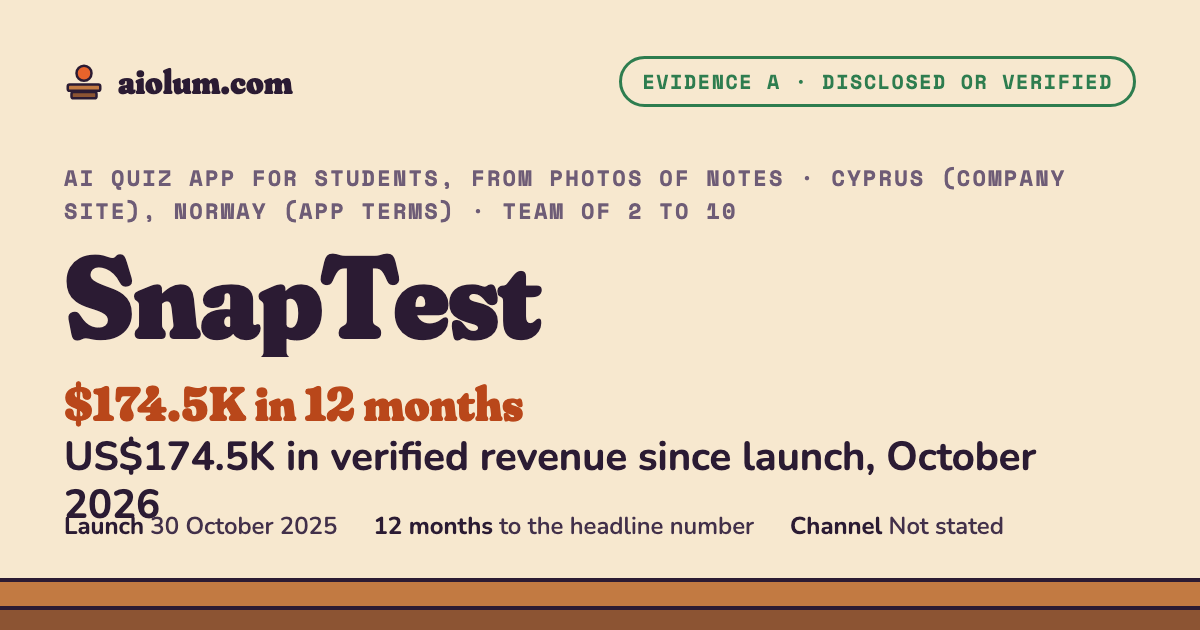
SnapTest is an iPhone and iPad app for students. The student takes a photo of handwritten notes or uploads a PDF, and the app turns that material into multiple-choice questions, served as short games with points, streaks and hints. The app's own terms describe it as "an app that helps you study with AI. You can take pictures of your notes, and the app will generate multiple-choice questions for you." The company does not name the model it uses. Reading handwriting from a photo and writing questions about it is the job of a multimodal model, a large language model that accepts images as well as text. The app is free to install with in-app purchases, payments made inside an iPhone app and collected by Apple: an Unlimited plan at US$4.99 a week or US$39.99 a year.
The App Store lists the seller as Cool App Company Ltd and the copyright holder as Emil Qvarfort, who is also the copyright holder of the seller's first app, Viral Score AI, from April 2025. On TrustMRR the founder appears only as "Emil". The seller has six apps in the store: a skincare scanner, a tanning timer, a room redesign app, a study timer, a social-media score app and SnapTest. Its website describes "a small studio in Limassol, Cyprus" with no open roles; the app's terms of October 2025 give a company address in Oslo, Norway. No source states how many people work there. Version 1.0 reached the App Store on 30 October 2025. TrustMRR, a service that reads revenue through the seller's own billing account, shows US$2,037 in December 2025, US$22,802 in January 2026, a best month of US$23,480 in March 2026, a fall to US$8,108 in August 2026, then US$22,835 in September 2026. By 23 October 2026 the total was US$174,534, with monthly recurring revenue (MRR, the monthly value of all active subscriptions) of US$16,988 from 1,470 subscriptions.
The revenue figures are grade A: TrustMRR reads them through an API key from RevenueCat, the subscription-management service that records the app's App Store purchases. The founder's name, the company's location and the team size come from App Store pages and the company's own websites, grade C, and they do not fully agree with each other. The page also shows earlier companies that sold gamified studying or photographed homework, and why they failed.
The numbers, graded
Each row shows the evidence grade and the source numbers from the list at the end of this page. The grades are explained in How Aiolum verifies.
| Fact | Value | Grade | How we know | Sources |
|---|---|---|---|---|
| Verified revenue, all time, to 23 October 2026 | US$174,534 | A | TrustMRR, read from the app's RevenueCat account through an API key, synced 23 October 2026 at 21:04 UTC. The last-12-months figure is the same, because the monthly table starts in December 2025. The profile does not say whether Apple's commission is already taken off. On 17 October 2026 the same profile showed US$170,501. | [1] |
| Best month | US$23,480 in March 2026 | A | TrustMRR monthly table. January 2026, the first full month after the December start, brought US$22,802; September 2026 brought US$22,835. | [1] |
| Revenue by month | Dec 2025 US$2,037; Jan 2026 US$22,802; Feb US$19,499; Mar US$23,480; Apr US$21,266; May US$16,417; Jun US$12,195; Jul US$9,270; Aug US$8,108; Sep US$22,835; Oct US$16,625 to 23 October | A | TrustMRR monthly table, synced 23 October 2026. The eleven months add up to exactly the all-time figure of US$174,534. | [1] |
| Fall and recovery | 64% down from January to August 2026, then 2.8 times up from August to September | calc | Calculated: (22,802 - 8,108) / 22,802 = 64.4%; 22,835 / 8,108 = 2.82. March to August was a fall of 65.5%. October's first 23 days, scaled to 31 days, would be about US$22,400. | [1] |
| Verified revenue, last 30 days to 23 October 2026 | US$23,207 | A | TrustMRR. Last 7 days: US$3,731. Last 3 months: US$49,063. Last 6 months: US$87,857. The profile gives a 30-day growth of 40.7% against the 30 days before. | [1] |
| Monthly recurring revenue (MRR), 23 October 2026 | US$16,988 from 1,470 active subscriptions | A | TrustMRR snapshot; 30-day MRR growth shown as 0.0%. On 17 October 2026 it was US$17,197 from 1,473 subscriptions. | [1] |
| Revenue per active subscription per month | about US$11.56 | calc | Calculated: 16,988 / 1,470. The yearly plan alone would give US$3.33 a month and the weekly plan US$21.62, so the subscribers are a mix of both. MRR times twelve is US$203,856 a year. | [1] |
| Where the revenue figures come from | RevenueCat, through an API key; merchant of record: no | A | TrustMRR's verification section. RevenueCat is a subscription-management service that records each App Store purchase; Apple is the merchant that charges the customer. No Google Analytics, DataFast or Search Console connection, so there are no verified traffic figures. | [1] |
| Prices | Unlimited Weekly US$4.99; Unlimited Yearly US$39.99 | C | The App Store page's in-app purchase list, read 17 October 2026, and the TrustMRR profile's pricing line. The App Store description says: "To get full access to the app, you need to purchase an auto-renewal subscription." | [2, 1] |
| Launch | version 1.0 on 30 October 2025 | C | The App Store version history, read 17 October 2026. The app's terms and privacy policy are dated 22 and 23 October 2025. TrustMRR gives a founding date of 5 November 2025. | [2, 7, 1] |
| Last app update shown | version 1.2.2 on 16 March 2026 | C | App Store version history, read 17 October 2026: nine versions from 30 October 2025 to 16 March 2026, and none after. The company's website says "SnapTest. The biggest update yet. August 2026." | [2, 4] |
| Ratings on the US App Store | 4 ratings, 3.3 out of 5 | C | Read 17 October 2026. One review of 10 September 2026: "literally had to pay to even use the app". One of 4 September 2026: "Good app to study". | [2] |
| Age rating and category | 4+, Education | C | App Store page. The company's own privacy policy of July 2026 says: "Our apps are not directed at children under 16". The app's terms say that minors need a parent's permission. | [2, 6, 7] |
| Seller and copyright holder | Cool App Company Ltd; copyright Emil Qvarfort | C | App Store page: "Seller Cool App Company Ltd" and "Copyright © 2026 Emil Qvarfort". The seller's first app, Viral Score AI, shows "Copyright © 2025 Emil Qvarfort"; its GlowApp shows the company as copyright holder. TrustMRR names the founder only as "Emil". | [2, 9, 10, 1] |
| Apps by the same seller | 6 | C | The App Store developer page, read 23 October 2026: Iglo: Study Timer, GlowApp: Skincare With AI, Tanned: AI Tanning & UV index, Decora - AI Home Design, SnapTest: AI Quiz & Study, Viral Score AI - Go Viral. | [3] |
| Company location | Limassol, Cyprus (company website, 2026); Oslo, Norway (app terms, October 2025) | C | The company website's terms, effective 14 July 2026: "Cool App Company Ltd, a company registered in Limassol, Cyprus". The app's terms, last updated 22 October 2025: "Coolappcompany ... a company registered in Norway… Oslo", with a Norwegian phone number. No company register entry was found; see the watch section. | [6, 7] |
| Not on the UK company register | no company named Cool App Company Ltd | B | A search of the Companies House register on 17 October 2026 for "cool app company" returned other companies only. The "Ltd" in the seller name is therefore not a UK registration. | [11] |
| Team | "a small studio"; 0 open roles | C | The company website: "We're a small studio that ships fast." The careers page: "A small studio in Limassol, Cyprus" and "0 open roles right now". No source gives a number of people. | [4, 5] |
| Outside funding | none disclosed | C | No source mentions investors. This is an absence of information, not a statement by the company. | [1, 4] |
| Technology | React Native, Convex, RevenueCat | C | The tech-stack section of the TrustMRR profile, which is written by the founder. Both websites are built with Next.js, visible in their page source (grade B). | [1, 4, 8] |
| Time from launch to the October 2026 figure | 12 months | calc | Calculated: 30 October 2025 to 23 October 2026 is 358 days. | [1, 2] |
How to read this table: a grade A value was read by TrustMRR from the app's RevenueCat account through an API key. A grade B value is a record that a public register or a page's source code shows. A grade C value is what the company or the App Store page states. A "calc" value was computed on this page from the rows above it.
| Plan | Per month, billed yearly (US$) | Per month, billed monthly (US$) | Limit |
|---|---|---|---|
| Free | 0 | 0 | install and onboarding; full access needs a subscription |
| Unlimited Weekly | 21.62 | US$4.99 a week, auto-renewing; monthly figure calculated | |
| Unlimited Yearly | 3.33 | US$39.99 a year, auto-renewing; monthly figure calculated |
The App Store page says that full access needs an auto-renewing subscription. There is no monthly plan. The weekly plan costs US$4.99 a week, which is US$21.62 a month and US$259.48 a year if kept for a year; the yearly plan costs US$39.99, 6.5 times less than a year of weekly payments. Version 1.1.1 of February 2026 added an onboarding with the words "try SnapTest for free". Apple collects the payments and keeps its commission; the TrustMRR profile does not say whether its figures are before or after that commission.
The timeline
From a first app in April 2025 to US$174,534 of verified revenue from the second one, in about twelve months after its launch. Each entry carries its grade.
- 8 April 2025CViral Score AI, the seller's first app, reaches the App Store at version 1.0, with Emil Qvarfort as copyright holder. [9]
- 22 and 23 October 2025CSnapTest's terms of use and privacy policy are published, naming Coolappcompany at an address in Oslo, Norway. [7]
- 30 October 2025CSnapTest version 1.0 in the App Store. Version 1.0.1 follows on 1 November. [2]
- 5 November 2025CFounding date given on the TrustMRR profile. [1]
- December 2025AFirst verified revenue: US$2,037. Updates on 12 and 16 December reduce the camera zoom and add analytics. [1, 2]
- January 2026AUS$22,802 in the first full month of the verified series, eleven times December. [1]
- 12 February 2026CVersion 1.1.1: "New onboarding experience - try SnapTest for free!" [2]
- March 2026ABest month, US$23,480. Version 1.2.2 on 16 March is the last update that the App Store shows by October 2026. [1, 2]
- April to August 2026ARevenue falls every month: US$21,266, US$16,417, US$12,195, US$9,270, US$8,108. [1]
- 14 July 2026CThe company website's terms and privacy policy take effect, now naming Cool App Company Ltd in Limassol, Cyprus, and announcing "SnapTest. The biggest update yet. August 2026." [4, 6]
- September 2026AUS$22,835, 2.8 times August. A review of 10 September complains of having to pay to use the app. [1, 2]
- 23 October 2026AUS$174,534 all time, US$16,625 in October so far, MRR of US$16,988 from 1,470 subscriptions. [1]
Why it worked
Four causes, in the order they mattered. Each one is a reusable lesson.
The photo is the whole input
The student does not type, upload a course or pick a topic. A photo of handwritten notes, or a PDF, is enough, and the model writes the questions. That is the step that was impossible before models could read handwriting, and it is why a one-screen app can replace the flashcard decks that students used to write by hand.
Study as a game
The company's page shows the app's screens: a question with four answers, a hint that costs a key, streak counters, points for each correct answer and a "Level up every day" promise. The app sells the habit, not the content, and the content is generated for each student.
A weekly price behind a paywall
US$4.99 a week is US$21.62 a month, a high price for a student app, but a small amount at the moment of paying before a test. The yearly plan is 6.5 times cheaper per week. The App Store description says that full access needs a subscription, and a reviewer wrote that the app could not be used without paying. The verified revenue per active subscription, about US$11.56 a month, shows that many subscribers pay the weekly price.
One studio, six apps
The seller published six apps between April 2025 and 2026, each with the same billing stack and the same template legal pages. The company's website also describes "Heimdall", which it calls a "creator intelligence engine" that writes the next marketing brief from the results of earlier posts. No source says which channel brought SnapTest's customers, so this page leaves the channel unknown.
How it was built
The stack comes from the founder-written part of the TrustMRR profile and from the page source of the two websites. Nothing here was confirmed by the makers of the tools. [1, 8, 4, 2]
- React Native, a framework for building iPhone and Android apps in JavaScript, for the app. Only an iOS version is published.
- Convex, a hosted backend that stores data and runs server functions, listed as the backend.
- RevenueCat for subscriptions: it records every App Store purchase, and TrustMRR reads the revenue from it through an API key.
- Apple's in-app purchases collect the money; Apple is the merchant of record, so the company never holds card details.
- Both websites, snaptestapp.com and coolappcompany.com, are Next.js sites; the company site loads its typeface from Fontshare.
- The App Store privacy labels say the app may use identifiers and usage data to track the user across other companies' apps, and that photos and names are collected but not linked to the user.
Tools named in the sources
Each one opens its page in the Tools tab, with every story that uses it.
The dead that came before
Four companies in the Loot Drop database sold gamified studying or photographed homework before a model could read a student's own notes. The values below are from that database and are not independently verified.
Grockit
The promiseGamified, social test preparation for the SAT, ACT and GMAT, with points and peer competition.
Why it diedThe database summary says the social and game features stopped being special as free and cheap study resources spread; Kaplan bought it and the product faded.
QuizUp
The promiseReal-time quiz battles on any topic, with a global audience.
Why it diedThe database summary says the first viral wave did not turn into retention or revenue, because content and features did not keep evolving.
Airy Labs
The promiseLearning games for children built on spaced repetition, adaptive difficulty and instant feedback.
Why it diedThe database summary says that the cost of building hand-made educational games met the economics of free apps, and parents could not see the difference from free alternatives.
Xuebajun
The promisePhotograph a homework problem and get an instant answer with steps, built on optical character recognition and a database of solved problems.
Why it diedThe database summary says the free homework app earned little, so the company pivoted to expensive live tutoring, and China then banned for-profit tutoring in 2021.
What changed
Xuebajun built photographed-homework help in 2013 with optical character recognition, which reads printed characters, and a database of already-solved problems. It needed a large team to collect answers, and it could only match questions that someone had solved before. Grockit and QuizUp needed people to write every question and every game level, and that cost is why a study game with US$44 million of funding could not stay ahead of free alternatives.
A multimodal model reads a student's own handwriting and writes new questions about it, so there is no database to build and no question writers to pay. The model cost is paid per use, and Apple collects the money. That is how a studio that calls itself small could publish six apps in eighteen months and take US$174,534 from this one in a year. The same ease means that the App Store's own suggestions on SnapTest's page list six other AI quiz and study apps.
Can one person copy it now?
The product, yes. The revenue, not guaranteed.
A photo-to-quiz app is a weekend of work with React Native, a hosted backend and a multimodal model, and the App Store page shows that many people have built one. SnapTest's verified revenue shows that one such app can take more than US$20,000 in a month, and also that it can lose two thirds of that in five months. The reason for both the rise and the recovery is not public.
Where it is still open: A version for one exam system or one country, with questions in that language and in the form that the real exam uses, is still open. So is a version that lets a teacher or a parent see what was studied; SnapTest is a single-student app.
- 1Build the smallest possible input: a photo or a PDF, then questions. Do not ask the student to type or organize anything.
- 2Charge from the first screen, with a weekly plan for the week before a test and a yearly plan priced at about eight weeks of the weekly plan.
- 3Use a subscription service such as RevenueCat from the first day; it also makes verified revenue possible later.
- 4Reuse the shell, the billing and the legal pages for the next app, so that each new app is cheap to try.
What to watch
The risks are the mirror image of the causes above.
A revenue curve that moves by two thirds
Verified revenue fell from US$23,480 in March 2026 to US$8,108 in August, then rose to US$22,835 in September. Students study less in summer, and the recovery matches the start of the school year, but no source confirms the cause. MRR growth over the last 30 days to 23 October 2026 is shown as 0.0%.
Who owns it and where
The App Store names Cool App Company Ltd as seller and Emil Qvarfort as copyright holder. The app's terms of October 2025 place the company in Oslo, Norway; the company website of July 2026 places it in Limassol, Cyprus. The UK register has no company of that name, and no Norwegian or Cypriot register entry could be read for this page. The headcount is not published anywhere.
Weekly pricing and the paywall
US$4.99 a week is US$259 a year if a student forgets to cancel. The App Store page has four ratings, 3.3 out of 5, and one of two written reviews says the app could not be used without paying. Apple's refund and cancellation rules protect the customer, and a refund wave would show in the RevenueCat figures.
Age rating against the company's own policy
The app is rated 4+ on the App Store, while the company's privacy policy says its apps are not directed at children under 16 and the app's terms say minors need a parent's permission. The App Store privacy labels also declare tracking across other companies' apps.
No update since March 2026
The App Store version history shows nine versions between 30 October 2025 and 16 March 2026 and none after, as read on 17 October 2026, while the company's website announced "the biggest update yet" for August 2026. Either the update was late or the store page had not caught up.
A crowded shelf
Apple's own suggestions on SnapTest's page list six other AI quiz and study apps, plus a flashcard timer. The input, a photo of notes, is the same for all of them, and the model is rented by all of them. Price, the game loop and marketing are the only differences.
Sources
The grade next to each source is the best grade that the source can support. "Read in full" means that the text of the page was downloaded and the numbers were checked in it.
- A TrustMRR profile of SnapTest, as read on 23 October 2026Read the markdown profile in full, live on 23 October 2026 and again against a copy from 17 October 2026. Revenue, MRR and subscription counts are read from RevenueCat through an API key and are grade A. The description, founder name "Emil", founding date, pricing line and tech stack are written by the founder, grade C.
- C App Store page: SnapTest: AI Quiz & Study, US storefrontRead in full on 17 October 2026. Source for the description, the in-app purchase prices, the version history, the ratings and reviews, the age rating, the seller name, the copyright holder and the privacy labels.
- C App Store developer page: Cool App CompanyRead in full on 23 October 2026. Lists the seller's six apps.
- C Cool App Company website, home pageRead in full on 17 October 2026. Source for the "small studio" statement, the SnapTest screens and wording, the Heimdall description and the August 2026 update announcement. The page source shows a Next.js build.
- C Cool App Company website, careers pageRead in full on 17 October 2026. States "A small studio in Limassol, Cyprus" and "0 open roles right now".
- C Cool App Company website, terms of use and privacy policy, effective 14 July 2026Read both pages in full on 17 October 2026. Source for the Limassol, Cyprus registration statement, the Cyprus governing law and the under-16 statement.
- C SnapTest terms of use, last updated 22 October 2025, and privacy policy, 23 October 2025Read both pages in full on 17 October 2026. Source for the product description in the company's words, the Oslo, Norway address and phone number, and the minors clause.
- C SnapTest website, home pageRead in full on 17 October 2026. Three feature lines and a "Get better grades by playing games" headline; no pricing page. The page source shows a Next.js build.
- C App Store page: Viral Score AI - Go Viral, by the same sellerRead the information section on 23 October 2026. Version 1.0 on 8 April 2025, seller Cool App Company Ltd, copyright Emil Qvarfort.
- C App Store page: GlowApp: Skincare With AI, by the same sellerRead the information section on 23 October 2026. Copyright Cool App Company Ltd, age rating 13+.
- B Companies House, UK register: company search for "cool app company"Read the first results page on 17 October 2026. No company named Cool App Company Ltd; the matches are unrelated companies.
- C Loot Drop database export, 1,749 failed startupsLocal export. AI-written summaries, not independently verified. Source for the failed predecessors.