Klipy
What is not verified
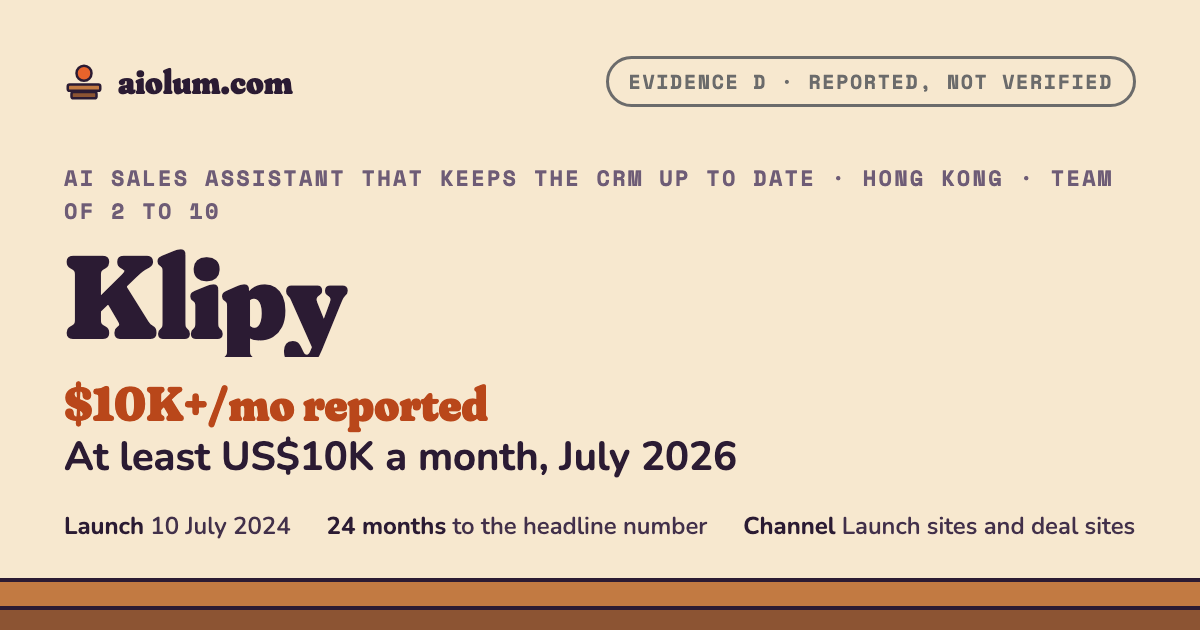
The headline figure, at least US$10,000 a month in July 2026, rests on one source: the founder's statement in his Indie Hackers interview of 15 July 2026, read here only in the Japanese newsletter Masa, Lagless Portal, issue 85, of 18 July 2026, which says the values are self-reported. The exact amount was not given; five figures means anything from US$10,000 to US$99,999 a month. No payment-processor profile, press report or second interview confirms it, and the US$1.5 million annual target is a goal, not a result. A reader could look for a TrustMRR or Stripe-verified profile, a second dated founder statement, or a filing after the June 2026 investment. The headline number is grade D: one claim or one estimate, with no second source. Aiolum shows it because the story is useful, and marks it so that it is not mistaken for a verified figure.
Klipy is an AI sales assistant for small business-to-business firms. It reads the owner's mailboxes, calendars and messaging accounts, joins video calls as a notetaker (a bot that records and transcribes a meeting), and writes every contact, company, deal and conversation into its own CRM, a customer relationship management database where a sales team keeps the record of each prospect. From those records it drafts the next follow-up email, a pre-meeting brief and a daily list of next moves. The user approves or rejects each draft. The company says that nothing is sent without that approval, and that a rejected draft costs nothing.
Jung-Hong Kim, a Korean engineer who had built and sold machine-vision retail-analytics companies in Hong Kong, released the first version on Product Hunt on 10 July 2024 and on Hacker News a week later, saying he had built it for his own fractional-executive business after getting tired of updating HubSpot. He founded the company in August 2024 with two co-founders, Tina Law and Joey Lee, in Hong Kong. A Japanese newsletter that summarized his Indie Hackers interview of 15 July 2026 reported that he said recurring revenue was in the five-figure range per month, that is at least US$10,000 a month, that about 4,000 companies used the product, and that the stated goal was US$1.5 million of annual recurring revenue by the end of 2026. The company's own pages count 4,300 customers in 64 countries in October 2026.
The money figure is grade D: one founder statement, on one date, read in a newsletter's summary rather than in the interview itself, with no payment-processor profile and no second figure to compare it with. Everything else on this page comes from the company's own pages, the AppSumo listing, Product Hunt, Hacker News and a 2024 archive of the first website, all grade C. The team is three co-founders. The company joined accelerator programs and took a first outside investment from SparkLabs Taiwan in June 2026, of an amount it has not disclosed.
The numbers, graded
Each row shows the evidence grade and the source numbers from the list at the end of this page. The grades are explained in How Aiolum verifies.
| Fact | Value | Grade | How we know | Sources |
|---|---|---|---|---|
| Monthly recurring revenue, July 2026 | five figures, that is at least US$10,000 a month | D | The founder's statement in his Indie Hackers interview of 15 July 2026, as quoted by the newsletter Masa, Lagless Portal, issue 85, on 18 July 2026. The newsletter says the values are self-reported. The interview itself was not read. | [1] |
| Minimum annual run rate from that figure | US$120,000 a year | calc | Calculated: US$10,000 times 12. The true figure can be anything from this up to just under US$1.2 million a year. | [1] |
| Stated goal for the end of 2026 | US$1.5 million in annual recurring revenue | D | A target the founder gave in the July 2026 interview, as quoted by the newsletter. Not a result. | [1] |
| Companies using the product, July 2026 | about 4,000 | D | Founder statement quoted by the newsletter. The company's own pages count 4,300 customers in October 2026. | [1, 2] |
| Customers and countries, October 2026 | 4,300 customers in 64 countries | C | The company's about and press pages. The customers page gives 2,300 sellers in 53 countries, apparently an older count that was not updated. | [2, 3, 11] |
| Emails processed per month | 2.3 million | C | Press page, October 2026. The company timeline says 2 million in January 2026. | [2, 3] |
| Team | 3 co-founders | C | Company pages name Jung-Hong Kim (CEO and engineer), Tina Law (COO) and Joey Lee (CPO) and say there are no other staff. The newsletter's summary of the interview says Kim runs it with 3 full-time co-founders, one more than the company's count. | [1, 2, 3] |
| Outside funding | accelerator programs; a first investment from SparkLabs Taiwan in June 2026, amount not disclosed | C | Company timeline. Programs listed: AppWorks #31 (September 2025), UBS Project Female Founder (March 2026), SparkLabs Taiwan #11, and an Industrial Bank of Korea program with 500 Global. | [2, 3] |
| AppSumo lifetime deal | US$59 one-time for the first tier, listed against US$320, 2 December 2024 to 9 February 2025 | C | The AppSumo listing. Three tiers, the third at US$339. The listing shows 19 reviews. The founder said in the interview that the deal was meant to lose money and recruit about 100 lifetime testers. | [6, 1] |
| Time to the first version | 3 months, coded by the founder | D | Founder statement quoted by the newsletter. | [1] |
| Public launches | Product Hunt on 10 July 2024, 21 August 2024 and 15 March 2026; Hacker News on 17 July 2024 | C | Product Hunt product page and the Hacker News archive. The company's own timeline dates the first shipped product to November 2024. | [7, 8, 2] |
| Time from the first launch to the revenue figure | 24 months | calc | Calculated: July 2024 to July 2026. From the company's own November 2024 date it is 20 months. | [1, 7] |
How to read this table: a grade D value is a single founder statement quoted by one newsletter, with no second source. A grade C value is a company statement on its own pages or a marketplace listing. A "calc" value was computed on this page from the rows above it. No value is grade A or B.
| Plan | Per month, billed yearly (US$) | Per month, billed monthly (US$) | Limit |
|---|---|---|---|
| Free | 0 | 200 tokens a month, 2 inboxes, 1 seat, 1 pipeline | |
| Starter | not offered | 39 per seat | 400 tokens per seat, up to 5 seats, unlimited inboxes |
| Growth | not offered | 89 per seat | 1,500 tokens per seat, unlimited seats, HubSpot and Attio sync |
| Professional | not offered | 149 per seat | 4,000 tokens per seat, Salesforce sync, audit logs, success manager |
| Extra tokens | 0.10 per token | pay as you go, with a monthly cap set by the user |
Every plan, the free one included, has all AI features. Paid plans add seats, exports, roles and support. Usage is metered in tokens: a draft costs 2 tokens, a meeting recording 10 tokens an hour, and a token is spent only when the user approves an action. Extra tokens cost US$0.10 each, up to a monthly cap the user sets. Prices are per seat per month.
The timeline
From a tool the founder wrote for his own consulting business to a three-founder company that reported five-figure monthly revenue, in 24 months. Each entry carries its grade.
- Before 2024CKim builds and sells machine-vision retail-analytics companies in Hong Kong as their technical lead. A later retail business collapses during COVID and leaves him in debt, which he repays over six years of consulting. [3, 1]
- 10 July 2024CFirst Product Hunt launch: "Klipy AI powered CRM, from hello to renewal". [7]
- 17 July 2024CShow HN. The founder writes that he built it for his own fractional CIO business because he kept forgetting to update HubSpot, and that other fractional executives and founders were already using it. [8]
- August 2024CThe company is founded by three co-founders. A second Product Hunt launch, Mailroom by Klipy, on 21 August. [2, 7]
- 1 October 2024CThe website useklipy.com presents "an actual simple CRM" that fills itself from email, free to start, aimed at founders, fractional executives and agencies. [9]
- 29 October 2024CThe founder's first post on AppSumo. The lifetime deal runs from 2 December 2024 to 9 February 2025 at US$59 for the first tier. [6]
- November 2024 to January 2025CThe company's own timeline: first product ships in November, first paying customer in December, 100 paying customers in January. [2]
- 30 May 2025CLinkedIn inbox integration: direct messages are read and answered inside the product. [10]
- June 2025CThe product moves from logging to the work after the call: follow-ups and next moves. Multi-pipeline support ships on 9 June. [2, 10]
- 25 July 2025CMeeting recording moves to Recall.ai. [10]
- August to September 2025C2,000 users. The company joins AppWorks batch #31 in Taiwan. [2]
- December 2025 to February 2026CHey Klipy v2, an agent with 27 skills, in beta on 27 December; generally available on 26 February 2026 running on Gemini and Claude. [10]
- January 2026CMore than 2 million emails processed a month. [2]
- March to June 2026CUBS Project Female Founder in March; third Product Hunt launch on 15 March; incorporation in Delaware in May; first outside investment from SparkLabs Taiwan in June, amount not disclosed. [2, 7]
- 15 July 2026DIndie Hackers interview. The founder reports five-figure monthly recurring revenue, about 4,000 companies, and a goal of US$1.5 million in annual recurring revenue by the end of the year, as quoted by a newsletter three days later. [1]
- 16 July 2026CMCP server for Claude and ChatGPT, with 38 tools; on 18 September it is listed in the Claude connector directory. [10]
- October 2026C4,300 customers in 64 countries, 2.3 million emails a month, headquarters moving to Seoul. [2, 3]
Why it worked
Four causes, in the order they mattered. Each one is a reusable lesson.
Charge from the first day
The founder said in the July 2026 interview, as quoted by the newsletter, that he did not want feedback from people unwilling to pay, because such feedback is mostly nice-to-have features. Pricing existed from the first launch.
Lifetime deals as a hiring budget for testers
He said that a lifetime deal cannot be profitable with the gross margin of a product built on large language models, and that he sold one anyway. The goal was about 100 core users who never cancel, keep giving feedback and bring referrals. The AppSumo deal of December 2024 sold the first tier at US$59 against a list price of US$320, as the listing shows.
Launch-site members become affiliates
The members of the launch sites, freelancers and small agencies, were turned into affiliates, so the people who bought the deal became the next sellers. Each launch site got its own offer, prepared by studying the previous month's top launches on Product Hunt, Microlaunch, Reddit and AppSumo.
Usage pricing on approved actions
Every plan has every AI feature. The company says a user pays a token only when a draft, a recording or a research lookup is approved, and that a rejected draft is free. Paid plans sell seats, exports and support rather than AI features, so the cost of the model is tied to approved work.
How it was built
These details come from the newsletter's summary of the founder's interview, the company's changelog and press page, and the Hacker News thread. They are grade C or D. [1, 8, 9, 10, 3]
- The founder wrote the first version himself in three months, for his own consulting business, before any co-founder joined. The first public product read a mailbox and created contacts and deals from it.
- Meeting recording was moved to Recall.ai in July 2025. Transcription covers 99 languages since September 2025.
- The agent, Hey Klipy v2, runs on Gemini and Claude since February 2026, with web search through Exa. Company data comes from a waterfall of People Data Labs, Clearbit and Apollo since March 2026.
- An MCP server since July 2026 lets Claude and ChatGPT read and write the CRM; it is listed in the Claude connector directory since September 2026. The founder called this a headless CRM: a data layer for agent ecosystems rather than an app with a screen.
- Google Cloud for Startups is listed as the technology partner. The product is CASA Tier 2 certified; SOC 2 Type II, ISO 27001 and HIPAA were in progress in October 2026.
- Growth followed a nine-step order the founder gave in the interview: ad pixels and event tracking first, a LinkedIn Ads audience, building in public, testimonials collected by every means, explanation videos on YouTube so that AI assistants find the product, support articles written for search and AI answers, direct messages to competitors' followers, and paid ads last.
Tools named in the sources
Each one opens its page in the Tools tab, with every story that uses it.
The dead that came before
Five companies in the Loot Drop database promised to fill a sales team's records or to find its contacts automatically. The values below are from that database and are not independently verified.
Brisk
The promisePull a salesperson's CRM, email, calendar and web data into one place and turn it into next actions.
Why it diedEvery customer needed custom work. The tailoring consumed the team, the platform never became standard, and no further funding came.
Xobni
The promiseContacts and conversation history built automatically from the inbox, inside Microsoft Outlook.
Why it diedTied to Outlook, which Microsoft improved itself. Mobile made the desktop add-on irrelevant. Yahoo bought the remains.
Elucify
The promiseAccurate, real-time contact data for sales teams from a crowdsourced database.
Why it diedZoomInfo and Clearbit already had the market. Crowdsourced data was hard to keep fresh, and users would not pay for data they did not trust.
Slik
The promiseSales intelligence on demand: aggregated data turned into actions for sales teams.
Why it diedLinkedIn Sales Navigator and ZoomInfo had more data and a bigger brand. Data went stale, customers churned, and the next round never came.
Mattermark
The promiseGrowth signals and funding data on private companies for investors and sales teams.
Why it diedCB Insights and PitchBook had deeper data. Data operations cost more than revenue grew, and the market of investors and large sales teams was small.
What changed
Four of the five sold data or analytics about prospects, and lost to incumbents with bigger databases: once a buyer compares contact data, the largest database wins, and the challenger's data goes stale first. Brisk and Xobni are closer to Klipy: both read a salesperson's own email and calendar and built the record from it. Brisk died of custom work per customer; Xobni died with the desktop add-on it depended on.
Klipy differs in three ways that the sources show. The record is built from the user's own conversations, so the valuable data is the customer's, not a database the company must keep fresh; the enrichment it adds comes from other vendors' data over a waterfall, which the company does not need to own. A large language model drafts the follow-up from the record, work that in 2012 needed a human, and the company charges per approved action, so the model cost is paid by the user who gets the result. And the product has run as a three-person company on accelerator money, where Brisk and Mattermark carried teams funded by venture rounds.
What has not changed is the competition. Attio, folk, HubSpot and Pipedrive all sell AI features for the same owner-seller, and the pricing page lists them as alternatives. The revenue figure is a single founder statement; the predecessors' lesson is that a crowded sales-tool market punishes the product that cannot show a difference.
Can one person copy it now?
The structure, yes. The revenue, not yet shown.
A CRM that fills itself from the owner's mailbox is a product one engineer can build in months, as this founder said he did, and charging from day one plus a loss-making lifetime deal to recruit permanent testers is a method any founder can repeat. What a reader cannot confirm is the result: the founder reported a five-figure monthly revenue in July 2026, and no second source shows it.
Where it is still open: Any back-office job that an owner-operator postpones because it is typing: bookkeeping from receipts, proposal drafting from calls, project status from chat. The same approval-gated agent with per-action pricing fits each of them.
- 1Build the tool for your own sales work first, and charge from the first launch so that feedback comes from payers.
- 2Sell a lifetime deal on a launch site as a tester-recruiting cost, not as revenue, and set the tier limits so that the loss is bounded.
- 3Turn the launch site's buyers into affiliates, and prepare a separate offer for each launch site after studying its recent winners.
- 4Price usage by approved action, so that model cost is paid only for work the customer accepted.
- 5Expose the data through an API and an MCP server, so that AI assistants can act as a second interface to the product.
What to watch
The risks are the mirror image of the causes above.
What is not verified
The headline figure, at least US$10,000 a month in July 2026, rests on one source: the founder's statement in his Indie Hackers interview of 15 July 2026, read here only in the Japanese newsletter Masa, Lagless Portal, issue 85, of 18 July 2026, which says the values are self-reported. The exact amount was not given; five figures means anything from US$10,000 to US$99,999 a month. No payment-processor profile, press report or second interview confirms it, and the US$1.5 million annual target is a goal, not a result. A reader could look for a TrustMRR or Stripe-verified profile, a second dated founder statement, or a filing after the June 2026 investment.
Funded, with the amount unknown
The company says SparkLabs Taiwan made its first outside investment in June 2026 and lists AppWorks, 500 Global, Industrial Bank of Korea and UBS as backers or programs. No amount is disclosed. If the round was large, the company may hire past the small-team size that this site covers; in October 2026 it still said it had three founders and no staff.
Two launch dates
Product Hunt and Hacker News show a public product in July 2024, and AppSumo sold lifetime deals from December 2024, but the company's own timeline dates the first shipped product to November 2024 and the first paying customer to December 2024. This page uses the July 2024 launch; from the company's date the time to the revenue figure is 20 months, not 24.
A crowded market with usage pricing
The pricing page itself lists HubSpot, Pipedrive, Attio, folk and Close as alternatives, and all of them sell AI features. Klipy's plans include every AI feature free and meter usage in tokens, so revenue depends on approved actions per seat, a figure that no source gives.
Features at the edge of outreach
The product finds a contact's work email and phone through third-party data vendors, reads and answers LinkedIn direct messages, and the founder's growth steps include messaging competitors' followers directly. The company says every message waits for the user's approval unless the user switches on automatic sending per channel. None of the plans sells bulk sending, inbox rotation or automated LinkedIn actions.
Sources
The grade next to each source is the best grade that the source can support. "Read in full" means that the text of the page was downloaded and the numbers were checked in it.
- D Masa, Lagless Portal, issue 85, 18 July 2026: Lifetime deals may run at a loss, the contrarian launch method of an AI CRM that reached five-digit MRR by hiring lifetime testers (in Japanese)Read in full. A newsletter summary of the founder's Indie Hackers interview of 15 July 2026, which this site may not fetch. Source for the five-figure monthly revenue, the 4,000 companies, the US$1.5 million target, the debt story, the three-month build, the lifetime-deal reasoning, the affiliate method and the nine growth steps. The newsletter marks these as self-reported public values.
- C Klipy: About Klipy, our story, team, and backersRead in full. Company timeline from August 2024 to October 2026, the three founders, backers and programs, customer and country counts.
- C Klipy: Press page, key factsRead in full. Legal entity, founders' backgrounds, investors, programs, technology partner, 4,300 customers, 2.3 million emails a month.
- C Klipy pricing page, read 23 October 2026Read in full. Plans, token prices, the statement that annual billing is not available, and the list of alternatives.
- C Klipy home page, read 23 October 2026Read in full. Product description, connected channels, integrations with Pipedrive, Attio, HubSpot and Notion, MCP server for Claude and ChatGPT, footer entity.
- C AppSumo: Klipy, fully automated CRM for small businessesRead in full. Lifetime-deal tiers and limits, deal dates in the page data, the US$59 and US$339 prices, 19 reviews, and the founder's post of 29 October 2024.
- C Product Hunt: Klipy AI product page with its three launchesRead in full. Launch dates of 10 July 2024, 21 August 2024 and 15 March 2026, 6 reviews, 347 followers.
- C Hacker News, 17 July 2024: Show HN: Klipy, all in one AI CRM for small and growing businesses (Algolia API record)Read in full through the Algolia API. The founder's comment on building it for his fractional CIO business and on the first users.
- C Wayback Machine snapshot of useklipy.com, 1 October 2024Read in full. The early product: a CRM that fills itself from email, free to start, for founders, fractional executives and agencies.
- C Klipy changelog: every release since 2024Read the dated entries from May 2025 to September 2026. Source for Recall.ai, Gemini and Claude, Exa, the enrichment vendors, the LinkedIn inbox, WhatsApp and the MCP server.
- C Klipy customers pageRead in full. Testimonials from named customers and the older counts of 2,300 sellers and 53 countries.
- C Loot Drop database export, 1,749 failed startupsLocal export. AI-written summaries, not independently verified. Source for the failed predecessors.