Setter AI
Setter AI is an AI appointment setter, a program that does the job of a human appointment setter: it contacts each new sales lead, asks a few questions and books a sales call for the business. A lead here is a person who filled in a form to ask for information, for example a Facebook lead ad, an ad with a form built into it. About 10 seconds after the form arrives, Setter AI writes to the person on WhatsApp, answers questions about the business and books a time in the business's Calendly or Google Calendar. A chat window on the business's website does the same for visitors. The company's FAQ says that WhatsApp and text messages are for following up "with leads that have submitted a form", so the AI writes to people who asked to be contacted.
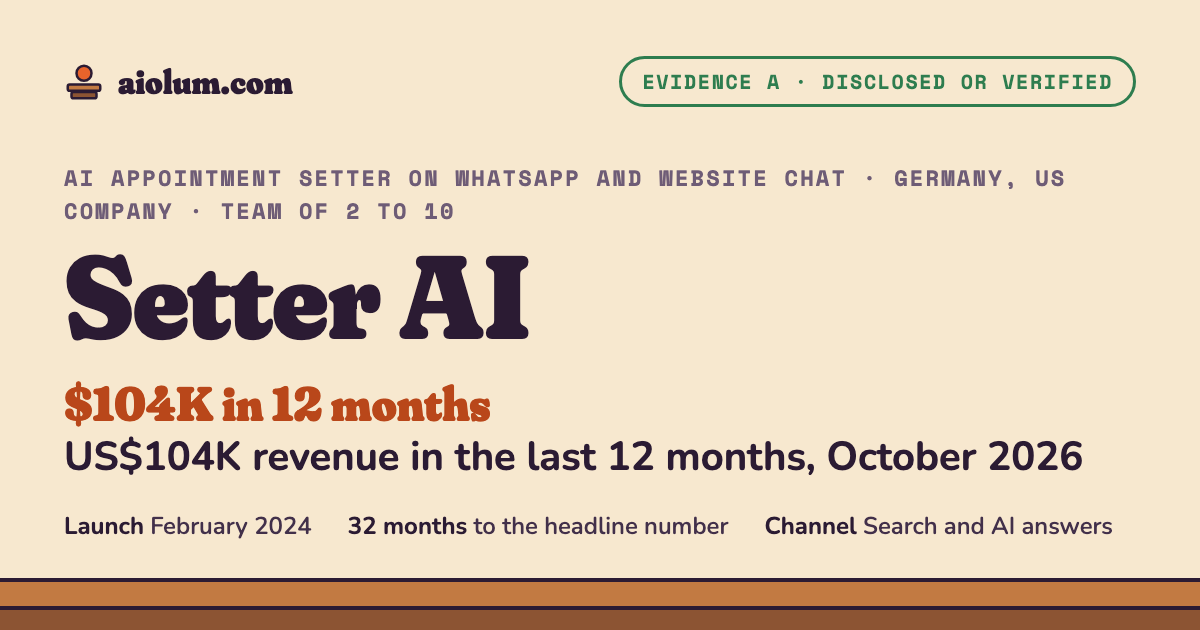
Josef Büttgen, a German software developer who had spent two years in Southeast Asia, started it with a co-founder in February 2024, three months into a "12 startups in 12 months" challenge that he began when his savings were running out. Product Hunt names Timo Nikolai as the second maker. The first version phoned each lead with an AI voice. By November 2024 it worked on WhatsApp, and in mid-2025 it added the website chat, launched on Product Hunt on 30 July 2025. On 29 July 2025 Büttgen told Indie Hackers that it made US$10,000 in monthly recurring revenue (MRR), the subscription revenue that repeats every month. TrustMRR, a site that reads a startup's revenue directly from its payment processor, shows US$211,323 in total revenue from Stripe and US$104,336 in the 12 months to 15 October 2026. It also shows a fall: US$12,447 in November 2025, US$1,796 in September 2026, and an MRR of US$1,528 from 14 subscriptions in October 2026.
The headline number is grade A, because TrustMRR reads it from the company's Stripe account through an API key. The July 2025 figure and most details of how the product was built are the founders' own statements, grade C. The page also explains the rules that apply when software sends automated messages to leads on WhatsApp, by text message in the US and to people in the EU, and it shows five failed startups that sold automated sales conversations before large language models existed.
The numbers, graded
Each row shows the evidence grade and the source numbers from the list at the end of this page. The grades are explained in How Aiolum verifies.
| Fact | Value | Grade | How we know | Sources |
|---|---|---|---|---|
| Verified revenue in the 12 months to 15 October 2026 | US$104,336 | A | TrustMRR, read from Stripe through an API key, last synced 15 October 2026. | [1] |
| Verified revenue since the start | US$211,323 | A | Same source, all Stripe payments up to 15 October 2026. | [1] |
| Revenue before the last 12 months | US$106,987 | calc | Calculated: US$211,323 minus US$104,336. This covers February 2024 to mid-October 2025. | [1] |
| Verified revenue per month, November 2025 to January 2026 | US$12,447, US$9,371 and US$8,914 | A | TrustMRR monthly timeline from Stripe. These months are of the same size as the US$10,000 MRR reported in July 2025. | [1] |
| Best month in the verified timeline | US$19,761 in May 2026 | A | TrustMRR monthly timeline. The sources do not say what made this month higher. | [1] |
| Verified revenue per month, August and September 2026 | US$2,894 and US$1,796 | A | TrustMRR monthly timeline. | [1] |
| Monthly recurring revenue, 15 October 2026 | US$1,528 from 14 active subscriptions | A | TrustMRR metric snapshot from Stripe. MRR fell 1.2% in the last 30 days. | [1] |
| Average MRR per active subscription | about US$109 a month | calc | Calculated: US$1,528 divided by 14. The cheapest plan on today's pricing page costs US$397 a month, so at most 3 of the 14 subscriptions can be on a listed plan; the rest pay less than any plan the page shows. | [1, 4] |
| Fall from November 2025 to September 2026 | 86% less revenue in the month | calc | Calculated: US$1,796 against US$12,447. September 2026 is also 91% below the best month, May 2026. | [1] |
| Monthly recurring revenue, July 2025 | US$10,000 | C | Founder interview on Indie Hackers, 29 July 2025: "Revenue $10K a month", reached "a little over a year" after he found the idea. | [2] |
| MRR in October 2026 compared with July 2025 | 85% lower | calc | Calculated: US$1,528 against US$10,000. | [1, 2] |
| Profit margin in the last 30 days | 90% | C | TrustMRR snapshot. The profile does not say where the cost figures come from. | [1] |
| Website visitors in the last 30 days | 2,594, or US$0.69 of revenue per visitor | A | TrustMRR reads traffic from Google Analytics through its API. Google Search Console is also connected. | [1] |
| Leads turned into meetings in the June 2024 case study | 215 meetings from 4,197 leads, 5.12% | C | Company blog post by Büttgen: two weeks of Facebook lead ads for a real estate project in Indonesia, with 7,989 AI phone calls including follow-ups. Calculated check: 215 divided by 4,197 is 5.12%. | [13] |
| Booking rate claimed today | 15% to 52% of leads | C | Homepage claim. No customer data is shown with it. | [3] |
| Price of the smallest plan today | US$497 a month, or US$397 a month billed yearly | C | Pricing page, 15 October 2026. The page does not define a credit; the FAQ says that pricing is per lead. | [4, 3] |
| Price list in May 2025 | free for 10 leads, then US$49, US$199 and US$499 a month for 50, 250 and 750 leads | C | The company's blog post that compares it with CloseBot. | [16] |
| Team | 2 founders | C | Büttgen writes of "my Co-Founder". Product Hunt names Josef Büttgen and Timo Nikolai as the makers, and Nikolai wrote of the company as "us" six weeks after the start. No staff count is published. | [2, 7, 8] |
| Outside funding | none found | C | Büttgen wrote in May 2024 that he was waiting for a reply from Y Combinator; YC's company directory has no page for Setter AI. In May 2026 he wrote that Stripe had mentioned him in a session on "the rise of bootstrapped businesses and solopreneurs". | [11, 21, 20] |
| Operating company | Setter AI LLC, United States | C | Named in the site footer and the terms; TrustMRR lists the country as US. The sitemap and footer show no German Impressum page, and a North Data search finds no German company named Setter AI. | [3, 5, 1, 23, 22] |
| Product Hunt launches | 5th product of the day on 9 January 2025, 8th on 30 July 2025 | C | Product Hunt page data. | [7] |
| Time from the start to the headline figure | 32 months | calc | Calculated: February 2024 to October 2026. Nikolai's post of 15 March 2024, "6 weeks in", points to 2 February 2024, the founded date on TrustMRR. | [1, 8] |
How to read this table: a grade A value comes from TrustMRR, which reads it from the company's Stripe account or its Google Analytics through an API. A grade C value is a statement by the founders, the company's own pages or a third party. A "calc" value was computed on this page from the rows above it.
| Plan | Per month, billed yearly (US$) | Per month, billed monthly (US$) | Limit |
|---|---|---|---|
| 500 credits a month | 397 | 497 | 1,000 credits during the offer; onboarding support, email support |
| 2,500 credits a month | 1,997 | 2,297 | 5,000 credits during the offer; onboarding done for you, email and Zoom support |
| 5,000 credits a month | 2,997 | 3,497 | 10,000 credits during the offer; custom integrations, 24/7 email and Zoom support |
The page lists three plans by number of credits, without plan names, and shows each credit amount doubled, marked "For Limited Period" on the monthly plans. It does not define a credit; the FAQ says that pricing is per lead and gets cheaper as the number of leads grows. All plans include unlimited messages and unlimited agents. Yearly billing is 13% to 20% cheaper than monthly billing. In May 2025 the company's blog listed much lower prices: free for 10 leads, then US$49, US$199 and US$499 a month for 50, 250 and 750 leads.
The timeline
From an AI that phoned new leads in 2024 to a WhatsApp and website booking agent, then a fall in revenue, in 32 months. Each entry carries its grade.
- Before 2024CBüttgen, who taught himself to code at 13, studies computer science, works as a freelancer to save money, and travels Southeast Asia for two years. A product that he built for almost a year, CourseStart, gets little traction. [2]
- 2 February 2024CThree months into a "12 startups in 12 months" challenge, begun when his savings ran low, Büttgen and a co-founder start Setter AI. This is the founded date on TrustMRR. Six weeks later Nikolai posts that people are "already recommending us". [2, 1, 8]
- 29 March to 5 April 2024CThe first version calls each new lead within 10 seconds with an AI voice and books the meeting into the calendar. A demo post blames its delay on "slow Bali internet". [9, 10]
- 9 May 2024CBüttgen writes that he is waiting for a reply from Y Combinator and has moved country twice to extend his money: "This is our last shot." YC's directory has no Setter AI page. [11, 21]
- 12 May 2024CBooked demo calls "got a bit out of hand" after Nikolai's posts spread widely on X, so visitors now answer qualifying questions before they can book. [12]
- 24 June 2024CCase study: a real estate project in Indonesia books 215 meetings from 4,197 Facebook form leads in two weeks with AI phone calls. [13]
- 20 November 2024CBüttgen offers access to an AI appointment setter for WhatsApp that books meetings into Calendly and needs no coding. [14]
- 9 January 2025CFirst Product Hunt launch, as "Calendly for WhatsApp": 5th product of the day. [7]
- 22 January 2025CHelp article: messages that the business sends first on WhatsApp go out through Zapier with a template from the customer's Meta Business Account. [15]
- 9 May 2025CPrice list on the company blog: free for 10 leads, US$49 a month for 50 leads, up to US$499 a month for 750 leads. [16]
- 29 July 2025CIndie Hackers interview: US$10,000 in monthly recurring revenue. [2]
- 30 July 2025CSecond Product Hunt launch, "after half a year of shipping": a chat agent that turns website visitors into booked calls. 8th product of the day. [7, 17]
- November 2025AStripe-verified revenue of US$12,447 in the month. [1]
- 23 to 25 November 2025CBüttgen launches a separate product, ProspectEcho, which finds contact details of companies that run Facebook ads. By his count the launch brings "$0 USD new MRR". [18]
- 15 January 2026BWhatsApp's new business terms against general-purpose AI assistants take effect. Meta says that businesses using AI to serve their own customers are not affected. [24]
- January to April 2026CBüttgen posts other new products: yourformsite, OnlyCats, TalkToYourComputer and CartGhost. [20]
- 12 March 2026CBüttgen writes that OpenAI has permanently restricted his account and that the appeal decision is final. [19]
- May 2026ABest month in the Stripe timeline: US$19,761. [1]
- September 2026AUS$1,796 in the month. [1]
- 15 October 2026AMRR of US$1,528 from 14 subscriptions; US$104,336 in the last 12 months and US$211,323 in total. Plans on the pricing page start at US$397 a month billed yearly. [1, 4]
Why it worked
Four causes, in the order they mattered. Each one is a reusable lesson.
A reply within 10 seconds
The product sells response time. A lead who filled in a form gets the first message about 10 seconds later, and follow-ups continue until the lead replies or books. In the June 2024 case study, a real estate project on the island of Sumba, Indonesia, booked 215 meetings from 4,197 Facebook form leads in two weeks with AI phone calls, a rate of 5.12%. The homepage now claims 15% to 52%, without data.
Sell the demo before the product
Büttgen wrote on Indie Hackers that his co-founder's simple "mocked" demo on the website already brought sales calls through organic search before they started building, and that this was their first test of demand. One section title of the interview is "Shipping and selling within two weeks".
Connect to leads that customers already buy
Customers already pay for leads: the real estate project in the case study runs Facebook lead ads, and a customer quote on the homepage speaks of 30,000 leads a month. Setter AI connects to such forms through Zapier or Make and books into Calendly, so the customer's sales process does not change. Accounts with more than 500 leads a month get the setup done for them.
Change the channel, keep the promise
The first version made phone calls with an AI voice in spring 2024. By November 2024 it worked on WhatsApp, and in January 2025 it was launched on Product Hunt as "Calendly for WhatsApp". A website chat followed in mid-2025 and was launched on Product Hunt on 30 July 2025, and a text-message version was shown as "Launching soon" in October 2026.
Search pages as the sales channel
The sitemap lists 129 pages: 41 blog posts, most of them comparisons with rival tools, 57 pages about WhatsApp business numbers by country, and 5 free tools such as a WhatsApp link generator. TrustMRR shows a domain rating of 43 and 2,594 visitors in the last 30 days. Büttgen wrote that they choose content by "gut feeling" and by checking what people search for in the tool Ahrefs.
How it was built
These details come from the founder-written part of the TrustMRR profile, the company's own pages and the source code of its website. They are grade C. [1, 7, 15, 6, 3, 5]
- Web app: Svelte, Tailwind CSS and TypeScript. Backend: Supabase, Redis, hosting on Render and DigitalOcean, Cloudflare, Clerk for login, Sentry for error tracking, and Stripe for payments.
- The language model comes from OpenAI: the tech stack lists OpenAI, and Product Hunt describes it as a "ChatGPT powered appointment setter". No source says which model version.
- WhatsApp messages go out through the customer's own WhatsApp Business number. A message that the business sends first needs a template created in the customer's Meta Business Account.
- Lead forms connect through Zapier or Make. Calendars connect through Calendly and Google Calendar, under Google's rules for API data. GoHighLevel and HubSpot are connected on request, and the footer links a WordPress plugin.
- The marketing website runs on Webflow, with Plausible, Microsoft Clarity and Google Tag Manager for analytics, Meta and LinkedIn advertising pixels, and an affiliate program that loads a script from Tolt, an affiliate-tracking service.
- The terms still describe "automated lead calling" and "AI voice agents" from the first, phone-based version. The FAQ says the AI speaks more than 113 languages.
Tools named in the sources
Each one opens its page in the Tools tab, with every story that uses it.
The dead that came before
Five companies in the Loot Drop database sold automated conversations that would turn an interested person into a buyer or a booked meeting, or sold the same scheduling work done by people. The values below are from that database and are not independently verified.
Zirtual
The promiseHuman virtual assistants who handled email and scheduling for busy executives.
Why it diedIt employed its assistants and grew the payroll faster than its cash allowed. The money ran out in the middle of an expansion.
Answerly
The promiseChatbots that answered customers' common questions, so that people handled only the hard cases.
Why it diedLanguage software was too weak at the time to hold a real conversation, and Zendesk and Intercom already had the customers.
RightHello
The promiseLive chat for online shops that turned website visitors into buyers with well-timed conversations.
Why it diedIntercom raised US$240 million for the same kind of tool. With US$600,000, RightHello could not compete.
Vanti
The promiseAI chatbots that gave shoppers personal advice and recommendations on behalf of brands.
Why it diedIt found no lasting demand in a crowded market for conversational AI. Customers were expensive to win and hard to connect.
Ve Interactive
The promiseAutomatic messages that brought back shoppers who had left items in their cart.
Why it diedIt was paid only when a sale happened, and it spent US$60 million on growth before that model could pay for itself.
What changed
The five predecessors sold the same result as Setter AI: an interested person turned into a sale or a booked meeting without a salesperson's time. Zirtual did the scheduling with paid human assistants and could not afford them. Answerly's bots came before language software could hold a conversation. RightHello and Vanti sold chat tools against much better funded competitors, and Ve Interactive was paid only for each sale.
Two things are different for Setter AI. A large language model from OpenAI holds the conversation in many languages, so no person is needed between the form and the calendar. WhatsApp's business platform, Zapier and Calendly supply the channel, the connections and the booking, so two people could build and sell it without funding. What has not changed is the competition: the company's own blog has comparison pages about rivals such as CloseBot, Lindy, Artisan, Structurely, Air AI, Bland AI, Synthflow, Respond.io, Wati and Manychat, and its Stripe revenue fell by 86% between November 2025 and September 2026.
Can one person copy it now?
The method, yes. The niche, crowded.
Two people without funding built a product that customers paid US$211,323 for, as Stripe records show, and they sold a demo before they built the product. The same niche now has many funded AI sales agents, and Setter AI's own revenue fell in 2026. The parts that still work are the demo-first test and one narrow promise that a customer can measure.
Where it is still open: Industries that buy many form leads and answer them slowly, such as real estate, solar and coaching, and countries where WhatsApp is the normal way to reach a business.
- 1Put a working demo or a mock-up on a page that can rank in search, and take sales calls before you build.
- 2Make one promise that a customer can measure, such as a first reply within 10 seconds, and publish a case study with real counts.
- 3Connect to the lead sources that customers already pay for, such as Meta lead ads and website forms, through Zapier or Make instead of building each integration.
- 4Message only people who filled in a form, and make each customer's form collect consent for every channel that the AI will use.
What to watch
The risks are the mirror image of the causes above.
Revenue is falling
Stripe shows US$12,447 in November 2025, a best month of US$19,761 in May 2026, and US$1,796 in September 2026. In October 2026 the MRR is US$1,528 from 14 subscriptions, 85% below the US$10,000 MRR of July 2025. The last three months brought US$11,348, 67% less than the three months before. No source explains the fall.
WhatsApp's rules decide who may use it
A message that a business sends first on WhatsApp must use a template from the business's Meta account, as Setter AI's own help page explains. Since 15 January 2026, WhatsApp's business terms forbid "AI Providers" whose AI is "the primary (rather than incidental or ancillary) functionality", "as determined by Meta in its sole discretion". Meta told TechCrunch that businesses that use AI to serve their own customers are not affected. Setter AI runs on each customer's own WhatsApp number to book that customer's meetings, the kind of use that Meta described as allowed, but the decision stays with Meta.
US rules for automated calls and texts
The Telephone Consumer Protection Act (TCPA) forbids calls to a mobile number "using any automatic telephone dialing system or an artificial or prerecorded voice" without "the prior express consent of the called party" (47 U.S.C. 227(b)(1)(A)). Setter AI's first product made such calls with an AI voice. For text messages, US carriers use A2P 10DLC, a registration standard for application-to-person messages from ordinary 10-digit numbers: "Anyone sending SMS/MMS messages over a 10DLC number from an application to the US must register for A2P 10DLC", according to Twilio. Setter AI's text-message page showed "Launching soon" on 15 October 2026. Its terms do not mention the consent of the people whom the AI contacts, so that consent depends on each customer's own forms.
EU and German rules
For leads in the EU, the GDPR allows the processing of personal data only on a legal basis, such as consent "for one or more specific purposes" (Article 6). German law adds § 7 of the Act against Unfair Competition (UWG): "Eine unzumutbare Belästigung ist stets anzunehmen ... bei Werbung unter Verwendung einer automatischen Anrufmaschine, eines Faxgerätes oder elektronischer Post, ohne dass eine vorherige ausdrückliche Einwilligung des Adressaten vorliegt". In English: an unreasonable nuisance is always assumed for advertising by an automatic calling machine, a fax machine or electronic mail without the addressee's prior express consent. Setter AI's privacy policy lists the GDPR rights, but no source shows how customers record each lead's consent.
Many competitors
AI sales agents are a crowded category. The company's own blog has comparison pages about rivals such as CloseBot, Lindy, Artisan, Structurely, Air AI, Bland AI, Synthflow, Respond.io, Wati and Manychat, and about general chat platforms such as Intercom, Drift and Chatbase. The entry price also rose: the cheapest paid plan was US$49 a month for 50 leads in May 2025, and in October 2026 it is US$497 a month for 500 credits.
One model provider
The language model comes from OpenAI. On 12 March 2026 Büttgen wrote that OpenAI had permanently restricted his account because it "identified activity that is not permitted under the OpenAI policies", that he had a paid ChatGPT plan and a funded API balance, and that the appeal decision was final. He did not say whether Setter AI's own access was affected. A change in OpenAI's rules or prices would reach the product directly.
The founder builds other products
Since November 2025 Büttgen has launched ProspectEcho, then yourformsite, OnlyCats, TalkToYourComputer and CartGhost, according to his posts on X. ProspectEcho's launch brought "$0 USD new MRR" by his own count. The sources do not say how much time either founder still gives to Setter AI.
Little is public about the company
The operator is Setter AI LLC, a US company named in the site footer and the terms. The site has no Impressum page, and a North Data search finds no German company named Setter AI. No source gives a staff count or any funding; Büttgen applied to Y Combinator in May 2024, and YC's directory has no page for Setter AI.
Sources
The grade next to each source is the best grade that the source can support. "Read in full" means that the text of the page was downloaded and the numbers were checked in it.
- A TrustMRR: Setter AI LLC, verified revenue profileRead the markdown profile (https://trustmrr.com/startup/setter-ai-llc.md) on 15 October 2026. Revenue, MRR, subscriptions and the monthly timeline come from Stripe through an API key; traffic comes from Google Analytics. The description, founded date and tech stack are written by the founder (grade C).
- C Indie Hackers, 29 July 2025, by James Fleischmann: From desperation and dwindling runway to $10k MRRRead the free part: header, introduction, table of contents and the comments, in which the founder answers questions. The rest is for subscribers and was not read. The introduction links Setter AI to trysetter.com.
- C Setter AI homepageRead in full on 15 October 2026, including the FAQ and the page source. Source for how the product works, the inbound and outbound answer, the channels, the integrations and the operator name Setter AI LLC.
- C Setter AI pricing pageRead in full on 15 October 2026. Monthly and yearly prices by credits.
- C Setter AI terms and conditionsRead in full. Describes automated lead calling and AI voice agents; searched for consent clauses and found none about the people contacted.
- C Setter AI privacy policyRead in full. Source for the Google Calendar integration and the GDPR rights.
- C Product Hunt: Setter AI, Calendly for WhatsAppRead the page data: the two makers, the launch dates of 9 January 2025 and 30 July 2025 with their daily ranks, and the product description.
- C Timo Nikolai on X, 15 March 2024: 6 weeks in @TrySetterRead through api.fxtwitter.com, in the TrySetter timeline.
- C Timo Nikolai on X, 29 March 2024: Setter AI calls up new leads in < 10 secondsRead through api.fxtwitter.com, in the TrySetter timeline.
- C Setter AI on X, 5 April 2024: AI Appointment Setter demoRead through api.fxtwitter.com. Source for the phone-call version and the remark about Bali internet.
- C Josef Büttgen on X, 9 May 2024: waiting for a reply from Y CombinatorRead through api.fxtwitter.com, in the TrySetter timeline.
- C Josef Büttgen on X, 12 May 2024: booked demos after a viral postRead through api.fxtwitter.com, in the TrySetter timeline.
- C Setter AI blog, 24 June 2024, by Josef Büttgen: Case Study: Booking 100+ real estate appointments per weekRead in full. Source for the lead, call and meeting counts of the phone-call version.
- C Josef Büttgen on X, 20 November 2024: AI appointment setter for WhatsAppRead through api.fxtwitter.com, in the TrySetter timeline.
- C Setter AI help article, 22 January 2025, by Josef Büttgen: How to send business-initiated WhatsApp messages from ZapierRead in full. Source for the Meta message template requirement.
- C Setter AI blog, 9 May 2025: The 5 Most Popular CloseBot Alternatives (2025)Read the section on Setter AI: channels and the price list at that time.
- C Josef Büttgen on X, 30 July 2025: live on Product Hunt againRead through api.fxtwitter.com, in the TrySetter timeline.
- C Josef Büttgen on X, 25 November 2025: launch statistics of ProspectEchoRead through api.fxtwitter.com, with his launch post of 23 November 2025.
- C Josef Büttgen on X, 12 March 2026: OpenAI account permanently restrictedRead in full through api.fxtwitter.com.
- C Josef Büttgen on X, posts from November 2025 to August 2026Read the timeline page by page through api.fxtwitter.com. Source for his other products and the Stripe Sessions post of 1 May 2026.
- C Y Combinator company directory: setter-aiOpened on 15 October 2026: "File Not Found".
- C North Data: search for Setter AIRead the result list on 15 October 2026. No German company of that name appears.
- C Setter AI sitemapRead in full and counted with a script: 129 pages, 41 blog posts, 57 country pages and 5 free tools.
- B TechCrunch, 18 October 2025, updated 15 January 2026, by Ivan Mehta: WhatsApp changes its terms to bar general-purpose chatbots from its platformRead in full. Quotes the new AI Providers clause of the WhatsApp Business Solution terms and Meta's statement that business customer-service bots are not affected.
- C Twilio documentation: What is A2P 10DLC?Read the sections on what A2P 10DLC is and who must register.
- A 47 U.S. Code § 227, Restrictions on use of telephone equipment (TCPA), Cornell Legal Information InstituteText of the law. Read subsection (b)(1)(A).
- A § 7 UWG, Unzumutbare Belästigungen, Gesetze im Internet (German Federal Ministry of Justice)Text of the law, read in full. The German original is quoted and translated on this page.
- A Art. 6 GDPR, Lawfulness of processing, gdpr-info.euText of the regulation. Read paragraph 1.
- C Loot Drop database export, 1,749 failed startupsLocal export. AI-written summaries, not independently verified. Source for the failed predecessors.
- C Setter AI text-message appointment setter pageRead in full on 15 October 2026: "Launching soon" and a waiting list.