Low Content AI
Low Content AI is a web application that produces the pages of simple books with AI. Its customers publish through Kindle Direct Publishing (KDP), Amazon's self-publishing service: a person uploads a book file, Amazon lists the book in its store, and Amazon prints one copy each time a buyer orders one, a method called print on demand. The publisher holds no stock and receives a royalty, which is a share of each sale. A low-content book is a book with little or no text to read, such as a notebook, a planner or a journal. Amazon's help page defines it as a book with "minimal or no content on the interior pages". Publishers use the term more widely and include coloring books and puzzle books, which Amazon's own page does not count as low-content. The tool generates drawings, puzzles, text and listing descriptions for all of these.
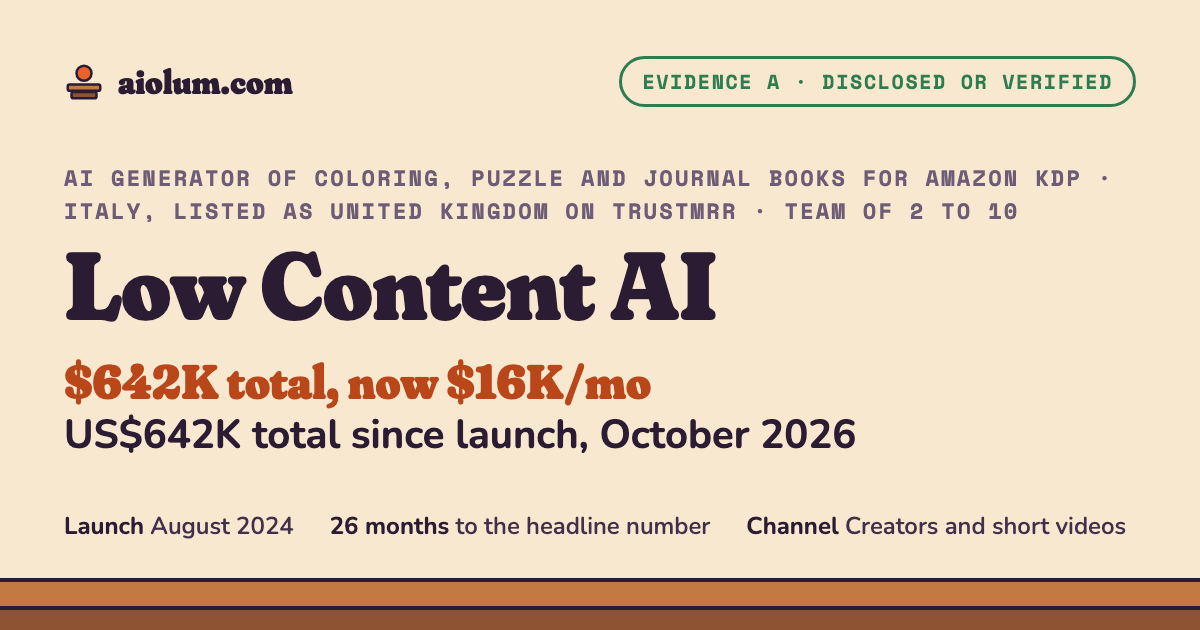
The founder named on TrustMRR is Brian Donatiello, whose X profile gives Milan as his location. TrustMRR gives 6 August 2024 as the founding date. Payment data that TrustMRR reads from the product's Stripe account shows US$642,409 paid by customers between the launch and 13 October 2026. That is a total since launch, not a yearly rate. The timing matters: US$430,839, which is 67% of it, came in the first 14 months, an average of about US$30,300 a month. The last 12 months brought US$211,570, an average of about US$17,600 a month. The present level is US$16,125 in the last 30 days and US$14,672 of monthly recurring revenue (MRR), the subscription revenue of one month, from 334 subscriptions. The public month-by-month table starts in November 2025 and stays between US$13,402 and US$25,642 without a clear direction. So the larger fall happened earlier, in months that the public profile does not show one by one.
Two things on this page are not verified, and the page says so where they matter. The first is the team: TrustMRR names one founder, but an archived copy of the site from January 2025 names a British company, Wealthy Magnet LTD, as the copyright holder, and the public register lists other people as its directors. The second is the sales channel: tutorial videos about KDP, an affiliate script (an affiliate is a partner who is paid a commission for each buyer that he sends) and an advertising pixel are visible, but no source says which of them brought the money. The founder has published no revenue figure of his own, so there is no claim to compare with the verified data. He has listed the product for sale at US$800,000 since December 2025. The customers' income depends on Amazon's rules about AI-generated books, which the last section quotes. The page also shows five failed startups that sold tools or services to people who publish books.
The numbers, graded
Each row shows the evidence grade and the source numbers from the list at the end of this page. The grades are explained in How Aiolum verifies.
| Fact | Value | Grade | How we know | Sources |
|---|---|---|---|---|
| Verified revenue since launch, August 2024 to 13 October 2026 | US$642,409 | A | Read from the Stripe account by TrustMRR through an API key. This is the sum of all payments in about 26 months. It is not a yearly rate and it is not profit. A copy cached one day earlier showed US$642,278. | [1] |
| Verified revenue, last 30 days | US$16,125 | A | Revenue last synced on 13 October 2026 at 14:38 UTC. The profile reports a change of minus 3.1% against the 30 days before. | [1] |
| Verified revenue, last 3, 6 and 12 months | US$46,172, US$103,979 and US$211,570 | A | [1] | |
| Share of the total that came in the last 12 months | 32.9% | calc | Calculated: 211,570 divided by 642,409 equals 0.329. Two thirds of the money was earned before mid-October 2025. | [1] |
| Revenue before the last 12 months | US$430,839, about US$30,300 a month | calc | Calculated: 642,409 minus 211,570 equals 430,839. From 6 August 2024 to 13 October 2025 is 433 days, or 14.22 months, and 430,839 divided by 14.22 equals 30,298. The public profile does not show these months one by one, so the highest month is not known. | [1] |
| Average of the last 12 months | about US$17,600 a month, 58% of the earlier average | calc | Calculated: 211,570 divided by 12 equals 17,631, and 17,631 divided by 30,298 equals 0.58. | [1] |
| Verified revenue per month, November 2025 to January 2026 | US$15,796, US$13,402, US$14,824 | A | The average is US$14,674. | [1] |
| Verified revenue per month, February to June 2026 | US$22,366, US$17,869, US$17,504, US$25,642, US$18,338 | A | The average is US$20,344. May 2026 is the highest month in the public table. | [1] |
| Verified revenue per month, July to September 2026 | US$14,791, US$16,253, US$16,499 | A | The average is US$15,848, which is 22.1% below the average of February to June. September 2026 is 4.5% above November 2025. | [1] |
| Last 6 months compared with the 6 months before | minus 3.4% | calc | Calculated: the last 12 months minus the last 6 months equals 107,591, and 103,979 divided by 107,591 equals 0.966. Inside the last year the level moved up and down but did not fall much. | [1] |
| Monthly recurring revenue, 13 October 2026 | US$14,672 from 334 active subscriptions | A | The profile reports a change of minus 16.7% in 30 days. The copy cached one day earlier showed US$14,706 and 336 subscriptions. | [1] |
| Revenue per subscription | about US$43.93 a month | calc | Calculated: 14,672 divided by 334. The plans cost €39, €49 and €99 a month. No exchange rate was applied on this page. | [1, 3] |
| Yearly run rate at the present level | US$176,064 to US$193,500 | calc | Calculated: 14,672 times 12, and 16,125 times 12. A run rate is the present monthly figure multiplied by twelve. It assumes that the level stays the same. | [1] |
| Profit margin, last 30 days | 75% | C | A profile snapshot. The profile does not say that costs are read from a verified source, so this is treated as the seller's figure. | [1] |
| Sale listing | asking US$800,000; first listed on 16 December 2025; 12 offers received | C | Listing details on the TrustMRR profile, set by the seller. Calculated: 800,000 divided by 211,570 equals 3.8 times the revenue of the last 12 months. The profile shows a multiple of 4.1, which equals 800,000 divided by twelve times the revenue of the last 30 days. | [1] |
| Founder | Brian Donatiello; 1 startup on TrustMRR | C | Named on the TrustMRR profile and founder page. His X profile gives Milan as his location and calls him the founder of OSIAX, a company that builds AI agents for business processes. He writes that he built AI systems for clients for years and that he built a career on Upwork, a marketplace for freelance work. | [2, 7, 8] |
| Founder's own revenue statements | none found | C | His X account was created on 10 December 2025. The 26 posts that could be read, from 4 July to 24 September 2026, are about OSIAX and AI coding and do not name Low Content AI. So there is no founder claim to compare with the verified data. | [7] |
| Company named on the site on 3 January 2025 | Wealthy Magnet LTD, London | C | The archived home page ends with: Copyright @ Wealthy Magnet LTD, 27 Old Gloucester Street, London. The British company register shows a company of that name at that address, incorporated on 17 September 2024, with the activity code for educational support services. Its four directors since then are other people, all resident in Italy. The founder's name does not appear, and his relation to the company is not verified. On 15 May 2026 and today the site footer names no company. | [5, 6, 3] |
| Employees of that company, 17 September 2024 to 30 September 2025 | 1 on average | C | Micro-entity accounts filed on 5 November 2025, not audited. They show net assets of 354,000, printed with a euro sign and tagged as pounds in the data, and no profit and loss statement. The register states that it does not check the accuracy of filed information. | [6] |
| Team size | not published | C | TrustMRR names one founder. No page that was read names an employee or a co-founder. Not verified. | [1, 2, 3] |
| Outside funding | none found | C | No investor, funding round or funding line was found on the profile, the site, the company register or the founder's posts. The founder has not stated it. | [1, 6, 7] |
| Law of the terms of service | Italian law, Court of Milan | C | Terms last updated on 9 January 2025. TrustMRR shows the United Kingdom as the country. This page gives Italy as the country because the founder's location, the terms and the residence of the directors of the named company all indicate Italy. | [4, 1, 6, 7] |
| YouTube tutorials that link to the tool, January and February 2025 | 5 videos by 4 channels, 5,740 views together | C | Dates and view counts as YouTube showed them on 13 October 2026: Dare Digital on 1 January (691 views) and 7 February (286), Digitaledu in Italian on 7 January (2,395), Mariana Montoya on 3 February (2,111) and Blaze Goldburst on 25 February (257). These views are too few to explain the revenue. Other videos may exist that the search did not return. | [10, 11, 12, 13] |
| Other sales channels visible in the page code | an Endorsely affiliate script and a Meta advertising pixel | C | Read on 13 October 2026. Endorsely describes itself as affiliate program software for subscription software: it records which partner sent a paying customer. The commission rate, the number of partners and the advertising budget are not public. | [3] |
| Cost of one generated image to the customer | about €0.16 to €0.20 | calc | Calculated from the terms and the monthly prices: 39 divided by 200 images equals 0.195, 49 divided by 300 equals 0.163, and 99 divided by 550 equals 0.18. | [3, 4] |
| Users, seller's estimate | about 1,000 | C | Profile text. The home page says thousands of creators. The verified number is 334 active subscriptions. | [1, 3] |
| Amazon's rule on AI content | AI-generated text, images and translations must be declared when a book is published | B | Amazon's content guidelines, read on 13 October 2026. The Guardian reported on 20 September 2023 that Amazon had introduced the requirement one week earlier. | [14, 16] |
| Amazon's limit on new titles | three a day for each publisher, since September 2023 | B | The Guardian, 20 September 2023, from Amazon's statement to the newspaper. Amazon said that the number may be adjusted. Amazon's own forum page loads by script and could not be read, so the present number is not verified. | [16] |
| Amazon's definition of a low-content book | minimal or no content on the interior pages; puzzle books and coloring books are not generally included | B | Amazon's help page, read on 13 October 2026. Low-content books are not eligible for the free ISBN that KDP gives to other books. | [15] |
| Reports of closed KDP accounts | described as increasingly common; no count is published | C | Two advice sites for self-publishers, in articles of October and December 2025, and one author's own account of January 2024. Amazon publishes no number of terminations. | [17, 18, 19] |
| Competing AI tools for low-content books that were read for this page | 3 | C | KDP Builder, with a free start of 75 credits. Low Content Studio, founded on 29 June 2026, with US$4.86 of verified revenue. A third tool that the channel JeffSetLife promoted through an affiliate link on 30 June and 21 July 2026. This is not a full count of the market. | [20, 22, 21] |
| Time from launch to the latest figure | 26 months | calc | Calculated: August 2024 to October 2026. | [1] |
How to read this table: a grade A value was read from the Stripe account by TrustMRR through an API key. A grade B value was published by Amazon about its own rules or by independent press. A grade C value is a profile detail written by the seller, a page of the company, an unaudited company filing, a founder post, a YouTube video or an advice site. A "calc" value was computed on this page from the rows above it.
| Plan | Per month, billed yearly (US$) | Per month, billed monthly (US$) | Limit |
|---|---|---|---|
| Basic | €32.50 | €39 | 40 million credits a month, about 200 images; basic templates |
| Pro | €40.83 | €49 | 60 million credits a month, about 300 images; priority generation, advanced templates |
| Star | €82.50 | €99 | 110 million credits a month, about 550 images; unlimited templates, API access |
The home page shows yearly billing first: €390, €490 and €990 a year, with the label Save 16.6%. The monthly prices of €39, €49 and €99 are in the page script, behind the Pay Monthly switch. The yearly column below is the yearly price divided by 12. Calculated check: 390 divided by 12 times 39 equals 0.833, which agrees with the label. Credits pay for generation. The site calls the unit credits and the terms of service call it tokens: one image costs 200,000 and one generated word about 1.33, so 40 million credits pay for 200 images if nothing else is generated. An archived copy of 3 January 2025 shows €292.50, €367.50 and €742.50 a year with the label Save 20%; each is exactly 75% of today's yearly price. Whether that was a lower list price or a temporary discount could not be read. The home page has a button that says Get Started for Free; the limit of the free use is not shown. There is no separate pricing page: the address /pricing returns an error page.
The timeline
From a login page in August 2024 to US$642,409 in total revenue in 26 months, with two thirds of it in the first 14 months. Each entry carries its grade.
- 6 August 2024CFounding date on the TrustMRR profile. The Wayback Machine first captured lowcontent.ai on 10 August 2024, and the privacy policy is dated 16 August 2024. [1, 5, 4]
- 17 September 2024CWealthy Magnet LTD is incorporated in London, by the British company register. The site names it as copyright holder in January 2025. [6, 5]
- 1 January 2025CThe earliest YouTube tutorial found that links to the tool: the channel Dare Digital lists it as the software used in the video. [11]
- 3 January 2025CThe archived site shows three yearly plans at €292.50, €367.50 and €742.50, and a login page with one option, a Google account. [5]
- 6 to 9 January 2025CA Product Hunt account for the tool is created on 6 January. An Italian review video appears on 7 January. The terms of service, under Italian law, are dated 9 January. [9, 10, 4]
- February 2025CThree more tutorials: Mariana Montoya on 3 February, Dare Digital on 7 February and Blaze Goldburst on 25 February. [12, 11, 13]
- August 2024 to October 2025AUS$430,839 of verified revenue in the first 14 months, about US$30,300 a month on average. Calculated from the verified totals; these months are not public one by one. [1]
- November 2025 to January 2026AVerified revenue of US$15,796, US$13,402 and US$14,824: about half of the earlier average. [1]
- 10 to 16 December 2025CThe founder opens his X account on 10 December and the product is listed for sale on TrustMRR on 16 December. A post of 17 July 2026 says that he had spent the last 7 months building an AI sales team product, which places the start of that work in the same weeks. [7, 1]
- February to June 2026AA higher period: US$22,366 in February and US$25,642 in May, the highest month in the public table. [1]
- 30 June 2026CJeffSetLife, a KDP channel, presents a different new AI tool for low-content books through an affiliate link. The video has 5,410 views; a second video of 21 July has 9,347. [21]
- July to September 2026AVerified revenue of US$14,791, US$16,253 and US$16,499. [1]
- 13 October 2026AUS$642,409 in total. US$16,125 in the last 30 days. MRR of US$14,672 from 334 subscriptions, down 16.7% in 30 days. Asking price US$800,000, with 12 offers received. [1]
Why it worked
Four causes, in the order they mattered. Each one is a reusable lesson.
A product named with the customer's own word
People who publish notebooks, planners and coloring books on Amazon call their business low-content publishing. The product and its domain use exactly that word, with AI added. A person who searches YouTube for a low-content AI tool finds videos that show it, next to videos that show its competitors.
A market that is taught by channels and courses
The customers learn the business from YouTube channels and paid courses, and those teachers need tools to show. Five tutorials in English and Italian linked to the tool in January and February 2025, and the site runs an affiliate script that can pay a partner for each buyer. The same channels link to several other tools in the same videos. No source says which share of the sales came this way.
Output that is ready for one platform
The promise is not a general image generator. It is a book file that Amazon's Kindle Direct Publishing accepts, with the listing description as well. The customer pays to skip the steps between a drawing and a book that can be sold.
Yearly plans shown first, and credits with a known cost
The home page shows yearly prices first, from €390 to €990, and a yearly price is collected on the first day. This may be one reason why the first 14 months were stronger than the next 12, but the public data cannot confirm it. Each plan gives a fixed number of credits, and one image costs 200,000 of them, so the cost of serving a customer has an upper limit. The profile shows a profit margin of 75%, which is the seller's figure.
How it was built
These details were read from the site's code, its terms of service and archived copies. The founder has not published a description of how he built it. They are grade C. [3, 4, 5, 1]
- The site is a Next.js application. Next.js is a framework for web applications written with React, and the pages load their script files from the framework's standard /_next/ path.
- Payments run on Stripe. TrustMRR reads the revenue from the Stripe account through an API key.
- In the archived copy of January 2025 the login page has one option: continue with a Google account.
- Generation is metered. The terms count the user's prompt, internal steps such as title generation and tool selection, and the generated output. One image costs 200,000 units and one generated word about 1.33.
- The pages do not say which AI models produce the images and the text.
- By the terms, a paying user owns the generated text and images and may keep using them after cancelling.
- The page code loads an Endorsely affiliate script and a Meta advertising pixel. The largest plan lists API access.
Tools named in the sources
Each one opens its page in the Tools tab, with every story that uses it.
The dead that came before
Five companies in the Loot Drop database sold tools or services to people who write and publish books, in a market where Amazon owns the store. The values below are from that database and are not independently verified.
Hyperink
The promiseHelp experts produce e-books for small niches quickly.
Why it diedSelf-publishing platforms gave authors more reach and better tools at lower cost, and niche titles earned too little.
Booktrope
The promisePublish a book with a team of editor, designer and marketer who share the royalties instead of charging fees.
Why it diedThe model was complex to run and did not reach scale. Kindle Direct Publishing gave authors a simpler path.
Vook
The promiseE-books with video and audio inside the text.
Why it diedReaders and publishers did not adopt the format, and Kindle and Apple's iBooks had the distribution.
Curious Fictions
The promiseA place where authors sell short stories directly to readers.
Why it diedKindle Direct Publishing and Wattpad already had the readers. Subscriptions and tips brought too little money.
Hiptype
The promiseAnalytics that show publishers how readers read their e-books.
Why it diedPublishers adopted it slowly, and Amazon and Apple kept their own reading data.
What changed
Each of the five tried to sell something to authors or publishers while Amazon owned the store and the readers. Three of them offered another path to publication and lost to Amazon's own path. Low Content AI does not compete with Kindle Direct Publishing. It supplies it: the customer still publishes on Amazon, and the tool only makes the files. That is why a small product could collect US$642,409 without a store, readers or publisher contracts of its own.
What changed is the cost of producing a page. In the 2010s a niche book needed an expert and an editor, and Hyperink and Booktrope existed to organise such people. Now an image model draws a coloring page for about €0.16 to €0.20 at this tool's prices. The dependence did not change. The tool's customers earn only while Amazon accepts their books, and Amazon answered the large number of AI-made books in 2023 with a duty to declare them and a daily limit on new titles. The predecessors lost to Amazon as a competitor. This business can lose to Amazon as the maker of the rules.
Can one person copy it now?
The method, yes. This market, with care.
The method is to choose a group that already pays for courses and tools around one narrow way of earning money, to name the product with the group's own word, and to give its teachers a reason to show the product. That can be repeated elsewhere. This market is harder now: the verified level is a little more than half of the early average, new tools appear every few months, and the customers' income depends on what Amazon accepts.
Where it is still open: Other marketplaces where individuals sell simple products in volume and learn the method from channels and courses: print-on-demand clothing, digital planners and printable pages, stock images, and listing text for small sellers.
- 1Find a group that has a specific name for its work and already buys tools for it. Use that name in the product name and the domain.
- 2Make the output ready for the platform where the group sells: the right page size, the right file format, and the listing text.
- 3Sell credits that map directly to your own cost for each image or word, so that every plan has a known margin.
- 4Give tutorial channels and course sellers an affiliate link, and expect them to show your competitors as well.
- 5Read the platform's rules before your customers do, and tell them plainly what they must declare.
What to watch
The risks are the mirror image of the causes above.
Amazon requires a declaration of AI-generated content
Amazon's content guidelines say: "We require you to inform us of AI-generated content (text, images, or translations) when you publish a new book or make edits to and republish an existing book through KDP." Content created by an AI tool counts as AI-generated "even if you applied substantial edits afterwards". Every book made with this tool falls under that definition. The guidelines add: "You are responsible for verifying that all AI-generated and/or AI-assisted content adheres to all content guidelines, including by complying with all applicable intellectual property rights." The Guardian reported on 20 September 2023 that Amazon had introduced the requirement one week earlier. The risk stays with the publisher, not with the tool.
Amazon's definition of low-content is narrower than the market's
Amazon's help page says: "A low-content book has minimal or no content on the interior pages. Low-content books are generally repetitive, and designed to be filled in by the user. This does not typically include activity books, such as puzzle books or coloring books, which generally do not feature repetitive content on each page." Its table lists notebooks, planners, journals and log books as low-content, and puzzle books and coloring books as not generally low-content. The page also says that low-content books "are not eligible for the free KDP ISBN"; an ISBN is the international number that identifies one edition of a book. The same guidelines forbid "content that's typically disappointing to customers". A customer of the tool has to know which of Amazon's categories each book belongs to.
A limit of three new titles a day
In September 2023 Amazon wrote on its KDP forum, as quoted by the Guardian: "in order to help protect against abuse, we are lowering the volume limits we have in place on new title creations". Amazon told the newspaper that the limit is three titles a day and may be adjusted. The method that this market teaches is volume: the page of one competing tool says that successful low-content publishers build catalogs of 50 to more than 200 products. A tool can make a book in minutes, but the platform accepts three new titles a day from one publisher.
Publishers report closed accounts
Kindlepreneur, an advice site for self-publishers, wrote in an article updated on 27 October 2025 that suspended or terminated accounts are "becoming increasingly common" and that "in most cases, account actions are triggered by an automated system rather than human review". The site selfpublishing.com wrote on 15 December 2025 that closures often follow when authors "release numerous low-content books that repeat the same templates or layouts", and that "uploading too many AI-generated titles in a short period can make your account seem suspiciously high-volume". One author wrote on 23 January 2024 that Amazon terminated her account and that she believes the cause was that she did not declare the use of AI on a book cover. These are reports and advice, not counts: Amazon publishes no number of terminations. A publisher who loses the account has no reason to renew a yearly plan.
The level is a little more than half of the early average
The first 14 months averaged about US$30,300 a month and the last 12 about US$17,600. Inside the last year the months move between US$13,402 and US$25,642 without a clear direction, but MRR fell by 16.7% in the 30 days to 13 October 2026. The product has been for sale since 16 December 2025 at US$800,000, which is 3.8 times the revenue of the last 12 months, and the founder's posts since July 2026 are about a different company. He wrote on 31 July 2026, about his years on a freelance marketplace: "Platforms can change the rules overnight." The same sentence describes the position of his customers on Amazon.
Many competing tools, sold the same way
KDP Builder offers an AI generator for low-content books with a free start of 75 credits. Low Content Studio, founded on 29 June 2026, sells plans at US$19 and US$49 a month and has US$4.86 of verified revenue. JeffSetLife, a KDP channel, promoted another new AI tool for low-content books through an affiliate link in two videos in June and July 2026, with 5,410 and 9,347 views. The image and text models behind such tools are open to every developer, so the product itself is easy to copy. What is hard to copy is a place in the tutorials of the channels, and the channels show several tools at once.
Who owns it, and who sent the first buyers, is not clear
TrustMRR names one founder and the United Kingdom. The site named Wealthy Magnet LTD as copyright holder in January 2025; that company's directors are other people resident in Italy, its activity code is educational support services, and the terms of service are under Italian law. A buyer of the business should ask where the customers of the first year came from.
Testimonials that cannot be checked
The home page shows three short testimonials signed Sarah M., John D. and Emma R., with the same wording as in the archived copy of January 2025, and it says that thousands of creators use the tool. The verified number is 334 active subscriptions, and the seller's own estimate on TrustMRR is about 1,000 users.
Sources
The grade next to each source is the best grade that the source can support. "Read in full" means that the text of the page was downloaded and the numbers were checked in it.
- A TrustMRR profile of Low Content AI, revenue read from Stripe by API keyRead the markdown profile on 13 October 2026 (revenue last synced 13 October 2026 at 14:38 UTC) and compared it with a copy cached one day earlier, which showed US$642,278. The revenue, MRR and subscription figures come from the Stripe account. The profile text, the founding date, the country, the user estimate, the profit margin and the sale listing are written by the seller and are grade C.
- A TrustMRR founder page of Brian Donatiello: 1 startup with verified revenueRead in full on 13 October 2026. It showed a total of US$642,683 after a later sync, one startup, and the link to his X account.
- C Low Content AI home page and its page scriptRead in full on 13 October 2026, with the script file that holds the plan data. Source for the product description, the yearly and monthly prices, the credits of each plan, the testimonials, the affiliate script and the advertising pixel. The address /pricing returned an error page. The home page of Endorsely was read for the description of its service.
- C Low Content AI terms and conditions, last updated 9 January 2025, and privacy policy, last updated 16 August 2024Read both in full. Source for the cost of an image and of a word, the ownership of generated content, the renewal and refund rules, and the choice of Italian law and the Court of Milan.
- C Wayback Machine copy of lowcontent.ai, 3 January 2025Read the archived home page and the archived login page of the same day in full, and the list of captures, which starts on 10 August 2024. Source for the earlier prices and for the footer that names Wealthy Magnet LTD. A copy of 15 May 2026 shows today's prices and no company name.
- C Companies House, the British company register: Wealthy Magnet LTD, company number 15962341Read the overview, the officers, the persons with significant control, the filing history and the micro-entity accounts for the period to 30 September 2025. The register states that it does not check the accuracy of filed information. The founder's name is not in these records.
- C Brian Donatiello on X: profile and posts of 4 July to 24 September 2026Read the profile and the 26 most recent posts through api.fxtwitter.com; older posts could not be opened. Source for his location, the date the account was created, his freelance background, the post of 17 July 2026 about 7 months of work on a new product, and the post of 31 July 2026 about platforms. No post names Low Content AI or gives a revenue figure.
- C OSIAX home pageRead in full on 13 October 2026. Source for the founder's present company and his description of his earlier work for clients. It does not name Low Content AI.
- C Product Hunt profile: Low Content AiRead in full. Source for the account date of 6 January 2025, the launch month and the product description that names coloring books, games and activity books.
- C YouTube, Digitaledu, 7 January 2025: SCOPRI Come Creare Libri per Amazon KDP in Modo Semplice e Veloce!Read the video description, the date and the view count; the video was not watched. An Italian review that lists coloring books, activity books, puzzle books, maze books and listing descriptions, and links to the tool.
- C YouTube, Dare Digital, 1 January 2025: I'M Using This SECRET Amazon KDP App to Make Passive Income! (and a second video of 7 February 2025)Read the descriptions, dates and view counts of both videos; the videos were not watched. Both list lowcontent.ai as the software used.
- C YouTube, Mariana Montoya, 3 February 2025: How to make low content book for KDP using AIRead the description, the date and the view count; the video was not watched. The first line links to the tool.
- C YouTube, Blaze Goldburst, 25 February 2025: Low Content AI: Software for Creating Profitable Amazon KDP Low Content Books!Read the title, the description, the date and the view count; the video was not watched. A promotional video for the tool.
- B Amazon KDP help: Content Guidelines, section on artificial intelligence contentRead the section on AI content and the section on disappointing content on 13 October 2026. Source for the quoted rule texts.
- B Amazon KDP help: Low-Content BooksRead in full on 13 October 2026. Source for Amazon's definition, the table of examples and the ISBN rule.
- B The Guardian, 20 September 2023: Amazon restricts authors from self-publishing more than three books a day after AI concernsRead in full. Source for the limit of three titles a day, Amazon's forum statement as quoted, and the timing of the AI declaration rule. Amazon's own forum page loads by script and could not be read.
- C Kindlepreneur, updated 27 October 2025: Amazon KDP Account Suspension: Causes, Prevention, and SolutionsRead the sections on warnings, suspensions and terminations. An advice site for self-publishers, not Amazon.
- C selfpublishing.com, 15 December 2025: Your Amazon KDP Account Was Closed - Now What?Read the sections on the reasons for closure. An advice site, not Amazon.
- C Jessica Shepherd's blog on Goodreads, 23 January 2024: KDP/Amazon Terminated My AccountRead in full. One author's own account of a termination and of what she believes caused it. Not confirmed by Amazon.
- C KDP Builder: AI Low-Content Book Generator for Amazon KDPRead in full on 13 October 2026. A competing tool. Source for its free start and for the statement about catalogs of 50 to more than 200 products.
- C YouTube, JeffSetLife, 30 June 2026: NEW AI Tool Makes Creating Low Content KDP Books Easier Than Ever (and a second video of 21 July 2026)Read the descriptions, dates and view counts of both videos, and followed the short link of the tool, which leads to an affiliate marketplace and not to lowcontent.ai. The videos were not watched.
- A TrustMRR profile of Low Content StudioRead the markdown profile on 13 October 2026. A competing tool founded on 29 June 2026. Its verified revenue is grade A; its prices are profile text.
- C Loot Drop database export, 1,749 failed startupsLocal export. AI-written summaries, not independently verified. Source for the failed predecessors.