MonAi
What is not verified
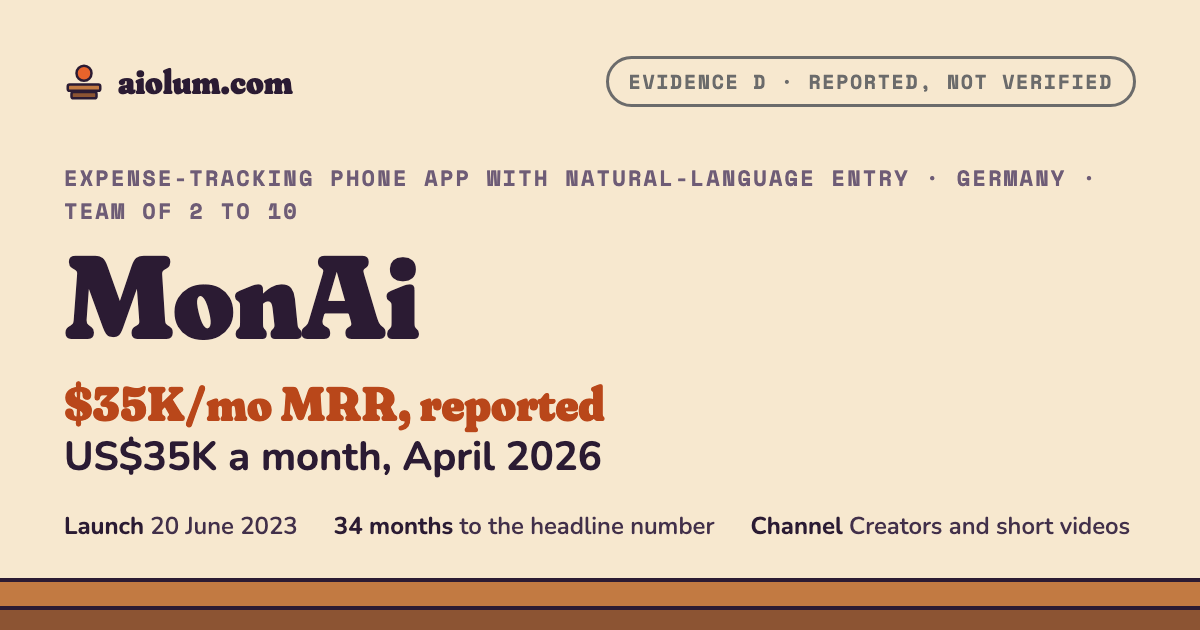
The headline figure, a bit over US$35,000 in monthly recurring revenue, rests on one statement by the founder, Florian Vates, in a Starter Story video interview published on 6 April 2026. The only other figure, US$40,000 to US$60,000 a month across four apps with about 90% from MonAi, is from an Indie Hackers interview of 13 May 2026 that this page could read only as retold by the directory SoFarBot. There is no RevenueCat, App Store or payment-processor data, and the Ponicorn directory lists a conflicting US$12,000 MRR dated August 2026. A reader could look for a RevenueCat or TrustMRR profile of MonAi, a second interview with the dashboard shown, or the founder's own posts on X. The headline number is grade D: one claim or one estimate, with no second source. Aiolum shows it because the story is useful, and marks it so that it is not mistaken for a verified figure.
MonAi is an expense tracker, an app in which a person records what they spend so that they can see their spending by category and month. Most such apps need a form for every purchase. MonAi replaces the form with natural-language entry: the user types or dictates a plain sentence, and a language model, a program that reads and writes text, such as the ones behind ChatGPT or Claude, extracts the amount, the date and the category. The app sells a subscription of about US$3 to US$4 a month after a seven-day trial, according to its App Store listing and its own FAQ page.
Florian Vates, an iOS developer at a mobile agency and a father of two in Freilassing, Germany, built the first version in a month or two in 2023 and launched it on Product Hunt on 20 June 2023, where it finished 25th of the day. He told Starter Story in April 2026 that it took him a year and a half to reach US$300 in monthly recurring revenue (MRR), the subscription income of one month. At the end of 2024, Charlie Alvarez, a Colombian content creator, found the founder's X link inside the app and offered to work together. The founder said that the first video multiplied MRR by ten within a week, that MRR was almost US$8,000 within a month, and that by April 2026 it was a bit over US$35,000. In an Indie Hackers interview of 13 May 2026, as retold by the directory SoFarBot, he said his four apps together made US$40,000 to US$60,000 a month, about 90% of it from MonAi. He left his job in January 2026.
Every money figure on this page is a statement by the founder, in one video interview and one written interview, with no payment-processor or app-store data to confirm it. The site marks it "Reported, not verified". The page also shows what happened to earlier personal-finance apps that promised simple expense tracking.
The numbers, graded
Each row shows the evidence grade and the source numbers from the list at the end of this page. The grades are explained in How Aiolum verifies.
| Fact | Value | Grade | How we know | Sources |
|---|---|---|---|---|
| Monthly recurring revenue, April 2026 | a bit over US$35,000 | D | The founder, in a Starter Story video interview published 6 April 2026: "we are currently at a bit over 35,000 of MRR". The page title says US$35K a month. No second source gives a MonAi-only figure. | [1] |
| Run rate from the April 2026 figure | about US$420,000 a year | calc | Calculated: 35,000 times 12. This is the headline figure of the page. | [1] |
| Revenue of all four apps per month, May 2026 | US$40,000 to US$60,000, about 90% from MonAi | D | The founder in an Indie Hackers interview of 13 May 2026, as quoted by SoFarBot. 90% of that range is US$36,000 to US$54,000, which is consistent with the April figure. The other apps are Mindr, Re-Frame and Max. | [2] |
| Monthly recurring revenue before the partnership, late 2024 | about US$300 | C | The founder in both interviews: about one and a half years of work alone reached US$300 in MRR. | [1, 2] |
| MRR one month after the first creator video, end of 2024 | almost US$8,000 | D | The founder to Starter Story: "within a week we 10x'd the MRR and within a month it was at almost 8K". The Indie Hackers retelling says about US$300 to US$12,000 in two months. | [1, 2] |
| MRR after the second video, early 2025 | US$13,000 | D | The founder to Starter Story: a second short video added more than US$5,000 of MRR. | [1] |
| Effect of the June 2025 video | about 1 million views and almost US$5,000 more MRR | D | The founder to Starter Story. The video told the story of Apple inviting him to WWDC; the transcript dates it "June 21". | [1] |
| Trial starts and conversion | 14% of visitors start a trial; 40% to 50% of trials convert | D | Founder figures from the Indie Hackers interview, as quoted by SoFarBot, with no sample size. | [2] |
| Creator deal | a percentage of profits plus a fixed monthly retainer | D | The founder to Starter Story. The first contract paid a percentage of revenue; it was changed because that did not scale. The amounts were not disclosed. | [1] |
| Videos per month | 3 | C | The founder in both interviews: three story-driven videos a month on the creator's own channel, quality over quantity. | [1, 2] |
| Team, 2026 | 3 people: the founder (design and iOS), Charlie Alvarez (content), Zeki (Android) | C | The company's FAQ and About section. The Android developer is named only by first name on the site. | [5] |
| Founder's employment | full-time iOS developer at an agency until half-time in 2025, left in January 2026 | C | December 2023 interview for the job; the Indie Hackers retelling for the half-time step and the January 2026 date; Starter Story: "earlier this year I was finally able to quit my job". | [1, 2, 6] |
| Outside funding | none mentioned | D | No source mentions investors. The app was a side project next to a job for its first two and a half years. | [1, 6] |
| Monthly tool costs, April 2026 | about US$725 plus one-time purchases | D | The founder to Starter Story: Claude Code US$100, RevenueCat about US$400, Appwrite US$25, OpenAI and Anthropic API calls about US$200; Helm US$175 one-time; Xcode and Figma free. | [1] |
| App Store rating, United States, October 2026 | 4.8 stars from 885 ratings | C | Read on the listing. The company's home page says 4.8 stars from more than 8,500 ratings, which would be all countries. | [4, 5] |
| Product Hunt launch | 20 June 2023, 25th of the day | C | Product Hunt page; the rank is from the founder's December 2023 interview. | [6, 7] |
| Ponicorn directory figure | US$12,000 MRR, dated August 2026, marked unverified | D | A directory entry that cites Indie Hackers. It matches the founder's figure for the first two months of the partnership, not the 2026 figures, so this page treats it as a misdated number and does not use it. | [3] |
| Time from launch to the April 2026 figure | 34 months | calc | Calculated: June 2023 to April 2026. | [1, 7] |
How to read this table: a grade D value is a single founder statement, made in one interview on one date, with no second source and no payment-processor data. A grade C value is a founder or company statement that two sources agree on, or a fact read on the company's own pages or store listing. A "calc" value was computed on this page from the rows above it. No value is grade A or B.
| Plan | Per month, billed yearly (US$) | Per month, billed monthly (US$) | Limit |
|---|---|---|---|
| Basic | 2.08 (US$24.99 a year, intro price) | 3.99, intro 2.99 | all features, one person |
| Family | 3.99 | shared with the family group, 5 or 6 people | |
| Student | 2.08 (US$24.99 a year) | 2.99 | on request by email |
| Monthly and Yearly, unnamed items | 6.00 (US$71.99 a year) | 7.99 | listed in the store without a description |
| Advanced, unnamed item | 2.99 | listed in the store without a description |
All plans start with a seven-day free trial, then an auto-renewing subscription bought through Apple or Google. The App Store lists an introductory price (Basic monthly intro US$2.99, Basic yearly intro US$24.99) and a regular price (Basic monthly US$3.99). The Family plan covers the family group through Apple Family Sharing or Google Family Library; the FAQ says up to 5 people, the home page says up to 6. Student prices are given on request by email. The App Store also lists items called Monthly (US$7.99), Yearly (US$71.99) and Advanced (US$2.99) without a description; they may be older or regional plans. The yearly column is the yearly price divided by 12. SoFarBot read the United Kingdom store in September 2026: Basic £2.99 a month or £24.99 a year, Family £3.99 a month or £34.99 a year.
The timeline
From a side project built in a month or two to a founder-reported US$35,000 a month, in 34 months, with the growth concentrated in the 16 months after a content creator joined. Each entry carries its grade.
- 2021 to 2023CVates, a senior iOS developer at a mobile agency, spends about two years with friends on CORDI, an app for planning events, and shuts it down for lack of users. He says the lesson was to launch in weeks, not years. [1, 6]
- Spring 2023CHe builds MonAi for himself in a month or two, because every expense tracker he tried needed too many taps and he wanted to try the new language models. [1, 6]
- 20 June 2023CLaunch on Product Hunt, 25th of the day with a handful of followers on X. Free to download; subscription for the full features, data kept in the user's iCloud. [6, 7]
- July 2023CHe starts posting the work in public on X. Marketing consists of that alone. [6]
- 4 December 2023CInterview with the Indie Goodies newsletter: 31 years old, two children, one hour a day for side projects. MonAi is "not my most successful app as of now". [6]
- Late 2024DAfter about a year and a half, MRR is about US$300, the founder says. Charlie Alvarez, a content creator in Colombia, finds the founder's X link in the app settings and proposes a partnership. [1, 2]
- End of 2024DThe first video, a plain walkthrough of the app in Spanish. The founder says MRR multiplied by ten within a week and reached almost US$8,000 within a month. [1]
- Early 2025DA second short video adds more than US$5,000 of MRR, to US$13,000, the founder says. Then a quiet period of testing. The deal moves from a share of revenue to a share of profits plus a retainer. [1]
- 2025DHe reduces his agency job to half-time. [2]
- June 2025DA video about Apple inviting him to WWDC gets about a million views and adds almost US$5,000 of MRR, he says. The team replaces a restricted free plan with a seven-day full trial and a hard paywall, which he says raised revenue and reviews. [1, 2]
- January 2026DHe leaves his job to work on the apps full-time. [1, 2]
- 6 April 2026DStarter Story publishes the video interview: a bit over US$35,000 in MRR, 7-day trial, three videos a month, a team of two plus an Android developer. [1]
- 13 May 2026DIndie Hackers interview, retold by SoFarBot: the four apps make US$40,000 to US$60,000 a month, about 90% from MonAi. [2]
- 22 October 2026CVersion 1.10.2 on the App Store. Version 1.10 added AI reports, a WhatsApp bot that turns a text or voice note into an entry, and automatic currency conversion. The site lists three people and a blog with several posts a week. [4, 5]
Why it worked
Four causes, in the order they mattered. Each one is a reusable lesson.
One creator, three videos a month, paid from profits
The founder says he works with one creator instead of twenty, and that the creator posts three story-driven videos a month on his own channel, each built around a problem such as a forgotten expense before showing the app. The first contract paid a share of revenue; the founder says it was changed to a share of profits plus a fixed monthly retainer, so that the creator earns more when the app earns more and has a reason to make better videos. The amounts were not disclosed.
A market the founder did not live in
The creator's audience is in Colombia and Latin America, and the videos are in Spanish. Starter Story's producer noted that the founder did not build for Germany or the United States, where he and the interviewers live, but partnered with someone who had an audience elsewhere. The founder says the same approach has not yet worked as well in the United States.
Remove the form
The product's only real difference from the hundreds of expense trackers is that entry takes one sentence or one voice note. On iPhone, a Shortcut can prompt for the entry right after an Apple Pay payment; on Android, the app reads the bank's payment notification. The founder says the app stays deliberately small: no tabs, no dashboards, because people stop tracking when it takes effort.
Full trial, then a hard paywall
The founder says the app was free with limits at first, and that testing showed a seven-day trial of everything followed by a paywall produced more revenue and better reviews. The founder reported to Indie Hackers that 14% of visitors start a trial and 40% to 50% of trials convert, figures without sample sizes.
How it was built
These details come from the founder's Starter Story interview of April 2026 and his December 2023 interview, plus the company's FAQ. They are founder statements, grade C and D. [1, 5, 6, 7]
- Native iOS app written in Xcode; the Android app is by a separate developer. The founder told Starter Story in April 2026 that he uses Claude Code heavily and pays US$100 a month for the Max plan.
- OpenAI models for the simple tasks (reading a sentence into entries) and Anthropic models for the deeper analysis (the AI reports); the founder said in April 2026 that the API calls cost about US$200 a month.
- RevenueCat for subscriptions and paywall experiments, which the founder said cost about US$400 a month in April 2026; the FAQ asks users for their RevenueCat ID to move a subscription between iOS and Android.
- Appwrite as backend, login and database for the account-based sync between devices, at US$25 a month according to the founder; the original version kept data in the user's iCloud with no login.
- Helm, a desktop tool for App Store Connect, bought as a lifetime plan for about US$175, the founder said; Figma on the free plan for design.
- Marketing: the founder's own posts on X from July 2023, a Product Hunt launch in June 2023, and from late 2024 the creator's videos on his own channels; the company's Instagram account is linked from the site. The founder says paid advertising is hard to make profitable at a US$3 subscription.
Tools named in the sources
Each one opens its page in the Tools tab, with every story that uses it.
The dead that came before
Five companies in the Loot Drop database sold personal expense tracking or shared budgets before language models existed. The values below are from that database and are not independently verified.
Birdy
The promiseA minimalist budgeting app without the bloat of other finance apps.
Why it diedUsers asked for bank connections and investing, the banks did not cooperate, and the money ran out before the app found enough paying users.
Wesabe
The promiseTrack your spending and get advice from a community of users.
Why it diedMint pulled transactions from the bank automatically and needed no typing; Wesabe asked the user to do more work, missed phones, and lost.
Glassjar
The promiseTrack expenses and save money as a group.
Why it diedSplitwise and Venmo already did the same for larger groups of users; Glassjar had no partner banks and could not explain what was different.
Ivella
The promiseA finance app for couples that splits expenses.
Why it diedSplitting bills was already a feature of bank apps and PayPal; a separate app with US$2.5 million could not win the couples' trust.
Clarity Money
The promiseExpense tracking, budgeting and subscription cleanup in one app.
Why it diedGoldman Sachs bought it in 2018, folded the technology into its Marcus bank and closed the brand.
What changed
Birdy promised in 2014 what MonAi promises now, a small expense tracker without bloat, and died because typing every purchase was work that users stopped doing, while the apps that connected to banks, Mint and its successors, did the typing for them. Wesabe lost to Mint for the same reason. The products that survived were bank connections, which need licences and contracts that a one-person company cannot get.
Two things changed. A language model now turns one spoken sentence into a categorized entry, so the typing cost fell close to zero without a bank connection; MonAi's FAQ says bank connections would make the subscription much more expensive, and the Apple Pay prompt and the Android notification reader capture most payments anyway. And distribution changed: Birdy, Glassjar and Ivella spent their funding on getting noticed, while MonAi's founder says one creator with his own audience, paid from profits, did it. Whether that holds outside one Spanish-speaking audience is still open, and the founder says it has not yet worked as well in the United States.
Can one person copy it now?
The product, easily. The distribution, only with the right partner.
An expense tracker with natural-language entry is a few weeks of work with current models, and the founder says building is the easy part. What made the money, according to him, was a creator who proposed the partnership himself, in a market the founder did not know, paid by a share of profits. The founder's own playbook, as told to Starter Story in April 2026, is to find a creator whose audience and tone match the product, offer a long-term profit share rather than a one-off post, and look outside the United States.
Where it is still open: Any daily record-keeping habit that dies from data entry: hours for freelancers, meals, medicines, mileage, time with clients. And any phone app with a small subscription that a creator in one language region could carry.
- 1Build the smallest version of a repeated daily task where a language model removes a form, and charge for it after a short full-feature trial.
- 2Put your own contact link inside the app; the partnership here started because a creator found it there.
- 3Offer one creator a long-term share of profits plus a retainer, not a fee per post, and let them make few, story-driven videos on their own channel.
- 4Test a market you do not live in; a local creator can carry the product where ads at a US$3 price do not pay.
What to watch
The risks are the mirror image of the causes above.
What is not verified
The headline figure, a bit over US$35,000 in monthly recurring revenue, rests on one statement by the founder, Florian Vates, in a Starter Story video interview published on 6 April 2026. The only other figure, US$40,000 to US$60,000 a month across four apps with about 90% from MonAi, is from an Indie Hackers interview of 13 May 2026 that this page could read only as retold by the directory SoFarBot. There is no RevenueCat, App Store or payment-processor data, and the Ponicorn directory lists a conflicting US$12,000 MRR dated August 2026. A reader could look for a RevenueCat or TrustMRR profile of MonAi, a second interview with the dashboard shown, or the founder's own posts on X.
One creator, one audience
The founder says growth came from one person's videos to one Spanish-speaking audience, and that the same approach has not yet worked as well in the United States. If the creator stops, or the audience moves on, there is no second channel; paid ads, he says, are hard to make profitable at this price.
Apple and Google take their share
Every subscription passes through the app stores, which keep up to 30% in the first year, and the stores decide the ranking, the review rules and the fees. A phone app has no other way to charge.
Cheap plan, crowded category
The plan costs about US$3 to US$4 a month, and the App Store lists dozens of expense trackers at similar prices. Bank apps add spending views for free. The founder's answer is to stay smaller and faster than the rest, which any competitor can copy.
Numbers that do not agree
The founder gives US$8,000 after one month to Starter Story and about US$12,000 after two months to Indie Hackers, which can both be true; the Family plan covers 5 people on the FAQ and 6 on the home page; the store lists plans named Monthly, Yearly and Advanced that the site does not explain; and one directory calls the founder Austrian, while his legal notice and his own words put him in Germany.
Sources
The grade next to each source is the best grade that the source can support. "Read in full" means that the text of the page was downloaded and the numbers were checked in it.
- D Starter Story, 6 April 2026, video interview by Pat Walls: This App Makes $35K/Month With One InfluencerRead the page and the full transcript. The founder's own words: the US$300 plateau, the US$35,000 MRR, the video-by-video growth, the creator deal, the tool stack and costs. A single dated founder statement, so grade D for the money figures.
- D SoFarBot, 13 September 2026: What MonAi does; $40K–$60K was portfolio revenue, not MonAi aloneRead in full. A directory's retelling of the founder's Indie Hackers interview of 13 May 2026, which this page may not read directly. Source for the four-app revenue range, the 90% share, the trial figures, the half-time and January 2026 job dates, and the UK store prices. It names the founder's country as Austria, which his legal notice contradicts.
- D Ponicorn directory entry: MonAi, $12k MRR, unverified, August 2026Read in full. A directory that cites Indie Hackers. Cited only for its conflicting figure and the technology list.
- C App Store listing, United States, read 23 October 2026: Expense Tracker - MonAiRead in full. Seller Florian Vates, 885 ratings at 4.8 stars, in-app purchase prices, version 1.10.2 of 22 October 2026 and the release notes.
- C MonAi website, home page, FAQ and legal notice (Impressum), read 23 October 2026Read the home page, the FAQ and the Impressum. The team of three, the trial and plan rules, the RevenueCat and account sync details, the founder's address in Freilassing, Germany.
- C Indie Goodies newsletter by Khoa Pham, 4 December 2023: Indie Interview: Florian VatesRead in full. The founder's written answers: his job, family, the CORDI failure, building in public from July 2023, the Product Hunt rank.
- C Product Hunt: MonAi, AI powered expense tracker, launched 20 June 2023Read in full. The launch date from the page data, 100 points, 80 followers.
- C Loot Drop database export, 1,749 failed startupsLocal export. AI-written summaries, not independently verified. Source for the failed predecessors.