Letterly
Letterly is a voice notes app for iPhone, Android, Mac, Windows and the web. The user speaks; a speech recognition model, software that turns recorded speech into written words, makes a transcript; and a large language model, an AI model trained on very large amounts of text that can rewrite text on request, turns the transcript into the text the user chose: a clean note, an email, a list, a post or a meeting summary split by speaker. A keyboard on the phone and a dictation tool on the computer let users speak into any other app. Its data processing agreement, the contract that lists the outside companies that handle user data, names Microsoft Azure and ElevenLabs for transcription and Google's Gemini for text processing (24 March 2026), and its privacy policy names OpenAI as an AI provider.
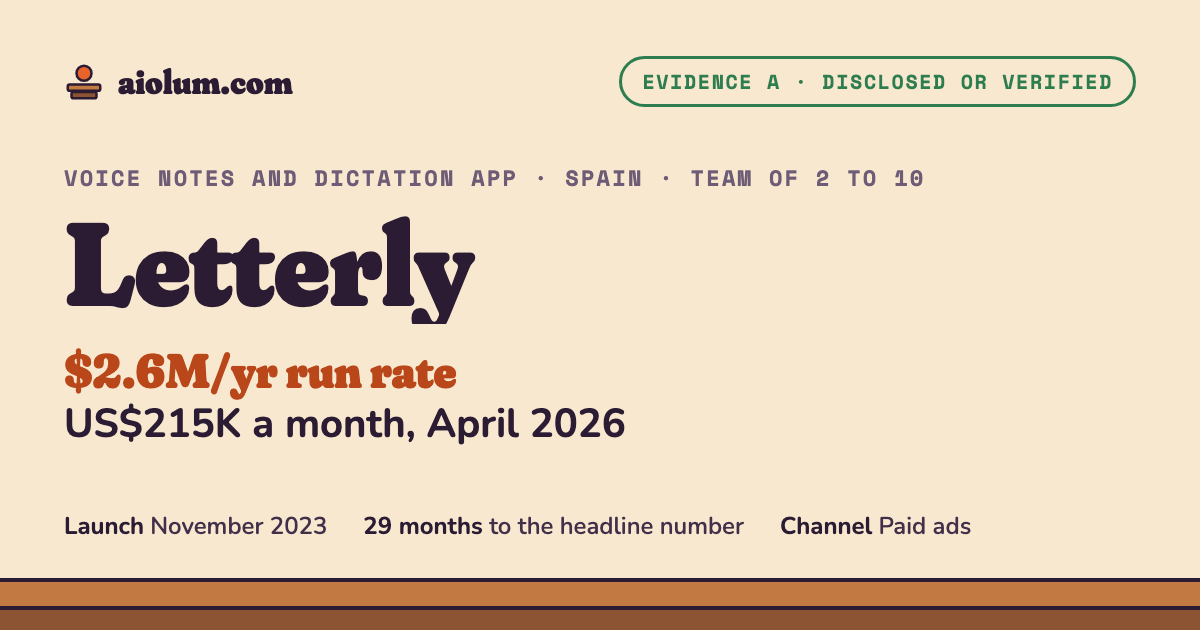
Anton Lebedev, its founder and CEO, had launched five startups in 15 years, and none succeeded, Adapty writes. In 2023 he and his team saw apps that sent audio to OpenAI's Whisper and the transcript to ChatGPT, found them badly made, and dropped their own project to build a simpler one. AppSumo, a marketplace that sells software deals, gives 1 September 2023 as the founding date, and the iPhone app was in the App Store by 23 November 2023. Lifetime deals on AppSumo brought early users from August 2024. From April to August 2025 the app's monthly recurring revenue (MRR, the money that active subscriptions bring in each month) rose 345%, and revenue for June to August 2025 was US$600,000, ten times the US$60,000 of March to May. The version of Adapty's case study last changed on 1 April 2026 says that Letterly makes US$215,000 a month with a team of 10 people, about US$2.58 million a year.
This page grades the US$215,000 a month A. Adapty's software runs the app's subscriptions: in the case study's words it handled "payments, receipt validation, cross-platform subscription management" and became the team's "ground truth" for decisions, and Adapty states the figure under its own name. Adapty is not the payment processor, the company that moves the money, because for app store purchases that is Apple or Google and for web sales it is Stripe. This site counts a payment company's customer story, such as Stripe's, as grade A for that reason, as it did for Wave AI. The case study does not say that the figure was read from Adapty's dashboard, does not date its word "today", and is a marketing page for Adapty's own product, so a stricter reader can treat it as grade B. Ten people is the upper limit of this site's small-team filter; the story is on the site only because the money evidence is grade A or B.
The numbers, graded
Each row shows the evidence grade and the source numbers from the list at the end of this page. The grades are explained in How Aiolum verifies.
| Fact | Value | Grade | How we know | Sources |
|---|---|---|---|---|
| Revenue per month, April 2026 version of the case study | US$215,000 | A | Adapty: "Today Letterly makes $215,000 a month". In the version last modified 1 April 2026, archived on 22 April 2026, and unchanged on the live page, modified 27 April 2026. The page was first published on 13 March 2026; no copy of that first version exists. The title, "Scaled to $215K/Month in 5 Months", ties the figure to the five months from April to August 2025, so it may describe the level reached in 2025. The page does not say whether app store fees are deducted. | [1, 2] |
| Run rate from US$215,000 a month | about US$2.58 million a year | calc | Calculated: US$215,000 times 12. This is the headline figure on this page. | [1] |
| Growth of monthly recurring revenue, April to August 2025 | +345% | A | Adapty: "From April to August 2025: Letterly’s MRR jumped 345%". August MRR was therefore 4.45 times April MRR (calculated). Adapty gives no MRR amounts. | [1, 2] |
| Revenue, March to May 2025 and June to August 2025 | US$60,000, then US$600,000 | A | Adapty: "total three-month revenue increased from $60K to $600K (Mar – May vs. Jun – Aug)". Ten times as much; June to August averages US$200,000 a month (both calculated). | [1] |
| Average revenue per user (ARPU), April to August 2025 | +253% | A | Adapty: "ARPU climbed 253%"; the highlights give 253.1%. | [1] |
| Revenue from the two best paywalls | US$127,000 and US$95,000 | A | Adapty: "Two of their winning paywalls brought in $127K and $95K." The page does not give the period. Together US$222,000 (calculated). | [1] |
| Installs, April to August 2025 | +188.8% | B | Adapty's highlights: "+188.8% increase in installs". A download count, not a payment figure. | [1] |
| Team at the US$215,000 figure | 10 people | B | Adapty: "Letterly runs a lean team of 10 people", on the same page as the revenue figure. A headcount is not a payment figure, so it is graded B. No source gives a smaller team at an earlier dated figure. | [1, 2] |
| Revenue per team member | about US$258,000 a year | calc | Calculated: US$2.58 million divided by 10 people. | [1] |
| April 2026 compared with June to August 2025 | about 7.5% higher | calc | Calculated: US$215,000 against the June to August 2025 average of US$200,000. That is within 15%, so this page counts the trend as flat. | [1] |
| Operator | the founder, as a self-employed person registered in Spain | C | Data processing agreement: "Letterly, operated by Anton Lebedev, Autónomo registered in Spain". Autónomo is the Spanish status of a self-employed person. The contacts page gives a business address in Valencia, and Apple's page lists him as seller and developer. | [5, 7, 3] |
| Outside funding | none reported | C | No source mentions an investor. A self-employed person has no company shares to sell, so the business in its present legal form has no equity investors (a deduction, not a statement by the company). | [1, 5] |
| Founding date | 1 September 2023 | C | AppSumo's company details: "Founded September 1, 2023". | [8] |
| iPhone app available | by 23 November 2023 | C | The first archived copy of the real letterly.app, 23 November 2023, links to the App Store and marks Google Play as "soon" with a waiting list for Android. | [9] |
| App Store ratings, October 2026 | about 1,100 ratings, 4.7 out of 5 | B | Apple's US page shows "1.1K Ratings". Apple counts them; they are not a payment figure. | [3] |
| Users claimed | more than 300,000 | C | Home page: "What 300,000 + users say". Not verified. | [4] |
| AppSumo reviews, October 2026 | 366 | B | AppSumo's deal page. Counted by the marketplace. | [8] |
| AI providers named by the company | Microsoft Azure, ElevenLabs, Google Gemini and OpenAI | C | Data processing agreement effective 24 March 2026 and privacy policy last updated 1 January 2026. Neither says which model does which step. | [5, 6] |
| Time from the iPhone app to the April 2026 figure | 29 months | calc | Calculated: November 2023 to April 2026. From the founding date of 1 September 2023 it would be 31 months. | [9, 2, 8] |
How to read this table: a grade A value is stated by Adapty, the company whose software records the app's subscriptions, in its case study under its own name. A grade B value is a count published by Adapty, Apple or AppSumo that is not a payment figure. A grade C value comes from Letterly's own pages, the founder's posts or the AppSumo listing. A "calc" value was computed on this page from the rows above it.
| Plan | Per month, billed yearly (US$) | Per month, billed monthly (US$) | Limit |
|---|---|---|---|
| PRO, 1 month | 19.99 | no limits on recordings or AI rewrites | |
| PRO, 3 months | 14.97 | billed 44.90 every 3 months | |
| PRO, 1 year | 5.83 to 8.33 | four App Store prices: 69.99, 79.99, 89.99 and 99.99 a year | |
| PRO, lifetime | 199.99 one-time | also listed at 249.99 one-time | |
| AppSumo lifetime deal | 89 one-time | 1 code, list price shown as 200; 10 codes for 890 |
The app is free to download, and the website says "Start for free" without listing the limits of the free version. Apple's page lists four yearly prices and two lifetime prices for the same PRO subscription and does not say which users see which price; an app that tests paywalls, as Adapty says Letterly does, needs a separate store product for each price it tests. Web purchases go through Stripe, and their prices are not published on letterly.app. Paid plans have no limits on recordings or AI rewrites.
The timeline
From a dropped project in 2023 to US$215,000 a month about 29 months after the iPhone app appeared, with lifetime deals first and paid ads later. Each entry carries its grade.
- Before 2023CLebedev spends 15 years on startups. He launches five, and none succeeds. [1]
- 2023CHe and his team see apps that transcribe audio with OpenAI's Whisper and reformat it with ChatGPT. They drop the project they were working on and build Letterly. [1]
- 1 September 2023CFounding date, as given on AppSumo. [8]
- By 23 November 2023CThe iPhone app is in the App Store: "Convert any speech to clear & structured text". Android is "soon". [9]
- August 2024CFirst launch on AppSumo, with a founder's post dated 14 August 2024. The app is then "a simple list of voice notes with a strict 15-minute limit". [8]
- 2 October 2024CSecond AppSumo launch. A web version is in beta, a Mac version is coming, and notes sync between phone and web. [8]
- 26 December 2024CThird AppSumo launch. The founder writes that launching there "has been one of the best decisions of 2024". [8]
- April to August 2025AMRR rises 345%, ARPU 253% and installs 188.8%. Revenue for June to August is US$600,000, ten times March to May. Advertising plays a major role. [1]
- 13 March 2026AAdapty publishes its case study on Letterly. [1]
- 1 April 2026AVersion of the case study that says "Today Letterly makes $215,000 a month" and gives a team of 10 people, archived on 22 April 2026. The same day Letterly releases an Android app rebuilt from the ground up. [2, 10]
- April 2026CMCP support: Claude, ChatGPT and Cursor can search and manage Letterly notes. [10]
- June 2026CLetterly Keyboard on iPhone and a dictation bubble on Android: users can dictate inside any app. [10]
- October 2026BStill updated every few weeks: version 2.7.8 on the App Store, about 1,100 ratings at 4.7. [3]
Why it worked
Four causes, in the order they mattered. Each one is a reusable lesson.
A proven idea, made simpler
Lebedev's earlier startups were new ideas that nobody used. This time, according to Adapty, he "chose a market-validated idea and focused entirely on execution": the Whisper and ChatGPT apps of 2023 had shown that people wanted the product, and Letterly made every screen and every interaction as simple as it could. Adapty names "ruthless simplicity" as the reason people pay while free tools exist.
Lifetime deals for early users
Letterly sold lifetime access on AppSumo in at least four launches between August 2024 and April 2025, and again in May 2026; today a code costs US$89. The founder's posts there thank the buyers for the requests that became the web and Mac versions, sync between devices and custom rewrite styles. The deal page shows 366 reviews.
Paid ads measured by subscription data
Adapty writes that advertising "played a major role" in the growth from April to August 2025, when installs rose 188.8%. The privacy policy lists Facebook Audience Network and AppsFlyer for advertising; AppsFlyer is an attribution tool, software that tells an app which ad brought each install. Adapty supplied the revenue side: MRR, ARPU and churn, the share of subscribers who cancel, by country and product.
Paywall tests
A paywall is the screen that asks the user to pay. With Adapty's Paywall Builder the team assembled and shipped its own paywall designs in twenty minutes instead of waiting for developers, and kept the ones that sold best. Two of the winning paywalls brought in US$127,000 and US$95,000. Apple's page today lists four yearly prices and two lifetime prices for the same PRO plan.
How it was built
These details come from Letterly's data processing agreement, privacy policy and updates page, Apple's App Store page and the Adapty case study. They are grade C. [5, 6, 10, 3, 1]
- Speech and text models: the data processing agreement of 24 March 2026 lists Microsoft Azure for "Transcription; text processing", ElevenLabs for "Transcription and voice processing" and Google's Gemini for "AI text processing". The privacy policy of 1 January 2026 names OpenAI as an AI provider. No source says which model does which step, or whether Letterly itself ever used Whisper.
- Infrastructure: Google Cloud Platform in the EU, Firebase Authentication for accounts, Vercel for the website, Sentry for error reports, OneSignal for messages to users, and Amplitude and Google Analytics for Firebase for product analytics.
- Payments: Apple and Google in-app purchases and Stripe for the web, with Adapty managing the subscriptions and the paywalls on all platforms.
- Apps for iPhone, iPad, Mac, Apple Watch, Android, Windows and the web, kept in sync. A keyboard on iPhone and a dictation bubble on Android, both from June 2026, let users speak into other apps.
- Connections: Zapier and webhooks send notes to other tools, and an MCP server (Model Context Protocol, a standard way for AI assistants to call outside tools) lets Claude, ChatGPT and Cursor search the notes, from April 2026.
- More than 90 languages detected automatically, recordings of up to 90 minutes, and no limits on recordings or rewrites in paid plans. The site says that notes are never used to train AI.
Tools named in the sources
Each one opens its page in the Tools tab, with every story that uses it.
The dead that came before
Five companies in the Loot Drop database tried to change how people put words into a device, or how they keep notes, and lost to what the platform owners shipped or to the phone itself. The values below are from that database and are not independently verified.
Whirlscape
The promiseMinuum, a one-line phone keyboard that saved screen space.
Why it diedThe default keyboards got better AI, and users stayed with them.
Tellme
The promiseInformation and services by voice command over the phone.
Why it diedPhone apps and AI assistants replaced its voice commands.
VocalIQ
The promiseTalking to computers in natural conversation.
Why it diedIt could not compete with the voice assistants of the large technology companies and ended inside Apple.
Springpad
The promiseSave and organize everything, from web articles to recipes, in one free app.
Why it diedUsers liked the free product, but the company did not find what they would pay for before the money ran out.
Humane
The promiseA US$700 AI badge with a laser projector, to replace the smartphone.
Why it diedNobody asked for a phone replacement, and the phone already did the job.
What changed
Each of the five tried to change how people put words into a device or keep notes, and each lost to what the platform owners shipped for free or to the phone itself: default keyboards beat Minuum, phone apps and assistants replaced Tellme's voice service, VocalIQ ended inside Apple, and Humane's badge could not replace the phone. Letterly sells into the same place. Apple's Notes and Phone apps record, transcribe and summarize, Google's Recorder summarizes on Pixel phones, and ChatGPT records, dictates and summarizes audio files.
Two things differ. First, the predecessors had to build their own technology and raised between US$500,000 and US$238 million to do it; Letterly rents speech recognition and language models from several providers and pays by use, and no source reports any investment. Second, Letterly sells a finished result, an email or a note in the user's style, in the apps where people already write, and it measures every price and every paywall with subscription data, so a team of 10 could see within five months which paywall and which ads brought paying users.
Can one person copy it now?
The product is copied often. The method can be copied.
A voice-to-text app is easy to build with rented models, and the App Store already shows many similar apps, AudioPen among them, while Apple, Google and OpenAI include the same features in their own products. What made Letterly earn money was execution: a simpler app than the first ones, early users from lifetime deals, then paid ads and paywall tests measured by subscription data. That needs money for ads and a team that can test quickly, so it is harder for one person than it looks.
Where it is still open: Dictation inside other apps, through a phone keyboard or a desktop app, and notes that AI assistants can read through MCP: the two directions that Letterly itself took in 2026.
- 1Choose an idea that rough early products have already proven, and make the simplest version of it.
- 2Sell lifetime deals on a marketplace early, for cash and for feature requests from real users.
- 3Run every purchase through one subscription platform, so that MRR, ARPU and churn are visible by country and product.
- 4Test paywalls and prices all the time, keep the winners, and buy ads only where the subscription data shows paying users.
What to watch
The risks are the mirror image of the causes above.
Ten people, the top of this site's range
Adapty says that Letterly runs a team of 10 people, on the same page as the US$215,000 a month. That is the upper limit of this site's small-team filter, and the story is here only because the revenue evidence is grade A. It is not a one-person business, and no source gives an earlier revenue figure from a smaller team.
A vendor's marketing page, and an undated "today"
The revenue figures come from Adapty's case study, a marketing page for its own product. It was published on 13 March 2026 and changed on 1 April and 27 April 2026; no archived copy of the first version exists. Its title ties US$215,000 a month to five months of growth in 2025, while the text says "today". It does not say whether the figure is before or after the app stores' fees, or whether it includes web sales. A stricter reader can grade it B.
Apple and Google build it into the phone
Apple announced on 10 June 2024: "In the Notes and Phone apps, users can now record, transcribe, and summarize audio." Google's feature drop of 6 December 2023 put "Summarize in Recorder", run by its Gemini Nano model on the phone, on the Pixel 8 Pro. Both come at no extra cost on the phones that support them.
ChatGPT does the same job
OpenAI's release notes list record mode in the ChatGPT Mac app (Team users from 4 June 2025, Plus users from 16 July 2025), a new speech-to-text model for dictation in all plans (26 June 2026), and audio uploads that "turn a meeting, interview, or lecture into structured notes or a follow-up email draft" for paid plans (6 October 2026). Adapty itself notes that Letterly earns money while "ChatGPT and dozens of other transcription tools remain free".
The same field on this site
Among this site's voice-note stories, Letterly's US$215,000 a month (grade A, team of 10) is below Wave AI's US$4 million a year in November 2024 (grade A, one founder) and far above AudioPen's US$15,000 to US$20,000 a month in February 2026 and AudioNotes's about US$7,200 a month in August 2024 (both grade C, one founder each), while Talknotes was sold for US$200,000 in July 2024 (grade B).
Rented models and unlimited use
Every recording goes to outside providers: Letterly's own documents name Microsoft Azure, ElevenLabs, Google's Gemini and OpenAI. Their prices and terms set Letterly's costs, and the company promises "no limits on recordings or AI rewrites", also to buyers of lifetime plans (US$89 on AppSumo, US$199.99 or US$249.99 on the App Store) who never pay again.
Growth paid for with ads
Adapty says that advertising played a major role in the 2025 growth. Ad-driven growth stops when ad prices rise or when many similar apps bid for the same users, and Apple's page for Letterly lists seven other voice and note apps under "You Might Also Like", AudioPen among them.
Sources
The grade next to each source is the best grade that the source can support. "Read in full" means that the text of the page was downloaded and the numbers were checked in it.
- A Adapty case study: How a team of 10 scaled Letterly to $215K/month without building infrastructure (published 13 March 2026, modified 27 April 2026)Read in full, live on 16 October 2026. Adapty runs the app's subscriptions. Source for the US$215,000 a month, the 2025 growth figures, the paywall results, the team of 10 and the founder's account.
- A Adapty case study on Letterly, Wayback Machine copy of 22 April 2026 (version modified 1 April 2026)Read in full. The earliest archived copy; its article text is the same as the live page, including US$215,000 a month and the team of 10. No copy of the first version of 13 March 2026 exists.
- B Apple App Store, US: Letterly: AI Note TakerRead in full on 16 October 2026. Source for the seller and developer name, the in-app purchase prices, the ratings, the version history and the similar apps.
- C Letterly home pageRead in full on 16 October 2026. Source for the features, the limits and the 300,000 users claim. The address letterly.app/pricing returns the same page; there is no pricing page.
- C Letterly Data Processing Agreement, effective 24 March 2026Read in full. Source for the operator's legal form and the list of sub-processors, the outside companies that handle user data.
- C Letterly privacy policy, last updated 1 January 2026Read the sections on third parties and AI providers. Source for OpenAI, the advertising tools and the infrastructure services.
- C Letterly contacts pageRead in full. Names the founder with a business address in Valencia, Spain.
- C AppSumo deal page: Letterly, AI speech-to-text appRead in full on 16 October 2026. Source for the deal prices, the founding date, the review count and the founder's posts of 14 August 2024, 2 October 2024, 26 December 2024, 17 April 2025 and 20 May 2026.
- C Letterly home page, Wayback Machine copy of 23 November 2023Read in full. The first archived copy of the real site: the iPhone app is available and Android is "soon".
- C Letterly updates pageRead the entries from March 2025 to October 2026. Source for the Android rebuild, MCP, the keyboard and the dictation tools.
- C Letterly affiliate programRead in full. A 30% commission for web sales made through a referral link.
- C Apple Newsroom, 10 June 2024: Introducing Apple Intelligence for iPhone, iPad, and MacRead the section on Notes and Phone. Source for the built-in recording, transcription and summaries.
- C Google blog, 6 December 2023: Pixel feature drop, December 2023Read the section on Recorder. Source for Summarize in Recorder with Gemini Nano on the Pixel 8 Pro.
- C OpenAI Help Center: ChatGPT release notesRead the entries on record mode (June and July 2025), dictation (26 June 2026) and audio uploads (6 October 2026).
- C Loot Drop database export, failed startupsLocal export. AI-written summaries, not independently verified. Source for the failed predecessors.