Wave AI
Wave is an AI note taker: an app that records a conversation and turns it into written notes with AI models. It works in two steps, as the founder describes them. First speech-to-text, a model that converts recorded audio into written words, makes a transcript. Then a large language model, a model trained on very large amounts of text that can read a transcript and write a shorter text from it, writes the summary and the action items. Wave records in-person meetings on the phone, phone calls on its own phone numbers, and Zoom, Google Meet or Microsoft Teams calls through a bot that joins the call. Its data processing terms name AssemblyAI for transcription, with Gladia as a backup, OpenAI for summaries and Anthropic for the chat assistant. It is sold as an in-app subscription, a recurring payment that Apple or Google collects through its app store: free for 30 minutes a month, then US$100 a year or US$15 a month in the app stores, or US$80 a year on the web.
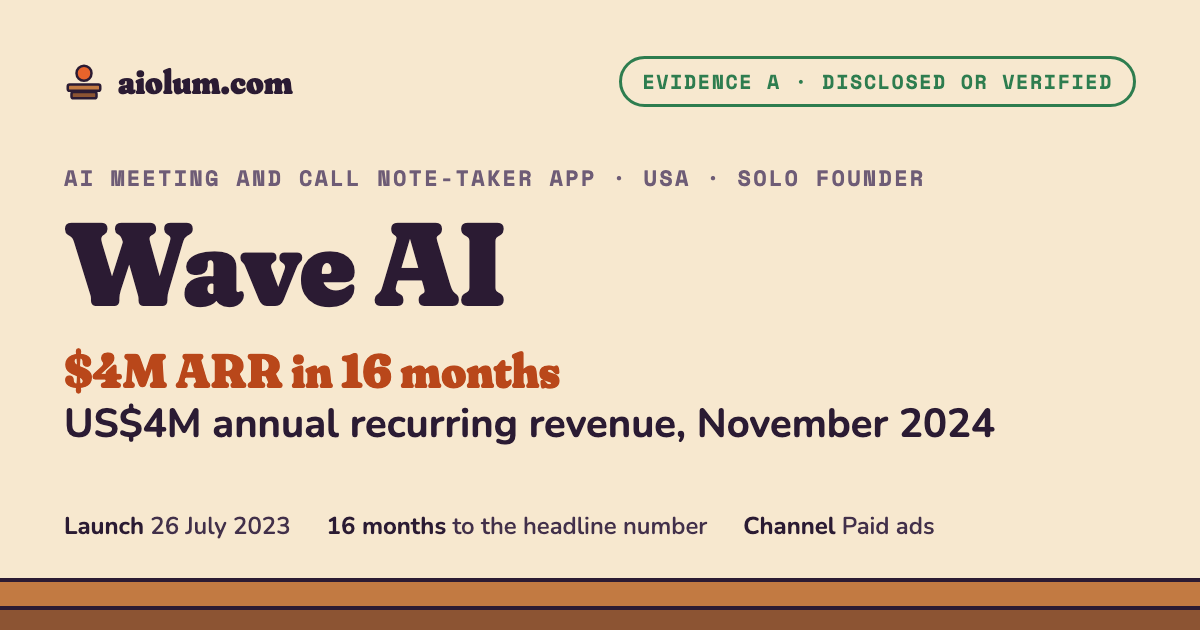
Josh Mohrer, formerly the general manager of Uber in New York, was out of work at the end of 2022 when ChatGPT appeared. He used it to write Swift, Apple's programming language for iPhone apps, and released Wave on the App Store on 26 July 2023. On 29 July 2024 Adapty, the company whose software runs the app's subscriptions, published a case study with US$2 million in annual recurring revenue (ARR, the yearly value of all active subscriptions), more than 50,000 downloads and one team member. By 10 November 2024 Adapty had changed the page to US$4 million ARR, and the founder had replied on X to a post about his US$2 million: "It's $4M actually." In an interview published on 3 February 2026 he said that Wave was at about US$7 million ARR, flat for a few months, that he keeps about US$3 million a year, and that he is still the whole team, with outside help over the years for design, ads and some engineering work.
This page grades the US$2 million and US$4 million figures A. Adapty is not the payment processor, the company that moves the money, because for app store purchases that is Apple or Google. But every purchase of the app passes through Adapty's software, which the founder calls his "central system for all things subscription", and Adapty states the figures under its own name. This site counts a payment company's customer story, such as Stripe's, as grade A for that reason. The case study does not say that the figures were read from Adapty's dashboard, so a stricter reader can treat them as grade B. The US$7 million, the profit and the costs are the founder's own words, grade C. The page also shows earlier companies that lost when a large platform gave the same feature away.
The numbers, graded
Each row shows the evidence grade and the source numbers from the list at the end of this page. The grades are explained in How Aiolum verifies.
| Fact | Value | Grade | How we know | Sources |
|---|---|---|---|---|
| Annual recurring revenue, November 2024 | US$4 million | A | Adapty's case study, in the version archived on 10 November 2024 and still on the page in October 2026: "Current ARR: $4M". Adapty runs the app's subscriptions. The founder gave the same figure on X: "It's $4M actually." | [1, 3] |
| Annual recurring revenue, July 2024 | US$2 million | A | The first version of the same case study, published on 29 July 2024 and archived on 8 August 2024: "Current ARR: $2M". | [2] |
| Annual recurring revenue, February 2026 | about US$7 million | C | Founder in a podcast interview published on 3 February 2026. He said that he had been "flat there for a few months". | [4] |
| Profit, early 2026 | about US$3 million a year | C | Founder, asked about profit: "Can I keep three? Or something like that." He also said that the business "did seven last year", in 2025, and that he would like ten in 2026. | [4] |
| Profit as a share of revenue | about 43% | calc | Calculated: US$3 million divided by US$7 million. Both are the founder's round numbers. | [4] |
| AI cost, late 2024 | 10% to 20% of revenue | C | Founder's replies on X, quoted by the Gaps income report for October 2024: about US$0.10 per hour of audio to OpenAI for transcription, and a similar amount for summaries. | [3] |
| AI cost in dollars at US$4 million ARR | about US$400,000 to US$800,000 a year | calc | Calculated: 10% and 20% of US$4 million. | [1, 3] |
| Team at US$2 million and US$4 million ARR | 1 person | B | Adapty: "Team members: 1". Other people did the design and the ad promotion; the founder wrote and maintained the app and answered every support email. A headcount is not a payment figure, so it is graded B. | [1, 2] |
| Team, February 2026 | the founder, with occasional helpers | C | Founder: "You're talking to the whole team." People came in and out over three years for some engineering and marketing work, and he brings on a new ad agency a few times a year. The website in October 2026 says "a small team in New York". | [4, 6] |
| Downloads | more than 50,000 by July 2024, more than 55,000 by November 2024 | B | Adapty's case study, the two archived versions. Not a payment figure. | [1, 2] |
| Recurring revenue per download | at most about US$73 a year | calc | Calculated: US$4 million divided by 55,000 downloads. The case study says more than 55,000, so the true value is lower. | [1] |
| App Store rating, October 2026 | 4.9 from 12,169 ratings | B | Apple's own App Store record. In February 2026 the founder named the 4.9 rating as a reason why App Store search sends him users. | [9, 4] |
| Plan mix, February 2026 | about a third weekly, a third monthly and a third annual, by number of subscribers | C | Founder. By dollars, most revenue comes from annual plans, and most money that comes in each day is renewals. | [4] |
| Outside funding | none | C | Founder: "I'm not gonna raise money." The app is published by Mohrer Associates LLC of New York, the seller name in the App Store and the operator named in the terms of service. | [4, 9, 6] |
| Time from App Store release to US$4 million ARR | 16 months | calc | Calculated: July 2023 to November 2024. Adapty writes "in 8 months" without saying where it starts counting. It cannot be the release date, because 8 months after July 2023 is March 2024, before Adapty's own US$2 million figure of July 2024. | [1, 9] |
How to read this table: a grade A value is stated by Adapty, the company whose software records the app's subscriptions, in its case study under its own name. A grade B value is a count published by Adapty or Apple that is not a payment figure. A grade C value is the founder's own words. A "calc" value was computed on this page from the rows above it.
| Plan | Per month, billed yearly (US$) | Per month, billed monthly (US$) | Limit |
|---|---|---|---|
| Free | 0 | 0 | 30 minutes of recording a month |
| Pro, bought on the web | 6.67 | 15 | unlimited recording; US$80 a year |
| Pro, App Store or Google Play | 8.33 | 15 | unlimited recording; US$100 a year |
| Teams | 7.50 per user | minimum 5 users; billing period not stated |
Pro bought on the web costs US$80 a year or US$15 a month, which the page calls 20% less than in the app stores. Pro bought through the App Store or Google Play costs US$100 a year or US$15 a month. Weekly billing also exists, and the page says that prices vary by platform and region. The App Store listing shows in-app purchases named Standard at US$6.00, US$15.00 and US$100.00 and older ones named Professional from US$6.99 to US$139.99, without saying which period each one covers. In February 2026 the annual plan came with a three-day free trial, which the founder said should be seven days.
The timeline
From a prototype written with ChatGPT to about US$7 million a year in recurring revenue, run by one person, in 31 months. Each entry carries its grade.
- End of 2022CMohrer, formerly general manager of Uber in New York, is out of work when ChatGPT appears. He uses it to become an engineer and builds small demos: a summary tool for New York State bills, an AI on top of a group chat, and an app that records audio, transcribes it and summarizes it. [4]
- 2023CThe first concept of the app, in Swift for the iPhone, is ready in one day: he splits the code into small parts and asks ChatGPT to write each part. [2]
- 26 July 2023BWave: AI Note Taker is released on the App Store by Mohrer Associates LLC. [9]
- 29 July 2024AAdapty publishes its case study: US$2 million ARR, more than 50,000 downloads, and one team member who also answers every support email. [2]
- By 10 November 2024AAdapty changes the case study to US$4 million ARR and more than 55,000 downloads. The Gaps income report for October 2024 quotes the founder's reply on X to a post that put Wave at US$2 million: "It's $4M actually." [1, 3]
- 3 February 2026CIn a Mixergy interview: about US$7 million ARR, flat for a few months, about US$3 million kept as profit, and no investors. New users come through Apple Search Ads, Google Ads and App Store search; Meta ads have not worked for more than a year. [4]
- 10 October 2026BVersion 4.1.0 of the iPhone app is released. Apple's record shows 12,169 ratings with an average of 4.9. [9]
- October 2026CThe website lists apps for iPhone, Android, Mac, Windows, the web and watches, and a phone line with real US and Canada numbers. It says Wave is built by "a small team in New York". [6]
Why it worked
Four causes, in the order they mattered. Each one is a reusable lesson.
Paid ads at the right time
The founder says that in Wave's early growth "meta ads worked super well" because the app was "a first of its kind thing"; once many similar apps existed, those ads stopped working. Adapty also names "strategic ad promotion" as a cause of the growth. Now Apple Search Ads on iPhone and Google Ads on Android bring users, together with App Store search, where more than 12,000 ratings at 4.9 make the app look trustworthy.
Paywall tests and annual plans
Every purchase runs through Adapty, which the founder uses to run A/B tests of the paywall, the screen that asks the user to pay. An A/B test shows two versions to different users and keeps the one that sells better. Adapty calls this testing the key to the app's growth. Subscribers split about evenly between weekly, monthly and annual plans, but most of the money comes from annual plans and from renewals.
Buy the best transcription
The founder says that he tried Whisper, AssemblyAI and Deepgram for transcription and was not afraid to pay for the best output. In late 2024 AI costs were 10% to 20% of revenue. In 2026 the company's data terms list AssemblyAI for transcription with Gladia as a backup, and OpenAI for summaries.
One person, with AI as the engineering team
ChatGPT wrote the first Swift code in parts in 2023. In 2026 he works with Claude Code and Anthropic's Opus model, which he says costs him US$200 a month as a subscription instead of US$50 to US$100 a day through the API. He answers the support messages himself, because that is where he learns about bugs and about what users want.
How it was built
These details come from the founder's interview, the Adapty case study and Wave's data processing terms, which list the outside services that handle customer data. They are grade C. [4, 2, 7, 6]
- Swift for the iPhone app. The first concept was written in one day in 2023, with ChatGPT writing each piece of code. The founder says that he wrote the first version himself and used AI for examples such as background audio recording.
- Speech-to-text: he tried Whisper 2 and 3, AssemblyAI and Deepgram. The 2026 data terms list AssemblyAI, with Gladia as a backup. Summaries and language features: OpenAI. The chat assistant: Anthropic.
- Google Cloud with Firebase and Firestore for storage, databases and login; Vercel for the web app and the API; Trigger.dev for the background transcription and summary jobs; Turbopuffer for search; Recall.ai for the bots that join Zoom, Meet and Teams calls.
- Phone calls: Twilio for call recording, and Telnyx for phone numbers, calls and text messages.
- Payments: Apple and Google in-app purchases, managed through Adapty, which also runs the paywall tests; Stripe for web subscriptions.
- Support through Intercom's in-app chat, answered by the founder on a page that he built himself on Intercom's API. PostHog for usage analytics, Sentry for errors, Customer.io for email.
- Coding in 2026 with Claude Code and the Opus model, after the Windsurf editor. The website says the service is SOC 2 Type 1 compliant, a security audit standard.
Tools named in the sources
Each one opens its page in the Tools tab, with every story that uses it.
The dead that came before
Four companies in the Loot Drop database promised to capture what people write or say and make it useful, or built a feature that a large platform then gave away. The values below are from that database and are not independently verified.
Kiko
The promiseA web calendar that made booking meetings easy.
Why it diedGoogle Calendar launched for free and made it irrelevant. The founders sold the company on eBay.
Tellme
The promiseInformation by voice: speak to the phone instead of reading a screen.
Why it diedApps and later AI assistants replaced its voice commands.
Springpad
The promiseCollect and organize everything, from web articles to recipes, in one notes app.
Why it diedUsers liked the free product, but the company never found what they would pay for before the money ran out.
Transpose
The promiseA notes app like Evernote for businesses, with templates and collaboration.
Why it diedIt charged US$14.99 against Evernote, with no venture money and no strong reason for users to switch.
What changed
Kiko died when Google gave away a calendar, and Springpad and Transpose died because free or established notes apps left users little reason to pay. Wave faces the same pressure. Zoom gave away meeting summaries to paid accounts in September 2023, Google Meet added note-taking in August 2024 and notes for in-person meetings in August 2026, and Apple added call recording and summaries to the iPhone in October 2024.
Three things differ. Speech-to-text and language models became good enough and cheap enough in 2023 to sell notes for US$100 a year with AI costs of 10% to 20% of revenue. One person with AI coding tools and occasional helpers could build and run apps for phones, computers, the web and watches, so the company needed no venture money. And Wave covers in one app what each platform covers only in part: in-person conversations, phone calls on a separate number, and calls in any meeting tool, with the same notes on every device.
Can one person copy it now?
The timing, no. The method, partly.
The months when a new kind of app could grow on Meta ads are over; the founder says such ads stopped working once many similar apps appeared. What can still be copied is the structure: a phone app that does one job well, paid model APIs instead of own models, constant paywall tests, annual plans, and one person who reads every support message.
Where it is still open: Recording and summary apps for one profession at a time (the founder was advised to build a version for doctors or for construction and chose a general app instead), and languages or regions that the large meeting tools serve poorly.
- 1Pick a job that a new model makes possible and ship the simplest version on the App Store.
- 2Buy the best speech or language API you can, and check that AI costs stay a small share of the price.
- 3Use a subscription platform to test paywalls and prices often, and offer annual plans.
- 4Answer support yourself; it is where you find the bugs and the next features.
What to watch
The risks are the mirror image of the causes above.
Phones and meeting tools now include it
Zoom made meeting summaries part of paid accounts at no extra cost on 5 September 2023. Google Meet began rolling out "Take notes for me" to selected Workspace customers on 27 August 2024 and started extending it to in-person meetings in August 2026. Apple added recording, transcription and summaries to the Phone and Notes apps with iOS 18.1 on 28 October 2024. Otter, an older rival app, has a free plan with 300 minutes a month and Pro listed at US$8.49 to US$16.99 a month. Wave's answer is one app for every kind of conversation.
Recording laws and consent
Federal law and 38 states with the District of Columbia allow a recording when one party to the conversation consents, but the Digital Media Law Project lists eleven states that require the consent of every party, among them California, Florida, Massachusetts, Pennsylvania and Washington. Apple's Phone app tells all participants automatically when a recording starts. Wave's terms make the user "solely responsible" for getting consent, and its call-recording page says to "inform the other party when required". The Wave pages read for this story do not say that the app announces a recording itself.
Growth has stopped, and ads are harder
In February 2026 the founder said that revenue had been flat for a few months at about US$7 million a year, and that Meta ads had not worked for more than a year because there are now many similar apps. The business depends on Apple Search Ads, Google Ads, App Store search and renewals.
Dependent on model providers
Transcription comes from AssemblyAI with Gladia as a backup, summaries from OpenAI and the chat assistant from Anthropic. A price rise, a policy change or a provider's own note-taking feature would hit the margin directly; in late 2024 these costs were already 10% to 20% of revenue.
Same idea, smaller results
The site's AudioNotes story (about US$7,200 a month in August 2024, founder figures) and Talknotes story (sold for US$200,000 in July 2024) sell the same record, transcribe and summarize idea for voice notes; Wave aimed at meetings and calls, bought ads, and reached US$4 million ARR in its second year.
One person, and a vendor's marketing page
The founder does the engineering and the support alone and says that things get missed. The grade A figures come from Adapty's marketing page, which changed from US$2 million to US$4 million without dating the change; the later figures are his own words.
Sources
The grade next to each source is the best grade that the source can support. "Read in full" means that the text of the page was downloaded and the numbers were checked in it.
- A Adapty case study: Wave AI, growing an indie app from $0 to $4M ARR with Adapty (published 29 July 2024, later changed; archived 10 November 2024)Read in full, live on 16 October 2026 and in the Wayback Machine copy of 10 November 2024, which already shows US$4M. Adapty runs the app's subscriptions. Source for the US$4M ARR, the team of one and the downloads.
- A Adapty case study, first version: from $0 to $2M ARR in 6 months, Wayback Machine copy of 8 August 2024Read in full. Source for the US$2M ARR, more than 50,000 downloads, the one-day prototype written with ChatGPT and the support done by the founder.
- C Gaps Income Report, October 2024 (published 10 November 2024): Josh Mohrer shared his AI note-taking has reached $4M in ARRRead the section on Wave. It quotes the founder's replies on X: the US$4M figure and the AI costs.
- C Mixergy, 3 February 2026: The $7 Million Vibe Coded App, Andrew Warner's interview with Josh MohrerRead the full transcript. Source for the US$7M ARR, the profit, the team, the ads, the tools and the plan mix. The transcript is automatic and gets some words wrong.
- C Wave pricing pageRead in full on 16 October 2026, including the answers to pricing questions in the page code.
- C Wave website: home, about, phone and terms of service pagesRead in full on 16 October 2026. Source for the platforms, the phone line, the operating company Mohrer Associates LLC and the consent clause in the terms.
- C Wave Data Processing Addendum, Annex 3: subprocessors and vendorsRead the subprocessor tables. Source for the AI providers and the infrastructure.
- C Wave: record phone calls, use-case pageRead in full, including the answer to "Is it legal to record phone calls?" in the page code.
- B App Store listing of Wave AI Note Taker & Recorder, and Apple's lookup record for app 6451491556Read in full on 16 October 2026. Apple's record gives the release date of 26 July 2023, the seller, the in-app purchases and the rating count.
- C Apple Newsroom, 28 October 2024: Apple Intelligence is available today on iPhone, iPad, and MacRead the section on the Notes and Phone apps. Source for call recording with an automatic notice to participants.
- C Zoom press release, 5 September 2023: Zoom introduces Zoom AI Companion, available at no additional cost with paid Zoom user accounts (GlobeNewswire copy on aap.com.au)Read in full. Zoom's investor site refused the download (HTTP 403), so the wire copy was used.
- C Google Workspace Updates, 27 August 2024: "Take notes for me" in Google Meet is now availableRead in full.
- C Google Workspace Updates, August 2026: Take Notes for me for in-person meetings is now availableRead in full. The month comes from the address of the post; the exact day was not confirmed.
- C Otter.ai pricing pageRead the plan table on 16 October 2026.
- C Digital Media Law Project: Recording Phone Calls and ConversationsRead in full. A legal guide for journalists, not legal advice; it notes later changes, for example in Illinois.
- C Loot Drop database export, failed startupsLocal export. AI-written summaries, not independently verified. Source for the failed predecessors.