Morph: Revenue, team and how it was built
Morph (Fast specialized models for coding agents, United States): US$6M a year in revenue as reported, August 2026. Evidence grade D: reported, not verified. Team: 1 founder (Tejas Bhakta); the Lean AI Leaderboard listed 1 employee in August 2026, the Y Combinator page listed a team of 3 in November 2026. Launched April 2025; still running, revenue growing.Added 5 November 2026 · updated 6 November 2026
- Outcome
- US$6M a year in revenue as reported, August 2026Revenue growing
- Evidence
- D reported, not verified
- Launch
- April 2025
- Status
- Still running
- Team
- 1 founder (Tejas Bhakta); the Lean AI Leaderboard listed 1 employee in August 2026, the Y Combinator page listed a team of 3 in November 2026
- Outside funding
- Y Combinator, Summer 2023 batch; amount not published in the sources read
- Main channel
- Not stated
What is not verified
The headline figure of US$6 million a year rests on one source: the Lean AI Leaderboard's August 2026 row, which cites a post by Tejas Bhakta on X that this page could not read. The earlier US$1 million figure for July 2025 is a Latka directory entry with no source recorded. No payment-processor profile, filing or press report confirms either. A reader could look for an interview in which the founder gives the figure, or a funding announcement that states revenue. The headline number is grade D: one claim or one estimate, with no second source. Aiolum shows it because the story is useful, and marks it so that it is not mistaken for a verified figure.
Morph sells inference, which means running a trained AI model to produce an answer, to companies that build coding agents: programs in which a large language model reads a codebase, plans a change and edits files by itself. Its first product, Fast Apply, takes the "lazy" edit that a large model writes, a snippet with markers such as "// ... existing code ...", and merges it into the full file. Later products search code (WarpGrep) and compress an agent's working memory (Compact). Everything is sold through one API that works like the OpenAI API.
The company is a Y Combinator company from the Summer 2023 batch with one listed founder, Tejas Bhakta. The first archived copy of its website, from 8 April 2025, already offered the edit model at "1000+ tokens/second". He announced it on Hacker News on 7 July 2025 at 4,500 tokens a second, and in September 2025 he wrote that a new version reached 10,500 tokens a second on one Nvidia B200 GPU. In March 2026 Amazon Web Services published a case study in which Binance reported its developers became 50 to 70 percent more effective with Fast Apply.
The money figures are not verified. Latka listed annual revenue of US$1 million in July 2025 with "source not recorded". The Lean AI Leaderboard, a public spreadsheet of small high-revenue companies, listed US$6 million a year and 1 employee in August 2026, citing a post by the founder on X that this page could not read. The Y Combinator page listed a team of 3 in November 2026, and the AWS case study quotes a founding researcher, so the team is very small but probably not one person.
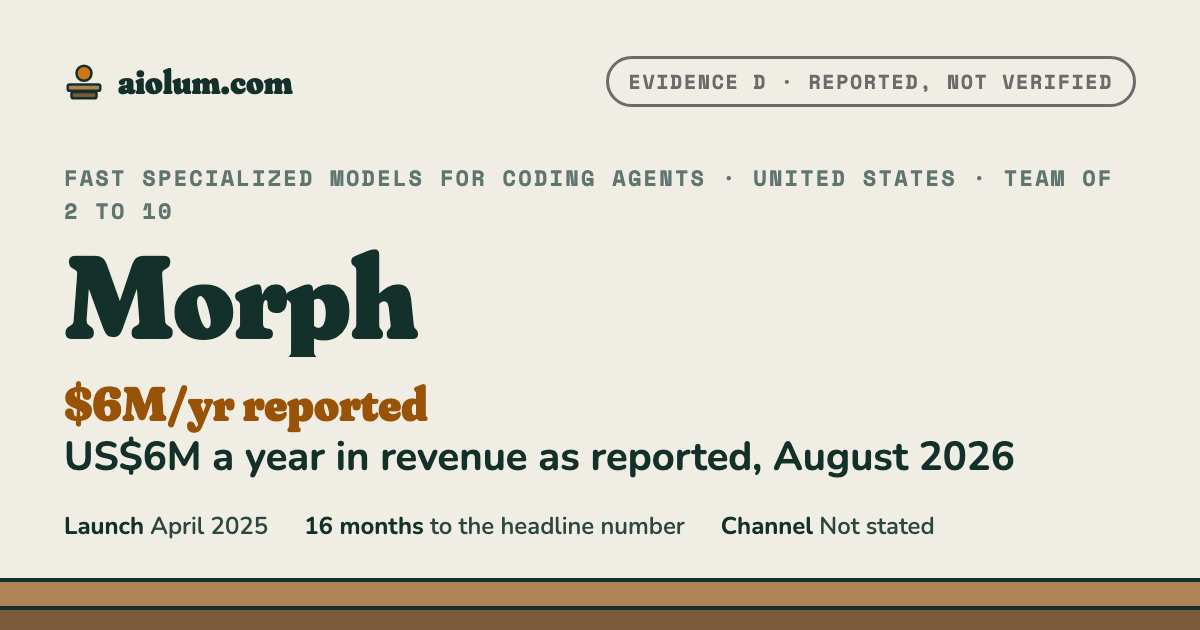
How much revenue does Morph make?
Each row shows the evidence grade and the source numbers from the list at the end of this page. The grades are explained in How Aiolum verifies.
| Fact | Value | Grade | How we know | Sources |
|---|---|---|---|---|
| Annual revenue, August 2026 | US$6,000,000 a year, as reported | D | Lean AI Leaderboard snapshot dated August 2026 (row for Morph, "AI Coding Models & Infrastructure", San Francisco). Its source column is a post by the founder on X, which this page could not read. Not verified. | [1] |
| Revenue per month implied by the August 2026 figure | about US$500,000 | calc | Calculated: US$6,000,000 divided by 12. | [1] |
| Annual revenue, July 2025 | US$1,000,000 | D | Latka company page: "Morph's annual revenue was $1M in July 2025 (source not recorded)." A directory figure with no named source. | [2] |
| Growth between the two reported figures | 6 times in 13 months | calc | Calculated: US$6,000,000 in August 2026 divided by US$1,000,000 in July 2025. Both inputs are grade D. | [1, 2] |
| Employees, August 2026 | 1 | D | Lean AI Leaderboard, same row. It also computes revenue per employee as US$6,000,000. | [1] |
| Team size, November 2026 | 3 | C | Y Combinator company page, read 5 November 2026. The page also lists open roles for a founding account executive and a member of technical staff. | [3] |
| Founders | 1, Tejas Bhakta, founder and CEO | C | The Y Combinator page lists one founder. AWS's case study calls him founder and CEO and quotes a founding researcher. | [3, 5] |
| Funding | Y Combinator, Summer 2023 batch | C | Y Combinator page. No source read gives the amount or a later round. | [3] |
| First archived website | 8 April 2025 | C | Internet Archive copy of morphllm.com: "The fastest way to apply updates to files", "1000+ Tokens/Second". The company changelog dates its first release "April 1, 2024", which does not fit the speeds it lists for 2024; this page uses April 2025. | [11, 8] |
| Launch on Hacker News | 7 July 2025, 217 points, 185 comments | C | "Launch HN: Morph (YC S23) – Apply AI code edits at 4,500 tokens/sec", posted by the founder. | [4] |
| Speed of the edit model | 10,500 tokens a second per request on one B200 GPU | C | Founder's blog post, 15 September 2025. The previous version ran at 4,500. The 7B model fits in 40 GB of GPU memory. | [9] |
| Customers | "over 20 coding services" and Binance | C | AWS case study, published about March 2026. Binance, with 5,000 developers, reported 50 to 70 percent more effective teams. | [5] |
| Training and hosting | Amazon EC2 P5 (Nvidia H100) for training, Amazon SageMaker for enterprise deployment | C | AWS case study and the founder's post about it. | [5, 12] |
| Prices | Free, US$20, US$60 and US$400 a month, or per token | C | Company pricing page, November 2026. | [7] |
| Time from first archived site to the August 2026 figure | 16 months | calc | Calculated: April 2025 to August 2026. | [11, 1] |
How to read this table: a grade D value is reported by one source that did not check it (a leaderboard that retells a founder post, or a directory estimate). A grade C value comes from the company's own pages, its founder, or a directory page the company maintains. A "calc" value was computed on this page. No value is grade A or B.
| Plan | Per month, billed yearly (US$) | Per month, billed monthly (US$) | Limit |
|---|---|---|---|
| Free | 0 | 250K credits, low rate limits | |
| Starter | 20 | 2M credits | |
| Pro | 60 | 8M credits | |
| Scale | 400 | 80M credits | |
| Enterprise | self-hosted or air-gapped, by contract |
Plans are monthly credit plans; 1 credit is about US$0.00001 and credits apply to every product. Pay-as-you-go prices per million tokens: Fast Apply 7B US$0.80 input and US$1.20 output, Fast Apply 14B US$0.90 and US$1.90, WarpGrep US$0.80 and US$0.80, Compact US$0.20 and US$0.50. There are no per-seat fees. Self-hosting and volume prices are sold to enterprises by contract. The page shows no yearly billing, so the yearly column is empty.
When did Morph launch, and how did it grow?
From a Y Combinator batch in 2023 to an API that serves coding agents at 10,500 tokens a second. Each entry carries its grade.
- Summer 2023CMorph is in Y Combinator's Summer 2023 batch, with Tejas Bhakta as its listed founder. [3]
- 8 April 2025CFirst archived copy of morphllm.com: an API that applies AI code edits to files at more than 1,000 tokens a second, cheaper than GPT-4o for the task. [11]
- 7 July 2025CLaunch on Hacker News at 4,500 tokens a second, priced at US$0.80 per million input tokens and US$1.20 per million output tokens. [4]
- July 2025DLatka lists annual revenue of US$1 million, with no source recorded. [2]
- 15 September 2025CThe founder writes that the edit model now runs at 10,500 tokens a second on one B200 GPU, using his own fused GPU kernels and speculative decoding. [9]
- 21 December 2025CWarpGrep, a search subagent that finds the right files and lines in a codebase, appears in the changelog. [8]
- March 2026CAWS publishes a case study on Morph; Binance reports 50 to 70 percent more effective developers. Morph lists its models on AWS Marketplace. [5, 12]
- 27 March 2026CThe founder explains on the START podcast that subagents keep the main model's context clean, and announces Compact at 33,000 tokens a second. [13]
- August 2026DThe Lean AI Leaderboard lists Morph at US$6 million a year with 1 employee, citing the founder's post on X. [1]
- 23 October 2026CMorph starts serving a DeepSeek model with its refusals removed, only to teams that pass a manual review, for security work. [10]
- November 2026CThe Y Combinator page lists a team of 3 and two open roles. [3]
Why did Morph work?
Four causes, in the order they mattered. Each one is a reusable lesson.
Specialization
A large model is good at deciding what to change and slow at rewriting a whole file. Morph trained a 7B model that does only the merge, with a vocabulary cut down to the tokens that code editing uses. A small model that does one task can run many times faster than a general one.
Own inference code
The founder wrote GPU kernels that fold attention and the feed-forward step into one pass, and uses <dfn>speculative decoding</dfn>: the system guesses several next tokens at once and checks them in one step, keeping the ones that are right. Code edits copy most of the original file, so most guesses are right.
Sell to builders, not to developers
Customers are the companies that make coding agents. They add one tool, edit_file, and call one API. Every agent they sell then sends traffic to Morph, priced per token.
Enterprise packaging
Self-hosting, zero data retention, SOC 2 and a listing on AWS Marketplace let large companies buy without sending code to a new vendor.
How it was built
These details come from the company's site, its blog and the AWS case study. They are grade C. [6, 9, 5, 7]
- Fast Apply models: morph-v3-fast (7B, 10,500+ tokens a second, 40 GB) and morph-v3-large (5,000 tokens a second, 80 GB).
- Custom inference engines instead of general serving software, hand-written CUDA and Triton kernels, and speculative decoding.
- Training on Amazon EC2 P5 instances with Nvidia H100 GPUs; enterprise deployment on Amazon SageMaker; later benchmarks on Nvidia B200.
- Models trained with reinforcement learning on real agent traces; WarpGrep was trained against a weighted F1 score on file and line retrieval.
- One OpenAI-compatible API, plus an MCP server, a TypeScript SDK, a Vercel AI SDK provider and a listing on OpenRouter.
- Every page of the website is also served as Markdown for AI agents, with an llms.txt index.
Tools named in the sources
Each one opens its page in the Tools tab, with every story that uses it.
Who tried this before Morph, and why did they fail?
Five companies in our database of failed startups sold tools to software developers or GPU compute for AI, and failed. The values below are from that database and are not independently verified.
Kite DevTool
The promiseAI code completion inside the developer's editor, years before GitHub Copilot.
Why it diedGitHub Copilot, built on OpenAI Codex and given away inside the dominant editor, took the market; developers would not pay for Kite.
Fig DevTool
The promiseEditor-style autocomplete for the terminal.
Why it diedDevelopers used it every day but few paid, so revenue never covered the cost of the team.
CodeSee
The promiseMaps of a codebase to help developers understand it faster.
Why it diedDevelopers liked the demos but could not show a return that justified paying.
Vectordash
The promiseCheap GPU time for AI and gaming from idle machines.
Why it diedLarge cloud providers offered steadier and better integrated GPU services.
FloydHub
The promiseA simple cloud platform to train machine-learning models.
Why it diedAWS SageMaker and other cloud services offered the same with more integration and scale.
The failed startups come from our database of 1,749 dead startups, retold here in our own words. Its entries are AI-assisted summaries of public sources, so these cards carry no evidence grade.
What changed
Kite, Fig and CodeSee sold to individual developers, who liked the tools and did not pay for them. Vectordash and FloydHub sold compute and lost to clouds that sold the same thing at a larger scale. Morph sells compute too, and its customers can in principle train their own merge model, as Cursor did.
Two things differ. First, Morph's customers are companies whose own revenue depends on how fast and reliable their agents are, so the buyer is a business with a budget, and usage grows with every agent they sell. Second, Morph does not sell general compute: it sells a narrow model tuned to one step, run on its own kernels, which a cloud provider does not offer off the shelf. The risk from the predecessors remains: the large model makers can build the same step into their own agents.
Can one person copy Morph now?
The idea, yes. The execution needs rare skills.
Finding one slow, error-prone step inside a popular AI workflow and selling a small model that does only that step is a pattern anyone can apply. Doing it at Morph's speed took model training, GPU kernel programming and GPU budget, which few solo founders have.
Where it is still open: Other narrow steps inside agents: test selection, log search, dependency upgrades, and checking user-interface changes, in domains outside code as well.
- 1Watch where coding agents or other AI agents waste time or fail, and pick one narrow step.
- 2Train or fine-tune a small open-weight model for that step only, and measure it against the general model on speed and accuracy.
- 3Offer it through an OpenAI-compatible API so that adding it is one tool definition.
- 4Sell to the companies that build agents, priced per token, and add self-hosting for enterprises.
What could go wrong for Morph?
The risks are the mirror image of the causes above.
What is not verified
The headline figure of US$6 million a year rests on one source: the Lean AI Leaderboard's August 2026 row, which cites a post by Tejas Bhakta on X that this page could not read. The earlier US$1 million figure for July 2025 is a Latka directory entry with no source recorded. No payment-processor profile, filing or press report confirms either. A reader could look for an interview in which the founder gives the figure, or a funding announcement that states revenue.
One employee or three
The leaderboard listed 1 employee in August 2026. The Y Combinator page listed a team of 3 in November 2026, the AWS case study quotes a founding researcher, and the company advertises two full-time roles. The business is run by a very small team, not by one person alone.
A model with its refusals removed
Since 23 October 2026 Morph serves a version of DeepSeek V4.1 Flash with its safety refusals removed ("Abliterated"). The founder writes that it is for red teams, incident responders and malware analysts, and that access is gated: "Every request is reviewed by a person" and access is "granted to named individuals". This is a legal product; some readers may see it as a risk.
Dates on the changelog
The company changelog dates its first release to 1 April 2024 and lists 10,500 tokens a second in May 2024, while the founder's own blog says 10,500 was reached in September 2025 and the first archived site is from April 2025. The changelog years look wrong; this page uses the archived site and blog dates.
Platform risk
The large model makers and the big coding agents can build their own merge and search models; Cursor already does this in house, as the founder said on Hacker News. Morph's prices per token also depend on the cost of GPUs.
Sources
The grade next to each source is the best grade that the source can support. "Read in full" means that the text of the page was downloaded and the numbers were checked in it.
- D Lean AI Leaderboard, published Google Sheet (CSV export), downloaded 5 November 2026Read the row for Morph (snapshot August 2026). Its source column is the founder's post on X (x.com/tejasybhakta/status/2090620183564231138), which was not fetched.
- D Latka: Morph revenue 2025Read in full. A directory page; the July 2025 figure has "source not recorded".
- C Y Combinator: Morph, Fast Models Optimized for Coding AgentsRead in full, 5 November 2026. Source for the batch, founder, team size and open roles.
- C Hacker News, 7 July 2025: Launch HN: Morph (YC S23) – Apply AI code edits at 4,500 tokens/secRead the founder's post and his replies in the comments.
- C AWS case study: Accelerating enterprise code editing using AWS with MorphRead in full. Source for the customer count, Binance's result and the AWS services used.
- C Morph home page (Markdown version)Read in full, 5 November 2026.
- C Morph pricing page (Markdown version)Read in full, 5 November 2026. Source for the pricing table.
- C Morph changelogRead in full. Its dates for 2024 conflict with other sources; see the watch box.
- C Morph blog, 15 September 2025, Tejas Bhakta: We Hit 10,500 Tokens/Sec on B200Read in full. Source for the speed, model sizes, kernels and speculative decoding.
- C Morph blog, 23 October 2026, Tejas Bhakta: Why We Serve an Uncensored DeepSeekRead the sections on why and how the model is gated; the privileged-access page was also read.
- C Internet Archive copy of morphllm.com, 8 April 2025Read in full. The earliest archived copy of the site.
- C Morph blog, 5 March 2026, Tejas Bhakta: Morph x AWS: The Fastest Code-Editing ModelRead in full.
- C START podcast, 27 March 2026: Tejas Bhakta, Founder & CEO, MorphRead the episode page and chapter list; the transcript page did not load as text.
- C Database of failed startups, local exportLocal export. AI-written summaries, not independently verified. Source for the failed predecessors.
Run this company? Send corrections or a verified figure to aiolum@livyden.com