CNVS: Revenue, team and how it was built
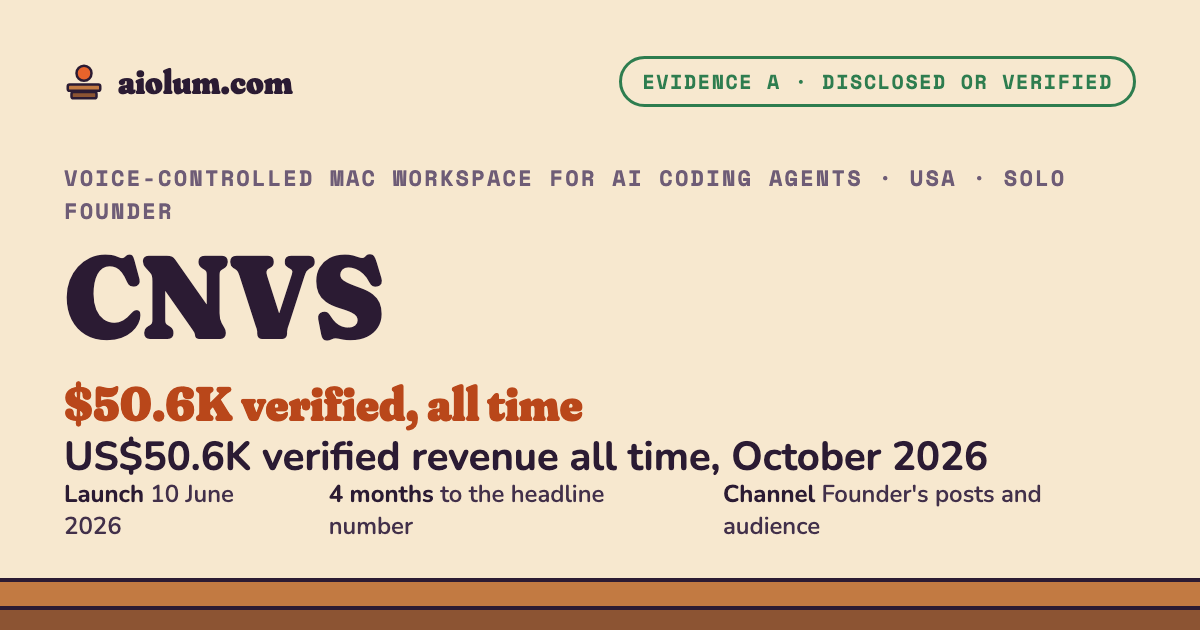
CNVS (Voice-controlled Mac workspace for AI coding agents, USA): US$50.6K verified revenue all time, October 2026. Evidence grade A: disclosed by a company or a filing, or verified by a payment processor. Team: 1 founder. Launched 10 June 2026; still running, revenue falling.Added 27 October 2026
- Outcome
- US$50.6K verified revenue all time, October 2026Revenue falling
- Evidence
- A disclosed by a company or a filing, or verified by a payment processor
- Launch
- 10 June 2026
- Status
- Still running
- Team
- 1 founder
- Outside funding
- None found
- Main channel
- Founder's posts and audience
CNVS, also called Canvas, is an agent workspace for macOS. A coding agent is a program, such as Anthropic's Claude Code or OpenAI's Codex, that reads a code base, edits files and runs commands by itself after a request in plain language. CNVS opens several of these agents side by side on an infinite canvas, a work surface without edges that the user can move around and zoom, and lets the user direct them by voice. It is a native Mac app written in Swift, and it uses the agent subscriptions that the user already pays for.
Max Blade, a solo founder and a former personal trainer, started selling it in June 2026; TrustMRR lists 10 June 2026 as the founding date. TrustMRR is a site that reads revenue directly from a company's payment provider. Its profile shows US$50,583 in revenue through Stripe up to 26 October 2026: US$23,718 in June, US$15,920 in July, then between about US$3,200 and US$4,000 a month. The founder said in a YouTube video that CNVS made more than US$19,000 in its first 11 days, and he posted on 19 July 2026 that it had done over US$36,000 in a little over a month. Both claims fit the Stripe totals.
The headline number is grade A because it comes from the payment provider. The launch claims are founder statements, grade C. The revenue pattern is a launch peak followed by a much smaller steady income: CNVS sells one-time licenses, so it has no recurring revenue. The page also shows four developer tools that could not get enough developers to pay.
How much revenue does CNVS make?
Each row shows the evidence grade and the source numbers from the list at the end of this page. The grades are explained in How Aiolum verifies.
| Fact | Value | Grade | How we know | Sources |
|---|---|---|---|---|
| Verified revenue, all time to 26 October 2026 | US$50,583 | A | TrustMRR, from the Stripe account through an API key. Revenue last synced 26 October 2026. | [1] |
| Verified revenue, June 2026 | US$23,718 | A | TrustMRR monthly timeline. The founding date on the profile is 10 June 2026, so this is about three weeks of sales. | [1] |
| Verified revenue, July 2026 | US$15,920 | A | TrustMRR monthly timeline. | [1] |
| Verified revenue, August and September 2026 | US$3,980 and US$3,781 | A | TrustMRR monthly timeline. | [1] |
| Verified revenue, 1 to 27 October 2026 | US$3,184 | A | TrustMRR monthly timeline; the last 30 days show US$3,383, 15.0% less than the 30 days before. | [1] |
| Share of all revenue from June and July 2026 | about 78% | calc | Calculated: 23,718 plus 15,920 equals 39,638; divided by 50,583. | [1] |
| Fall from June to September 2026 | about 84% | calc | Calculated: 1 minus 3,781 divided by 23,718. | [1] |
| Recurring revenue | US$0, with 0 active subscriptions | A | TrustMRR snapshot. CNVS sells one-time licenses, so its revenue is not recurring. | [1] |
| Sales implied at US$199, August to October 2026 | 20, 19 and 16 licenses | calc | Calculated: 3,980, 3,781 and 3,184 divided by 199 give whole numbers. This assumes every sale was at US$199. | [1] |
| Revenue in the first 11 days | more than US$19,000 | C | Founder in his YouTube video 'Why Your Vibe Coded App Isn't Making Money', as ProvenStartups summarized it on 26 September 2026. ProvenStartups notes the video gives 'no customer count, net receipts, refund total, or audited payment evidence'. It fits the Stripe total of US$23,718 for June. | [5, 6] |
| Revenue by 19 July 2026 | over US$36,000 'in a little over a month' | C | Founder's post on X, quoted by Brag in Public. Stripe shows US$39,638 by the end of July, so the claim fits. | [4] |
| Founder's audience | 24,946 followers on X; a Discord community of more than 500 | C | Follower count on the TrustMRR profile; the Discord figure is from the founder's post of 19 July 2026. | [1, 4] |
| Team | 1 founder | C | ProvenStartups: 'Team Solo (Max Blade)'. TrustMRR names one founder. | [1, 5] |
| First formal release note | version 1.3.2, 17 June 2026 | C | The release notes call it 'the first formal CNVS release note'. Later versions: 1.4.0 on 3 August 2026 and 1.5.2 on 20 September 2026. | [3] |
How to read this table: a grade A value was read from the company's Stripe account by TrustMRR. A grade C value is a founder statement, a founder-written profile field, or the company's own page. A "calc" value was computed on this page from the rows above it.
| Plan | Per month, billed yearly (US$) | Per month, billed monthly (US$) | Limit |
|---|---|---|---|
| License #1 to #5, founder price | 99 one-time | Home page: '5 left' | |
| License #6 to #50 | 129 one-time | Home page | |
| License #51 to #150 | 169 one-time | Home page | |
| License, TrustMRR profile | 199 one-time | Founder-written pricing field |
CNVS is a one-time purchase with no subscription; the home page says it 'works with your existing AI subscriptions', so the user pays the agent providers separately. The home page shows rising prices by license number. The founder-written TrustMRR profile says US$199 one-time, and every daily revenue total in October 2026 is a multiple of US$199, so the current price is probably US$199. This page could not settle the difference.
When did CNVS launch, and how did it grow?
From the first sales on 10 June 2026 to US$50,583 in verified revenue by 26 October 2026. Each entry carries its grade.
- 10 June 2026CFounding date on the TrustMRR profile. Sales start the same month. [1]
- 17 June 2026CVersion 1.3.2, 'Nightglass': the canvas, voice control, project-bound terminals, themes and a first local control server. [3]
- About 21 June 2026CMore than US$19,000 in the first 11 days, by the founder's account in a YouTube video. [5, 6]
- June 2026AUS$23,718 in revenue through Stripe. [1]
- 19 July 2026CThe founder posts over US$36,000 in a little over a month and lists his lessons: lifetime licenses sell more easily than subscriptions, daily live streams, a Discord community of 500 or more. [4]
- July 2026AUS$15,920 in revenue through Stripe. [1]
- 3 August 2026CVersion 1.4.0, 'Shorthand': Apple's on-device model writes a one-line title for each agent's task. [3]
- August and September 2026ARevenue falls to US$3,980 and US$3,781 a month. [1]
- 20 September 2026CVersion 1.5.2, 'Distraction Guard': alerts when an agent finishes or needs the user, also on an iPhone companion app, CNVS Pocket. [3]
- 26 October 2026ATrustMRR shows US$50,583 all time and US$3,383 in the last 30 days. [1]
Why did CNVS work?
Four causes, in the order they mattered. Each one is a reusable lesson.
A new habit, a native app
People who use coding agents now run several at once. The release notes describe the problem: 'eight terminals scrolling, and no way to tell at a glance which one is doing what.' CNVS gives each agent a card on a canvas with its status and a short title, and moves the user to whichever agent needs an answer.
Pay once, no model costs
The founder wrote that 'Lifetime licenses are 100x easier to sell than subscriptions'. CNVS can charge once because it pays for no AI model: the agents run on the user's own subscriptions, and the task titles use Apple's on-device model, with 'no per-request cost'. The cost of this choice is that revenue depends on new buyers every month.
Selling in public, every day
The founder's lessons in July 2026 were daily live streams, which he said force him to show up, and a Discord community of more than 500 people who give feedback. His X account has about 25,000 followers. The product itself is easy to show on video: many agents working at once on one screen.
A launch peak
About 78% of all revenue came in June and July 2026. The founder wrote that he builds 'around what is hot', and that his iPhone app QuickClaw also reached US$7,200 in seven days. Products built around a new trend sell fast at launch, and the Stripe figures show how fast the sales then fall.
How it was built
These details come from the release notes and the home page (grade C), from the ProvenStartups summary of the founder's video (grade C), and from the public page code (grade B). [1, 2, 3, 5]
- A native macOS app written in Swift: 'Apple Native macOS, built in Swift.' The terminal engine is SwiftTerm, a terminal library, updated to version 1.20 in September 2026.
- Speech recognition runs on the Mac with a local Nvidia Parakeet model, according to ProvenStartups' summary of the founder's video.
- Since version 1.4.0 in August 2026, Apple's on-device model writes a short title for each agent's task. Nothing leaves the Mac, and there is no key to add.
- The agents are the user's own command-line tools: Claude Code, Cursor and Codex, and since September 2026 also Kimi, Qwen, Grok and OpenCode with native status reports.
- An iPhone companion app, CNVS Pocket, receives alerts through the company's relay server, which forwards end-to-end encrypted messages that it cannot read.
- Payments go through Stripe, as the TrustMRR profile shows. The website is built with the Astro framework and uses DataFast for visitor analytics, as its page code shows.
Tools named in the sources
Each one opens its page in the Tools tab, with every story that uses it.
Who tried this before CNVS, and why did they fail?
Four developer tools in the Loot Drop database promised a better way to write code and could not get enough developers to pay. The values below are from that database and are not independently verified.
Kite DevTool
The promiseAI code completion inside the programmer's editor.
Why it diedIts freemium model never earned enough, and GitHub Copilot, built on a far stronger OpenAI model and sold through GitHub, took the market.
Fig DevTool
The promiseAutocomplete and visual helpers for the command-line terminal.
Why it diedDevelopers used it daily but would not pay for terminal tools; it was acquired by AWS in 2024.
Light Table/Eve
The promiseA new kind of code editor with live feedback, then a tool to build apps without code.
Why it diedProfessional developers stayed with the editors they knew, and the change of direction to Eve lacked focus and money.
CodeSee
The promiseVisual maps of a code base so developers understand it faster.
Why it diedDevelopers liked the pictures, but engineering managers could not see enough return to pay for it.
The failed startups come from Loot Drop, a free database of dead startups, retold here in our own words. Loot Drop describes its entries as AI-assisted summaries of public sources, so these cards carry no evidence grade.
What changed
The earlier tools tried to make the programmer faster at writing code, and they had to win against free editors. Kite built its own models and lost to Copilot; Fig and CodeSee had happy users who would not pay. Each raised millions of dollars, the Loot Drop database lists, and needed many paying customers every month.
CNVS works one level higher. The agents write the code, and CNVS only helps one person direct many of them at once, so it needs no model of its own and runs on the user's Mac. One founder could build it, sell it to his own followers, and keep the revenue, which TrustMRR reports at US$50,583 in four and a half months. The open question is the same one that ended Fig: whether developers keep paying for a tool around their tools.
Can one person copy CNVS now?
The launch, yes, with the same risk. The product, hard.
Agent workspaces are a new category, and the companies that make the agents, as well as editor makers such as Cursor, can add the same features. What can be copied is the method: build a visible tool around a new habit, show it every day on live streams, sell it once to an audience that already follows you, and expect sales to fall after the first weeks.
Where it is still open: The same idea works outside programming: a workspace that directs several AI agents at once for research, video editing or customer support, with voice control and one place to see which agent needs an answer.
- 1Watch what heavy users of a new AI tool struggle with, such as following many agents at once.
- 2Build a tool around that problem that needs no model of its own, so a one-time price can work.
- 3Show the tool working on live streams and short videos, where the result is easy to see.
- 4Plan for the fall after launch: updates, new versions or a second product to bring new buyers.
What could go wrong for CNVS?
The risks are the mirror image of the causes above.
Revenue fell after the launch
Stripe shows US$23,718 in June 2026 and then between US$3,184 and US$3,980 a month from August to October, with the last 30 days 15.0% below the 30 days before. One-time licenses bring no recurring revenue, so the business depends on new buyers every month.
Prices do not agree
On 27 October 2026 the home page lists US$99 for a founder license with '5 left', US$129 for licenses 6 to 50 and US$169 for licenses 51 to 150. The founder-written TrustMRR profile says '$199 one-time payment', and the daily revenue totals in October are multiples of US$199. One buyer's review on the home page mentions paying 169 dollars.
Launch claims are the founder's
The US$19,000 in 11 days comes from the founder's video, which this page did not open; it is read from the ProvenStartups summary. The US$36,000 claim comes from his post on X, read on Brag in Public. Both fit the Stripe totals, but neither gives a number of buyers or refunds.
Depends on other companies' agents
CNVS directs agents made by Anthropic, OpenAI, Cursor and others, on the user's own subscriptions. If those companies change their command-line tools or build the same multi-agent view, CNVS loses its reason to exist.
Other products of the same founder
The founder also built Talk Macros, a voice calorie tracker that ProvenStartups reports at more than US$1,000 a month, and an iPhone app called QuickClaw, which he says made US$7,200 in seven days. This page did not check either product.
Sources
The grade next to each source is the best grade that the source can support. "Read in full" means that the text of the page was downloaded and the numbers were checked in it.
- A TrustMRR, CNVS markdown profile, data as of 26 October 2026Read the markdown profile. The revenue figures come from Stripe through an API key; the description, founding date and pricing fields are founder-written. Source for every verified revenue figure.
- C CNVS home page, read 27 October 2026Read in full, with the page code. Source for the product description, the license prices, the reviews and the website tools.
- C CNVS Release Notes, versions 1.3.2 (17 June 2026) to 1.5.2 (20 September 2026)Read in full. Source for the features, the version dates, Apple's on-device model and SwiftTerm.
- C Brag in Public feed, read 27 October 2026: Max Blade, 19 July 2026, my mac app CNVS has done over $36k in a little over a monthRead the entry from the copy downloaded on 27 October 2026. The site imports the founder's X post; the post itself could not be opened. Source for the July claim and the founder's lessons.
- C ProvenStartups, CNVS (Canvas): $19,000+ revenue in 11 days, revenue receipt 644Read the free part, from the copy downloaded on 25 October 2026. A research site that summarizes the founder's video. Source for the 11-day claim, the team, and the speech model.
- C Max Blade on YouTube: Why Your Vibe Coded App Isn't Making MoneyCould not open; cited from ProvenStartups' summary, captured 26 September 2026.
- C ProvenStartups, Talk Macros (voice-first calorie tracker), revenue receipt 326Read the free part, from the copy downloaded on 25 October 2026. Source for the founder's earlier app and his background as a personal trainer.
- C Loot Drop database export, failed startupsLocal export. AI-written summaries, not independently verified. Source for the failed predecessors.