Myreader: Revenue, team and how it was built
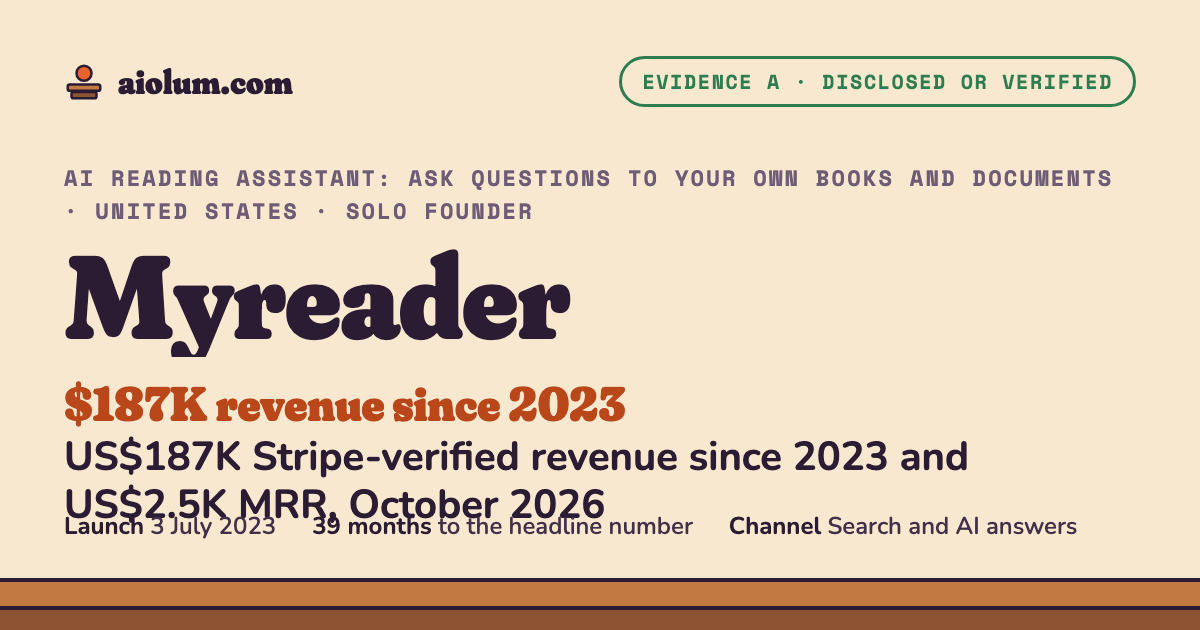
Myreader (AI reading assistant: ask questions to your own books and documents, United States): US$187K Stripe-verified revenue since 2023 and US$2.5K MRR, October 2026. Evidence grade A: disclosed by a company or a filing, or verified by a payment processor. Team: 1 founder (TrustMRR profile: Team size 1 person). Launched 3 July 2023; still running, revenue falling.Added 27 October 2026
- Outcome
- US$187K Stripe-verified revenue since 2023 and US$2.5K MRR, October 2026Revenue falling
- Evidence
- A disclosed by a company or a filing, or verified by a payment processor
- Launch
- 3 July 2023
- Status
- Still running
- Team
- 1 founder (TrustMRR profile: Team size 1 person)
- Outside funding
- None; the TrustMRR profile says Bootstrapped
- Group
- Learning and study
- Main channel
- Search and AI answers
Myreader is a retrieval-augmented reading assistant. Retrieval-augmented means that the program first searches the user's own documents for the passages that match the question, then gives those passages to a large language model as context, so the answer is built from the book and not from the model's memory. The user sees the answer with citations, links that open the exact page in the uploaded book. The same text can be read aloud as an audiobook. The company is Myreader, Inc., a United States company founded on 12 May 2023 according to its TrustMRR profile, and run by one person, Prasann Pandya, who posted the Product Hunt launch on 3 July 2023 as "Founder at myreader.ai".
The money is read by TrustMRR from the company's Stripe account through an API key, a password that lets one program read another program's data: US$187,007 in total since the account started, US$33,575 in the twelve months to 27 October 2026, and US$2,488 of MRR, monthly recurring revenue, the sum of all active subscriptions counted per month, from 222 subscriptions. The last twelve months are the smallest part of the total: about US$153,432 came in before November 2025, about US$5,291 a month on average over those 29 months (calculated), so the business was more than twice as large then as it is now.
This page grades every number. The Stripe figures are grade A. The dates come from the Internet Archive, Product Hunt and Apple's App Store, grade B. Everything the founder wrote about the business, including that the team is one person, is grade C. The business was listed for sale on TrustMRR on 11 September 2026 at US$60,000, and the founder wrote in the listing that a relaunch with a mobile app is planned.
How much revenue does Myreader make?
Each row shows the evidence grade and the source numbers from the list at the end of this page. The grades are explained in How Aiolum verifies.
| Fact | Value | Grade | How we know | Sources |
|---|---|---|---|---|
| Total revenue, all time, to 27 October 2026 | US$187,007 | A | Read by TrustMRR from the company's Stripe account through an API key, last synced on 27 October 2026 at 00:01 UTC. The profile does not say when the Stripe account's history begins; the company was founded on 12 May 2023. | [1] |
| Revenue in the last 12 months, to 27 October 2026 | US$33,575 | A | Same source. Last 6 months US$13,949, last 3 months US$6,064, last 30 days US$2,243. | [1] |
| MRR, 27 October 2026 | US$2,488 from 222 active subscriptions | A | Monthly recurring revenue counts monthly plans at their price and yearly plans at one twelfth of the yearly price. TrustMRR shows MRR down 7.9% in the last 30 days, while 30-day revenue was up 10.1%. | [1] |
| Revenue before the last 12 months | about US$153,432 | calc | Calculated: US$187,007 minus US$33,575. If the Stripe history starts at the founding in May 2023, that is about 29 months (June 2023 to October 2025), or about US$5,291 a month on average, 2.1 times the current MRR. | [1] |
| Verified revenue per month, November 2025 to October 2026 | US$2,953 in November 2025, highest US$3,589 in January 2026, lowest US$1,425 in August 2026, US$2,468 in September 2026 | A | TrustMRR monthly timeline. August 2026 was 60.3% below January (calculated). October to the 27th: US$2,011. The average of the last three months, US$2,021, is 37.6% below the average of November to January, US$3,240 (calculated). | [1] |
| MRR times 12 | US$29,856 a year | calc | Calculated: US$2,488 times 12. | [1] |
| Average MRR per active subscription | US$11.21 | calc | Calculated: US$2,488 divided by 222. Between the Lite price (US$7.50 to US$10) and the Pro price (US$15 to US$20). | [1, 3] |
| Listed for sale | asking US$60,000, first listed 11 September 2026 | C | TrustMRR acquisition section: listing tier Starter, revenue multiple 2.1x, 4 acquisition offers received, 2,550 interested buyers who saw the listing recently. The asking price is 2.0 times MRR times 12 and 1.8 times the last twelve months' revenue (calculated). The seller's message says a relaunch with a mobile app is planned. | [1] |
| Users | '100,000+ students and professionals' on the site; 180,000 estimated in the TrustMRR profile | C | Company statements. The TrustMRR profile also says 'about 30 signups a day'. The 222 active subscriptions are 0.2% of 100,000 (calculated). | [2, 1] |
| Product Hunt launch, 3 July 2023 | number 10 of the day, 161 points, later 4.7 stars from 6 reviews | B | Product Hunt page, read on 27 October 2026, featured on 3 July 2023. The founder's launch comment explains the idea: a system that reads books for him and suggests which pages to read. | [10] |
| Price of the Lite plan | US$6 yearly or US$8 monthly in June 2024; US$7.50 or US$10 in October 2026 | B | Internet Archive copy of the pricing page, 3 June 2024, and the live page. A rise of 25.0% (calculated). Pro stayed at US$15 and US$20. The limits changed from questions a day to questions a month. | [12, 3] |
| First prices, July 2023 | free plan with about 800 pages and 20 questions a day; about 5 euros a month for 100 questions a day and about 4,000 pages | C | Review by Fidel Navamuel on Outils Tice, 5 July 2023, two days after the Product Hunt launch; the page was updated in May 2026 but keeps the 2023 limits. | [13] |
| iPhone app | version 1.0 on 23 September 2026, version 1.2.1 on 3 October 2026; free with in-app purchases; age rating 4+ | B | App Store listing, read on 27 October 2026: 1 rating of 5.0, category Education, seller Myreader Inc., requires iOS 16.4. The TrustMRR profile (text written before the launch) says 'Mobile app is on the way waiting for review'. | [9, 1] |
| Affiliate program | 30% of revenue from referred customers for 12 months, paid by PayPal on the 2nd of each month | C | Company's affiliate page. The home page loads the Rewardful affiliate script. | [4, 2] |
| Profit margin, last 30 days | 70.0% | C | TrustMRR snapshot, outside its list of Stripe-verified metrics. | [1] |
| Team | 1 person | C | TrustMRR profile field 'Team size: 1 person', filled in by the founder. Product Hunt shows Prasann Pandya as 'Founder at myreader.ai'. | [1, 10] |
| Outside funding | none | C | TrustMRR profile: Funding Bootstrapped. | [1] |
| Country | United States | C | TrustMRR profile: Country US. The terms of service are governed by the laws of California. | [1, 5] |
| Technology | JavaScript frontend, Python backend, Stripe | C | TrustMRR tech stack fields. The home page source uses Bootstrap and jQuery. No source names the language model or the speech voices used. | [1, 2] |
| Time from the Product Hunt launch to the October 2026 figures | 39 months | calc | Calculated: July 2023 to October 2026. | [10, 1] |
How to read this table: a grade A value was read by TrustMRR from the company's Stripe account through an API key; it is not a founder statement. A grade B value is a record kept by an outside platform: Apple's App Store, Product Hunt or the Internet Archive. A grade C value is a statement by the founder or the company, a profile field that the founder filled in, or a reviewer's description. A "calc" value was computed on this page from the rows above it.
| Plan | Per month, billed yearly (US$) | Per month, billed monthly (US$) | Limit |
|---|---|---|---|
| Free | 0 | 0 | 5 questions a day, 200 pages in total, 10 MB per file, audiobooks, OCR |
| Lite | 7.5 | 10 | 250 questions a month, 5,000 pages a month, 250 MB per file, 10 hours of audiobooks |
| Pro | 15 | 20 | 1,000 questions a month, 15,000 pages a month, no size limit, 30 hours of audiobooks |
The pricing page shows the yearly price by default and says 'Save 25% on annual plans. Cancel anytime.' Its script switches Lite between US$7.5 and US$10 and Pro between US$15 and US$20. The App Store lists the same plans as in-app purchases: Lite Annual US$89.99 and Pro Annual US$179.99, which is US$7.50 and US$15.00 a month (calculated), Lite Monthly US$9.99 and Pro Monthly US$19.99. Free-plan books are deleted after 7 days of inactivity. The terms say refunds are not provided except in exceptional circumstances, requested within 14 days. In June 2024 the Internet Archive shows Lite at US$6 yearly or US$8 monthly with 100 queries a day and about 4,000 pages, and Pro at the same US$15 or US$20 with 1,000 queries a day and about 20,000 pages; the free plan then had 10 queries a day.
When did Myreader launch, and how did it grow?
From a waiting list in May 2023 to US$187,007 of verified revenue in October 2026, with the best verified months behind it. Each entry carries its grade.
- 12 May 2023CFounding date given in the TrustMRR profile. [1]
- 13 May 2023BEarliest copy of myreader.ai in the Internet Archive: 'Let an AI read books for you', with a form to join the waitlist and 'get early access before this is released publicly'. [11]
- 3 July 2023BLaunch on Product Hunt as 'Myreader AI: Let an AI read books for you', number 10 of the day with 161 points. The founder writes that he always wanted a system that reads books for him and suggests which pages to read. [10]
- 5 July 2023COutils Tice, a French blog on digital tools for teachers, reviews it: free plan of about 800 pages and 20 questions a day, paid plan of about 5 euros a month. [13]
- 11 April 2024CTerms of service last updated. Users may upload only material they own or have the right to use. [5]
- 3 June 2024BPricing page in the Internet Archive: Free with 10 queries a day, Lite US$6 yearly or US$8 monthly, Pro US$15 or US$20, with page limits of about 200, 4,000 and 20,000 pages. [12]
- November 2025 to January 2026AVerified revenue of US$2,953, US$3,179 and US$3,589 a month, the best months in the published timeline. [1]
- August 2026AVerified revenue falls to US$1,425, the lowest month in the published timeline. [1]
- 11 September 2026CListed for sale on TrustMRR at US$60,000. The founder's message: 'I still haven't given up and gearing for a relaunch with a mobile app.' [1]
- 23 September 2026BMyreader for iPhone, version 1.0, appears in the App Store. Versions 1.1, 1.2 and 1.2.1 follow by 3 October. [9]
- 27 October 2026ATrustMRR reads US$187,007 of all-time revenue, US$33,575 in the last twelve months and US$2,488 of MRR from 222 subscriptions from the Stripe account. Prices are US$7.50 to US$10 for Lite and US$15 to US$20 for Pro. [1, 3]
Why did Myreader work?
Four causes, in the order they mattered. Each one is a reusable lesson.
A page for every kind of reader
The site has landing pages for medical students, law students, MBA students, researchers, seminary students and readers of codes and standards, and a free Explore library with a page for each of more than 40 public-domain books, from The Republic to Moby-Dick, where anyone can ask questions without an account. The TrustMRR profile lists SEO as the only marketing channel and says the business gets about 30 sign-ups a day from it. No source records any advertising spend.
Retrieval first, then the model
The reviewer's 2023 description matches the product today: the program finds the relevant sections in the user's books, then uses them as context to answer, and shows the sections with the answer. That keeps the model's cost per question small, because only a few pages go to the model, and it gives the citation that students and lawyers need to check the answer. It also means the product does not answer questions outside the uploaded books.
Metered freemium
The free plan is enough to try: 5 questions a day and 200 pages. Paid plans sell more questions and more pages, US$7.50 to US$20 a month. The limit moved from questions a day in 2024 to questions a month in 2026, which makes the paid plans smaller than they look: 250 questions a month on Lite is about 8 a day.
Audio as a second product
Any uploaded document can be played as an audiobook in 50 or more voices and 30 or more languages, and the iPhone app that appeared in September 2026 is built around listening: background playback, lock-screen controls, speed control. The one App Store review, from a user who describes themselves as a professor, is about listening to research papers while reading along.
How it was built
These details come from the TrustMRR profile fields that the founder filled in, from the company's own pages and from the source code of its home page. They are grade C unless marked. [1, 2, 4, 9, 3]
- JavaScript frontend and Python backend, with Stripe for payments (TrustMRR tech stack fields). Stripe is also the payment provider whose API TrustMRR reads, grade A.
- The home page is a server-rendered page built with Bootstrap and jQuery, not a JavaScript framework; its hero word rotates between use cases only after load, so crawlers see 'textbooks' (visible in the page source, grade B).
- The affiliate program runs on Rewardful; its script is loaded on the home page (grade B). Affiliates get 30% for 12 months and are paid through PayPal.
- No source names the language model, the embedding model or the text-to-speech provider. The site says 50+ voices and 30+ languages for audio and 16 languages for documents.
- Files accepted: PDF, EPUB, AZW, Word, PowerPoint, web article links and YouTube links, with OCR for scanned documents, up to 15,000 pages a month on Pro.
- The iPhone app (version 1.0, 23 September 2026) syncs with the web account, is 70.5 MB, requires iOS 16.4, and sells the same plans as in-app purchases.
- The profile says the team is one person and the company is bootstrapped.
Tools named in the sources
Each one opens its page in the Tools tab, with every story that uses it.
Who tried this before Myreader, and why did they fail?
Five companies in the Loot Drop database tried to change how people read or study with books, documents and audio, and failed. The values below are from that database and are not independently verified.
Kno
The promiseInteractive digital textbooks for students.
Why it diedThe publishers digitized their own textbooks faster and cheaper, and schools moved slowly. Intel bought what was left.
Oyster
The promiseUnlimited e-books for a monthly fee, the 'Netflix for books'.
Why it diedPublishers demanded high fees for the books and Amazon set the prices. Oyster paid for content that Myreader's users bring themselves.
Springpad
The promiseCollect, organize and access web articles, recipes and notes in one place.
Why it diedA loved free product whose users would not pay for premium features; Evernote moved faster.
openmargin
The promiseSocial reading: annotate e-books together with strangers.
Why it diedNeeded a critical mass of readers that never came, while Amazon and Goodreads added social features to the readers people already used.
Voicery
The promiseNatural-sounding text-to-speech voices.
Why it diedGoogle, Amazon and Microsoft sold better voices cheaper, bundled with their clouds. Myreader rents such voices instead of building them.
The failed startups come from Loot Drop, a free database of dead startups, retold here in our own words. Loot Drop describes its entries as AI-assisted summaries of public sources, so these cards carry no evidence grade.
What changed
The predecessors paid for the content, for the voices or for the readers. Oyster and Kno had to license books from publishers; Voicery had to build speech models against the clouds; openmargin and Springpad had to gather a crowd before anyone would pay. Myreader has none of these costs. The user uploads books they already own, the language model and the voices are rented per use, and each customer pays alone, so one paying student is a profit without a crowd.
What the predecessors did not have was a model that can answer a question from any book. That capability arrived in 2023 and made a one-person product possible. It also made the product easy to copy: the Product Hunt page lists ChatPDF and Scispace as similar products. The verified revenue shows what that means: the best months are behind the business, revenue in the last twelve months is a fifth of the total, and the founder has put it up for sale while preparing a relaunch.
Can one person copy Myreader now?
The structure, yes. The timing, no.
A one-person document-question product with a free tier, usage-metered plans and landing pages for each reader group reached about US$5,000 a month of verified revenue in its first two years with no outside money. In 2026 the same product competes with free file upload in every major chat assistant, and its verified revenue has fallen to about US$2,000 to US$2,500 a month. The method is copyable; the window for a generic 'chat with your PDF' product has closed.
Where it is still open: Readers with large private libraries that general assistants do not index well: codes and standards, case law, theology, medical references, and institutions that want a preloaded library for their own students, which Myreader's FAQ offers as a custom version.
- 1Pick one reader group whose books the big assistants handle badly (long textbooks, standards, scanned documents) and write a landing page for it.
- 2Retrieve first, answer second, and show the page citation; that is what makes the answer checkable and the model cost small.
- 3Meter the paid plans by pages and questions, and keep the free plan large enough to try with a real book.
- 4Add listening: the same text as audio gave Myreader a second use and the reason for a phone app.
What could go wrong for Myreader?
The risks are the mirror image of the causes above.
For sale, and shrinking
The business was listed for sale on TrustMRR on 11 September 2026 at US$60,000, with 4 offers received by 27 October. Verified MRR fell 7.9% in the last 30 days and verified monthly revenue fell from US$3,589 in January 2026 to US$1,425 in August, 60.3% lower, before recovering to US$2,468 in September. The current MRR of US$2,488 is just above this site's floor of US$2,000 a month; the US$187,007 total is far above the US$25,000 total that also qualifies. A buyer would take over a product whose best months are in the past.
Most of the revenue is history
US$153,432 of the US$187,007 came before November 2025, about US$5,291 a month on average if the Stripe history starts at the May 2023 founding (calculated). The published monthly timeline covers only the last twelve months, so this page cannot show when the decline began or how high the peak was.
The decision rule applied: purpose gate on the home and pricing pages
This story was released by the rule that a new TrustMRR lead needs the purpose gate and the 26 October 2026 rules checked on the home and pricing pages. Read on 27 October 2026, the home page sells 'Ask your textbooks', 'Chat with your library', 'Listen on the go' and 'Smart Citations'; the pricing page sells questions, pages, audiobook hours, OCR and bulk upload. Neither page, nor the terms, the affiliate page, the iPhone page or the medical-students page, contains 'undetectable', 'humanizer', 'bypass', 'Parasite SEO', income promises or fake-account posting. The product reads and answers; it does not write essays for students, so the rule on writing tools marketed to students does not apply. The medical-students page does market study help: 'Make me a study guide for antipsychotic side effects from my uploads' and 'Quiz me on cardiac pharmacology with page references'. Its testimonials section on the home page is empty in the page source, so there are no fabricated testimonials to judge.
Affiliate program with a stated commission
The affiliate page says 'Earn 30% for every customer you refer' and 'earn 30% of the revenue we make from them for 12 months', paid through PayPal on the 2nd of each month. Under the 26 October 2026 rule, an affiliate program that states its commission is not an income promise. No page claims how much users earn with the product.
Other people's books
Users upload copyrighted textbooks. The terms, updated 11 April 2024, say 'You may only upload documents, articles, videos and other material that you own or have the right to use', keep the user's rights to the upload, and give a takedown address for copyright complaints. The free Explore library offers only public-domain classics. No source reports a publisher's complaint.
The big assistants do this for free
ChatGPT plugins limited PDFs to about 300 pages at launch, according to a Product Hunt comment in July 2023; that was the gap Myreader filled. The Product Hunt page lists ChatPDF, ChatDox AI and Scispace as similar products, and the medical-students page sells 'No tab-switching, no Ctrl+F through 1,500 pages', an argument against general assistants. The verified decline since January 2026 happened while those assistants grew.
What the sources do not say
No source names the language model, the embedding model or the voice provider, so the cost per question is unknown; the TrustMRR profit margin of 70.0% is a founder-entered field. The team size of one and the user counts of 100,000 and 180,000 are company statements. The founder has no interviews or posts that this page could find outside Product Hunt and TrustMRR. The country is US in the profile and the terms name California law; no city is stated.
Sources
The grade next to each source is the best grade that the source can support. "Read in full" means that the text of the page was downloaded and the numbers were checked in it.
- A TrustMRR: Myreader, Inc., payment-verified revenue profile, synced 27 October 2026Read the markdown profile (https://trustmrr.com/startup/myreader-inc.md) in full, live copy synced on 27 October 2026 at 00:01 UTC. The revenue, MRR, subscription and monthly figures were read from Stripe through an API key. The description, founded date, founder, team size, funding, country, user count, tech stack, profit margin and sale listing fields are not in the verified list and are grade C.
- C Myreader home page: Your AI Reading AssistantRead in full on 27 October 2026, text and page source. Source for the features, the user count, the FAQ, the languages, the custom version for institutions, and the Bootstrap, jQuery and Rewardful scripts. The testimonials section is empty in the source.
- C Myreader pricing pageRead in full on 27 October 2026, including the script that switches the yearly and monthly prices. Source for the three plans and their limits.
- C Myreader affiliate pageRead in full. Source for the 30% commission, the 12 months and the PayPal payments.
- C Myreader Inc. terms of service and refund policyRead in full. Source for the update date, the upload rule, the copyright takedown address, California law and the refund policy.
- C Myreader for iPhone: Ask and listen to your books on the goRead in full. Source for the app's listening features and the shared library with the web.
- C MyReader for Medical Students: Ask Your Textbooks, Get Page-Cited AnswersRead in full. One of the landing pages per reader group; source for the study-help marketing quoted in 'watch'.
- C Explore the Library: chat with the great booksRead in full. Source for the free public-domain library of more than 40 books; the sitemap lists a page for each.
- B App Store: Myreader - Ask your books, by Myreader Inc.Read the listing on 27 October 2026. A record kept by Apple: version history from 23 September 2026, in-app purchase prices, age rating 4+, size, one rating and review.
- B Product Hunt: Myreader AI, Let an AI read books for youRead the page and its embedded data on 27 October 2026. Source for the launch date (featured 3 July 2023), the day rank, the points, the reviews, the maker Prasann Pandya ('Founder at myreader.ai') and the launch comment. Comments by other users are grade C.
- B Internet Archive copy of myreader.ai, 13 May 2023Read in full. The earliest copy that the Wayback availability API returns; it shows a waitlist form and the first description.
- B Internet Archive copy of the Myreader pricing page, 3 June 2024Read in full, including the price-switch script. Source for the 2024 plans, prices and limits.
- C Outils Tice, Fidel Navamuel, 5 July 2023: MyReader. An iA assistant that allows you to query the content of your booksRead in full on 27 October 2026 (English edition of a French blog for teachers; page last updated 12 May 2026). A reviewer's description of how the product worked in July 2023 and its first prices.
- C Loot Drop database export, 1,749 failed startupsLocal export. AI-written summaries, not independently verified. Source for the failed predecessors.