Vibe3D AI: Revenue, team and how it was built
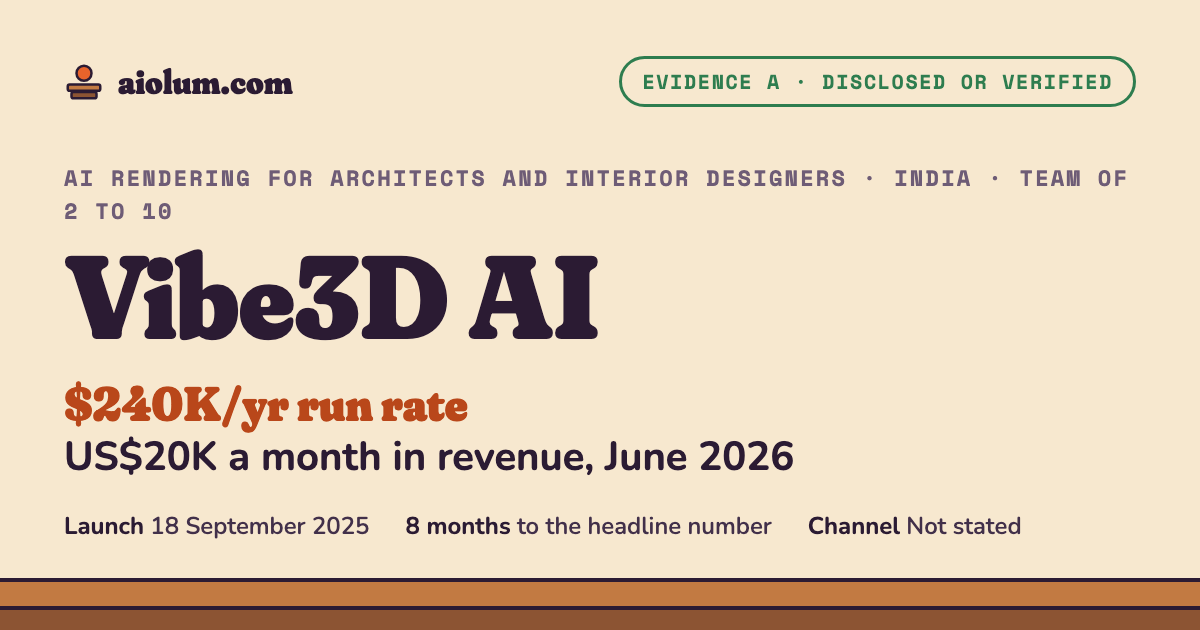
Vibe3D AI (AI rendering for architects and interior designers, India): US$20K a month in revenue, June 2026. Evidence grade A: disclosed by a company or a filing, or verified by a payment processor. Team: 3 co-founders, described as a three-person team in June 2026. Launched 18 September 2025; still running, revenue growing.Added 25 October 2026
- Outcome
- US$20K a month in revenue, June 2026Revenue growing
- Evidence
- A disclosed by a company or a filing, or verified by a payment processor
- Launch
- 18 September 2025
- Status
- Still running
- Team
- 3 co-founders, described as a three-person team in June 2026
- Outside funding
- None (bootstrapped)
- Main channel
- Not stated
Vibe3D is a rendering tool for architects and interior designers. Rendering means making a realistic picture of a building or a room from a 3D model; done the classic way, a 3D artist sets up materials and lights in a program such as V-Ray or Enscape and a powerful computer calculates the image for minutes or hours. Here the user uploads a scene from a model made in SketchUp, Revit, Rhino or a similar program, and an AI model in the cloud returns a photoreal image in about 30 seconds while keeping the geometry, materials and camera angle. Typed instructions then change the time of day, the light or a material. The company says the work runs on its own cloud GPU clusters, so the user needs only a browser. The site does not say which image models it uses. It sells credits, prepaid units that each output uses up: 1 credit for a standard render, 4 for a "HyperReal" render, 1 per second of video.
Brijesh Patel, Arunangshu Bhakta and Smit Patel founded it in India in 2025. They had built Flynx, a floating web browser for Android, from 2014; the founder's profile lists Flynx as acquired. The first archived page of vibe3d.ai is from 19 August 2025, and the official launch on Product Hunt was on 18 September 2025. On 24 January 2026, an archived copy of Brijesh Patel's IndiePage profile shows US$5,300 of monthly revenue, a figure he typed in himself. On 2 June 2026, Dodo Payments, the company that processes and collects Vibe3D's payments, published a case study that says Vibe3D generates US$20,000 in monthly recurring revenue, is profitable, has no outside funding, and has paying customers in more than 150 countries.
The headline figure comes from the payment processor, grade A. One correction is needed: Dodo Payments called it recurring revenue, but two weeks later Vibe3D's own pricing page said that it sold only one-time credit packs and no subscriptions. The figure is therefore best read as US$20,000 of sales a month, which must be earned again every month. The page also shows four failed companies that sold interior design pictures with human designers or rented expensive GPUs for a low monthly price.
How much revenue does Vibe3D AI make?
Each row shows the evidence grade and the source numbers from the list at the end of this page. The grades are explained in How Aiolum verifies.
| Fact | Value | Grade | How we know | Sources |
|---|---|---|---|---|
| Monthly revenue, June 2026 | US$20,000 | A | Dodo Payments case study, published 2 June 2026. Dodo Payments is the merchant of record that collects Vibe3D's payments. It calls the figure monthly recurring revenue, but the pricing page of 16 June 2026 sold only one-time packs. | [1, 12] |
| Run rate from the June 2026 figure | US$240,000 a year | calc | Calculated: US$20,000 times 12. A run rate assumes that the month repeats; one-time pack sales may not. | [1] |
| Monthly revenue on the founder's IndiePage profile, seen 24 January 2026 | US$5,300 | D | Entered by Brijesh Patel by hand, not connected to a payment processor. The page shows no date of entry; an archived copy dates it to 24 January 2026 or earlier. The live profile still showed US$5,300 on 25 October 2026, so it was not updated after the June figure. | [3, 2] |
| Change from the January to the June figure | about 3.8 times in about 4 months | calc | Calculated: US$20,000 divided by US$5,300, from 24 January to 2 June 2026. The two figures come from different sources and the January one may be older than its archive date. | [1, 3] |
| Sales needed for US$20,000 a month | about 513 Pro packs at US$39, or about 202 Studio packs at US$99 | calc | Calculated, as a check against the June 2026 price list. The home page claimed 120,000 sign-ups by October 2026, so this many purchases a month is plausible. | [1, 12, 6] |
| Countries with paying customers, June 2026 | more than 150 | A | Dodo Payments case study. The founder is quoted that they had expected 10 to 20 countries. | [1] |
| Conversion rate after the change of payment provider | doubled | C | Brijesh Patel, quoted in the Dodo Payments case study. The earlier provider is not named; international payments were difficult to process at checkout. | [1] |
| Profit and funding, June 2026 | profitable, no outside funding | C | Dodo Payments case study, from the company's account. No profit figure is given. | [1] |
| Team | 3 co-founders: CEO, CPO and CTO | C | The About page names Brijesh Patel, Arunangshu Bhakta and Smit Patel. The Dodo Payments case study calls it a three-person team that has worked together for more than fifteen years. | [4, 1] |
| Sign-ups claimed, November 2025 | more than 12,000 designers within 3 months of launch | C | The company's Peerlist listing of 6 November 2025 and the home page archived on 13 November 2025. | [8, 10] |
| Sign-ups claimed, October 2026 | more than 120,000 architects and designers in more than 180 countries | C | Home page, 25 October 2026. These are accounts, not paying customers. The home page of 24 December 2025 showed two different counts, 25,000+ and 16,000+. | [6, 11] |
| Renders created, October 2026 | more than 2,000,000, about 30 seconds each on average | C | Home page claims. | [6] |
| Price of 100 renders, August 2025 | US$49 (shown as reduced from US$59) | C | Home page archived on 19 August 2025. Packs of 500 renders cost US$179 and of 1,000 renders US$299, all pay-as-you-go. | [9] |
| Price per credit, October 2026 | US$0.13 on the Pro monthly plan, US$0.165 to US$0.195 in one-time packs | calc | Calculated from the pricing page: US$39 for 300 credits, US$39 for 200 credits, US$99 for 600 credits. | [5] |
| Monthly revenue goal on IndiePage | US$50,000 | C | The founder's own goal, shown on his profile in January and October 2026. His Peerlist headline also says he is scaling Vibe3D to US$50,000 a month. | [2, 3, 8] |
| Time from launch to the June 2026 figure | 8 months | calc | Calculated: 18 September 2025 to 2 June 2026 is 257 days, about 8.4 months. | [7, 1] |
How to read this table: the grade A values come from the case study by Dodo Payments, the merchant of record that collects Vibe3D's payments. Grade C values are the company's own pages and the founder's statements. The grade D value is a figure that the founder typed into his IndiePage profile. A "calc" value was computed on this page from the rows above it.
| Plan | Per month, billed yearly (US$) | Per month, billed monthly (US$) | Limit |
|---|---|---|---|
| Starter, monthly | 19 | 75 credits a month | |
| Pro, monthly | 39 | 300 credits a month; shown as 33% off US$59 | |
| Studio, monthly | 79 | unlimited usage, priority support; shown as 39% off US$129 | |
| Pro pack | 39 one-time | 200 credits; shown as 33% off | |
| Studio pack | 99 one-time | 600 credits; shown as 33% off | |
| Student | 9 one-time | 50 credits, needs a .edu or .ac email address |
There is no yearly billing. The Pro and Studio prices are shown as a "limited-time" discount; the same kind of launch offer has been on the site since November 2025. One credit buys one standard render or edit; a HyperReal render costs 4 credits, a HyperReal edit 2, and a walkthrough video 1 credit per second. One-time credits never expire; monthly credits are refreshed each billing cycle. Every new account gets 3 free renders. Until at least 16 June 2026 the site sold only the one-time packs.
When did Vibe3D AI launch, and how did it grow?
From a floating browser for Android in 2014 to an AI rendering service with paying customers in more than 150 countries, eight months after its launch. Each entry carries its grade.
- 2014CThe founders' first product, Flynx, a floating web browser for Android, launches on Google Play. In mid-2014 it is selected for TLabs India, and in early 2015 tech publications cover it. [13]
- 2016CFlynx development is paused. The founder's IndiePage profile lists Flynx as acquired; the Dodo Payments case study says that the team then worked together at Byju's. [13, 2, 1]
- 19 August 2025CFirst archived copy of vibe3d.ai, a site built with Framer that promises 3D renders in seconds, with pay-as-you-go packs from US$49 for 100 renders to US$299 for 1,000. [9]
- 18 September 2025COfficial launch on Product Hunt, after a month of tests with a first group of designers, with 50% off all paid plans. [7]
- 31 October 2025CBrijesh Patel adds Vibe3D and Flynx to his IndiePage profile, which says "Sold one startup. Now building another." [2]
- November 2025CThe company says it has more than 12,000 designers within 3 months of launch. Packs now cost US$9 for 30 credits, US$39 for 200 and US$99 for 600, with a launch discount of up to 33%. [8, 10]
- 24 December 2025CThe starter pack becomes US$19 for 50 credits. The home page claims more than 25,000 designers and architects. [11]
- 24 January 2026DAn archived copy of the founder's IndiePage profile shows US$5,300 a month for Vibe3D, a figure he entered by hand. [3]
- 2 June 2026ADodo Payments publishes its case study: US$20,000 a month, profitable, bootstrapped, a three-person team, paying customers in more than 150 countries, conversion doubled after the move to Dodo. [1]
- 16 June 2026CThe pricing page says Vibe3D is "completely pay-as-you-go" with "no monthly subscriptions, recurring charges, or automatic renewals". [12]
- October 2026CMonthly plans at US$19, US$39 and US$79 now sit next to the one-time packs. The home page claims more than 120,000 users and 2,000,000 renders. [5, 6]
Why did Vibe3D AI work?
Four causes, in the order they mattered. Each one is a reusable lesson.
One profession, one job
General image generators make attractive rooms that do not match the drawings. Vibe3D sells to architects and interior designers only, and its promise is that the render keeps the modeled geometry, materials and camera. The company's Peerlist listing says that this is the difference from other AI tools, which do not preserve the model and so are not usable by professionals.
A checkout that works abroad
Most buyers came from outside India. The founder told Dodo Payments that international payments did not work well with the first provider, and that the conversion rate doubled when the company moved to a merchant of record, a seller that takes the payment, collects sales tax and VAT in each country and pays out the rest. For three people that also removed the tax work.
Credits instead of seats
Rendering costs GPU time per image, so Vibe3D prices per output: 1 credit for a standard render, 4 for the better HyperReal render, 1 per second of video. Credits in packs never expire. This lets an occasional user pay once, and it matches the cost of each sale to the price.
Lower entry prices
In August 2025 the smallest pack cost US$49 for 100 renders. By November 2025 a first pack cost US$9, and later US$19 for 50 credits, with 3 free renders on sign-up. Monthly plans came later, in 2026, after the case study's June figure.
How it was built
These details come from the company's own pages, its Peerlist listing, the payment processor's case study and the page source of the site. Most are grade C. [8, 6, 9, 1, 7, 14]
- A web app at app.vibe3d.ai. The Peerlist listing names JavaScript, ReactJS and TypeScript.
- The work runs on the company's cloud GPU clusters, according to the home page, so a user needs only a browser. The site does not name the image models.
- The first marketing site, archived from August to December 2025, was built with Framer; its page source shows a Framer generator tag. Product analytics come from PostHog, visible in the page source from November 2025 to October 2026.
- Payments, sales tax and VAT go through Dodo Payments as merchant of record. Smit Patel, the CTO, integrated it in one to two days.
- Launches on Product Hunt in September 2025 and on Peerlist in November 2025. A creator program offers sponsored content, affiliate rewards and free access to architecture creators and students.
Tools named in the sources
Each one opens its page in the Tools tab, with every story that uses it.
Who tried this before Vibe3D AI, and why did they fail?
Four companies in the Loot Drop database sold pictures of designed rooms, or rented GPU power cheaply each month. The values below are from that database and are not independently verified.
Modsy
The promisePhotorealistic 3D renders of a customer's own room with furniture that could be bought.
Why it diedMarketed as AI, but each room needed hours of human designer time. High customer acquisition cost and few repeat buyers.
Laurel & Wolf
The promiseFlat-fee online interior design from professional designers.
Why it diedThe flat fee did not cover the cost of finding customers, and quality fell as the designer network grew.
Tastemaker
The promiseAffordable interior design for middle-income homes.
Why it diedA distributed workforce of designers gave uneven service, and better-funded competitors took the market.
Blade (Shadow)
The promiseA powerful Windows gaming PC streamed from the cloud for a low monthly fee.
Why it diedEach subscriber needed expensive GPU hardware that became outdated before the monthly fees paid for it.
The failed startups come from Loot Drop, a free database of dead startups, retold here in our own words. Loot Drop describes its entries as AI-assisted summaries of public sources, so these cards carry no evidence grade.
What changed
Modsy, Laurel & Wolf and Tastemaker sold the same thing that Vibe3D sells: a convincing picture of a room before it exists. All three paid people for each picture, so every new customer added hours of designer work, and the price could not cover it. Vibe3D's buyer is a professional who already has the 3D model, and an AI model makes the picture in about 30 seconds, according to the company. The cost of one more render is GPU time, not a person's afternoon.
Shadow is the warning on the other side. It rented a GPU for a fixed low monthly price and lost money on each heavy user. Vibe3D charges per output with credits, which ties price to GPU cost. Its newest plan, Studio at US$79 a month with unlimited usage, is the one place where that link is cut, and its pricing page does not say what limits apply.
Can one person copy Vibe3D AI now?
Yes, if you pick a profession that already has the input file.
Architects and interior designers already have a 3D model, so the product only has to turn it into a picture that respects the model. A small team can sell that worldwide with a merchant of record and credit packs. The copyable part is the choice of niche and the payment setup. The hard part is the quality of the model output, which is the whole product and which larger image-model companies also improve.
Where it is still open: The same input-to-picture step for other professions with files: landscape plans, kitchen and furniture configurators, product photos from CAD files, floor plans for real estate agents.
- 1Choose a profession whose customers already hold a structured input (a model, a drawing, a file) and need a finished picture or document from it.
- 2Promise fidelity to the input, not creativity, and show it with before-and-after examples.
- 3Price per output with credits that match your GPU cost, and start with a cheap first pack.
- 4Use a merchant of record from the first day if most buyers will be abroad.
What could go wrong for Vibe3D AI?
The risks are the mirror image of the causes above.
"Recurring" is the wrong word
Dodo Payments wrote US$20,000 in monthly recurring revenue on 2 June 2026. On 16 June 2026 Vibe3D's pricing page said there were "no monthly subscriptions, recurring charges, or automatic renewals". The money came from one-time packs that must be sold again each month. Monthly plans appeared later in 2026.
One dated figure from a vendor
The US$20,000 figure appears in a marketing case study by the payment provider, which benefits from the customer's success. There is no later figure. The founder's own IndiePage number, US$5,300, was not updated after June 2026 and is older.
Sign-ups are not customers
The home page claims 120,000 architects and designers. These are accounts with 3 free renders, not buyers. In December 2025 the same page showed two different counts.
A permanent launch discount
A "launch offer" or "limited-time offer" of about 33% off has been on the site since November 2025. Buyers who notice may distrust the list price.
Large image models improve fast
The product depends on image models that bigger companies also sell to everyone. A general model that keeps geometry well would reduce the gap. Other AI rendering services for architects already compete for the same buyers.
Sources
The grade next to each source is the best grade that the source can support. "Read in full" means that the text of the page was downloaded and the numbers were checked in it.
- A Dodo Payments case study, 2 June 2026: How Dodo Payments helped Vibe3D double conversions and reach 150+ countriesRead in full. Dodo Payments is Vibe3D's merchant of record. Source for the monthly revenue, the countries, the conversion change, the team, the funding and the founders' history. The publication date is in the page's article:published_time tag.
- D Brijesh Patel's IndiePage profile, read 25 October 2026Read in full, including the page data. Founder-entered monthly revenue of US$5,300, not connected to a payment processor; the date the Vibe3D entry was created; Flynx marked as acquired; the US$50,000 goal.
- D Wayback Machine copy of the IndiePage profile, 24 January 2026Read in full. The only archived copy; it dates the US$5,300 figure to 24 January 2026 or earlier.
- C Vibe3D About page, read 25 October 2026Read in full. Source for the founders' names and roles and the founding year.
- C Vibe3D pricing page, read 25 October 2026Read in full, including the product data in the page. Source for the current plans, packs and credit costs.
- C Vibe3D home page, read 25 October 2026Read in full. Source for the product description, the user and render counts, the GPU claim and the page source.
- C Product Hunt: Vibe3D.ai, launch of 18 September 2025Read the launch section and the maker's comment by Brijesh Patel. Source for the launch date and the launch discount.
- C Peerlist project page: Vibe3D, November 2025Read in full. The company's own listing. Source for the 12,000 sign-ups, the technology list and the founder's profile headline.
- C Wayback Machine copy of vibe3d.ai, 19 August 2025Read in full. The first archived home page. Source for the first prices and the Framer site.
- C Wayback Machine copy of vibe3d.ai, 13 November 2025Read the pricing and user-count sections. Source for the November 2025 prices.
- C Wayback Machine copy of vibe3d.ai, 24 December 2025Read the pricing and user-count sections. Source for the US$19 starter pack and the two user counts.
- C Wayback Machine copy of the Vibe3D pricing page, 16 June 2026Read in full. Shows that two weeks after the case study the company sold only one-time packs.
- C Flynx websiteRead in full. The founders' earlier Android browser, with its 2014 to 2016 history and press quotes.
- C Vibe3D Creator Program page, read 25 October 2026Read in full. Source for the creator, affiliate and student program.
- C Loot Drop database export, 1,749 failed startupsLocal export. AI-written summaries, not independently verified. Source for the failed predecessors.