Supergrow
Supergrow is a web app that writes and schedules LinkedIn posts for founders, creators, ghostwriters and marketing teams. A member types an idea, records a voice note, adds a YouTube video, an article or a PDF, or talks for 10 to 15 minutes with an AI interviewer, and the app turns it into drafts in the member's own style, then publishes them at a chosen time. The text comes from third-party large language models, programs trained on large amounts of text that write new text from an instruction; the company does not say which ones. In October 2026 it costs US$39 a month for one account and US$199 a month for five.
Deven Bhooshan, a software engineer based in India who had worked at Amazon and GoJek, started it in April 2023 with Utsav Patel, after Twitter's new API prices ended his previous product. An API is the interface through which one program uses another company's service. The two founders posted their progress and their numbers in public on LinkedIn and X, and sold a lifetime deal, one payment for permanent access, through RocketHub for US$65,000 in total. Then they moved the business to subscriptions. The founder reported US$14,310 of monthly recurring revenue (MRR), the monthly value of all active subscriptions, in August 2024, and US$230,000 a year from more than 800 recurring customers in April 2025. They raised no outside money and trade as Supergrow Innovations LLP, a limited liability partnership, a company form in which each partner's personal liability is limited, registered in Bangalore.
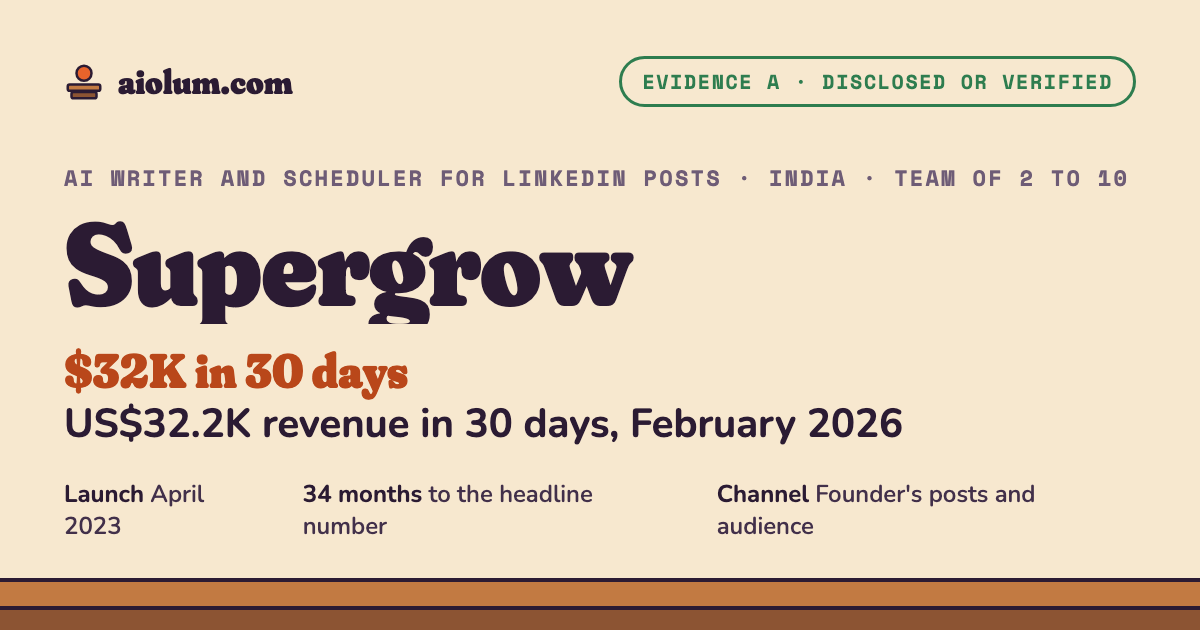
The headline is grade A. TrustMRR, a site that reads revenue directly from a company's payment account, read US$32,216 of payments in the 30 days to 28 February 2026 from Supergrow's Stripe account, the payment processor that charges its customers' cards, through an API key, a password that lets one program read another program's data. Then the key expired, so nothing newer is verified. The same profile shows MRR of US$79,479, about 2.5 times the payments, without saying why, so this page uses the payments. The company has two founders, and LinkedIn lists 8 people there in October 2026.
The numbers, graded
Each row shows the evidence grade and the source numbers from the list at the end of this page. The grades are explained in How Aiolum verifies.
| Fact | Value | Grade | How we know | Sources |
|---|---|---|---|---|
| Verified revenue in the 30 days to 28 February 2026 | US$32,216 | A | TrustMRR, read from Stripe through an API key. 14.0% more than in the 30 days before. This is the headline figure. | [1] |
| Run rate from the 30-day figure | about US$386,592 a year | calc | Calculated: US$32,216 times 12. | [1] |
| Verified revenue by month | November 2025: US$30,247. December: US$39,107. January 2026: US$29,842. February: US$29,760 | A | TrustMRR monthly table. Calculated: February is 1.6% below November and 23.9% below December. January and February together are 14.1% below November and December together. | [1] |
| Monthly recurring revenue (MRR) at the last sync | US$79,479, with 2,315 active subscriptions | A | TrustMRR snapshot, up 24.9% in 30 days. Calculated: it is 2.47 times the payments of the same 30 days, or US$34.33 per subscription against US$13.92 collected. The profile does not explain the gap, so this page does not use MRR as the headline. | [1] |
| All-time verified revenue | US$474,580 to 28 February 2026 | A | TrustMRR. The profile does not say from which date the Stripe history starts. | [1] |
| Verified revenue before mid-October 2025 | about US$334,161 | calc | Calculated: US$474,580 minus the five months in the monthly table. Those five months add up exactly to the profile's 12-month figure of US$140,419, so the October 2025 value covers only part of that month. | [1] |
| State of the verification | Stripe key expired. Last sync 28 February 2026 | A | No newer data reached TrustMRR, so the profile shows US$0 for the last 3 and 6 months. Calculated: 229 days between the last sync and 15 October 2026. | [1] |
| Annual recurring revenue, April 2025 | US$230,000, from more than 800 recurring customers | C | Founder's blog, 21 April 2025. Calculated: about US$19,167 a month. | [2] |
| MRR, August 2024 | US$14,310 | C | Founder's monthly report on X, 2 September 2024: up 20.88% in a month, 1,629 signups, 168 new paying customers, 2,986 posts published through the app. | [3] |
| Revenue and MRR, November 2023 | US$36,449 revenue. US$1,716 MRR | C | Founder's report on LinkedIn, 1 December 2023: revenue up 1,381% and MRR up 28% on October, 226 new paying customers. More than US$32,000 came from a lifetime deal for agencies, of which the founders expected to keep 50%. | [4] |
| Lifetime deal on RocketHub, total | US$65,000 | C | Founder's blog. He writes that most deal platforms keep 30% to 50% of sales. A buyer's review on RocketHub's page says the highest tier cost US$240 one-time for 50 LinkedIn accounts. | [2, 4, 13] |
| Growth from August 2024 to February 2026 | 2.25 times in 18 months | calc | Calculated: US$32,216 of verified payments in 30 days against the founder's US$14,310 MRR. The two figures are different measures, so the multiple is approximate. | [1, 3] |
| Team | 2 co-founders. LinkedIn lists 8 people in October 2026 | C | Deven Bhooshan is CEO and Utsav Patel is CMO; both are the partnership's designated partners. One product engineer joined in August 2024. LinkedIn gives the company size as 2 to 10 employees. No source gives the headcount at February 2026. | [5, 7, 3, 8] |
| Outside funding | none | C | Founder, April 2025: the lifetime deal gave enough money to grow "without needing to raise external funding". Investors approached the founders; no round is reported. | [2] |
| Operating company | Supergrow Innovations LLP, Bangalore | C | A limited liability partnership, LLPIN ACH-0505, incorporated on 7 May 2024 with paid-up capital of ₹10,000. The terms of service name it as the operator, under Indian law. | [6, 7] |
| Prices, October 2026 | US$39 a month for one account, US$199 for five | C | Pricing page. US$31 and US$189 a month when billed yearly. 7-day free trial. | [9] |
| Affiliate commission | 30% of every payment, for the life of the customer | C | Company page. It also claims a trial-to-paid conversion rate of 12% to 14%. | [12] |
| Time from start to the February 2026 figure | 34 months | calc | Calculated: April 2023, when the founder says he started Supergrow, to February 2026. | [2, 1] |
How to read this table: a grade A value was read by TrustMRR from Supergrow's Stripe account and stops on 28 February 2026. A grade C value is a founder statement, a company page or a third-party page. A "calc" value was computed on this page from the rows above it.
| Plan | Per month, billed yearly (US$) | Per month, billed monthly (US$) | Limit |
|---|---|---|---|
| Pro | 31 | 39 | 1 LinkedIn account |
| Teams | 189 | 199 | 5 accounts |
| Enterprise | custom | custom | more than 5 executives |
Every plan starts with a 7-day free trial. The page says yearly billing saves up to 20%, and its questions section gives the yearly prices: Pro US$31 a month and Teams US$189 a month. In August 2026 a competitor's review listed a US$19 Starter plan and a US$139 Teams plan with four accounts; the October page shows neither.
The timeline
From a Twitter tool ended by an API price change to Stripe-verified payments of US$32,216 in 30 days, in 34 months. Each entry carries its grade.
- 2015 to 2023CDeven Bhooshan works at Amazon in 2015, co-founds MindIQ, an AI chatbot builder, in 2016, joins GoJek in 2017, and consults for other teams from 2021 to 2023. [14]
- Before April 2023CHis previous product, Honeypot, which found sales leads on Twitter, makes US$12,000 a year when Twitter's new API prices end it. Another founder whose Twitter tool was hit the same way contacts him and becomes his co-founder. [2]
- April 2023CHe starts Supergrow after studying Taplio, AuthoredUp and ContentIn. The first version does one thing: it turns a short paragraph into a LinkedIn post, with one click to generate and two to publish. [2]
- November 2023CA lifetime deal for agencies brings in more than US$32,000. The month's revenue is US$36,449 and MRR is US$1,716. A Black Friday discount sells 15 annual plans. [4]
- After the lifetime dealCThe lifetime deal on RocketHub totals US$65,000. Subscription pricing launches on Product Hunt, where Supergrow becomes #1 Product of the Week; visitors pay US$1 for the first month, and more than half stay at the full price. [2]
- 7 May 2024CSupergrow Innovations LLP is incorporated in Bangalore with the two founders as designated partners. [7]
- August 2024CMRR reaches US$14,310 in the best month of growth so far. The company starts a blog for search traffic and hires a product engineer. [3]
- 21 April 2025CThe founder writes that Supergrow makes US$230,000 a year from more than 800 recurring customers, and that it is moving from individual buyers to companies. [2]
- November 2025 to February 2026AStripe shows US$30,247, US$39,107, US$29,842 and US$29,760 in the four months. [1]
- 28 February 2026ALast sync with TrustMRR: US$32,216 in 30 days, MRR of US$79,479 and US$474,580 all-time. The Stripe key then expired, on a date the profile does not show, and nothing newer is verified. [1]
- 31 July 2026CLinkedIn adds a "Seems like AI slop" report option and says it already shows such posts less outside the writer's own network. [19]
- 24 August 2026CTaplio, a competitor, reviews Supergrow on its own blog and lists plans at US$19, US$39 and US$139 a month. [21]
- September 2026CSupergrow is listed in Claude's connector directory, so Claude and ChatGPT users can draft posts and read analytics from their AI assistant. In the same month LinkedIn removes its own AI option for rewriting posts. [10, 11, 20]
- October 2026CPro costs US$39 a month and Teams US$199. LinkedIn lists 8 people at the company. The founder also builds a second product, WarmDogo, an agent that finds sales leads. [9, 8, 14]
Why it worked
Four causes, in the order they mattered. Each one is a reusable lesson.
Pick a market that already pays
The founder studied the tools that people already used, Taplio, AuthoredUp and ContentIn, and found that none wrote good posts, the one task users needed most. Supergrow's first version did only that. He writes that a competitor's venture funding is no proof of a market; paying customers are.
Public posts brought the first customers
Both founders posted progress, decisions and numbers on LinkedIn and X. The founder writes that the first customers came from his LinkedIn network, and that the lifetime-deal platform and investors contacted them because of those posts.
A lifetime deal paid for the start
RocketHub sold one-time lifetime access for a total of US$65,000, and kept a share; in November 2023 the founder expected half. He writes that this money let them grow without investors, and that only about 10% of lifetime buyers use the product actively, so the cost of supporting them stayed small.
Then subscriptions, influencers and affiliates
Subscription pricing launched on Product Hunt with a US$1 first month. The co-founder ran partnerships with LinkedIn influencers as a second channel, and an affiliate program pays 30% of every renewal. Search traffic came late: the blog started only in August 2024, which the founder calls a mistake.
From individuals to teams
For two years most buyers were individuals, and the founder writes that business buyers cancel less and pay more predictably. By 2026 the product is sold to marketing teams: a US$199 plan for five executives, approval steps, leaderboards and an Enterprise plan.
How it was built
These details come from the founder's blog post, his posts and the company's own pages. They are grade C. [2, 6, 15, 23, 11, 10, 1]
- The first version had one-click post generation and two-click publishing, and nothing else: no analytics, no scheduling, no dashboards.
- Posts are written by third-party large language models, according to the terms of service. No source names the models. The founder names OpenAI's GPT-3 as one reason he started.
- Feedback ran through Intercom chat, then Canny for feature requests, with Microsoft Clarity and Mixpanel to see what users did, and 3 to 4 customer calls a week. The founder says he watched every user's session recording, sometimes more than 300 a day, for almost a year.
- They refused to build automated LinkedIn direct messages, although many users asked for it.
- Inputs besides typed ideas: voice notes, YouTube videos, articles, PDFs, and a 10 to 15 minute interview with an AI interviewer called PostCast.
- In 2026 Supergrow added an MCP server, a standard connection that lets AI assistants use another app's functions. Claude and ChatGPT connect by signing in, and Supergrow is listed in Claude's connector directory.
- Payments run through Stripe.
Tools named in the sources
Each one opens its page in the Tools tab, with every story that uses it.
The dead that came before
Five companies in the Loot Drop database built a tool on top of a social network that they did not control. The values below are from that database and are not independently verified.
BranchOut
The promiseA professional network like LinkedIn, built inside Facebook.
Why it diedFacebook changed its API rules and cut off the growth that the product depended on.
PostRocket
The promiseMore reach for Facebook pages through data-driven post timing.
Why it diedFacebook changed its API, and the company had no plan for another product.
Pixelpipe
The promisePost photos and videos to every social network at once.
Why it diedThe networks closed their APIs and built cross-posting in themselves.
Klout
The promiseA score from 1 to 100 for a person's influence on social media.
Why it diedFacebook and Twitter built better analytics themselves.
ThinkUp
The promisePersonal analytics on a user's social media activity, beyond likes and retweets.
Why it diedIt stayed a desktop product while social media moved to phones, and it did little marketing.
What changed
All five depended on a social network's API or its users, and the network ended them by changing its rules or by building the feature itself. Supergrow makes the same bet on LinkedIn. LinkedIn released its own AI post writer in 2023, forbids unauthorized automated posting, commenting and liking, and in 2026 started to show low-effort AI posts to fewer people.
Three things differ. Supergrow charged from the start and took no outside money, so it needs far less revenue than the funded predecessors to stay alive. It writes the content, a task that LinkedIn itself stepped back from: in September 2026 it removed its AI option for rewriting posts, and by October it offered Premium members a proofreader that only edits the member's own words. And it moved toward companies, which buy for many employees and cancel less. LinkedIn's actions against AI posts could still reduce its customers' reach, and with it their reason to pay.
Can one person copy it now?
The method, yes. The same market, with care.
Every step of the method is documented by the founder and needs little money: study paying competitors, post in public, pay for the start with a lifetime deal, then sell subscriptions. The market for LinkedIn writing tools is now crowded, and LinkedIn acts against generic AI posts, so a new entrant needs a narrower buyer and output that reads like a real person.
Where it is still open: Tools for companies that want many employees to post about their work (called employee advocacy), and other professional platforms where people must post regularly but the platform does not write for them.
- 1Choose a market where people already pay, use the competitors every day, and do their weakest core task better.
- 2Post your progress and numbers where your buyers are. The founder's first customers, the deal platform and the investors' interest all came from those posts.
- 3Sell a lifetime deal for cash and feedback, and plan for the platform to keep 30% to 50% of it.
- 4Switch to subscriptions with a launch offer, then add a channel that is not your own posts, such as influencers or affiliates paid from each renewal.
What to watch
The risks are the mirror image of the causes above.
Verified figures stop in February 2026
TrustMRR's Stripe key expired, and the last sync was on 28 February 2026, 229 days before this page was written. The 75 posts in the founder's X timeline from December 2025 to October 2026 give no newer revenue figure. The company still sells and ships updates, but nothing after February 2026 is verified.
MRR and payments disagree
The same profile shows MRR of US$79,479 but payments of US$32,216 in 30 days, and 2,315 active subscriptions while the founder-written part of the profile estimates 1,200 users. Every plan starts with a 7-day free trial. No source explains the gap, so this page uses the payments.
LinkedIn writes, then restricts, AI posts
By 26 September 2023 LinkedIn had launched its own tool that drafts a post from a member's ideas. On 31 July 2026 it added an option to report posts that "seem like AI slop", said it already shows such posts less outside the writer's network, and said it uses better classifiers, programs that sort posts automatically, to find them. In September 2026 it removed its own AI rewriting option. A tool whose output reads as generic may cost its customers their reach.
LinkedIn's rules on automation
LinkedIn's User Agreement, effective 3 November 2025, forbids bots or other unauthorized automated methods to create, comment on, like or share posts, and its help pages warn that members who use such tools risk restricted accounts. Supergrow schedules posts, writes AI comments and publishes for team members. Its home page calls it a LinkedIn Verified Partner; this page could not check that claim.
Many competing tools
Taplio, AuthoredUp and ContentIn were there first. Taplio now reviews Supergrow on its own blog and offers the same Claude connection. The founder writes that copycats duplicated his product. Supergrow's own prices changed within two months in 2026, from US$19, US$39 and US$139 to US$39 and US$199.
A team of eight, not two
There are two founders, and LinkedIn lists 8 people at the company in October 2026, within a stated size of 2 to 10 employees. No source gives the headcount at the February 2026 figure. At eight people, Supergrow is near the upper limit of a small team on this site.
Dependence on model providers
The writing comes from third-party large language models that the company does not name. The providers set their prices, rules and quality, and the same models are available to every competitor and to LinkedIn.
A second product
In 2026 the founder also builds WarmDogo, an agent that finds sales leads, so Supergrow no longer has all of his time.
Sources
The grade next to each source is the best grade that the source can support. "Read in full" means that the text of the page was downloaded and the numbers were checked in it.
- A TrustMRR: Supergrow, revenue verified through StripeRead the markdown profile (https://trustmrr.com/startup/supergrow.md) in full on 15 October 2026. Its Verification Sources section says Stripe through an API key, the key expired, last revenue sync 28 February 2026. Source for every grade A figure. The profile text, such as the user estimate and the B2C label, is founder-written, grade C.
- C Deven Bhooshan's blog, 21 April 2025: From Zero to $230K ARR: The Indie Hacker's PlaybookRead in full. The founder's own account. Source for the start date, Honeypot, the competitor study, the RocketHub total, Product Hunt, the funding statement, the feedback tools and the two mistakes.
- C Deven Bhooshan on X, 2 September 2024: August report for SupergrowRead in full through api.fxtwitter.com. Source for the August 2024 MRR, signups, customers, the start of the blog and the first engineer.
- C Deven Bhooshan on LinkedIn, 1 December 2023: November report for SupergrowRead the public post. The date comes from the post's ID. Source for the November 2023 revenue, MRR, customers and the lifetime deal for agencies.
- C Supergrow: About usRead in full. Names Deven Bhooshan as CEO and co-founder and Utsav Patel as CMO and co-founder. Its user count (1,200+) appears older than the TrustMRR data.
- C Supergrow: Terms of ServiceRead the sections on the operator, AI output, third-party services and governing law.
- C Falcon Ebiz: Supergrow Innovations LLP, LLPIN ACH-0505Read in full. A commercial copy of the Ministry of Corporate Affairs register, not the register itself. Source for the incorporation date, the paid-up capital and the two designated partners. Finanvo.in gives the same incorporation date.
- C LinkedIn: Supergrow company page, read 15 October 2026Read the public page. Company size 2 to 10 employees, 8 people listed as employees.
- C Supergrow pricing page, read 15 October 2026Read in full, including the questions section that gives the yearly prices.
- C Supergrow blog, 29 September 2026: What's new in Supergrow: September 2026Read the contents and the summary. Written by Deven Bhooshan. Shows that the product is still developed.
- C Supergrow changelogRead the entries on the MCP connection for Claude and ChatGPT.
- C Supergrow affiliate programRead in full. Source for the commission and the claimed trial-to-paid rate.
- C RocketHub: Supergrow lifetime dealRead the deal page and its 8 customer reviews. A buyer's review gives the US$240 price of the top tier.
- C Deven Bhooshan's websiteRead in full. Source for the founder's career and the second product, WarmDogo.
- C Deven Bhooshan on X, 17 September 2026: watching session recordingsRead in full through api.fxtwitter.com. His timeline from 21 December 2025 to 13 October 2026, 75 posts as the API lists them, was read for revenue figures and has none.
- C LinkedIn User Agreement, effective 3 November 2025Read the sections on what members must not do and on generative AI features.
- C LinkedIn Help: Prohibited software and extensionsRead in full.
- C Digital Works, 26 September 2023: LinkedIn's AI-powered writing tool for postsRead in full. A Danish agency's description of LinkedIn's tool that drafts posts.
- C ProPakistani, 31 July 2026: LinkedIn Finally Adds a Button To Kill All That AI SlopRead in full. Reports LinkedIn's statements; LinkedIn's own announcement was not read.
- C Metricool, 2 October 2026: LinkedIn Swaps Its AI Post Writer for a Proofreading ToolRead in full.
- C Taplio blog, 24 August 2026: Supergrow Review 2026Read the verdict and the plan sections. Written by a competitor, as the page itself says.
- C Loot Drop database export, failed startupsLocal export. AI-written summaries, not independently verified. Source for the failed predecessors.
- C Supergrow home page, read 15 October 2026Read in full. Source for the input types, the length of a PostCast interview and the "LinkedIn Verified Partner" claim.