Wafer: Revenue, team and how it was built
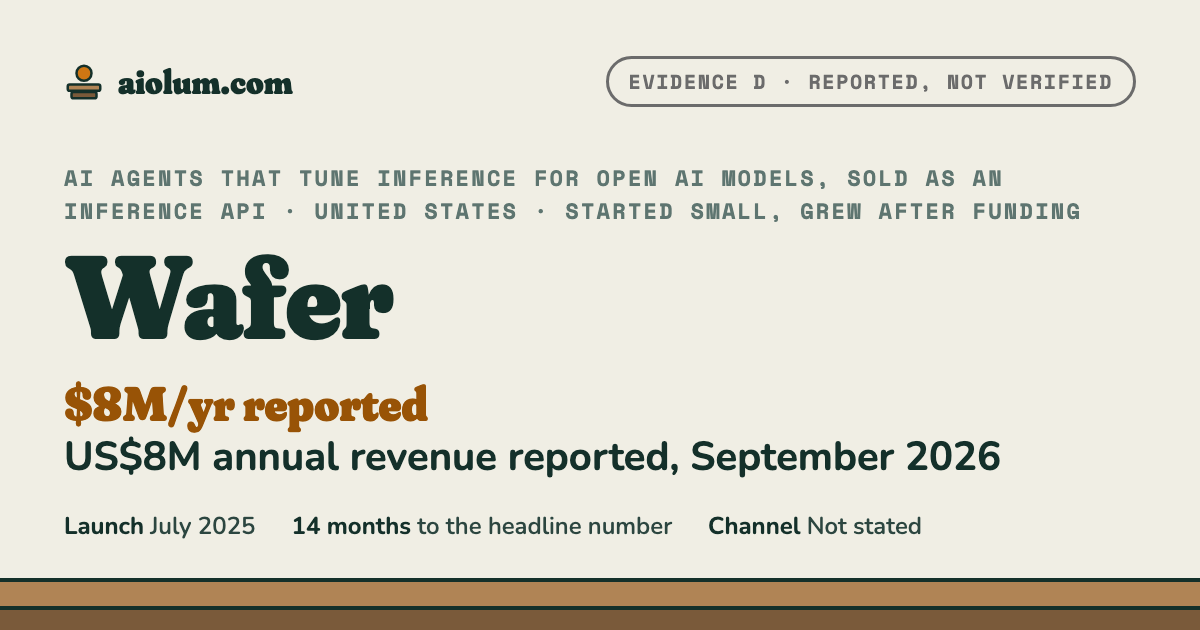
Wafer (AI agents that tune inference for open AI models, sold as an inference API, United States): US$8M annual revenue reported, September 2026. Evidence grade D: reported, not verified. Team: 2 co-founders (Y Combinator, Summer 2025); 5 people signed the April 2026 seed post; 8 employees at the September 2026 figure (Lean AI Leaderboard); 18 people on the team page and 15 on YC's page, November 2026. Launched July 2025; still running.Added 6 November 2026
- Outcome
- US$8M annual revenue reported, September 2026
- Evidence
- D reported, not verified
- Launch
- July 2025
- Status
- Still running
- Team
- 2 co-founders (Y Combinator, Summer 2025); 5 people signed the April 2026 seed post; 8 employees at the September 2026 figure (Lean AI Leaderboard); 18 people on the team page and 15 on YC's page, November 2026
- Outside funding
- US$44M in total: US$4M seed led by Fifty Years (April 2026) and US$40M Series A co-led by Marathon and Chemistry (September 2026), as the company states
- Main channel
- Not stated
What is not verified
The US$8 million in annual revenue and the 8 employees rest on one source: the Lean AI Leaderboard row with a September 2026 snapshot, which cites an article by Stephanie Palazzolo in The Information of 1 September 2026. That article is behind a paywall; only its headline, date and summary were read, and they do not show the revenue figure. The company has not published a revenue figure. A reader could look for the full article, a company statement or an investor's disclosure. The headline number is grade D: one claim or one estimate, with no second source. Aiolum shows it because the story is useful, and marks it so that it is not mistaken for a verified figure.
Wafer is an inference provider: a company that runs AI models on its own GPUs and sells the answers through an API, so the customer does not need its own servers. It serves open-weight models, models whose trained parameters are published, so anyone may run them, such as GLM-5.3, Kimi K3 and DeepSeek V4. What it sells on top is continual inference, its name for agents that watch a customer's traffic and keep changing the serving stack (the inference engine, the GPU kernels, small programs that run on the graphics chip, and the batching and caching rules) to cut latency and cost.
Emilio Andere and Steven Arellano, friends from the University of Chicago, founded it in 2025 and went through Y Combinator's Summer 2025 batch. The first products were tools for GPU engineers: an open benchmark suite in July 2025 and an editor extension with a profiler in December 2025. In 2026 it moved to selling inference. Its seed post of April 2026 was signed by five people. The company states a US$4 million seed in April 2026 and a US$40 million Series A on 1 September 2026.
The headline is grade D. The Lean AI Leaderboard, a public spreadsheet of small AI companies, lists Wafer with US$8 million in annual revenue and 8 employees for a September 2026 snapshot, and cites a paywalled article in The Information of 1 September 2026 that could not be read here. No payment processor, filing or company statement confirms the figure. By November 2026 the company's team page names 18 people.
How much revenue does Wafer make?
Each row shows the evidence grade and the source numbers from the list at the end of this page. The grades are explained in How Aiolum verifies.
| Fact | Value | Grade | How we know | Sources |
|---|---|---|---|---|
| Annual revenue, September 2026 snapshot | US$8,000,000 | D | Lean AI Leaderboard, column 'Annual Revenue', snapshot 'Sep 2026', with The Information's article of 1 September 2026 as its source. The article is behind a paywall and was not read. One source. | [1, 2] |
| Revenue per month implied by that figure | about US$666,667 | calc | Calculated: US$8,000,000 divided by 12. Only as good as the leaderboard figure. | [1] |
| Employees at the snapshot | 8 | D | Lean AI Leaderboard, same row. The leaderboard also lists revenue per employee of US$1,000,000 and '4' in its column 'Months to reach ARR'. | [1] |
| Team, November 2026 | 2 founders and 16 more people | C | Team page: founders Emilio Andere (CEO) and Steven Arellano (CTO), 10 technical staff and 6 people in sales and operations. Y Combinator's page gives a team size of 15. | [7, 8] |
| Team at the seed round, April 2026 | 5 people | C | The seed post is signed 'Emilio, Steven, John, Ian, Danny'. | [6] |
| Founded | 2025, Y Combinator Summer 2025 batch | C | Company's information page and Y Combinator's company page. | [4, 8] |
| Seed round | US$4 million led by Fifty Years, announced 14 April 2026 | C | Company's seed post and information page. | [6, 4] |
| Series A | US$40 million co-led by Marathon and Chemistry, announced 1 September 2026 | C | Company's post. Wing, AMD Ventures and Outset Capital took part; Fifty Years and Y Combinator invested again. The leaderboard's total funding of US$44 million agrees with the two rounds. | [5, 1] |
| Valuation at the Series A | US$220 million post-money | C | Company's information page, updated 31 October 2026. The Information's headline says 'US$200 Million-Plus'; the leaderboard lists US$200,000,000. | [4, 2, 1] |
| Acquisition offers | reported, no buyer or amount public | D | Only the headline of The Information's article: 'Lands Acquisition Offers'. The text was not read. | [2] |
| Tokens served | more than 10 trillion | C | Home page: '10T+ tokens of continual inference'. No date or period is given. | [3] |
| Serverless price range | US$0.05 to US$2.00 input and US$0.20 to US$15.00 output per million tokens | C | Public model catalog, read 6 November 2026, 12 models, all marked serverless-only. | [11] |
| Hardware | NVIDIA and AMD GPUs | C | Information page. Blog posts report runs on AMD MI355X GPUs. | [4, 9] |
| Example customer result | 379 ms average model latency for Y Combinator's voice simulator | C | Wafer's case study, 4,168 model turns; 31% lower than the OpenAI setup and 44% lower than the Cerebras setup that YC tested. Customer measurements reported by Wafer. YC is also an investor. | [12] |
| Time from first public release to the revenue figure | 14 months | calc | Calculated: July 2025 (first blog posts) to September 2026. | [9, 1] |
How to read this table: a grade D value comes from one source that no one else confirms, here a public leaderboard that cites a paywalled news article. A grade C value is the company's own statement on its pages. A "calc" value was computed on this page from the rows above it. No value is grade A or B.
| Plan | Per month, billed yearly (US$) | Per month, billed monthly (US$) | Limit |
|---|---|---|---|
| GLM-5.3-Flash, serverless | US$0.05 input and US$0.20 output per million tokens | ||
| DeepSeek-V4-Flash-0731-Fast, serverless | US$0.13 input and US$0.23 output per million tokens | ||
| GLM-5.3, serverless | US$0.20 input and US$1.80 output per million tokens | ||
| DeepSeek-V4-Pro, serverless | US$0.28 input and US$3.96 output per million tokens | ||
| Kimi-K3, serverless | US$0.60 input and US$15.00 output per million tokens | ||
| Kimi-K3.1-Pro, serverless | US$2.00 input and US$10.00 output per million tokens | ||
| Dedicated deployment | custom | configured per customer model and traffic; no public price |
Serverless use is paid per token from prepaid credits; there is no monthly plan, so the per-month columns are empty. The catalog gives list prices in US cents per million tokens; this table converts them to US dollars. Cached input is cheaper (for example US$0.18 per million tokens for GLM-5.3). The documentation says prices change as the catalog changes, and that accounts may have their own rates or dynamic pricing. Dedicated deployments are quoted per customer.
When did Wafer launch, and how did it grow?
From two university friends in Y Combinator to a US$40 million Series A in about 14 months. Each entry carries its grade.
- 2025CEmilio Andere and Steven Arellano, who met as first-year students at the University of Chicago, found Wafer and join Y Combinator's Summer 2025 batch. [4, 6, 8]
- 14 July 2025CFirst blog posts, including Chip Benchmark, an open suite that compares open-weight models across accelerators. [9]
- 19 December 2025CLaunch of the Wafer extension for VS Code and Cursor: GPU profiling with NVIDIA Nsight Compute, a compiler explorer and GPU documentation in the editor. [10]
- 14 April 2026CUS$4 million seed round led by Fifty Years. The post is signed by five people. [6]
- 10 June 2026CPost with DigitalOcean on speeding up Kimi 2.5, DeepSeek V3.2 and GLM-5 on AMD GPUs. [9]
- 1 September 2026CUS$40 million Series A co-led by Marathon and Chemistry. The same day The Information reports a valuation above US$200 million and acquisition offers. [5, 2]
- September 2026DThe Lean AI Leaderboard lists US$8 million in annual revenue and 8 employees. [1]
- November 2026CThe team page names 18 people; serverless prices for 12 open-weight models are public. [7, 11]
Why did Wafer work?
Four causes, in the order they mattered. Each one is a reusable lesson.
Agents do the performance work
The founders' seed post says the scarce resource is performance engineers who profile, read traces and rewrite kernels by hand. Wafer's agents profile a workload, find the bottleneck and test changes to batching, scheduling, memory layout, caching and decoding, and check each change for correctness before it goes live.
Keep tuning after launch
The company's information page says most optimization is done once before deployment. Wafer repeats it as traffic, models and hardware change, and calls this continual inference.
Hardware beyond NVIDIA
The blog reports fast runs on AMD MI355X GPUs and a joint post with DigitalOcean; AMD Ventures joined the Series A. Getting good speed on cheaper or less used chips is where hand tuning is most scarce.
Tools first, then inference
The company first published a benchmark suite and an editor extension for GPU engineers, then sold the same skill as an inference API with per-token prices and dedicated deployments.
How it was built
These details come from the company's own pages and blog. They are grade C. [4, 11, 9, 10]
- Serverless API compatible with the OpenAI and Anthropic request formats, at pass.wafer.ai/v1, paid from prepaid credits.
- Models are open-weight models that Wafer hosts on its own fleet, for example GLM-5.3 in NVFP4 format with a 1-million-token context window.
- Optimization covers the model configuration, the inference engine, GPU kernels and hardware choice, on NVIDIA and AMD GPUs.
- Zero data retention is the default for every serverless request, according to the information page.
- Earlier products: an open chip benchmark suite (July 2025) and an editor extension for VS Code and Cursor that runs NVIDIA Nsight Compute profiles (December 2025).
Tools named in the sources
Each one opens its page in the Tools tab, with every story that uses it.
Who tried this before Wafer, and why did they fail?
Four companies in our database of failed startups sold GPU compute or AI hardware and lost to larger providers. The values below are from that database and are not independently verified.
Vectordash
The promiseCheap GPU power for gamers and AI developers from a network of idle GPUs.
Why it diedLarge cloud providers offered integrated GPU services; the spread-out network could not give steady performance.
FloydHub
The promiseA managed cloud for training machine learning models on GPUs.
Why it diedAWS SageMaker and similar services from the large clouds offered more at scale, and the GPU costs did not leave a margin.
Vathys
The promiseNew processors built for AI workloads, more efficient than GPUs.
Why it diedIt could not raise the capital that chip production needs against NVIDIA and other large players.
Surge Cloud
The promiseA regional cloud for Central and Eastern Europe with lower latency than AWS or Azure.
Why it diedHardware costs grew with each customer while AWS opened European regions and cut prices.
The failed startups come from our database of 1,749 dead startups, retold here in our own words. Its entries are AI-assisted summaries of public sources, so these cards carry no evidence grade.
What changed
All four sold raw compute or new chips and competed with the large clouds on price and scale. They lost because GPUs and data centers cost the same for them as for anyone, and the large providers bought more cheaply.
Wafer sells the tuning, not only the GPU hours. Its claim is that AI agents can do the scarce performance-engineering work, so a small team gets more tokens per GPU than a provider that tunes once by hand. Open-weight models from several labs give it a product to serve without owning a model. Whether this holds against Together AI, Fireworks, Groq or Cerebras, which the company itself compares against, is not shown by any figure on this page.
Can one person copy Wafer now?
Not by one person.
The company raised US$44 million by its own statement and pays for a GPU fleet, and its team is built from kernel and infrastructure engineers. A solo founder cannot copy the inference business. The smaller part, tools for GPU engineers such as profilers inside the editor, is closer to what one person can build.
Where it is still open: Tuning agents for one narrow stack: a single accelerator family, one inference engine, or one workload type such as voice agents, sold to teams that run their own models.
- 1Pick a scarce, measurable skill (here kernel tuning) and build an agent that does part of it.
- 2Publish open benchmarks and developer tools first, to show the skill in public.
- 3Sell the result as a metered API with public per-token prices, and publish customer latency numbers.
- 4Work on hardware that the market leader neglects, where hand tuning is rarest.
What could go wrong for Wafer?
The risks are the mirror image of the causes above.
What is not verified
The US$8 million in annual revenue and the 8 employees rest on one source: the Lean AI Leaderboard row with a September 2026 snapshot, which cites an article by Stephanie Palazzolo in The Information of 1 September 2026. That article is behind a paywall; only its headline, date and summary were read, and they do not show the revenue figure. The company has not published a revenue figure. A reader could look for the full article, a company statement or an investor's disclosure.
Team size
Two co-founders started it in 2025, and five people signed the seed post in April 2026. The leaderboard lists 8 employees at the September 2026 figure. In November 2026 the team page names 18 people and Y Combinator's page gives 15, so the company is now larger than the site's small-team range, after US$44 million in funding by the company's statement.
Funding and acquisition offers
The rounds and the US$220 million valuation are the company's own statements. The Information's headline says the company 'Lands Acquisition Offers'; no buyer, amount or answer is public.
Competition
Wafer's own site has comparison pages against Modal, Cerebras, Together AI, Groq, Baseten and Fireworks, all larger inference providers. On this site Morph also sells fast models through an API, and LLM Gateway and Opper route requests to many model providers without hosting the models themselves.
Dependence on model providers and hardware
Wafer does not train its own models. Its catalog lists open-weight models from other labs (GLM from Z.ai, Kimi, DeepSeek, Qwen), so its product depends on those labs continuing to publish weights that customers want. It also depends on GPU supply from NVIDIA and AMD; AMD Ventures is an investor and the blog's speed results are mostly on AMD chips.
Customer results and testimonials
Latency and cost figures on the home page and in the Y Combinator case study are customer measurements reported by Wafer. Y Combinator is both a customer and an investor. The YC product in the case study lets users talk to AI versions of YC partners; Wafer only supplies the model answers. The site also publishes dozens of question-style blog pages, such as 'which inference providers are fastest for voice agents', that recommend Wafer.
Sources
The grade next to each source is the best grade that the source can support. "Read in full" means that the text of the page was downloaded and the numbers were checked in it.
- D Lean AI Leaderboard, public spreadsheet of lean AI companies, row 'Wafer', snapshot September 2026Read the Wafer row in the published Google Sheet that the page embeds, downloaded as CSV on 6 November 2026. A third-party list; it cites The Information for this row.
- D The Information, 1 September 2026, by Stephanie Palazzolo: Wafer, An Inference Provider That Uses Non-Nvidia Chips, Lands Acquisition Offers and $200 Million-Plus ValuationCould not read beyond the paywall. Read the headline, date, author and summary in the page's metadata only.
- C Wafer home page: Continual InferenceRead in full on 6 November 2026. Source for the token count and the customer quotations.
- C Wafer: Official information about Wafer, last updated 31 October 2026Read in full. Source for the founding year, founders, rounds, valuation, products and hardware.
- C Wafer blog, 1 September 2026: Wafer Raises $40M Series A to Build AI That Optimizes AIRead in full.
- C Wafer blog, 14 April 2026: Announcing our Seed RoundRead in full. Source for the founders' story, the seed amount and the five signatures.
- C Wafer team pageRead in full on 6 November 2026. Counted 18 named people.
- C Y Combinator company page: Wafer, AI that makes AI fastRead the page data: batch Summer 2025, founded 2025, team size 15, two founders.
- C Wafer blog indexRead the list of post titles and dates, July 2025 to July 2026.
- C Wafer blog, 19 December 2025: Introducing the Wafer Extension for VS Code and CursorRead the opening sections.
- C Wafer model catalog (pass.wafer.ai/v1/models) and documentation page Models and CapabilitiesRead the documentation in full and the public catalog JSON on 6 November 2026, without an API key, so list prices.
- C Wafer case study: How YC lowered response latency and increased time spent with its AI partnersRead in full. Customer measurements reported by Wafer.
- C Database of failed startups, local exportLocal export. AI-written summaries, not independently verified. Source for the failed predecessors.
Run this company? Send corrections or a verified figure to aiolum@livyden.com