Anchr: Revenue, team and how it was built
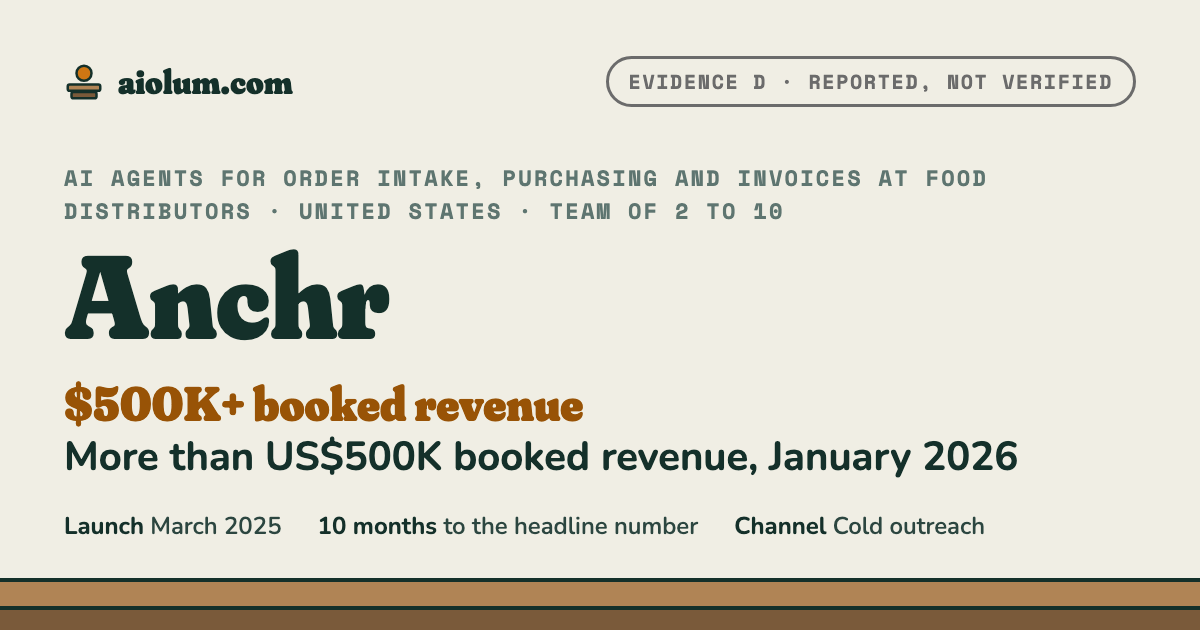
Anchr (AI agents for order intake, purchasing and invoices at food distributors, United States): More than US$500K booked revenue, January 2026. Evidence grade D: reported, not verified. Team: 2 co-founders and co-CEOs; headcount after the March 2026 round not published. Launched March 2025; still running, revenue growing.Added 6 November 2026
- Outcome
- More than US$500K booked revenue, January 2026Revenue growing
- Evidence
- D reported, not verified
- Launch
- March 2025
- Status
- Still running
- Team
- 2 co-founders and co-CEOs; headcount after the March 2026 round not published
- Outside funding
- US$5.8M round led by a16z speedrun, March 2026 (called pre-seed by Axios and seed by other press)
- Main channel
- Cold outreach
What is not verified
The headline, more than US$500,000 in booked revenue, rests on one statement by Anchr's lead investor, a16z speedrun, in its newsletter of 20 January 2026. The "seven-figure" booked revenue of March 2026 comes from the company's own funding announcement as reported by Tech Funding News, without an amount. No payment-processor profile, filing or named customer confirms either figure. A reader could look for a customer case study that names the distributor, or a later interview with recognised revenue. The headline number is grade D: one claim or one estimate, with no second source. Aiolum shows it because the story is useful, and marks it so that it is not mistaken for a verified figure.
Anchr sells AI agents, programs that use a large language model to read a task, look up data in other systems and take steps toward finishing it, to food distributors. The first agent handles order intake, the work of turning a customer's email, text message or spreadsheet into a sales order. Anchr connects to the distributor's ERP (enterprise resource planning system, the database that holds customers, items, prices, stock and invoices), such as NetSuite, SAP or QuickBooks, instead of replacing it.
Tzar Taraporvala and Smayan Mehra, childhood friends who are both co-founders and co-CEOs, started it; the first archived copy of its site is from 14 March 2025. In January 2026 a16z speedrun, its lead investor, wrote that Anchr had set a goal of US$500,000 in booked revenue (the value of signed contracts, not money already received) during the speedrun program and passed it after a deal with a publicly traded food distributor. In March 2026 the company's funding announcement, as reported by Tech Funding News, said it booked seven-figure revenue within 12 weeks of the program, and it announced a US$5.8 million round.
The bookings figures come from the investor and from the company's own announcement, so this page grades them D. No payment processor, filing or customer has confirmed them, and booked revenue is not the same as revenue earned.
How much revenue does Anchr make?
Each row shows the evidence grade and the source numbers from the list at the end of this page. The grades are explained in How Aiolum verifies.
| Fact | Value | Grade | How we know | Sources |
|---|---|---|---|---|
| Booked revenue, January 2026 | more than US$500,000 | D | a16z speedrun newsletter, 20 January 2026, written by its head of go-to-market: the founders set a stretch goal of US$500,000 in booked revenue by the end of the program and surpassed it after an enterprise deal. Booked revenue is signed contract value, not cash received. | [1] |
| Booked revenue, March 2026 | "seven-figure", no exact amount | D | The company's funding announcement as reported by Tech Funding News, 10 March 2026: "Within just 12 weeks of the Speedrun programme, Anchr booked seven-figure revenue". Customers ranged from regional distributors to a US$5 billion publicly traded company. | [2] |
| Largest deal | a publicly traded food distribution company | D | a16z newsletter. The founders met its CEO at an industry conference and then pitched about ten of its executives. The customer is not named. | [1] |
| Funding | US$5.8 million, announced 10 March 2026 | C | Led by a16z speedrun with Anterra Capital, Offline Ventures, a third venture firm and, in Tech Funding News' words, "leaders from OpenAI". Axios called it pre-seed; SiliconANGLE and Tech Funding News called it seed. | [2, 3, 5] |
| Founders | Tzar Taraporvala and Smayan Mehra, co-founders and co-CEOs | C | Both 26 years old in January 2026 per the a16z newsletter, which says they were friends from age five; Tech Funding News says age four. | [1, 2] |
| Headcount | not published | C | Sources name only the two founders. No source gives a later team size. | [1, 2, 3] |
| First archived site | 14 March 2025 | C | Internet Archive copy: "Modernizing food distribution with seamless automations and intelligent analytics", with order management, procurement, AI-driven inventory and an "Anchr AI" sales and support agent. | [7] |
| Origin | months of work at Wulf's Fish, a Boston seafood distributor | C | Tech Funding News and SiliconANGLE, from the company's account: orders were typed in at 3 a.m. and finance reconciled invoices across disconnected tools. | [2, 3] |
| Customer results claimed | about 40% of daily working time recovered for 8 sales representatives | D | Company announcement, March 2026. Another customer is said to have cut aged-inventory write-offs by US$30,000 in one month (Tech Funding News) or to be on track for about US$65 more per order (SiliconANGLE). These are customer outcomes, not Anchr revenue. | [2, 3] |
| Systems it connects to | NetSuite, SAP, QuickBooks, Xero, Salesforce, HubSpot, Google Workspace, Microsoft 365, WhatsApp, email | C | Home page, November 2026. | [4] |
| Markets on the site, November 2026 | food distribution, industrial and MRO, healthcare and pharma, building supplies, consumer packaged goods | C | The home page now says "The AI Supply Chain Employee" for all five; the 2025 site and the 2026 press spoke only of food distribution. | [4, 7] |
| Time from first archived site to the January 2026 figure | 10 months | calc | Calculated: March 2025 to January 2026. | [1, 7] |
How to read this table: a grade D value is reported by one party with an interest in the company (its investor or its own announcement) and not checked by anyone else. A grade C value comes from the company's own pages. A "calc" value was computed on this page.
| Plan | Per month, billed yearly (US$) | Per month, billed monthly (US$) | Limit |
|---|---|---|---|
| Contract after a demo | price not published |
The site has no pricing page. Every call to action is "Get a demo", "Schedule a demo" or "Book a meeting". The a16z speedrun newsletter describes the largest deal as six figures in its advice section, without a contract price.
When did Anchr launch, and how did it grow?
From the first archived site in March 2025 to a US$5.8 million round in March 2026, as the company and its investor describe it. Each entry carries its grade.
- Before March 2025CThe founders spend months mapping orders, purchasing and invoicing at Wulf's Fish, a Boston seafood distributor. [2, 3]
- 14 March 2025CFirst archived copy of anchr.tech: order management, procurement and AI-driven inventory for food distributors. [7]
- Before 20 January 2026DAnchr is in the a16z speedrun program, class SR005, with a stretch goal of US$500,000 in booked revenue set by the founders. [1]
- 20 January 2026Da16z speedrun's newsletter tells how the founders won an enterprise deal with a publicly traded food distributor and passed the US$500,000 goal. [1]
- 10 March 2026DAnchr announces a US$5.8 million round led by a16z speedrun. Its announcement says it booked seven-figure revenue within 12 weeks of the program. [2, 3]
- November 2026CThe site sells "The AI Supply Chain Employee" to five industries and lists more than 40 press mentions. [4, 5]
Why did Anchr work?
Four causes, in the order they mattered. Each one is a reusable lesson.
One narrow, manual job first
Order intake at food distributors is high-volume typing from emails and texts into an ERP. One quote on the company's home page says a customer spent "40+ hours a week manually logging orders". An agent that drafts the order and flags unit mismatches ("case" against "lb") replaces that typing while a person still approves it.
Connect, do not replace
Distributors do not want to change their ERP. Anchr reads from and writes to NetSuite, SAP, QuickBooks and the others, so the customer keeps its system of record. Tech Funding News contrasts this with ordering apps such as Choco and Pepper, which mainly digitise the customer's order.
Founder-led enterprise sales
The a16z newsletter describes the founders flying repeatedly to meet the CEO and then the executive team of a publicly traded distributor, and getting four mutual contacts to introduce them. The investor said this one deal took booked revenue past US$500,000.
How it was built
Few build details are public. These come from the company's pages and press reports of its announcement. [4, 6, 8]
- Four layers on the home page: a data and integration layer, a shared company model of products and rules (an ontology), a runtime that limits what agents may do and sends work for approval, and the specialised agents.
- Agents work in sessions that show their steps, sources and output files; a person can answer the agent's questions in a chat box.
- The privacy policy, effective 17 February 2026, and the other pages read do not name the model provider.
- Sold by demo and contract, not self-serve sign-up.
Tools named in the sources
Each one opens its page in the Tools tab, with every story that uses it.
Who tried this before Anchr, and why did they fail?
Four companies in our database of failed startups tried to modernise ordering, purchasing or distribution for small and mid-sized businesses. The values below are from that database and are not independently verified.
Kinnek
The promiseA marketplace that made procurement for small businesses quick instead of a hunt for vendors.
Why it diedAmazon Business and Alibaba already had the supplier networks, and small businesses adopted it slowly.
TradeGecko
The promiseInventory and order management for small and mid-sized sellers across sales channels.
Why it diedIntuit bought it in 2020 and folded it into QuickBooks; integrations were expensive to maintain.
Stoqo
The promiseConnect small Indonesian restaurants straight to food suppliers, without layers of middlemen.
Why it diedIt held stock and ran warehouses and delivery on margins of about 8%, which could not cover its costs.
ShopX
The promiseA B2B marketplace linking consumer brands directly to India's neighbourhood stores.
Why it diedThin marketplace margins could not pay for field sales visits to each store.
The failed startups come from our database of 1,749 dead startups, retold here in our own words. Its entries are AI-assisted summaries of public sources, so these cards carry no evidence grade.
What changed
Stoqo and ShopX tried to move the goods themselves and died of the cost of warehouses, trucks and field agents. Kinnek and TradeGecko sold software that asked businesses to change how they ordered or which system they used, and larger platforms won.
Anchr carries no stock and asks the distributor to change nothing: the agent reads the email or message the customer already sends and writes into the ERP the distributor already has. Large language models made that possible, because reading a free-text order with unit names, abbreviations and attachments was the step that older software could not automate.
Can one person copy Anchr now?
The method, partly. The scale, not alone.
One person can still pick a manual back-office job in one industry, sit with a customer to map it, and build an agent that drafts the work for human approval. What a16z described for Anchr, two founders flying to win a contract with a public company and then a US$5.8 million round reported by the press, needs more than one person and outside money.
Where it is still open: Other distributors with the same order-by-email problem: industrial parts, building supplies, medical supplies, beverages, and regional distributors too small for enterprise software.
- 1Spend weeks inside one customer's operation and write down every manual step.
- 2Automate the step with the most typing first, with a person approving each output.
- 3Integrate with the systems the customer already runs instead of replacing them.
- 4Sell in person to the largest buyers you can reach, through several warm introductions.
What could go wrong for Anchr?
The risks are the mirror image of the causes above.
What is not verified
The headline, more than US$500,000 in booked revenue, rests on one statement by Anchr's lead investor, a16z speedrun, in its newsletter of 20 January 2026. The "seven-figure" booked revenue of March 2026 comes from the company's own funding announcement as reported by Tech Funding News, without an amount. No payment-processor profile, filing or named customer confirms either figure. A reader could look for a customer case study that names the distributor, or a later interview with recognised revenue.
Bookings are not revenue
Booked revenue is the value of signed contracts, which may run over several years and may be paid in instalments or cancelled. The sources do not give the contract length or how much has been paid.
Anonymous testimonials and illustrative numbers
The four customer quotes on the home page are signed only with initials and a job title (for example "PE Director of Business Development"), with no company name. The outcome figures on the home page are labelled "Illustrative estimates based on Anchr's value capture study for a $50M distributor". The press page counts 45 mentions, many of them reprints of one press release.
Competition
Tech Funding News names Choco and Pepper as ordering platforms for food distribution. On this site, Lark sells similar AI agents for purchasing, inventory and sales at wholesale distributors.
Dependence on model providers and platforms
No page read names the language model behind the agents, so the dependence on one provider cannot be judged; Tech Funding News says leaders from OpenAI invested. The product also depends on access to customers' ERP, email and messaging accounts, including WhatsApp, which the home page lists among connected systems.
The team today
Only the two founders are named. After a US$5.8 million round the team has probably grown, but no source gives a number, so this page calls it a small team with headcount not published.
Sources
The grade next to each source is the best grade that the source can support. "Read in full" means that the text of the page was downloaded and the numbers were checked in it.
- D a16z speedrun newsletter, 20 January 2026: How to Land Your First $500k Contract, by Macy MillsRead in full. Written by the lead investor's head of go-to-market. Source for the booked-revenue goal and figure, the enterprise deal, the founders' ages and the sales method.
- D Tech Funding News, 10 March 2026: From childhood friends to founders: Can Anchr fix the broken backbone of food supply chains with $5.8MRead in full. Based on the company's announcement. Source for the round, the investors, the seven-figure bookings, Wulf's Fish and the competitors.
- C SiliconANGLE, 10 March 2026: Anchr brings AI to America's food supply distribution chain with $5.8M raiseRead in full. Source for the round, the founders' titles and the customer results the company claims.
- C Anchr home page, read 6 November 2026Read in full. Source for the agents, the four layers, the connected systems, the industries, the testimonials and the illustrative estimates.
- C Anchr press page, read 6 November 2026Read in full. Source for the press count and the Axios summary (New York-based, pre-seed). The Axios article itself answered 403 and was not read.
- C Anchr case studies page, read 6 November 2026Read in full. Source for the order intake, upsell and customer resolution agents.
- C Internet Archive copy of anchr.tech, 14 March 2025Read in full. Earliest copy in the archive. Source for the first product description.
- C Anchr privacy policy, effective 17 February 2026Searched for model providers and subprocessors; none is named.
- C Database of failed startups, local exportLocal export. AI-written summaries, not independently verified. Source for the failed predecessors.
Run this company? Send corrections or a verified figure to aiolum@livyden.com