Tutti: Revenue, team and how it was built
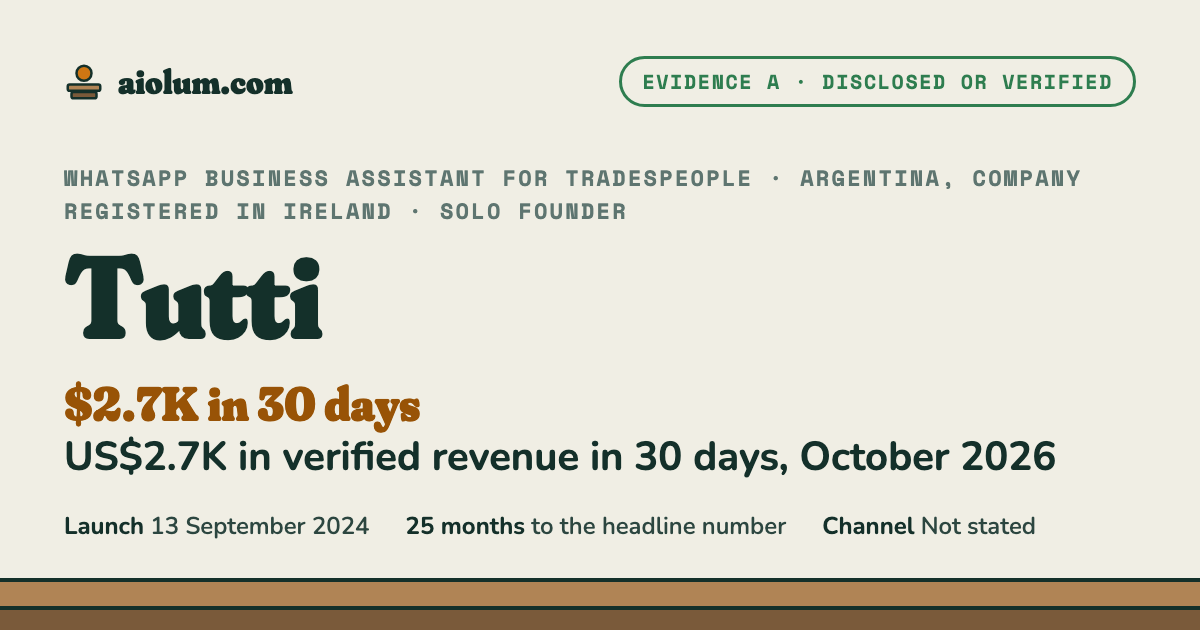
Tutti (WhatsApp business assistant for tradespeople, Argentina, company registered in Ireland): US$2.7K in verified revenue in 30 days, October 2026. Evidence grade A: disclosed by a company or a filing, or verified by a payment processor. Team: 1 person, by the founder's TrustMRR listing. Launched 13 September 2024; still running, revenue growing.Added 31 October 2026
- Outcome
- US$2.7K in verified revenue in 30 days, October 2026Revenue growing
- Evidence
- A disclosed by a company or a filing, or verified by a payment processor
- Launch
- 13 September 2024
- Status
- Still running
- Team
- 1 person, by the founder's TrustMRR listing
- Outside funding
- None (bootstrapped, by the founder's TrustMRR listing)
- Main channel
- Not stated
Tutti calls itself an ERP for construction workers that works entirely through chat. ERP means enterprise resource planning: software that keeps a business's quotes, invoices, customers, payments and stock in one place. Tutti has no screens to learn. The tradesperson writes or speaks to it in WhatsApp, and a large language model, an AI program that reads and writes text, turns the message into a document. Messages travel over the WhatsApp Business Platform, Meta's official service through which companies send and receive WhatsApp messages; the privacy policy names Meta Platforms Ireland as the provider of that channel.
Tomás Stambulsky, who describes himself on his own site as an entrepreneur and AI builder with "8+ years building, 3 startups", is named as the founder on TrustMRR and in the site footer. TrustMRR gives 13 September 2024 as the founding date. The company behind the service is Detach Labs Limited, registered in Dublin. The site is in Spanish and serves tradespeople in Spain, Mexico and Argentina. On 31 October 2026 TrustMRR, which reads revenue directly from the company's Stripe account, showed US$2,695 in the last 30 days, monthly recurring revenue (MRR, the subscription revenue that repeats every month) of US$1,290 from 36 active subscriptions, and US$18,975 since the start.
The revenue figures on this page are grade A because the payment processor supplies them. The team size, the funding and the founding date are the founder's own entries (grade C). Monthly revenue rose from US$288 in November 2025 to US$2,744 in October 2026. The business has been listed for sale on TrustMRR since January 2026. The page also shows failed startups that sold software or services to contractors and small businesses.
How much revenue does Tutti make?
Each row shows the evidence grade and the source numbers from the list at the end of this page. The grades are explained in How Aiolum verifies.
| Fact | Value | Grade | How we know | Sources |
|---|---|---|---|---|
| Verified revenue, 30 days to 31 October 2026 | US$2,695 | A | TrustMRR, from the Stripe API; revenue last synced 31 October 2026 at 08:34 UTC. Marked +10.2% against the 30 days before. | [1] |
| Monthly recurring revenue, 31 October 2026 | US$1,290 from 36 active subscriptions | A | TrustMRR metric snapshot. Last 30 days MRR growth: -8.4%. | [1] |
| Verified revenue, all time to 31 October 2026 | US$18,975 | A | TrustMRR. Last 12 months: US$16,539; last 6 months: US$12,022; last 3 months: US$7,122. | [1] |
| Revenue by month | Nov 2025 US$288; Dec US$325; Jan 2026 US$456; Feb US$706; Mar US$1,271; Apr US$1,334; May US$1,321; Jun US$1,892; Jul US$1,690; Aug US$2,076; Sep US$2,437; Oct US$2,744 | A | TrustMRR monthly table. The twelve months add up to US$16,540, one dollar from the last-12-months figure because of rounding. | [1] |
| Revenue before November 2025 | US$2,436 | calc | Calculated: US$18,975 all time minus US$16,539 in the last 12 months. | [1] |
| Run rate from the 30-day figure | about US$32,340 a year | calc | Calculated: US$2,695 times 12. The MRR times 12 is US$15,480; the difference is explained in the watch list. | [1] |
| Average MRR per subscription | about US$35.83 | calc | Calculated: US$1,290 divided by 36. Close to the €36 monthly price in the App Store. | [1, 6] |
| Growth over twelve months | about 9.5 times | calc | Calculated: US$2,744 in October 2026 divided by US$288 in November 2025. | [1] |
| Where the revenue figures come from | Stripe, through an API key; merchant of record: no | A | TrustMRR verification section. Google Search Console is also connected: 21,038 search impressions in the last 30 days. Subscriptions bought in the iPhone app go through RevenueCat and the App Store, which the Stripe figures do not include. | [1, 4] |
| Profit margin, last 30 days | 90.0% | C | TrustMRR snapshot. The profile does not say how costs were entered, so this page does not treat it as verified. | [1] |
| Team size and funding | 1 person; bootstrapped | C | Founder's entries on TrustMRR. The pricing page offers setup help from "nuestro equipo" (our team (translation)) without a number, and no source suggests more than 10 people. | [1, 3] |
| Professionals using Tutti | more than 2,300 | C | Home page: "+2.300 profesionales llevan ya su negocio con Tutti" (more than 2,300 professionals already run their business with Tutti (translation)). TrustMRR shows the same 2,300 as the estimated user count. Only 36 subscriptions are active in Stripe. | [2, 1] |
| WhatsApp access | official WhatsApp Business Platform through Meta | C | Privacy policy, list of processors: "Meta Platforms Ireland Ltd. | WhatsApp Business Platform: envío y recepción de mensajes" (sending and receiving messages (translation)). | [4] |
| Operating company | Detach Labs Limited, Dublin, registration number 806938 | C | Terms of use, section 1, and the site footer. The iPhone app is published by Orbit Software LLC. | [5, 6] |
| Asking price on TrustMRR | US$250,000, listed since 21 January 2026 | C | Set by the seller. TrustMRR shows a revenue multiple of 7.7 times and 6 offers received. | [1] |
| Time from founding date to the October 2026 figure | 25 months | calc | Calculated: September 2024 to October 2026. The founding date is the founder's entry on TrustMRR. | [1] |
How to read this table: a grade A value comes from TrustMRR, which reads it from the company's Stripe account through an API key. A grade C value is the founder's own entry on TrustMRR or the company's own pages. A "calc" value was computed on this page from the rows above it.
| Plan | Per month, billed yearly (US$) | Per month, billed monthly (US$) | Limit |
|---|---|---|---|
| Flexible | 99 | 25 quotes a month, WhatsApp, 10 AI renders a month; extra quotes €0.50 each | |
| Pro | 149 | 75 quotes a month, WhatsApp and calls, 30 AI renders a month; extra quotes €0.25 each | |
| Expert | 229 | unlimited quotes, WhatsApp, calls and app, 100 AI renders a month, two WhatsApp numbers | |
| Tutti Mensual, iPhone app | €36.00 a month through the App Store | ||
| Tutti Anual, iPhone app | €209.99 or €214.99 a year through the App Store |
The web pricing page showed the three plans in US dollars with 50% off the first three months, and charged extra quotes in euros. The same page's title says "desde 36€/mes" (from €36 a month (translation)), and the iPhone app sells a monthly subscription for €36.00 and a yearly one for €209.99 in its description and €214.99 in its list of in-app purchases. MRR divided by active subscriptions on TrustMRR is about US$35.83, close to the €36 price, so most paying customers seem to pay the lower price; no source says which price each country sees. Every plan starts with a 7-day free trial.
When did Tutti launch, and how did it grow?
From a founding date in September 2024 to more than US$2,000 a month in verified revenue in August 2026. Each entry carries its grade.
- 13 September 2024CFounding date that the founder entered on TrustMRR. [1]
- 25 April 2025CFirst version of Tutti's terms of use, according to the version note on the current terms. [5]
- 13 May 2025CFirst Internet Archive capture of soytutti.com. The privacy policy's first version is dated 6 May 2025. [8, 4]
- November 2025AVerified revenue of US$288 in the month, the first month in TrustMRR's public twelve-month table. [1]
- 21 January 2026CThe founder lists Tutti for sale on TrustMRR. The asking price on 31 October 2026 is US$250,000. [1]
- March 2026AMonthly verified revenue passes US$1,000 for the first time: US$1,271. [1]
- August 2026AMonthly verified revenue passes US$2,000: US$2,076. [1]
- 4 to 23 October 2026CiPhone app versions 1.1.0 to 1.1.5 add a virtual receptionist that answers the tradesperson's own clients, a client summary, and monthly or yearly plans. [6]
- 15 October 2026CNew terms and privacy policy, version 2.0, in force from 22 October, with a full list of the providers that process data. [5, 4]
- 31 October 2026AUS$2,695 in the last 30 days, MRR of US$1,290 from 36 subscriptions, and US$18,975 in total, all read from Stripe by TrustMRR. [1]
Why did Tutti work?
Four causes, in the order they mattered. Each one is a reusable lesson.
No new app to learn
The home page promises "Sin apps. Sin papeleo. Sin ordenador." (No apps. No paperwork. No computer (translation)). The tradesperson keeps using WhatsApp, the app that is already open on the phone, and the assistant answers there. That removes the training step that makes office software hard to sell to people who work on building sites.
Voice, photo or text in, a finished PDF out
A voice note or a photo of the material is enough. The home page says a quote arrives in about 30 seconds as a PDF with the business's logo, VAT and due dates, ready to forward to the client, and that a quote becomes an invoice in two messages.
One narrow customer
Every page speaks to one group: electricians, plumbers, bricklayers, painters, tilers, heating and cooling installers, gardeners and cleaners. The site has a separate page for each trade, and the examples use their real tasks: bathroom renovations, square metres of tiles, cash payments on the job.
Rented AI, small fixed costs
Tutti does not train its own models. The privacy policy lists DeepSeek through OpenRouter for most answers, OpenAI for voice notes and images, and Anthropic as the backup engine. Servers are rented from Hetzner. TrustMRR shows a 90.0% profit margin for the last 30 days, a figure the profile does not explain.
How it was built
These details come from Tutti's privacy policy, terms and App Store page, all read on 31 October 2026. They are grade C. [4, 5, 6]
- Messages go through Meta's WhatsApp Business Platform. The terms forbid users to send unsolicited messages or break Meta's WhatsApp Business policies.
- Answers come from language models: DeepSeek through OpenRouter, OpenAI for voice-note transcription and reading images and documents, Anthropic as the backup engine and for the voice agent, and Google Gemini for the virtual receptionist. The policy says the providers are contracted not to train on the data.
- Renders of finished jobs are made with Kie.ai; photos and logos are stored on Cloudinary.
- Databases and the service run on Hetzner servers in Germany and Finland; Firebase handles login and some server functions; Cloudflare serves the domains.
- Web subscriptions are paid through Stripe; subscriptions in the iPhone and Android apps go through RevenueCat.
- Leads are kept in HubSpot, email goes out through Brevo, product use is measured with PostHog and Mixpanel, and model calls are traced in LangSmith for debugging.
- Human support runs in a self-hosted Chatwoot inbox on WhatsApp; a phone line uses VAPI and Telnyx.
Tools named in the sources
Each one opens its page in the Tools tab, with every story that uses it.
Who tried this before Tutti, and why did they fail?
Four companies in our database of failed startups tried to sell software or services to contractors, small businesses or shoppers, three of them with large funding. The values below are from that database and are not independently verified.
Kaodim
The promiseA marketplace that connected homeowners in Southeast Asia with vetted contractors through quotes.
Why it diedIt charged contractors for leads that did not become jobs, so contractors left and quality fell.
Pro.com
The promiseHome renovations made simple by matching homeowners with contractors.
Why it diedBetter-known rivals filled the market, and its model needed too many people to grow.
Kyte (B2B SaaS)
The promiseOne operations platform for small Indian businesses: inventory, billing and customer records instead of spreadsheets.
Why it diedCustomers paid little, selling to them cost a lot, and the product grew too many features.
Operator
The promiseA personal shopper in a chat app, run by people with help from software.
Why it diedHuman experts behind every chat cost too much against Amazon.
The failed startups come from our database of 1,749 dead startups, retold here in our own words. Its entries are AI-assisted summaries of public sources, so these cards carry no evidence grade.
What changed
Kaodim and Pro.com tried to earn money by bringing work to contractors, and found that contractors do not keep paying for leads that do not turn into jobs. Kyte sold small businesses a full office system and found that a low price could not pay for sales effort and a growing list of features. Operator answered customers in a chat, but people did the work behind each chat, so every new customer added cost.
Tutti sells something narrower: it does the tradesperson's own paperwork, which is needed after every job whether or not new work arrives. A language model now does the part that Operator paid people for, so a new customer adds model fees, not staff. And it lives inside WhatsApp, so it needs no sales team to train users. It is still small: the verified revenue in the 30 days to 31 October 2026 was US$2,695, and TrustMRR's monthly table shows that it took until March 2026 to pass US$1,000 in a month.
Can one person copy Tutti now?
Yes, in another trade or country.
The method is clear from Tutti's own pages: pick a group of people who work away from a desk, take the documents they hate making, and let them ask for those documents in the chat app they already use, through the official business channel. The founder's TrustMRR listing says the system does not depend on one language or country.
Where it is still open: Other trades that work on site and quote every job: car mechanics, cleaning companies, gardeners, event caterers, and the same trades in countries where WhatsApp is the main business channel, such as Brazil, India and much of Africa.
- 1Choose one trade and learn its documents: quotes, invoices, delivery notes, progress reports with photos.
- 2Build on the official WhatsApp Business Platform, through Meta or a provider Meta approves, never on an unofficial WhatsApp connection.
- 3Accept voice notes and photos, not only text, because people on a job site do not type.
- 4Return a finished PDF in the chat that the user can forward to the client at once.
- 5Charge a monthly subscription with a free trial, and keep model costs low by routing most requests to a cheap model.
What could go wrong for Tutti?
The risks are the mirror image of the causes above.
Why the headline is the 30-day figure
TrustMRR shows US$2,695 in the 30 days to 31 October 2026 but MRR of only US$1,290. The profile does not split the difference. The terms say that extra quotes beyond a plan's limit are billed on the next invoice and that yearly plans exist, and both would add revenue that is not monthly subscription revenue. The page uses the 30-day figure because it is the payment total that Stripe recorded; the MRR is shown next to it.
Users claimed versus subscriptions paid
The home page says more than 2,300 professionals use Tutti, and TrustMRR repeats 2,300 as an estimated user count. Stripe shows 36 active subscriptions. Subscriptions bought in the iPhone or Android app are billed through the app stores and RevenueCat, so the Stripe count may miss some paying users, but no source gives that number.
Two company names and the founder's country
Tutti's terms name Detach Labs Limited in Dublin as the provider. The iPhone app is published by Orbit Software LLC, and the App Store notes that Orbit Software LLC "no se ha identificado como comerciante" (has not identified itself as a trader (translation)), so EU consumer rights do not apply to purchases in the app. TrustMRR gives Argentina as the country, and the founder's own site lists Madrid among its keywords.
It depends on Meta
Every message passes through Meta's WhatsApp Business Platform. The terms say the service may end at once if Meta or another provider stops it. A change in Meta's prices or rules for business messages would change Tutti's costs or its product.
Listed for sale
The founder has offered the business on TrustMRR since 21 January 2026, asking US$250,000, which TrustMRR calls 7.7 times revenue (the 30-day revenue times 12). A buyer may change the product, the prices or the providers.
Shared price data and AI mistakes
The privacy policy says Tutti computes price ranges by trade, area and period from all users' quotes and invoices and may publish them or make them available to third parties, in aggregated and anonymised form. The terms warn that the AI can get prices, quantities and dates wrong and that the user is responsible for each document, including its tax correctness.
Sources
The grade next to each source is the best grade that the source can support. "Read in full" means that the text of the page was downloaded and the numbers were checked in it.
- A TrustMRR: Tutti, verified revenue profileRead the markdown profile, downloaded on 31 October 2026 (revenue last synced 31 October 2026). Source for the 30-day, monthly and all-time revenue, the MRR and the subscriptions; the description, team size, funding, founding date, user count and sale listing are founder-written (grade C).
- C Tutti home page: Gestiona tu negocio por WhatsApp fácilmenteRead in full on 31 October 2026. Source for the product, the trades served, the user claim and the founder credit in the footer.
- C Precios de Tutti: Planes para autónomos desde 36€/mesRead in full on 31 October 2026. Prices are drawn by a script; the plan prices were read from the page as downloaded, in US dollars.
- C Política de privacidad de Tutti, version 2.0, published 15 October 2026Read in full. Source for the WhatsApp Business Platform, the list of processors and models, and the shared price data.
- C Términos y condiciones de uso de Tutti, version 2.0, published 15 October 2026Read in full. Source for the operating company, the earlier version date, Stripe billing, extra-quote charges and the rules on WhatsApp use.
- C App Store (Spain): Tutti Agent, Presupuestos y facturas fácilRead in full on 31 October 2026. Source for the app prices, the version history and the publisher Orbit Software LLC.
- C Tomás Stambulsky, personal site: I Ship StuffRead the page description only; the page loads its text by script. Source for the founder's own description of his background.
- C Internet Archive capture list for soytutti.com, read 31 October 2026Read in full. The first capture is dated 13 May 2025.
- C Database of failed startups, local exportLocal export. AI-written summaries, not independently verified. Source for the failed predecessors.