Ardent: Product, team and how it was built
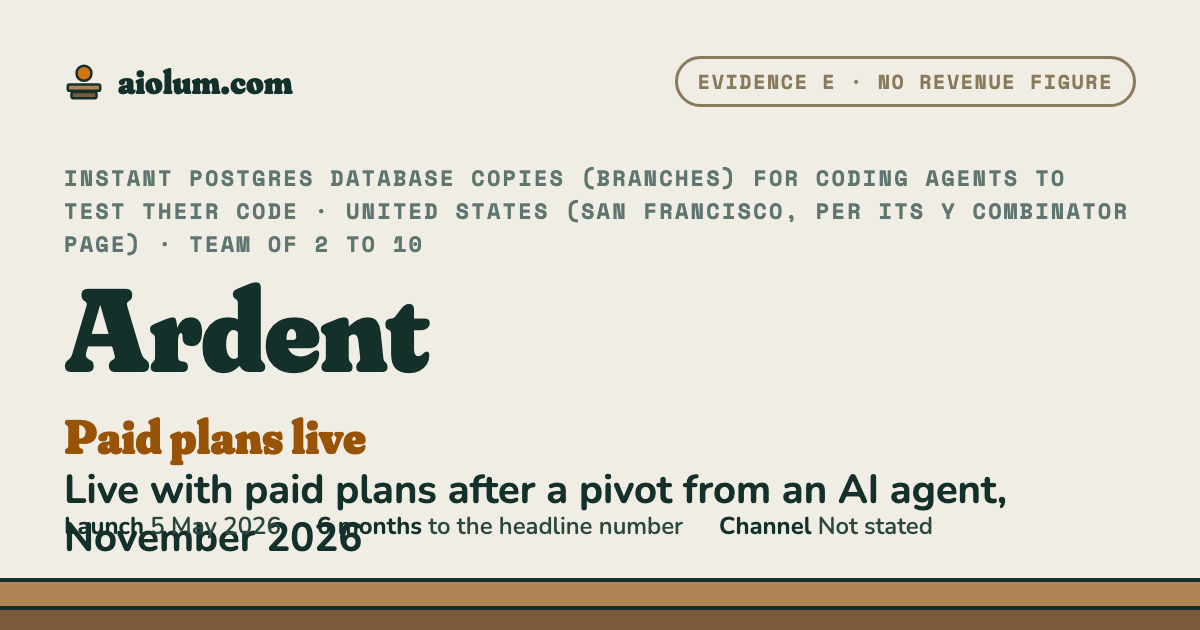
Ardent (Instant Postgres database copies (branches) for coding agents to test their code, United States (San Francisco, per its Y Combinator page)): Live with paid plans after a pivot from an AI agent, November 2026. Evidence grade E: no revenue figure was checked. Team: 1 founder listed (Vikram Chennai, Founder/CEO); team size 3 on the Y Combinator company page, November 2026, with one open founding-engineer role. Launched 5 May 2026; still running.Added 7 November 2026
- Outcome
- Live with paid plans after a pivot from an AI agent, November 2026
- Evidence
- E no revenue figure was checked
- Launch
- 5 May 2026
- Status
- Still running
- Team
- 1 founder listed (Vikram Chennai, Founder/CEO); team size 3 on the Y Combinator company page, November 2026, with one open founding-engineer role
- Outside funding
- Y Combinator, Spring 2026 batch; amount not published
- Main channel
- Not stated
What is not verified
No figure for the revenue Ardent has today was found. The only money statement is one sentence by the founder in the Y Combinator launch post of 5 May 2026 about the earlier product: 'We churned almost 200K in ARR'. Churn is recurring revenue lost when customers cancel; the sentence gives no currency, no date and no figure for the recurring revenue the company had, so it is not used as a headline. No TrustMRR profile (the pipeline's list of TrustMRR slugs has no Ardent entry), filing, round announcement or interview with figures was found. Supermemory, Surface Labs and Zennagents are named as users by Ardent only. A reader could look for a seed-round announcement or a customer case study that names a client. This story is grade E: the business is real and its product, price and customers are described from public pages, but no revenue figure was checked. Aiolum shows it as an idea worth studying, not as proof that it makes money.
Ardent sells database branching for Postgres: a branch is a full, separate copy of a database that you can change and then throw away, the way a git branch is a copy of code. Each branch uses copy-on-write, a storage method in which the copy shares the original's data blocks and stores only the blocks it changes, so the company says a copy of a database of any size appears in under 6 seconds. The buyers are engineering teams that let coding agents (AI programs such as Claude Code, Cursor or Codex that write and run code) write migrations (changes to the structure of database tables) and backfills (jobs that fill in or correct data in existing rows), and who want those agents to test on a 1:1 copy of production instead of on production itself.
Vikram Chennai, a former machine-learning engineer who studied computer science at Cornell, founded Ardent in San Francisco in 2025, according to its Y Combinator page. Its first product was an "AI Data Engineer", a coding agent that wrote data pipelines, migrations and backfills; in the Y Combinator launch post of 5 May 2026 he wrote that customers would not put its untested database code into production and that "We churned almost 200K in ARR". The new product is the missing test environment, and in November 2026 the Y Combinator page lists the company in the Spring 2026 batch with a team of 3.
No figure for the revenue Ardent has today was found, so this story is grade E: the product is live and the pricing page lists a paid plan, but its money is not verified. The churn sentence describes revenue that was lost, not revenue the company has. The page also shows earlier companies that sold managed databases, cloud development environments or AI coding help and failed.
How much revenue does Ardent make?
Each row shows the evidence grade and the source numbers from the list at the end of this page. The grades are explained in How Aiolum verifies.
| Fact | Value | Grade | How we know | Sources |
|---|---|---|---|---|
| Status, November 2026 | Live site with sign-up, a free Starter plan and a paid Scale plan | C | Home page and pricing page read 7 November 2026: 'Get started', 'Book a Demo', 'Backed by Y Combinator'. | [1, 2] |
| Founder | Vikram Chennai, Founder/CEO | C | Y Combinator company page founder list; bio: 'Formerly ML Engineer, Cornell CS'. The launch post is signed by him. | [3, 4] |
| Team | 3 people, November 2026 | C | Y Combinator company page data: team_size 3, one founder listed, one open role 'Founding Engineer - Product (Staff)'. | [3] |
| Founded and location | 2025, San Francisco | C | Y Combinator company page: year_founded 2025, location San Francisco, batch P26 (Spring 2026), status Active. | [3] |
| Launch of the current product | 5 May 2026, Y Combinator launch post | C | Launch 'Ardent - Clone any postgres DB of any size in <6s', created 2026-05-05, 16 votes when read. The founder shows a 1.6 TB database cloned in 6 seconds in a linked video. | [4] |
| First product | An AI Data Engineer coding agent; customers left | D | Launch post, 5 May 2026: generated code 'would never be tested and was too unstable to put in production' and 'We churned almost 200K in ARR'. One founder sentence; no currency, no date and no figure for the revenue the company had. | [4] |
| Prices | Starter US$0, Scale US$250 a month, Enterprise custom, all plus usage | C | Pricing page: compute US$0.40 per CU-hour, storage US$0.70 per GB-month. | [2] |
| Named users | Supermemory and Surface Labs (launch post); a testimonial by the CTO of Zennagents (home page) | C | Named by Ardent only; none of these companies was found confirming it. | [4, 1] |
| Supported databases | Postgres on Supabase, AWS RDS, PlanetScale or self-hosted | C | Documentation FAQ: 'More databases coming soon'. | [7] |
| How a branch is made | From a read replica fed by logical replication, with copy-on-write storage | C | Architecture page: production data flows through a Kafka-backed pipeline into a read replica; branches are full Postgres instances cloned from it and share its storage. Idle branches suspend after 5 minutes (FAQ). | [6, 7] |
| Funding | Y Combinator, Spring 2026; amount not published | C | The home page also quotes Zach Wilson, founder of Dataexpert.io: 'I'm investing in Ardent'. No round size was found. | [3, 1] |
| Time from launch to the November 2026 status | 6 months | calc | Calculated: May 2026 to November 2026. | [4, 2] |
How to read this table: product and price values come from the Ardent site and documentation read on 7 November 2026; founder, team size and launch date from the Y Combinator company page and launch post read the same day. The one money statement, the churn of the first product, is a single founder sentence (grade D). No value is grade A or B.
| Plan | Per month, billed yearly (US$) | Per month, billed monthly (US$) | Limit |
|---|---|---|---|
| Starter | 0 | US$30 one-time credit, up to 3 projects, community support, plus compute and storage | |
| Scale | 250 | US$100 a month in credits, unlimited projects, Slack support, plus compute and storage | |
| Enterprise | custom | dedicated infrastructure, BYOC, VPC, custom SLAs | |
| Compute, after credits | US$0.40 per CU-hour | ||
| Storage, after credits | US$0.70 per GB-month |
Both self-serve plans add usage charges after the included credits: compute at US$0.40 per CU-hour (1 CU is 1 vCPU and 4 GB of memory) and storage at US$0.70 per GB-month. The page shows no yearly billing. Enterprise adds unlimited compute and storage, deployment in the customer's own cloud (BYOC) or behind a VPC, custom SLAs and team-level access controls.
When did Ardent launch, and how did it grow?
From a failed AI data-engineering agent in 2025 to a database-copy service for coding agents, launched in May 2026. Each entry carries its grade.
- 2025CVikram Chennai founds Ardent in San Francisco. Its first product is an AI Data Engineer, a coding agent that writes data pipelines, migrations and backfills. [3, 4]
- Before May 2026DCustomers will not run the agent's untested database code in production. The founder later writes: 'We churned almost 200K in ARR'. [4]
- 5 May 2026CY Combinator launch post for the new product: clones of any Postgres database in under 6 seconds, with Supermemory and Surface Labs named as users. [4]
- Spring 2026CArdent is in the Y Combinator Spring 2026 batch (P26). [3]
- 28 October 2026CThe sitemap lists use-case pages for Claude Code, Cursor, CI/CD and Supabase, and comparison pages for Neon branching, Aurora cloning and database replicas. [8]
- November 2026CThe site sells Starter, Scale and Enterprise plans; the Y Combinator page lists 3 people. [1, 2, 3]
Why did Ardent work?
Four causes, in the order they mattered. Each one is a reusable lesson.
Build the tool that the failed product needed
The AI Data Engineer wrote database code that nobody could test safely, and the founder wrote that this is why customers left. Ardent sells the missing test environment to every team that now uses coding agents, not only to its own former customers.
Copies from a replica, not from production
Ardent streams changes from the production database into a read replica by logical replication (the Postgres feature that sends row changes to another server) and makes every branch from that replica, so many branches put no load on production. Branches share storage by copy-on-write and suspend when idle, so the customer pays mainly for changed data and active compute.
The agent is a user
The CLI works like git, a branch is handed to the agent as one connection URL that cannot reach production credentials, and the documentation publishes a SKILL.md file that Claude Code loads so that the agent creates and deletes its own branches.
How it was built
These details come from Ardent's documentation, its Y Combinator pages and the site's HTML. They are grade C. [6, 7, 5, 3, 1]
- A split architecture: a control plane run by Ardent (branch coordination, connection routing, policies, auth, usage and billing) and a data plane that holds the customer's data, on Ardent's cloud or in the customer's own cloud account.
- The Ardent Replicator takes logical replication from production through a Kafka-backed pipeline into a read replica; custom event triggers replay schema changes (DDL) in order on the replica.
- Each branch is a full Postgres instance cloned from the replica, with autoscaling compute and copy-on-write storage shared with the replica.
- Connection URLs pass through Ardent's branch proxy, so a branch URL given to an agent cannot reach production or its credentials.
- A CLI installed with npm, an API with API keys, and a SKILL.md file for Claude Code; the documentation is hosted on Mintlify.
- The marketing site's HTML loads its files from /_next/static paths, the layout of a Next.js app; the open founding-engineer role lists Go and PostgreSQL as skills.
Who tried this before Ardent, and why did they fail?
Three companies in our database of failed startups sold developers relief from setup or coding work and failed. The values below are from that database and are not independently verified.
FathomDB
The promiseManaged cloud databases, so developers did not have to run database servers themselves.
Why it diedAWS and other large clouds offered the same service, and it did not have the money to keep up.
Nitrous.io
The promiseCloud development environments, so developers could write code anywhere without local setup.
Why it diedAWS bought its competitor Cloud9 and gave it away free, while Nitrous.io spent its money trying to sell the same thing.
Kite DevTool
The promiseAI code completion inside code editors, years before GitHub Copilot.
Why it diedIts free product did not turn into paying customers, and GitHub Copilot had more distribution and stronger models.
The failed startups come from our database of 1,749 dead startups, retold here in our own words. Its entries are AI-assisted summaries of public sources, so these cards carry no evidence grade.
What changed
FathomDB sold managed cloud databases and lost to AWS; Nitrous.io sold cloud development environments and lost when AWS bought Cloud9 and gave it away; Kite sold AI code completion and could not turn free users into paying ones before GitHub Copilot arrived, as the database records them. Each sold developers relief from setup work that a large platform could later give away.
Ardent does not replace the database provider: it works next to Supabase, AWS RDS or PlanetScale and adds disposable copies for a new kind of user, the coding agent, which needs a separate copy for each task and, the founder wrote, makes teams ship "100x more DB code". The old risk remains: database providers offer their own branching and cloning, and Ardent's own site has comparison pages for Neon branching and Aurora cloning.
Can one person copy Ardent now?
Hard for one person: it needs deep Postgres replication work and money for infrastructure.
The method is general: when your own AI product fails because a piece of infrastructure is missing, sell that piece to everyone who has the same problem. Ardent's founder had built the agent first, so he knew what it lacked. The replication pipeline, copy-on-write storage and branch proxy are a large engineering job, as Ardent's own FAQ says.
Where it is still open: Other systems that coding agents cannot test safely today: copies of message queues, search indexes and object storage, and sandbox cloud accounts for infrastructure code.
- 1Write down why customers did not trust your agent's output, and look for the missing tool, not a better prompt.
- 2Build the smallest version of that tool that works with the providers customers already use, so that nobody has to migrate.
- 3Make the agent itself a user: a CLI, a connection URL, and a skill file that the agent can read.
- 4Charge a base plan plus usage, so that idle copies cost the customer little.
What could go wrong for Ardent?
The risks are the mirror image of the causes above.
What is not verified
No figure for the revenue Ardent has today was found. The only money statement is one sentence by the founder in the Y Combinator launch post of 5 May 2026 about the earlier product: 'We churned almost 200K in ARR'. Churn is recurring revenue lost when customers cancel; the sentence gives no currency, no date and no figure for the recurring revenue the company had, so it is not used as a headline. No TrustMRR profile (the pipeline's list of TrustMRR slugs has no Ardent entry), filing, round announcement or interview with figures was found. Supermemory, Surface Labs and Zennagents are named as users by Ardent only. A reader could look for a seed-round announcement or a customer case study that names a client.
Endorsements on the home page
The home page quotes a Head of Data at Chevron, the CEO of Openledger, the CTO of Zennagents and an investor, Zach Wilson of Dataexpert.io. None of these was checked with the person or the company, and the Chevron quote does not say that Chevron uses Ardent. The 'Customer Impact' counters (downtime, release speed, hours saved) show 0 in the downloaded HTML because a script fills them, so their values could not be read.
Competition
Database providers sell their own copies: Ardent's sitemap lists comparison pages for Neon branching, Aurora cloning and database replicas, and its FAQ says a team could build the same thing with enough work. On this site the closest stories are developer-tools stories about infrastructure for coding agents, such as Omnara (a control plane for agents) and Metorial (an MCP gateway); neither copies databases.
Dependence on model providers
Ardent runs no language model itself in the sources read; it is infrastructure built for coding agents, which is why it is listed as AI-native. Its demand depends on agents made by others: the documentation names Claude Code and Cursor, and the launch post names Claude, Codex and Cursor. It also depends on database providers that allow logical replication; Supabase, AWS RDS and PlanetScale are the supported connectors.
Sources
The grade next to each source is the best grade that the source can support. "Read in full" means that the text of the page was downloaded and the numbers were checked in it.
- C Ardent: Database branching for coding agents (home page)Read in full on 7 November 2026. Source for the product claims, the supported providers, the quotes, the counters and the Y Combinator badge.
- C Pricing | ArdentRead in full on 7 November 2026. Source for the plans, credits and usage prices.
- C Ardent: Database sandboxes for Agents | Y CombinatorRead the page data on 7 November 2026. Source for the founder and his title, team size 3, year founded 2025, San Francisco, batch P26 and the open founding-engineer role.
- C Ardent launch post on Launch YC, 5 May 2026: Clone any postgres DB of any size in under 6 secondsRead in full on 7 November 2026. Source for the earlier AI Data Engineer, the churn sentence, the named users, the 1.6 TB demonstration and the launch date.
- C AI agents, Ardent documentationRead in full (markdown version) on 7 November 2026. Source for the URL handoff and the SKILL.md for Claude Code.
- C Architecture, Ardent documentationRead in full (markdown version) on 7 November 2026. Source for the control plane, data plane, Replicator, Kafka pipeline, read replica and copy-on-write branches.
- C FAQ, Ardent documentationRead in full (markdown version) on 7 November 2026. Source for the supported databases, branch time, auto-suspend after 5 minutes and the npm install.
- C Ardent sitemapRead in full on 7 November 2026. Source for the use-case and comparison pages and their 28 October 2026 date; the comparison pages themselves were not read.
- C Database of failed startups, local exportLocal export. AI-written summaries, not independently verified. Source for the failed predecessors.
Run this company? Send corrections or a verified figure to aiolum@livyden.com