Develop Health: Revenue, team and how it was built
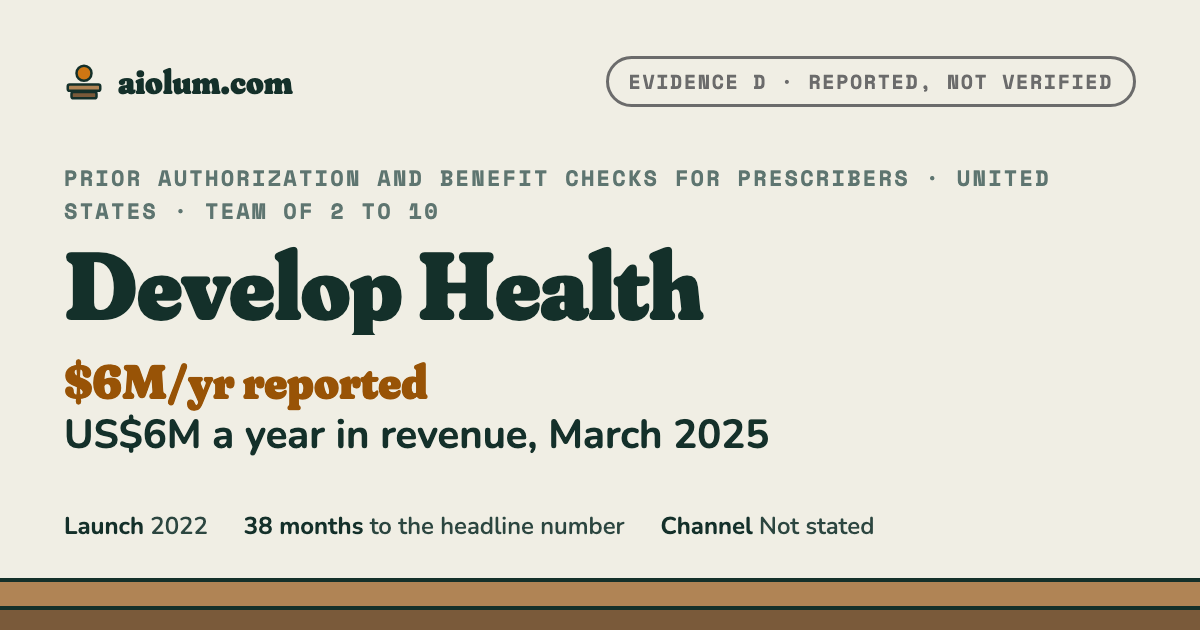
Develop Health (Prior authorization and benefit checks for prescribers, United States): US$6M a year in revenue, March 2025. Evidence grade D: reported, not verified. Team: 2 co-founders (Mel van Londen and Benjamin Easton); 5 employees in March 2025 per the Lean AI Leaderboard, 8 in April 2025 per Latka from LinkedIn; 18 open jobs in November 2026, current headcount not published. Launched 2022; still running.Added 5 November 2026 · updated 6 November 2026
- Outcome
- US$6M a year in revenue, March 2025
- Evidence
- D reported, not verified
- Launch
- 2022
- Status
- Still running
- Team
- 2 co-founders (Mel van Londen and Benjamin Easton); 5 employees in March 2025 per the Lean AI Leaderboard, 8 in April 2025 per Latka from LinkedIn; 18 open jobs in November 2026, current headcount not published
- Outside funding
- US$17.6M in total by August 2025, including a US$14.3M Series A led by Wing Venture Capital
- Main channel
- Not stated
What is not verified
The headline figure of US$6 million a year, with 5 employees, rests on one source: the Lean AI Leaderboard's March 2025 row, whose source column says "Private Verification with Founder", so the evidence itself is not public. Latka repeats the figure and cites the leaderboard, so it is not a second source. The company has not published revenue, and the Series A reports in August 2025 give no revenue figure. A reader could look for a revenue figure in a later interview with the founders or a funding announcement. The headline number is grade D: one claim or one estimate, with no second source. Aiolum shows it because the story is useful, and marks it so that it is not mistaken for a verified figure.
Develop Health sells software for prior authorization, the approval that a US health insurer or its pharmacy benefit manager (PBM, the company that runs the drug part of an insurance plan) must give before it pays for certain medicines. It also does benefit verification: it checks, before or while a doctor writes a prescription, whether the patient's plan covers the drug, what it will cost and what the plan requires. The company calls this "prescription AI": the software reads the plan's questions and the patient's chart notes, fills in every answer it can find with a pointer to where it found it, sends the form, follows it up and drafts an appeal after a denial. It connects to EHR systems (electronic health records, the software in which doctors keep patient charts), such as athenahealth, Epic and Cerner.
Mel van Londen (CEO) and Benjamin Easton founded the company; both had worked at the healthcare software startups Canvas Medical and Rupa Health. Latka and the Lean AI Leaderboard give 2022 as the founding year. In March 2025 the Lean AI Leaderboard listed Develop Health at US$6 million a year in revenue with 5 employees and US$3.2 million in funding, and gave its source as "Private Verification with Founder". In August 2025 the company announced a US$14.3 million Series A led by Wing Venture Capital, for US$17.6 million in total. In November 2026 its jobs page lists 18 open roles, so the team is probably larger now, but no source gives the current headcount.
The revenue figure is grade D: one directory reported it, and it says it checked the figure privately with the founder; Latka repeats the same figure and cites that directory. No filing, payment processor or press report confirms it. The product is administrative software for medical offices and pharmacies, not a treatment; one of its published customers is a weight-loss program that prescribes GLP-1 drugs.
How much revenue does Develop Health make?
Each row shows the evidence grade and the source numbers from the list at the end of this page. The grades are explained in How Aiolum verifies.
| Fact | Value | Grade | How we know | Sources |
|---|---|---|---|---|
| Revenue, March 2025 snapshot | US$6,000,000 a year | D | Lean AI Leaderboard row for Develop Health, snapshot March 2025, source column "Private Verification with Founder". The same row says Profitable: Yes. No second independent source. | [1] |
| Revenue, April 2025, as Latka shows it | US$6 million a year | D | Latka's page gives US$6M for April 2025 and names leanaileaderboard.com as its source, so it is the same figure, not a second confirmation. | [2] |
| Revenue per month from the yearly figure | about US$500,000 | calc | Calculated: US$6,000,000 divided by 12. | [1] |
| Employees, March 2025 | 5 | D | Lean AI Leaderboard, same row. It computes revenue per employee as US$1,200,000. | [1] |
| Employees, April 2025 | 8 | D | Latka, citing LinkedIn. | [2] |
| Founders | Mel van Londen (CEO) and Benjamin Easton | C | Both press reports of the Series A. The company's About page lists Ben Easton as co-founder and CTO. Both had worked at Canvas Medical and Rupa Health. | [3, 4, 6] |
| Founded | 2022 | D | Latka and the Lean AI Leaderboard. The month is not published. | [1, 2] |
| Time from founding to the March 2025 figure | 27 to 38 months | calc | Calculated: from December 2022 or January 2022 to March 2025. The page uses 38 because the founding month is not published. | [1, 2] |
| Funding before the Series A | US$3.2 million (leaderboard); US$3.3 million (calculated) | calc | Calculated: US$17.6 million in total minus the US$14.3 million Series A. The leaderboard lists US$3.2 million in March 2025. | [1, 3] |
| Series A, announced 20 August 2025 | US$14.3 million, led by Wing Venture Capital | C | Company announcement as reported by MedCity News and Pulse 2. Afore Capital, J Ventures and South Park Commons also invested. Total raised: US$17.6 million. | [3, 4] |
| Patients helped | over 3.6 million | C | Company's job posting, November 2026: "over the past couple of years have helped over 3.6 million patients". In August 2025 the company said it aimed at over 1 million patients by the end of the year. | [10, 4] |
| Leadership listed on the site, November 2026 | 6 people, among them the two co-founders | C | About page: CEO, CTO, chief commercial officer and three heads of function. | [6] |
| Open jobs, November 2026 | 18 | C | Company's jobs board: engineers, sales, customer success, a pharmacist, legal and marketing. A posting says the company is "scaling rapidly following a major funding round" and will open a San Francisco office in January 2027. | [10] |
| Customer result, weight-loss program | hands-on time per prior authorization from 10 to 3 minutes | C | Company's case study on Calibrate, with a quote from Calibrate's director of product. It also reports 5 to 7 times fewer requests per member. | [8] |
| Customer result, primary care group | about 800 prior authorizations in six weeks; 20 to 30 staff hours saved a week | C | Company's case study on Arches Primary Care, about 30 providers. Its director of pharmacy found the product in the athenahealth Marketplace. | [9] |
| Security certifications | SOC 2 Type 2 and HITRUST | C | Company's ClearPA page, which also says AI models never train on patients' data. | [7] |
How to read this table: grade D is a figure from one directory that no second independent source confirms. Grade C is the company's own statement, on its site or to the press. A "calc" value was computed on this page from the rows above it. No value is grade A or B.
| Plan | Per month, billed yearly (US$) | Per month, billed monthly (US$) | Limit |
|---|---|---|---|
| ClearPA, for a doctor's office that receives a request | 0 | 0 | no fee, no contract; pharmacies pay |
| Prior authorization and benefit verification for providers | quote only | quote only | sold after a demo |
| Products for payers, pharmacies and drug makers | quote only | quote only | sold after a demo |
The products for providers, payers, pharmacies and drug makers are sold after a demo, and no price is shown. The ClearPA portal is free for the doctor's office: the company says pharmacies pay for the prior authorizations of the prescriptions they fill. A customer case study says the product was available for free in the athenahealth Marketplace when that practice started.
When did Develop Health launch, and how did it grow?
From two founders with healthcare software experience to a funded company with 18 open jobs. Each entry carries its grade.
- Before 2022CMel van Londen and Benjamin Easton work at the healthcare software startups Canvas Medical and Rupa Health. [3, 4]
- 2022DDevelop Health is founded. [1, 2]
- March 2025DThe Lean AI Leaderboard lists Develop Health at US$6 million a year with 5 employees and US$3.2 million in funding, verified privately with the founder. [1]
- April 2025DLatka shows the same US$6 million and 8 employees from LinkedIn. [2]
- 20 August 2025CSeries A of US$14.3 million led by Wing Venture Capital, US$17.6 million in total. The plan: deeper EHR and PBM integrations, then labs and imaging on the medical side of insurance. [3, 4]
- November 2026CThe site offers products for providers, payers, pharmacies and drug makers, and the free ClearPA portal for doctors' offices. 18 jobs are open; a posting reports over 3.6 million patients helped. [5, 7, 10]
Why did Develop Health work?
Four causes, in the order they mattered. Each one is a reusable lesson.
Domain experience
Both founders came from healthcare software startups that sold to doctors' offices. In the Series A coverage the CEO describes the work the product replaces: finding the right form, filling it in by hand, faxing it and waiting on hold with the insurer.
AI fills the form from the chart
The software reads the insurer's questions and the chart notes, answers each question it can support with a pointer to the source, and sends the questions it cannot answer to a person. A practice in the case studies reviews each request in about two minutes.
Inside the EHR and the marketplaces
It connects to EHR systems so coverage checks appear while the doctor prescribes. One primary care group found it in the athenahealth Marketplace and set it up in two days.
Someone else pays for the doctor's side
Through ClearPA, a pharmacy sends the doctor's office a passkey and a prepared request. The office pays nothing; the company says pharmacies cover the cost for the prescriptions they fill.
How it was built
These details come from the company's own pages and the press reports of its Series A. They are grade C. The company has not published its technology stack. [7, 5, 3, 4, 10]
- A GenAI system that reads payer rules and chart notes and drafts every answer, showing where each answer came from; it leaves unanswered what it cannot find.
- Integrations with EHR systems and pharmacy benefit managers. Most practices go live within a week; Epic and Cerner sites take about six weeks.
- ClearPA: a portal where an office enters a passkey, uploads chart notes and submits, with status updates by fax and in the portal.
- HIPAA compliance, SOC 2 Type 2 and HITRUST certification, and a stated rule that models do not train on patient data.
- The marketing site is built with Framer, and hiring runs through Ashby.
Tools named in the sources
Each one opens its page in the Tools tab, with every story that uses it.
Who tried this before Develop Health, and why did they fail?
Four companies tried to sell software around insurance paperwork, prescriptions or medical offices and failed. The values below come from a database of failed startups and are not independently verified.
Olive AI
The promiseSoftware bots that would handle prior authorizations, claims denials, eligibility checks and billing for hospitals.
Why it diedIt sold autonomous AI but delivered labor-intensive automation that needed many engineers per customer, and the costs never came down.
Opkit
The promiseAutomated health insurance verification and claims processing for healthcare providers.
Why it diedHealthcare organizations adopted slowly, integration with existing systems was hard, and it failed to win long-term contracts before the money ran out.
Pear Therapeutics
The promisePrescription apps cleared by the FDA that doctors would prescribe and insurers would pay for.
Why it diedInsurers would not pay, doctors did not prescribe, and prior authorization stayed manual; it had drug-company costs and software prices.
Outcome Health
The promiseScreens in doctors' offices that showed drug advertising at the moment of the prescription decision.
Why it diedThe founders inflated engagement numbers sold to drug makers and were convicted of fraud.
The failed startups come from our database of 1,749 dead startups, retold here in our own words. Its entries are AI-assisted summaries of public sources, so these cards carry no evidence grade.
What changed
Olive AI sold the same promise, AI that does prior authorizations and billing, and needed armies of engineers to make each hospital work. Opkit tried insurance verification for providers and could not get through slow buying and hard integrations. Both show that the paperwork problem is real and that the cost of each integration decides whether the business works.
Two things differ for Develop Health. Large language models can read a free-text chart note and an insurer's question list, which the older rule-based automation could not do without custom work for each form. And EHR marketplaces such as athenahealth's let a practice install the product itself in two days, so a small team could serve many offices before it hired a sales force. The Lean AI Leaderboard reported US$6 million a year with 5 employees before the Series A; the company then raised money to hire, which Olive also did, and the open question is whether the cost per customer stays low as it grows.
Can one person copy Develop Health now?
Not by one person.
The product needs healthcare compliance (HIPAA, SOC 2, HITRUST), integrations with EHR systems and insurers, and founders who already knew how medical offices work. That is a team and capital business. The pattern behind it is still useful: find a paperwork step in a regulated industry where a person copies facts from one document into another form, and let a language model do the copy with a pointer to the source.
Where it is still open: Other approvals that still run on forms and fax: labs and imaging on the medical side of insurance, which the company itself named as its next step, and similar checks in dental and veterinary offices.
- 1Pick a form-heavy step that you know from working inside the industry.
- 2Show the source of every answer the model fills in, and leave the rest for a person.
- 3Get listed in the marketplace of the software your customers already use.
- 4Let the party that gains most from the form, here the pharmacy, pay for it.
What could go wrong for Develop Health?
The risks are the mirror image of the causes above.
What is not verified
The headline figure of US$6 million a year, with 5 employees, rests on one source: the Lean AI Leaderboard's March 2025 row, whose source column says "Private Verification with Founder", so the evidence itself is not public. Latka repeats the figure and cites the leaderboard, so it is not a second source. The company has not published revenue, and the Series A reports in August 2025 give no revenue figure. A reader could look for a revenue figure in a later interview with the founders or a funding announcement.
Regulated field
The product handles patient health information and sends requests to insurers on behalf of doctors, and its AI drafts clinical answers and appeals from chart notes. The company says it is HIPAA-compliant and holds SOC 2 Type 2 and HITRUST certification, and that a person reviews before submission. One published customer is a weight-loss program that prescribes GLP-1 drugs such as Ozempic and Wegovy. Develop Health itself makes no treatment claim; it sells administrative software.
The team has grown
Five employees in March 2025 and eight in April 2025 are directory figures. After the US$14.3 million Series A the jobs board lists 18 open roles in November 2026, and the About page lists six leaders. The current headcount is not published, so this page keeps the small-team label of the headline date.
Company-written case studies
The customer results (70% less time per request, 800 requests in six weeks, US$40,000 to US$50,000 saved) come from case studies on the company's own site, with quotes from the customers. No third party has checked them.
Large rivals and a crowded market
The Arches case study names CoverMyMeds and Surescripts as the tools staff used before, and the predecessors on this page show how expensive this market has been for funded companies.
Sources
The grade next to each source is the best grade that the source can support. "Read in full" means that the text of the page was downloaded and the numbers were checked in it.
- D Lean AI Leaderboard, published Google Sheet (CSV export), downloaded 5 November 2026Read the row for Develop Health (rank 37, snapshot March 2025). Its source column says "Private Verification with Founder". The same sheet is embedded on leanaileaderboard.com, which was also read.
- D Latka: Develop Health revenue 2025Read in full. Revenue figure cited to leanaileaderboard.com; employee count cited to LinkedIn; founding year 2022.
- C MedCity News, Marissa Plescia, 22 August 2025: Develop Health Secures $14.3M to Streamline Prior AuthorizationRead in full. Source for the round, the investors, the total raised, the founders' background and the CEO's description of the product.
- C Pulse 2.0, Amit Chowdhry, 22 August 2025: Develop Health: $14.3 Million Series A Raised To Automate Prior Authorization And Medication AccessRead in full. Source for the two founders, the plans for the funding and the patient goal.
- C Develop Health home page, read 5 November 2026Read in full. Source for what the product does and for whom.
- C Develop Health: About UsRead in full. Source for the leadership list and the mission statement.
- C Develop Health: ClearPARead in full. Source for the free portal, who pays, the certifications and how the AI fills answers.
- C Develop Health case study: How Calibrate Streamlined Prior Authorizations with Develop HealthRead in full. Company-written case study with customer quotes.
- C Develop Health case study: How Arches Primary Care Cleared Its Prior Auth Backlog With Develop HealthRead in full. Company-written case study; source for the athenahealth Marketplace listing and the setup time.
- C Develop Health jobs board on Ashby, and the Executive Operations and Office Manager posting, read 5 November 2026Read the list of 18 open roles and one posting in full. Source for the patient count, the growth statement and the office plans.
- C Develop Health: For ProvidersRead in full. Source for the setup times and the appeal workflow.
Run this company? Send corrections or a verified figure to aiolum@livyden.com