Chamber: Revenue, team and how it was built
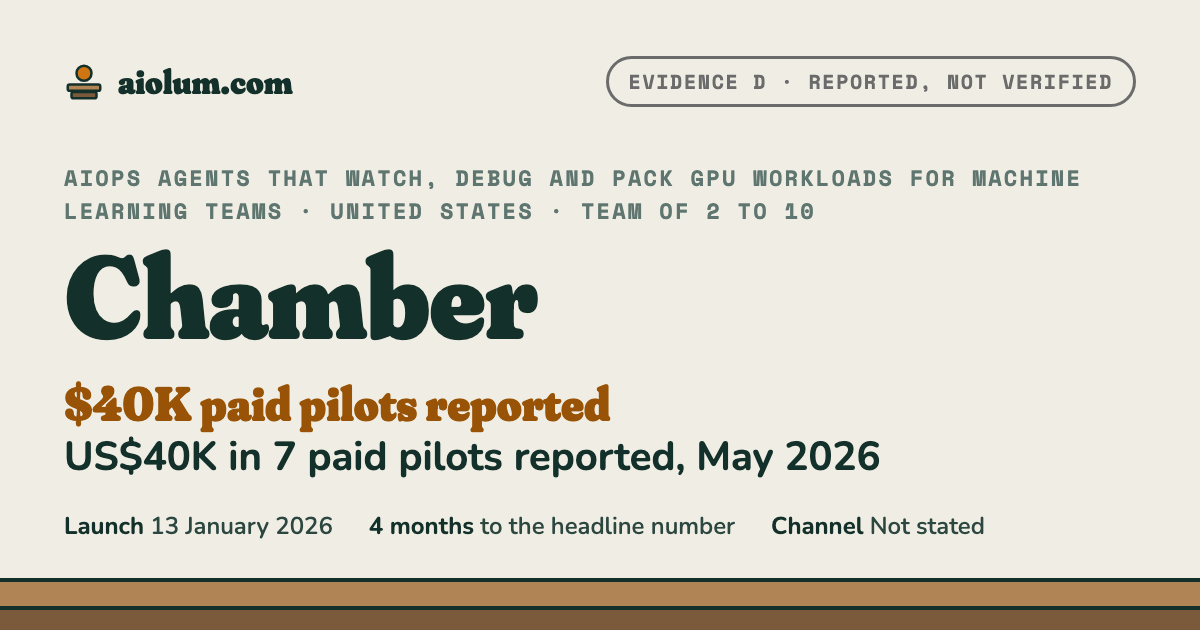
Chamber (AIOps agents that watch, debug and pack GPU workloads for machine learning teams, United States): US$40K in 7 paid pilots reported, May 2026. Evidence grade D: reported, not verified. Team: 4 founders, all former Amazon or AWS engineers; YC lists a team size of 4 (read November 2026). Launched 13 January 2026; still running.Added 5 November 2026 · updated 6 November 2026
- Outcome
- US$40K in 7 paid pilots reported, May 2026
- Evidence
- D reported, not verified
- Launch
- 13 January 2026
- Status
- Still running
- Team
- 4 founders, all former Amazon or AWS engineers; YC lists a team size of 4 (read November 2026)
- Outside funding
- Y Combinator, Winter 2026 batch; no round amount found in the sources
- Main channel
- Not stated
What is not verified
The headline, 7 paid pilots totalling US$40,000, rests on one sentence in an UpNext recap of Web Summit Vancouver published on 15 May 2026, which repeats the company's pitch. No payment processor, customer or investor has confirmed it, and the pilot customers, including the "Global Fortune 1000" one, are not named. The US$250,000 "ARR on conversion" in the same sentence is a forecast. A reader could look for a later funding announcement, a customer case study or a revenue profile. The headline number is grade D: one claim or one estimate, with no second source. Aiolum shows it because the story is useful, and marks it so that it is not mistaken for a verified figure.
Chamber is an AIOps product. AIOps (AI for IT operations) means software that uses AI models to watch computer systems, find the cause of failures and fix them without a person. Chamber does this for GPU clusters, groups of servers with graphics processors that companies use to train machine learning models. Its agents read job logs, Kubernetes events and GPU metrics, match a failure (for example a CUDA out-of-memory error, when a training job asks the GPU for more memory than it has) against a bank of known failure patterns, and apply a typed fix: an action from a fixed, reversible list, with limits on how many jobs it can touch.
Charles Ding (CEO), Andreas Bloomquist, Jason Ong and Shaocheng Wang founded it. All four list earlier work at Amazon or AWS on Y Combinator's company page, and Bloomquist writes that he led the launch of Amazon's central GPU orchestration service. Chamber joined Y Combinator's Winter 2026 batch and posted its launch on 13 January 2026. In May 2026 the news site UpNext wrote, in a recap of startups at Web Summit Vancouver, that the company had "7 paid pilots totaling $40k", which this page takes as the headline figure.
That figure is one statement in one article, so this page grades it D: reported, not verified. The same sentence says "$250k ARR on conversion", which is a forecast of what the pilots would pay if they became yearly contracts, not revenue, so this page does not use it as a headline. The page also shows three earlier GPU and machine-learning infrastructure startups from our database of failed startups that failed against the large cloud providers.
How much revenue does Chamber make?
Each row shows the evidence grade and the source numbers from the list at the end of this page. The grades are explained in How Aiolum verifies.
| Fact | Value | Grade | How we know | Sources |
|---|---|---|---|---|
| Paid pilots, May 2026 | 7 paid pilots totalling US$40,000 | D | UpNext recap of Web Summit Vancouver 2026, published 15 May 2026: "The company has 7 paid pilots totaling $40k and $250k ARR on conversion, including one Global Fortune 1000 customer." The source of the numbers is the company's pitch; no second source. | [1] |
| Yearly revenue if the pilots convert | US$250,000 ARR, as a forecast | D | Same sentence. ARR means annual recurring revenue. "On conversion" makes it a forecast, not money received, so it is not the headline. | [1] |
| Largest pilot customer | one "Global Fortune 1000" company, not named | D | Same sentence. The customer's name is not given. | [1] |
| Average value per pilot | about US$5,714 | calc | Calculated: US$40,000 divided by 7 pilots. | [1] |
| Founders | Charles Ding (Founder/CEO), Andreas Bloomquist, Jason Ong (Founder/CPO), Shaocheng Wang (Founder/CTO) | C | Y Combinator company page. Ding's profile: "Second Time Founder with 1X Exit | Former Engineering Leader at Meta & Amazon | Ex-Microsoft". The exit is not named. | [2] |
| Team size | 4 | C | Y Combinator company page, read 5 November 2026. The team size field is written by the company. | [2] |
| Year founded | 2026 on Y Combinator; 2024 in the site's own structured data | C | The two company-written pages disagree. Both are after 2022. | [2, 4] |
| Location | Seattle on Y Combinator; "Built in San Francisco" on the site footer | C | Company-written pages. | [2, 4] |
| Funding | Y Combinator, Winter 2026 batch | C | Y Combinator page and the company's about page. No amount is stated in the sources read. | [2, 5] |
| Launch post | 13 January 2026, "Chamber – Autopilot for AI Infrastructure", 269 votes | C | Launch YC post by Charles Ding, created 13 January 2026, read inside the Y Combinator company page. The first Internet Archive capture of usechamber.io is 14 January 2026. | [3, 8] |
| Idle GPU claim in the launch post | 30 to 60% of reserved enterprise GPU capacity idle | C | The company's own market claim; this page did not check it. | [3] |
| Where it runs | Kubernetes and Slurm, on AWS, GCP, Azure or on-premises | C | Home page FAQ. Installed with Helm into the customer's cluster; the site says models, data and code stay there and only anonymized operational metadata reaches Chamber. | [4] |
| Security audit | SOC 2 Type I and Type II, stated as attested | C | Home page footer and FAQ. No audit report was read. | [4] |
| Prices | not published | C | Pricing page, read 5 November 2026. | [6] |
| Time from launch to the pilot figure | 4 months | calc | Calculated: January 2026 to May 2026. | [1, 3] |
How to read this table: a grade D value is a single statement in one article with no second source. A grade C value is read on the company's own pages or on its Y Combinator profile, which the company writes. A "calc" value was computed on this page. No value is grade A or B.
| Plan | Per month, billed yearly (US$) | Per month, billed monthly (US$) | Limit |
|---|---|---|---|
| Free dashboard (January 2026 launch offer) | 0 | 0 | GPU usage dashboard and monitoring agent; may have changed since |
| Tailored plan | custom | custom | by fleet size, infrastructure and team needs; quote from the founders |
The pricing page says "Every team's GPU infrastructure is different. Talk to us and we'll put together the right plan for your setup." and asks visitors to talk to the founders. The January 2026 launch post offered a free GPU Intelligence Dashboard and monitoring agent through a self-service sign-up. The pilot prices behind the reported US$40,000 are not public.
When did Chamber launch, and how did it grow?
From a Launch YC post in January 2026 to seven paid pilots reported in May 2026, four months later. Each entry carries its grade.
- Before 2026CThe founders work at Amazon and AWS on GPU orchestration, observability and infrastructure products. Bloomquist leads the launch of Amazon's central GPU orchestration service. [2]
- 13 January 2026CLaunch YC post: "Chamber – Autopilot for AI Infrastructure". It offers a free GPU dashboard and asks for introductions to companies that spend millions on reserved GPUs. [3]
- 14 January 2026CFirst Internet Archive capture of usechamber.io. [8]
- Winter 2026CY Combinator Winter 2026 batch. [2, 5]
- May 2026DPitch at Web Summit Vancouver 2026. UpNext reports 7 paid pilots totalling US$40,000, one of them a Fortune 1000 company. [1]
- November 2026CThe site sells "AIOps agents for ML teams" with the Chambie agent in Slack; prices by quote only. [4, 6]
Why did Chamber work?
Four causes, in the order they mattered. Each one is a reusable lesson.
Experience from the same problem inside Amazon
The founders had built GPU sharing and observability systems for Amazon's own teams. The about page says they built these platforms before and are now building them for other companies. This gave them the failure patterns and the scheduling ideas before the first customer.
A narrow agent, not a general chat agent
The site argues that a general AI agent waits for a person and has no memory of the cluster. Chamber's agents keep a live graph of jobs, checkpoints and owners, compare each failure with a bank of known failures, and may act only through a short list of reversible actions. That limit is what lets a customer allow it to act at night without a person.
Paid pilots before a price list
UpNext reported in May 2026 that Chamber had seven paid pilots worth US$40,000 in total. Enterprise infrastructure is usually sold this way: a short paid trial on the customer's cluster, then a yearly contract. The pricing page still has no prices, only a call with the founders.
Installed inside the customer's cluster
The software runs in the customer's own cloud account or data center, and the site says models, datasets and code never leave it. Together with the stated SOC 2 audits, this answers the first question a large company's security team asks.
How it was built
These details come from the company's own pages and its Y Combinator launch post. They are grade C. [4, 7, 3]
- Installed with one Helm command into Kubernetes; the site says it maps GPUs, workloads and teams by itself, with no configuration files.
- Supports Kubernetes and Slurm clusters on AWS, GCP, Azure and on-premises hardware, including mixed setups.
- A live workload graph per customer: topology, checkpoints, configurations, owners, GPU and CPU phases and cost.
- A pattern bank of GPU failures (out-of-memory errors, NCCL timeouts, ECC memory errors, slow nodes), each with a known fix.
- The Chambie agent answers in Slack, a command line, a Python SDK and a web console, and sends alerts by Slack, email and webhooks.
- The site does not say which AI model provider the agents use.
Tools named in the sources
Each one opens its page in the Tools tab, with every story that uses it.
Who tried this before Chamber, and why did they fail?
Three companies in our database of failed startups sold GPU or machine-learning infrastructure and lost to the large cloud providers. The values below are from that database and are not independently verified.
Vectordash
The promiseCheap GPU time for gamers and AI developers from a network of other people's idle GPUs.
Why it diedLarge cloud providers offered integrated GPU services; the spread-out network could not give steady performance.
FloydHub
The promiseA managed cloud for training machine learning models, with GPUs and notebooks ready to use.
Why it diedAWS SageMaker and the other cloud platforms offered the same with more services, and the GPU costs did not leave a margin.
Streamdal
The promiseReal-time observability for streaming data pipelines.
Why it diedDatadog, Splunk and open-source tools offered observability as part of larger suites, and IT budgets fell.
The failed startups come from our database of 1,749 dead startups, retold here in our own words. Its entries are AI-assisted summaries of public sources, so these cards carry no evidence grade.
What changed
Vectordash and FloydHub sold GPU time, so they competed with AWS, Google Cloud and Azure on the thing those companies sell best. Streamdal sold observability against Datadog and Splunk, which bundle it. Each lost to a larger vendor that already had the customer.
Chamber does not sell GPUs. It sells better use of GPUs that the customer has already reserved, on any cloud and on-premises, so the cloud providers are platforms it runs on, not direct rivals. GPU spending by AI teams is much larger in 2026 than in 2017 to 2020, and the AI agent can now read logs and propose fixes, which was manual work for the earlier tools. The risk that remains is the same as for Streamdal: a large cloud or observability vendor can add the same feature.
Can one person copy Chamber now?
Not by one person without this background.
Chamber's start rests on four engineers who built GPU orchestration inside Amazon, a Y Combinator place, and sales to companies with large GPU fleets. A solo founder could copy the pattern in a smaller niche: take an internal tool that large companies build for themselves, add an AI agent that acts only through safe, reversible steps, and sell paid pilots before a price list.
Where it is still open: Smaller fleets that large tools ignore: university and research labs, inference servers for small AI companies, and single-cloud teams that rent a few dozen GPUs.
- 1Pick an operations problem you solved inside a large company, where the failures repeat and have known fixes.
- 2Install inside the customer's own cluster, so their data never leaves it, and pass a SOC 2 audit early.
- 3Limit the agent to a short list of reversible actions with limits on scope, so a customer lets it act at night.
- 4Sell short paid pilots and convert them to yearly contracts.
What could go wrong for Chamber?
The risks are the mirror image of the causes above.
What is not verified
The headline, 7 paid pilots totalling US$40,000, rests on one sentence in an UpNext recap of Web Summit Vancouver published on 15 May 2026, which repeats the company's pitch. No payment processor, customer or investor has confirmed it, and the pilot customers, including the "Global Fortune 1000" one, are not named. The US$250,000 "ARR on conversion" in the same sentence is a forecast. A reader could look for a later funding announcement, a customer case study or a revenue profile.
Company pages disagree
Y Combinator gives the founding year as 2026 and the location as Seattle; the site's own structured data says the company was founded in 2024 and the footer says "Built in San Francisco". The home page shows a "BUILT BY VETERANS FROM" logo row and "SOC 2 Type I & II" badges; no audit report or logo permission was checked.
Competition
The closest story on this site is Mendral, an AI DevOps agent for CI failures and flaky tests, which also sells an agent that diagnoses failed jobs, but for build pipelines rather than GPU training. The predecessors on this page show the larger risk: cloud providers, schedulers and observability vendors can add an AI agent to the tools customers already use.
Dependence on model providers
The site says its agents use natural language and AI root-cause analysis, but none of the pages read names the language model or the provider behind them. If a provider is used, its price and terms are a cost and a risk that the sources do not describe.
Enterprise sales and a small team
Customers are companies with large GPU fleets, the prices are by quote, and the FAQ says "We handle deployment for you". Each pilot needs the founders' time, which limits how many a four-person team can run at once.
Sources
The grade next to each source is the best grade that the source can support. "Read in full" means that the text of the page was downloaded and the numbers were checked in it.
- D UpNext, 15 May 2026: Web Summit Vancouver 2026: Enterprise AI Deployment RecapRead the section on Chamber in the copy downloaded by the pipeline on 6 November 2026. Source for the 7 paid pilots, the US$40,000 and the US$250,000 forecast.
- C Y Combinator company page: Chamber, The AIOps Agent for ML TeamsRead in full, including the page data: founders and their profiles, team size, year founded, location and batch.
- C Launch YC, 13 January 2026: Chamber – Autopilot for AI InfrastructureRead in full as embedded in the Y Combinator company page data (created 13 January 2026, posted by Charles Ding).
- C Chamber home pageRead in full on 5 November 2026, including the FAQ and the structured data in the page source.
- C Chamber about pageRead in full. Source for the founders' story and the Y Combinator batch.
- C Chamber pricing pageRead in full on 5 November 2026. No prices are published.
- C Chamber features pageRead the feature walkthrough.
- C Internet Archive capture list for usechamber.ioRead the first captures; the earliest is 14 January 2026.
- C Database of failed startups, local exportLocal export. AI-written summaries, not independently verified. Source for the failed predecessors.
Run this company? Send corrections or a verified figure to aiolum@livyden.com