Magai
Magai is a model aggregator: a product that gives access to the AI models of several companies through one account. The customer pays one subscription and can talk to GPT, Claude, Gemini or Grok in the same chat. Magai calls each provider through its API, the interface that lets one program send requests to another, and pays the provider for every message. Several other products have similar names. This page is about Magai at magai.co, which some summaries of a 2025 video spell "Magi".
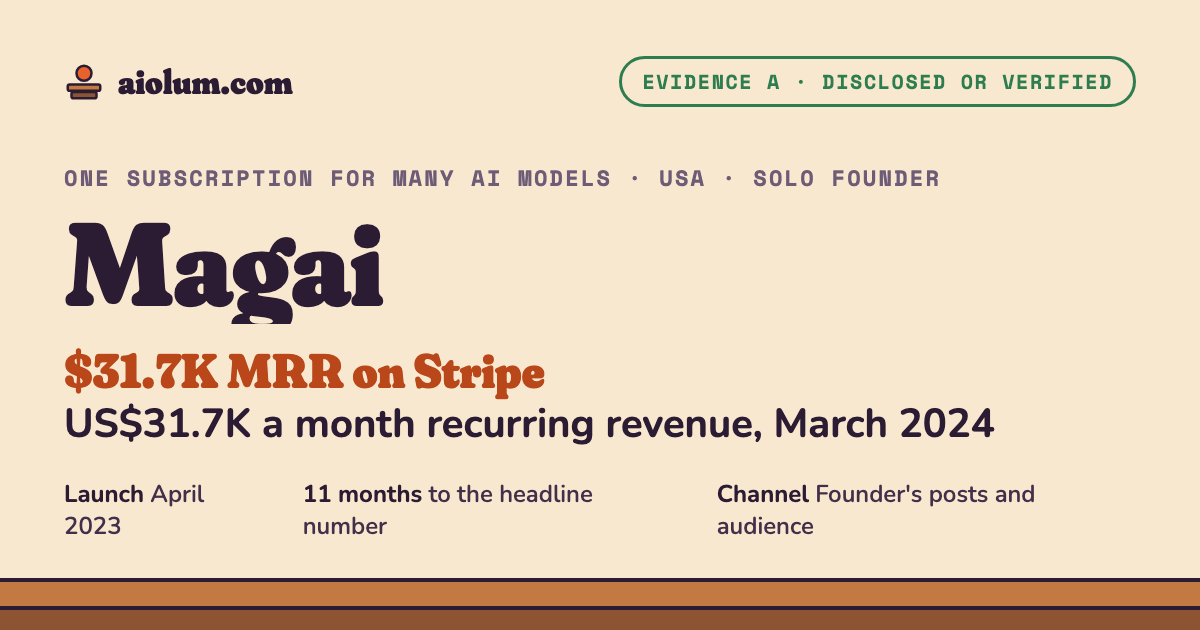
Dustin W. Stout of Bakersfield, California built it alone in 8 weeks with Bubble, a no-code tool, which means a tool for building web applications by arranging visual blocks instead of writing program code. Plans were on sale by 8 April 2023. A chart on Stripe, the payment processor, shows US$31,745.58 of MRR, monthly recurring revenue, the sum of all active subscriptions counted per month, in March 2024. In a Starter Story episode of 11 October 2025 he said the business made "almost US$100,000 a month". By then the company's site named 7 people. Indie Hackers repeated "nearly US$100,000" in February 2026, so the claims show no growth between those two dates.
The headline number on this page is the Stripe figure, grade A, because Stripe itself hosts the chart. It is from the first year, when the founder ran the business without a staff: the company's about page named only him until 2025. The later figure of almost US$100,000 a month is a founder statement, grade C, and no document for it is public. The share of revenue that remains after paying the model providers is not published for any date. The page also shows what happened to earlier companies that sold other companies' products for one flat price.
The numbers, graded
Each row shows the evidence grade and the source numbers from the list at the end of this page. The grades are explained in How Aiolum verifies.
| Fact | Value | Grade | How we know | Sources |
|---|---|---|---|---|
| Monthly recurring revenue, March 2024 | US$31,745.58 | A | Stripe profile of the account @heymagai, MRR chart for March 2023 to March 2024. The chart gives US$70.66 for the period before. The founder posted the link on 5 May 2026 and called it year 1. | [1, 5] |
| Run rate from the March 2024 figure | about US$381,000 a year | calc | Calculated: US$31,745.58 times 12 = US$380,946.96. This is the headline figure on this page. | [1] |
| Revenue per month, October 2025 | "almost US$100,000" | C | Founder's words in the Starter Story episode of 11 October 2025. The video title says $100K a month and the podcast version says $99K a month. He gave no exact figure, and the transcript mentions no dashboard. | [3, 2] |
| Run rate from the October 2025 statement | under US$1.2 million a year | calc | Calculated: US$100,000 times 12 = US$1,200,000 as the upper limit; US$99,000 times 12 = US$1,188,000. | [3] |
| Monthly recurring revenue, February 2026 | "nearly US$100,000" | C | Indie Hackers, 25 February 2026. The same level as four months earlier, so the two statements show no growth. | [7] |
| Monthly recurring revenue, October 2023 | US$23,000 with 1,010 paying subscribers | C | Indie Hackers, 19 October 2023, and the founder's comment of 21 October 2023. He counted about 1,500 paid users in total; some had lifetime deals from his earlier products. | [6] |
| Average revenue per paying subscriber, October 2023 | about US$22.77 a month | calc | Calculated: US$23,000 divided by 1,010. | [6] |
| Monthly recurring revenue, 30 June 2023 | US$6,600 | C | Founder's post on X: from US$0 in less than 90 days. | [9] |
| Lifetime-deal sale, 5 to 20 June 2023 | US$114,238 in 15 days, of which Magai received US$57,119 | C | Founder's blog. Sold through the deal site RocketHub with a 50/50 split: 475 sales and 45 refunds. One-time prices of US$99, US$199 and US$399. | [4] |
| Revenue recorded by Latka | US$267,600 a year as of October 2023; estimate of US$588,100 for October 2024 | C | A third party. The 2023 value has no recorded source; divided by 12 it is US$22,300 a month, close to the founder's US$23,000. The 2024 value is Latka's own estimate. | [14] |
| Share of revenue left after model costs | not published | C | The founder says API costs and Stripe fees were paid out of revenue, and that the first year was profitable because he paid no staff. No source that was read gives a percentage. | [5, 4] |
| Fixed bills at the start | a domain name and the Bubble subscription | C | Founder on the Bubble forum, 5 May 2026. API costs and Stripe fees came out of revenue. | [5] |
| Founder's money before Magai | US$230.17 in the bank; US$30,000 earned in all of 2022 | C | Founder's blog. Two earlier products had failed and US$65,000 was lost. | [4] |
| Time to build the first version | 8 weeks, alone | C | Founder's blog and the Starter Story episode. He learned Bubble from an online course. | [4, 3] |
| Team size by date | 1 in 2023; 6 in April 2025; 7 in October 2025; 12 in May 2026; 8 named in October 2026 | C | Indie Hackers 2023, company press release, the company's about page on 3 October 2025 and 13 October 2026, and the founder's forum post of 5 May 2026. The count of 12 is his own and may include part-time people. | [6, 8, 10, 5, 11] |
| Revenue per person from the October 2025 statement | at most about US$171,000 a year | calc | Calculated: US$1,200,000 divided by 7 people = US$171,429. | [3, 10] |
| Outside funding | none found for Magai | C | Latka lists no funding. The founder writes that his two earlier products attracted investors. A reader's comment on the 2023 Indie Hackers interview says he kept those investors for Magai; the interview text needs a login, so this is not verified. | [14, 4, 6] |
| Audience before the launch | "over 100,000 email subscribers" in 2025; "over 20,000" newsletter subscribers in 2023 | C | Two founder statements that differ. The first is from the Starter Story episode and speaks of ten years in total, the second from his Indie Hackers comment of 21 October 2023, with more than 30,000 blog visitors a month. | [3, 6] |
| Time from launch to the Stripe figure | 11 months | calc | Calculated: April 2023 to March 2024. The site showed a waiting list on 8 March 2023 and sold plans by 8 April 2023. | [1, 13] |
How to read this table: the grade A value comes from a chart that Stripe hosts on its own domain. A grade C value is a statement by the founder or his company, or a third-party estimate that says so. A "calc" value was computed on this page from the rows above it. No one outside the company has confirmed the figures after March 2024.
| Plan | Per month, billed yearly (US$) | Per month, billed monthly (US$) | Limit |
|---|---|---|---|
| Standard | 16.67 | 20 | US$20 of usage a month; standard models; 100 scheduled task runs |
| Pro | 33.33 | 40 | US$40 of usage a month; also the most expensive models; 1,000 scheduled task runs |
| Ultra | 166.67 | 200 | US$200 of usage a month; unlimited scheduled task runs |
| Extra user on Standard | 20 | per user | |
| Usage top-up | 5 to 20 one-time | US$5, US$10 or US$20 without changing plan | |
| Enterprise | custom | above ten seats, through sales |
Yearly billing costs US$200, US$400 or US$2,000 a year, which the page calls a saving of 17%. Each plan includes model usage equal to its own monthly price, and the page says that how far the usage goes depends on the models chosen. It does not say at what rate usage is counted, so the margin cannot be computed from the page. There is no free plan and no trial; every plan has a 30-day refund. In October 2025 the founder described two plans: US$20 for one user and US$40 for a team of up to five.
The timeline
From a bank balance of US$230.17 to a Stripe-recorded US$31,745.58 a month in 11 months, and then to a team of 7. Each entry carries its grade.
- 2014CStout, a marketing blogger and consultant, starts a WordPress plugin company with partners. It is his first software product. [3, 7]
- 2020 to 2022CHe leaves that company with money for about 18 months. Two new products fail, US$65,000 is lost, and his bank balance falls to US$230.17. He earns US$30,000 in all of 2022. [4]
- November 2022 to early 2023CChatGPT appears. He finds it has no chat search and no folders, learns Bubble from an online course, and builds Magai alone in 8 weeks. [4, 3]
- 8 March 2023Cmagai.co shows a sign-up form for a beta list. [13]
- April 2023CPlans are on sale by 8 April, with GPT-4, chat folders and a 7-day trial. He says he had customers on the first day and US$1,500 of MRR after 30 days. [13, 4, 3]
- 5 to 20 June 2023CA 15-day lifetime-deal sale on RocketHub brings US$114,238, of which he receives US$57,119. Before it, Magai had about 200 subscribers and about US$4,000 of MRR. [4]
- 30 June 2023CUS$6,600 of MRR in less than 90 days. [9]
- 19 October 2023CIndie Hackers reports US$23,000 of MRR, reached, in its words, without marketing. He counts 1,010 paying subscribers. [6]
- March 2024AThe Stripe chart for the first twelve months ends at US$31,745.58 of MRR. [1]
- 2 April 2025CA company press release says that Magai was first run by one person and that the team is now six, with new people in support, development and content. [8]
- 11 October 2025CStarter Story publishes the episode in which he says almost US$100,000 a month. Eight days earlier the about page named 7 people. [2, 3, 10]
- February 2026CVersion 3, written fully in custom code without Bubble, is ready. Indie Hackers reports nearly US$100,000 of MRR. [7]
- 30 April to 5 May 2026CUsers of the Bubble forum doubt a short clip about the story. He answers with the Stripe chart, and writes that Magai supports 12 team members and has almost fully left Bubble. [5, 1]
- 13 October 2026CThe site sells three plans from US$20 to US$200 a month and names 8 people. No revenue figure newer than February 2026 was found. [12, 11]
Why it worked
Four causes, in the order they mattered. Each one is a reusable lesson.
Readers before the product
He had written a blog about marketing for ten years. When Magai opened, he told the readers of his blog and newsletter, and they bought without any advertising. He gives two different sizes for this audience, more than 20,000 newsletter subscribers in 2023 and more than 100,000 email subscribers in 2025, but both statements describe the same method.
One bill instead of five
The Magai pricing page lists five subscriptions, among them ChatGPT Plus and Claude Pro, at US$20 a month each. Magai sells access to the models behind all of them from US$20, with features that ChatGPT lacked in early 2023, such as search in old chats and folders.
Commissions that repeat
The affiliate program was part of the first version. A person who refers a customer is paid again every month that the customer pays, so the referrer earns more from customers who stay.
It pays the model bill itself
TypingMind, also on this site, sells only the chat interface, and its customer pays the model provider with their own API key, so TypingMind has no cost per message. Magai pays the providers out of a flat subscription, so every heavy user lowers its profit, and it has not published how much is left.
How it was built
These details come from the founder's blog, his forum posts and the Starter Story episode. They are grade C. [3, 4, 5, 7, 13]
- The interface was built in Bubble in 8 weeks, with a small amount of code that the founder could write himself. He had no developer training and learned from one online course.
- OpenRouter is the single access point for the language models, and fal.ai for image, video and audio models. Some providers are connected directly; he says his OpenAI account has the highest usage tier.
- Stripe takes the payments, ConvertKit sends the email, Google Analytics shows how the app is used, and Ahrefs tracks the search ranking.
- The first hired developer built a proxy server that streams model answers word by word, after a Bubble plugin for this did not work as needed.
- There is no free plan. In 2023 there was a 7-day trial with 10,000 words; in 2026 there is a 30-day refund instead.
- A small team of developers rewrote the product in custom code, because, the founder writes, the limits of Bubble were stopping progress. Version 3 was ready in February 2026, and the move was almost complete in May 2026.
Tools named in the sources
Each one opens its page in the Tools tab, with every story that uses it.
The dead that came before
Four companies in the Loot Drop database sold access to other companies' products through one subscription or one interface. The values below are from that database and are not independently verified.
Oyster
The promiseUnlimited e-books for one monthly fee.
Why it diedPublishers asked for high fees, so a wide choice of books at a flat price lost money. Amazon competed with lower prices and its own reading device.
Rdio
The promiseAll music for one monthly fee, with your friends' playlists.
Why it diedMusic licenses were expensive, and Spotify had more money for partnerships, a free plan and winning users.
SetJam
The promiseOne place to find and watch shows from every streaming service.
Why it diedIt lacked the license agreements to show the content itself, and Netflix and Hulu grew their own libraries until fewer people needed an aggregator.
Singly
The promiseOne API for the data of many social networks.
Why it diedIt depended on the APIs of other companies, which were not reliable. Appcelerator bought it in 2013 and moved attention away from the product.
What changed
Each of the four sold other companies' products under one price or one interface, and each depended on suppliers that could raise the cost, refuse the license or sell the same bundle themselves. Magai is the same structure. It buys every answer from OpenAI, Anthropic, Google and the others, and those companies sell their own US$20 subscriptions to the same customers.
Three things differ. First, the suppliers publish their API prices and sell to anyone, so Magai needs no license negotiation, and with several suppliers no single one can stop it. Second, the plans are not unlimited: each includes a fixed amount of usage and sells top-ups, which limits the loss on a heavy user. Oyster sold unlimited use. Third, the starting cost was a domain name and a Bubble subscription, not US$17 million. What is unknown is the margin, and the one time Magai sold lifetime access, in June 2023, the founder wrote that he would not do it again soon because each lifetime customer keeps costing money.
Can one person copy it now?
The build, yes. The first customers, only with an audience.
A working model aggregator can be built today with OpenRouter, fal.ai and a no-code tool or an AI coding tool, for almost no money. What cannot be copied in 8 weeks is the ten years of blog readers who bought on the first day. The market is also fuller than in April 2023: Poe and other aggregators sell a similar bundle, and the model makers sell their own apps.
Where it is still open: Bundles for a specific profession, where the buyer wants one bill and one set of data rules: the Magai site now has pages for schools, lawyers, health professionals and agencies.
- 1Use the leading product in a new market every day, and list what it lacks. His list was chat search, folders and saved prompts.
- 2Build the first version with tools you can learn in weeks, and sell it before you can afford developers.
- 3Tell the readers you already have, and pay affiliates a commission on every month their referrals pay.
- 4Give each plan a fixed amount of usage and sell top-ups. Do not sell unlimited or lifetime access to a product with a cost per use.
- 5Rewrite in custom code only when revenue pays for developers and the first tool limits the product.
What to watch
The risks are the mirror image of the causes above.
The verified number is old
Stripe confirms US$31,745.58 a month in March 2024. The figure of almost US$100,000 a month is the founder's word in two interviews, and neither shows a document. The Stripe chart he posted in May 2026 stops in March 2024, and a forum user asked why.
The margin is not public
Every message costs Magai money, and the model providers set the price. A revenue figure for an aggregator says less than the same figure for a product without usage costs. The founder says the first year was profitable because he paid no staff; the company now supports 8 to 12 people.
It is no longer a one-person business
The founder built and sold the product alone in 2023. When he said almost US$100,000 a month, the site named 7 people. Revenue per person at that level is at most about US$171,000 a year before model costs.
A 2023 number in a 2025 press release
The press release of 2 April 2025 says that Magai made over US$114,000 in two weeks shortly after the team grew. The founder's own blog reports US$114,238 in 15 days for the lifetime-deal sale of June 2023, of which half went to the deal site. The press release gives no date, so the two may be the same event.
Numbers change when others retell them
A short clip that reached the Bubble forum said US$1,000 on day one and US$10,000 in month two. In the episode itself the founder says US$3,000 in the first month, US$4,000 in the second and US$10,000 in the third. Forum users called the story false because of the clip.
The suppliers are also the competitors
OpenAI, Anthropic and Google sell their own subscriptions to the same customers and can add any feature that Magai has. What Magai keeps is all models in one place, and its own site lists Poe, which sells the same, among the products it compares itself with.
Lifetime customers
In June 2023, 475 lifetime plans were sold for one payment each, and 45 were refunded. The usage of the others is a cost for as long as they use the product.
Sources
The grade next to each source is the best grade that the source can support. "Read in full" means that the text of the page was downloaded and the numbers were checked in it.
- A Stripe profile of Magai (@heymagai): MRR chart, March 2023 to March 2024The page loads by script, so its text could not be read. Read the preview image that Stripe generates for the page and serves from files.stripe.com: MRR US$31,745.58, plus 44,827.23%, US$70.66 in the previous period. The founder posted this link on the Bubble forum on 5 May 2026.
- C Starter Story on YouTube, 11 October 2025: I built a $100K/month AI appRead the title, the date, the view count and the description, which names Dustin Stout, magai.co and his X account. YouTube blocked the download of the captions, so the spoken words were read in the next source.
- C StationLM transcript of the podcast version: I built a $99K/month AI app, Starter StoryRead the full transcript. It is a machine transcript and writes the product name as Magi. Source for the words almost $100,000 a month, the first-year figures, the tools and the 2025 plans.
- C Magai blog, Dustin W. Stout, 5 July 2023: Making $114,238 in 15 days: WTF Just Happened?Read in full. Founder's own account. Source for the money lost before Magai, the 8-week build, the lifetime-deal sale and its split.
- C Bubble forum, 30 April to 5 May 2026: $99k/ month with an app that started on BubbleRead all 29 posts through the forum's JSON. The founder writes as dustinstout on 4 and 5 May 2026. Source for the 12 team members, the first-year costs, the move away from Bubble and the doubts of other users.
- C Indie Hackers, 19 October 2023: Hitting $20k MRR in 6 months without marketingRead the open introduction and the comments, where the founder answers. The interview text needs a login and was not read.
- C Indie Hackers, 25 February 2026: From broke to $100k MRR in four yearsRead the open first section and the comments, where the founder answers on 12 March 2026. The rest needs a login and was not read.
- C Newsfile press release, 2 April 2025: AI Platform Magai Expands Team, Reaches Key Milestone Amid Growing DemandRead in full. A paid release by the company. Source for the team of six and the place, Bakersfield, California.
- C Dustin W. Stout on X, 30 June 2023: $0-$6.6k MRR in less than 90 daysRead in full through api.fxtwitter.com.
- C Magai about page in the Wayback Machine, 3 October 2025Read the team list: 7 named people. Also read the copies of 7 June 2023, 2 October 2024 and 1 April 2025, which name only the founder, and of 17 May 2026.
- C Magai about page and press page, read 13 October 2026Read in full. The about page names 8 people. The press page gives the founding year 2023, the founder and California.
- C Magai pricing page, read 13 October 2026Read in full. The yearly prices are in the page's embedded data.
- C Magai home page in the Wayback Machine, 8 April 2023Read in full, and the copy of 8 March 2023, which shows only a beta sign-up form. The first prices load by script and could not be read.
- C Latka company page: Magai revenueRead in full. One value without a recorded source, one estimate, and a count of 1 employee on LinkedIn in October 2024.
- C Better Launch playbook page: 7 tactics from Dustin, Magi, $100K/monthRead in full. A summary of the Starter Story episode with quotations. It gives only the first name and spells the product Magi.
- C Loot Drop database export, 1,749 failed startupsLocal export. AI-written summaries, not independently verified. Source for the failed predecessors.