CoverAI: Revenue, sale and how it was built
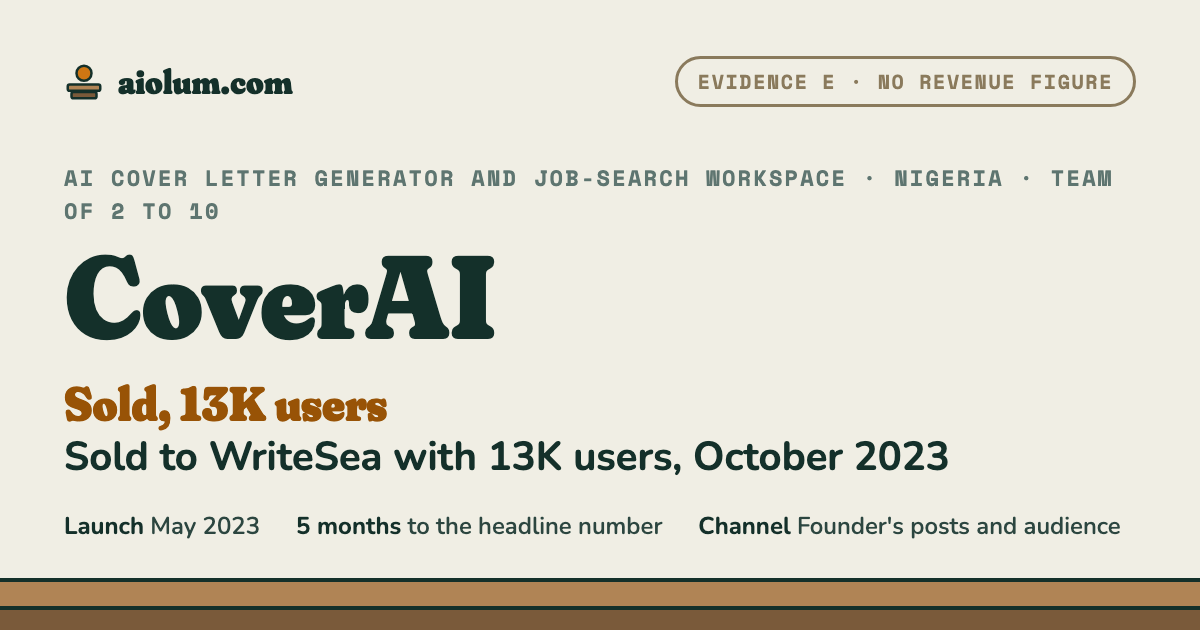
CoverAI (AI cover letter generator and job-search workspace, Nigeria): Sold to WriteSea with 13K users, October 2023. Evidence grade E: no revenue figure was checked. Team: 2 people: founder Chris Adolphus and a software engineer friend (Techpoint Africa, October 2023). Launched May 2023; sold 5 months after launch.Added 8 November 2026
- Outcome
- Sold to WriteSea with 13K users, October 2023
- Evidence
- E no revenue figure was checked
- Launch
- May 2023
- Status
- Sold, 5 months after launch
- Team
- 2 people: founder Chris Adolphus and a software engineer friend (Techpoint Africa, October 2023)
- Outside funding
- Self-funded; TechCabal reported about US$386 of the founder's own money (as quoted by Condia)
- Main channel
- Founder's posts and audience
What is not verified
No revenue figure was found, and the sale price was not disclosed. Techpoint called the sale five-figure. Condia, citing TechCabal's report, wrote that the deal was estimated at no more than US$50,000, and Daba Finance wrote that one source estimated it at less than US$50,000. TechCabal's article could not be opened (a request on 3 November 2026 got the answer 'Please contact the site owner for access'). The 13,000 users and the 12 to 15 buyers come from the founder's interviews, and the sources disagree on the number of buyers. Daba Finance wrote that WriteSea declined to comment. No payment-processor profile, Acquire.com listing or buyer statement was found. A reader could look for a WriteSea announcement or the Acquire.com listing. This story is grade E: the business is real and its product, price and customers are described from public pages, but no revenue figure was checked. Aiolum shows it as an idea worth studying, not as proof that it makes money.
CoverAI was a web app that wrote cover letters, the one-page letters that a job seeker sends with a CV to explain why they fit a role. It used a large language model, a neural network trained on large amounts of text that writes text from an instruction; Daba Finance reported in October 2023 that the model came from OpenAI. By the time of the sale the app also rewrote CVs, suggested interview questions to practise, tracked job applications and wrote networking messages for recruiters and other professionals.
Chris Adolphus, a former lead designer at Chaka (Condia), built the first version in May 2023 with a software engineer friend, Techpoint Africa reported. In September 2023 he listed it on Acquire.com, a marketplace where owners sell small online businesses, and in October 2023 it was sold to WriteSea, a US company that sells career and recruitment software. He told Techpoint that it had 13,000 users at the sale, all of them organic, and that he only posted about it on his LinkedIn.
No source gives revenue or the sale price, so this story is grade E. Techpoint called it a five-figure exit; Condia, citing TechCabal's first report, wrote that the deal was estimated at no more than US$50,000, and the founder declined to give the amount. The page also shows earlier companies that tried to make job search easier and failed.
How much did CoverAI make, and what was it sold for?
Each row shows the evidence grade and the source numbers from the list at the end of this page. The grades are explained in How Aiolum verifies.
| Fact | Value | Grade | How we know | Sources |
|---|---|---|---|---|
| Users at the sale, October 2023 | 13,000, all organic | D | The founder to Techpoint Africa, 11 October 2023: 'At the time of its sale, it had 13,000 users, all gotten organically'. No other source gives a user count. | [1] |
| Sale | acquired by WriteSea, October 2023 | C | Reported by Condia (10 October 2023, citing TechCabal's first report), Techpoint Africa and Daba Finance (11 October 2023); Briter records the acquisition on 11 October 2023. Daba Finance wrote that WriteSea declined to comment. Condia calls WriteSea Tulsa-based, Daba Finance New York-based. | [2, 1, 3, 6] |
| Sale price | not disclosed; reported as five figures, estimated at no more than US$50,000 | D | Techpoint's headline says 'for five figures' while its text says 'an undisclosed amount'. Condia: 'The report estimated that the deal was not worth more than $50,000, Adolphus declined to comment on the exact value.' Daba Finance: 'one source estimated it to be less than $50,000'. | [1, 2, 3] |
| Buyers who made contact | 12 to 15, through Acquire.com | D | Techpoint: offers from 15 potential buyers. Condia, citing TechCabal: approached by more than 12 buyers via Acquire. Daba Finance: 12 offers on Acquire.com. The sources do not agree on the number. | [1, 2, 3] |
| First version | May 2023 | C | Techpoint: 'In May 2023, he teamed up with a software engineer friend to build the first version of CoverAI.' Condia and Daba Finance called it three months old in October 2023, and Briter lists it as founded in 2023. The Internet Archive's first capture of coverai.co is from 18 May 2023. | [1, 2, 6, 7] |
| Team | 2 people | C | Techpoint: the founder and a software engineer friend, 'the duo'. The engineer is not named in any source. | [1] |
| Outside funding | none; about US$386 of the founder's own money | D | Condia: 'According to TechCabal, Adolphus self-funded the AI platform with about $386.' The TechCabal article itself could not be opened. | [2] |
| Prices, October 2023 | free, then US$5 Basic, US$7 Premium, US$15 Lifetime | C | Daba Finance, 11 October 2023: a freemium model with 'a $5 basic plan, a $7 premium plan, and a $15 lifetime plan'. The archived pricing page of 27 February 2024 shows the same prices with credit limits. | [3, 5] |
| AI model | OpenAI's large language model | C | Daba Finance, 11 October 2023. No source names the exact model. | [3] |
| Users in the first two weeks | more than 200 | D | Techpoint, from the founder: the first version was 'attracting more than 200 users in the first two weeks'. | [1] |
| Site status | archived as live until April 2026; error 522 on 8 November 2026 | C | The Internet Archive holds captures of www.coverai.co with status 200 from May 2023 to April 2026: the home page last on 14 February 2026 and the pricing page, with the same four plans, on 20 April 2026. On 8 November 2026 both www.coverai.co and app.coverai.co answered 'error code: 522' (the Cloudflare code for a server that does not answer). | [7, 8, 11] |
| Time from the first version to the sale | 5 months | calc | Calculated: May 2023 to October 2023. | [1, 2] |
How to read this table: the user counts, the number of offers and the price range come from the founder's interviews and from press reports that no buyer statement confirms (grade D); the sale itself, the team and the prices were reported by several outlets or shown on the archived site (grade C); a "calc" value was computed on this page. No value is grade A or B.
| Plan | Per month, billed yearly (US$) | Per month, billed monthly (US$) | Limit |
|---|---|---|---|
| Free | 0 | 0 | 10 credits |
| Basic | 5 (period not shown) | 20 credits; cover letters, CV, tracker, interview prep | |
| Premium | 7 (period not shown) | 40 credits; adds networking messages | |
| Lifetime | 15 one-time | 40 credits every month for life |
The pricing page sells credits and does not say whether the Basic and Premium prices are monthly or one-time. Daba Finance called them three subscription tiers; the home page in October 2023 said that users "pay to buy credit" and that there were no refunds. The Lifetime plan gave 40 credits every month for one payment. The free plan gave 10 credits. Prices are in US dollars as shown.
When did CoverAI launch, and how did it grow?
From a first version in May 2023 to a sale in October 2023, then a site that went offline in 2026. Each entry carries its grade.
- May 2023CAdolphus and a software engineer friend build the first version: the user enters experience and achievements and gets a cover letter. The Internet Archive first captures coverai.co on 18 May 2023. [1, 7]
- September 2023CAfter a rebuild based on early user feedback, the founder lists CoverAI on Acquire.com. [1]
- 10 October 2023CCondia reports, after TechCabal, that WriteSea has bought the three-month-old startup in an undisclosed deal. [2]
- 11 October 2023DThe founder tells Techpoint Africa that CoverAI had 13,000 users at the sale and that the team built it to be sold. Daba Finance reports the plans and the use of OpenAI's model. [1, 3]
- 27 February 2024CThe archived pricing page, after the sale, still shows the free plan and the US$5, US$7 and US$15 plans. [5]
- November 2026Ccoverai.co no longer answers; the last archived captures with status 200 are of the home page on 14 February 2026 and of the pricing page on 20 April 2026. [8, 11]
Why did CoverAI work?
Four causes, in the order they mattered. Each one is a reusable lesson.
Built to be sold
The founder told Techpoint: 'For us, from day one, we were building for acquisition because we actually have other ideas we want to explore.' He listed the app on Acquire.com about four months after the first version and chose one buyer among the offers. In his words, the work was about 'positioning, getting the right metrics, and getting the right buyer'.
One task that everyone dislikes
The first version did one thing: it turned a list of experience and achievements into a cover letter. In the founder's words, 'everybody hates writing cover letters'. By the sale it also helped with CVs, networking and interview preparation, and the home page showed an application tracker.
Free use first, then credits
Every user got 10 free credits, and the paid plans sold more credits; the home page said that users 'only pay for what you use'. The founder said that he only posted about it on his LinkedIn, and Techpoint wrote that the team did little marketing.
How it was built
Few build details are public. These come from Techpoint Africa, Daba Finance and the archived pages of coverai.co. [1, 3, 4, 5]
- A web app at app.coverai.co with sign-up by email address, and a marketing site built with Next.js (the archived pages load their files from /_next/static).
- Text generation by OpenAI's large language model, as Daba Finance reported; no source names the model version.
- Credits as the unit of payment: the free plan gave 10, and the paid plans gave more. The home page said that there were no refunds because users paid for credits.
- Free side tools to bring in users: two-minute quizzes for salary insights ('Know worth') and suitable roles ('Job card'), and a free CV template offered through Gumroad.
- An affiliate program that paid referrers when a referred customer bought credits.
- Built by two people: a designer as founder and a software engineer friend. A first version, then a rebuild of the minimum viable product after feedback from the first users.
Tools named in the sources
Each one opens its page in the Tools tab, with every story that uses it.
Who tried this before CoverAI, and why did they fail?
Three companies in our database of failed startups tried to make job search or job applications easier and failed. The values below are from that database and are not independently verified.
Jobspice
The promiseAn online tool to make professional-looking resumes quickly from templates, for job seekers who are not designers.
Why it diedIt sold one narrow product while free resume templates spread online and LinkedIn grew; it never added job matching or networking.
Jobridge
The promiseA job board that joined local business directories and offline networks with online job search.
Why it diedWithout outside money it could not scale the offline part, and digital job platforms took the market first.
WantRemoteJob
The promiseA job board only for remote jobs in the IT industry, started by a software engineer.
Why it diedThe large job platforms added remote-job filters, and the niche board had no money to compete on features or marketing.
The failed startups come from our database of 1,749 dead startups, retold here in our own words. Its entries are AI-assisted summaries of public sources, so these cards carry no evidence grade.
What changed
Jobspice saved job seekers design work with templates, and free templates soon did the same. Jobridge and WantRemoteJob were job boards, which need many employers and many job seekers at the same time before they are useful. All three had to grow into lasting companies to succeed.
CoverAI did the writing itself with a language model, so one user could get a full letter in minutes with no network effect needed. It also had a different goal: the founders planned from the first day to sell it, not to outlast the large platforms. Building on a model API kept the cost low (Condia reported, after TechCabal, about US$386 of the founder's own money), and it also means that the same product is easy for anyone else to build.
Can one person copy CoverAI now?
Yes, the product is easy to copy; the sale is harder.
Two people built and sold a cover letter generator on a model API in about five months, and one person could build the same product today. Many such tools now exist, so a new one needs a narrow audience or a channel of its own, and a buyer who wants the users more than the code.
Where it is still open: Narrower job-search tasks: letters for one profession or country, applications in a second language, and tools for career-services offices that buy for many job seekers.
- 1Pick one writing task that job seekers dislike and make it work from a short form.
- 2Give free credits at sign-up and sell credit packs, so that each model call is paid for.
- 3Post about it to your own network and track sign-ups from the first week.
- 4If the goal is a sale, list it on a startup marketplace once the user count is clear, and talk to several buyers.
What could go wrong for CoverAI?
The risks are the mirror image of the causes above.
What is not verified
No revenue figure was found, and the sale price was not disclosed. Techpoint called the sale five-figure. Condia, citing TechCabal's report, wrote that the deal was estimated at no more than US$50,000, and Daba Finance wrote that one source estimated it at less than US$50,000. TechCabal's article could not be opened (a request on 3 November 2026 got the answer 'Please contact the site owner for access'). The 13,000 users and the 12 to 15 buyers come from the founder's interviews, and the sources disagree on the number of buyers. Daba Finance wrote that WriteSea declined to comment. No payment-processor profile, Acquire.com listing or buyer statement was found. A reader could look for a WriteSea announcement or the Acquire.com listing.
Trust signals on the 2023 home page
The archived home page of 11 October 2023 carries a banner 'Google, Amazon, Facebook certified CV/Resume' for a free template, with no source for the certification. A logo strip is labelled 'Some companies our users are applying to with CoverAI', so the logos are employers that users applied to, not customers. Figures about recruiters and cover letters (for example '26% Of recruiters considered coverletters to be important') are shown without a source.
Competition and model providers
Many AI resume and cover letter tools compete for the same job seekers; on this site the closest stories are YourCoverLetter, another AI cover letter generator that was sold, and CoverDoc. The buyer's own site now lists 'Al Cover Letter Generation' among WriteSea's products. CoverAI depended on OpenAI's model for its text, as Daba Finance reported, so model prices and terms set its costs.
The product today
No source says what WriteSea did with CoverAI after the sale. The site was archived as live until April 2026, and on 8 November 2026 coverai.co and app.coverai.co did not answer. Condia wrote that WriteSea planned to buy 1,000 companies in two to three years.
Sources
The grade next to each source is the best grade that the source can support. "Read in full" means that the text of the page was downloaded and the numbers were checked in it.
- C Techpoint Africa, 11 October 2023, by Chimgozirim Nwokoma: How this Nigerian-founded company went from 0 to a five-figure exit in 3 months (page title: Whitesea acquires CoverAI for five figures)Read in full (downloaded 3 November 2026). A founder interview. Source for the May 2023 first version, the team of two, the Acquire.com listing, the 15 buyers, the 13,000 users and the founder's quotes. The headline spells the buyer 'Whitesea', the text 'Writesea'.
- C Condia (formerly Benjamin Dada), 10 October 2023, by Johnstone Kpilaakaa: Tulsa-based WriteSea acquires CoverAI, a Nigerian AI startupRead in full (downloaded 3 November 2026). Source for the founder's background, the 'three-month-old' startup, the price estimate and the US$386 of own money, which it attributes to TechCabal's first report, and WriteSea's plan to buy 1,000 companies.
- C Daba Finance, 11 October 2023: New York-based firm acquires Nigerian startup CoverAIRead in full (downloaded 8 November 2026). Source for the OpenAI model, the freemium model and the three paid plans, the 12 offers, the estimate under US$50,000 and WriteSea declining to comment.
- C CoverAI home page, Internet Archive copy of 11 October 2023Read in full (downloaded 8 November 2026). A capture made the day after the sale was first reported, and the earliest whose HTML holds the marketing text (the captures of 22 May 2023, also status 200, hold only the app's script shell). Source for the features, the free quizzes, the credit and refund rules, the affiliate program, the banner and the logo strip.
- C CoverAI pricing page, Internet Archive copy of 27 February 2024Read in full (downloaded 8 November 2026). The earliest archived copy of the pricing page, from after the sale; the prices match Daba Finance's October 2023 report.
- D Briter: CoverAI company profileRead in full (downloaded 3 November 2026; on 8 November 2026 the page answered 404 Not Found). A data directory. Source for 'Founded 2023' and the acquisition by Writesea dated 11 October 2023, amount undisclosed.
- C Internet Archive capture index for coverai.coRead in full (downloaded 8 November 2026). One capture per month: the first on 18 May 2023, home page captures with status 200 from 11 October 2023 to 2 February 2026.
- C coverai.co and app.coverai.co, requested 8 November 2026Both hosts answered with status 522 and the text 'error code: 522'. An earlier request on 3 November 2026 gave the same answer.
- C WriteSea press pageRead the product menu (downloaded 3 November 2026). Source for WriteSea's current product list, which includes AI cover letter generation. The page does not mention CoverAI.
- C Database of failed startups, local exportLocal export. AI-written summaries, not independently verified. Source for the failed predecessors.
- C Internet Archive capture index for coverai.co from 5 February 2026Read in full (downloaded 8 November 2026). Captures with status 200 of the home page on 12 and 14 February 2026, the quiz page on 14 March 2026 and the pricing and privacy pages on 20 April 2026, plus image files to 2 May 2026. The pricing copy of 20 April 2026 shows the same free, US$5, US$7 and US$15 plans.
Run this company? Send corrections or a verified figure to aiolum@livyden.com