CreativeClaw
CreativeClaw is a remote MCP server for making images, video and audio. MCP (Model Context Protocol) is an open standard, created by Anthropic, for connecting an AI assistant to outside programs. An MCP server is a program that offers the assistant a list of tools: functions with a name, a description and typed inputs, such as generate_image or generate_video. The assistant reads the list and decides during a conversation when to call one. Remote means that the server runs on the vendor's machines, and the user only adds one address or installs one plugin in Claude or ChatGPT. A product can be sold this way because the server knows who is calling. The user logs in once with OAuth, a standard login in which one service acts for a user without seeing the password, and the server then charges each tool call to that user's balance of prepaid credits. CreativeClaw's server card lists 48 tools. They send the request to image, video, speech and 3D models of other companies and return a file.
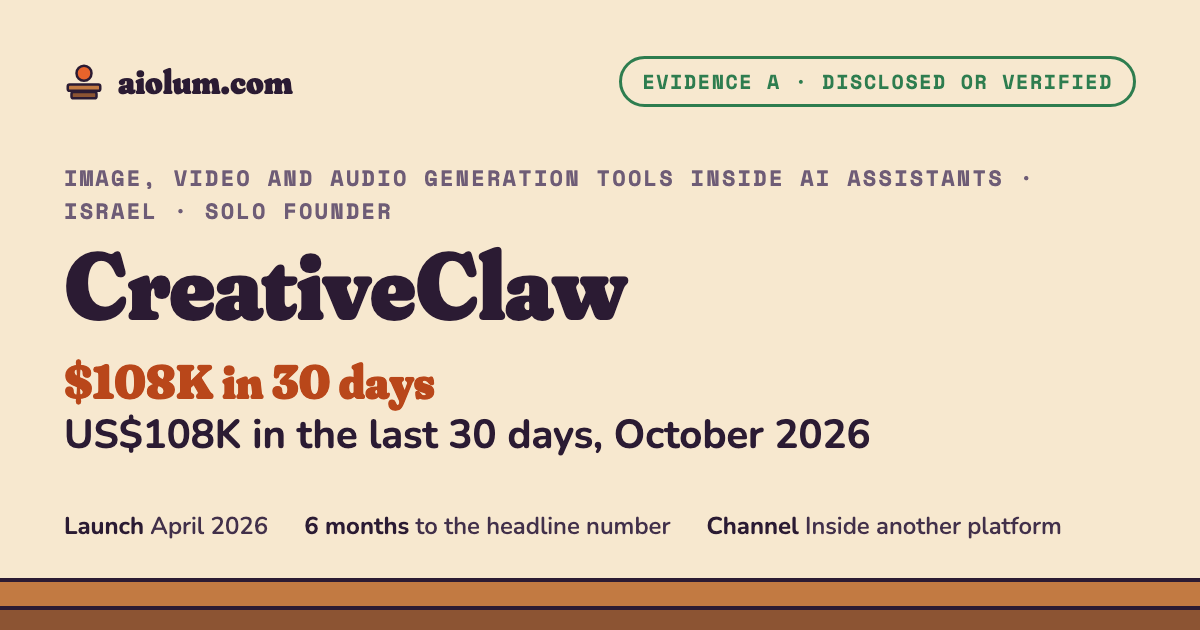
Itay Dressler, an engineer in Tel Aviv, made the first commit on 30 March 2026 and announced the product on X on 13 April 2026. He wrote that he works on it full time as a "Solo bootstrapped builder". Before that he was a co-founder and the technology chief of theGist, a workplace AI company that raised US$7 million in 2022 and closed in September 2025. The payment records of CreativeClaw, which TrustMRR reads from the payment provider Polar, show US$30 in April, US$5,254 in August and US$92,894 in September 2026. On 13 October 2026 the last 30 days stood at US$108,177, and the total since the start at US$142,846. About 76% of all the money that the business has ever received arrived in those 30 days.
The revenue figures are grade A: they come from the payment provider through an API key, not from the founder. They are gross receipts for credits. They do not show what CreativeClaw pays the companies whose models it resells, so the margin is not verified. One strong month in a business that is six months old is also not a trend, and this page does not multiply the month into a yearly figure. The page also shows what happened to earlier companies that grew inside a platform owned by someone else.
The numbers, graded
Each row shows the evidence grade and the source numbers from the list at the end of this page. The grades are explained in How Aiolum verifies.
| Fact | Value | Grade | How we know | Sources |
|---|---|---|---|---|
| Revenue in the last 30 days, at 13 October 2026 | US$108,177 | A | TrustMRR, read from the Polar account by API key, synced 13 October 2026 at 11:56 UTC. One 30-day period, not a yearly figure. The copy cached one day earlier showed US$109,037 for its own 30 days. | [1] |
| Revenue since the start, at 13 October 2026 | US$142,846 | A | Same source and sync. The first payment was in April 2026. This is the money figure that this site stores for the story. | [1] |
| Share of all revenue that arrived in the last 30 days | about 76% | calc | Calculated: 108,177 / 142,846 = 75.7%. | [1] |
| Revenue by month, 2026 | April US$30; May US$365; June US$1,715; July US$2,735; August US$5,254; September US$92,894; October to the 13th US$39,854 | A | TrustMRR monthly table. March 2026 is US$0. | [1] |
| September 2026 compared with August 2026 | 17.7 times | calc | Calculated: 92,894 / 5,254. | [1] |
| First 12 days of September 2026 | US$21,930, about US$1,828 a day | calc | Calculated: the September total minus days 13 to 30 of the daily table. The value for 13 September, US$4,388, is in the copy cached on 12 October and has left the live table. About 11 times the daily average of August, so the rise began in the first days of the month. | [1] |
| Daily revenue, 14 September to 12 October 2026 | US$2,056 to US$6,927 a day; highest on 16 September | A | TrustMRR daily table, 29 full days. The largest day is 6.5% of the table's total, so the month is many small purchases and not a few large payments. | [1] |
| Average per day, peak week and after | US$5,211 for 14 to 20 September; US$3,117 for 21 September to 12 October | calc | Calculated from the daily table. The later level is about 40% below the peak week and stayed between US$2,056 and US$4,422 for 22 days. | [1] |
| MRR and active subscriptions | US$10,540 a month; 203 subscriptions | A | TrustMRR snapshot. MRR is monthly recurring revenue. The site says there is no subscription, and no page read for this story explains what the payment provider counts as one. Not verified: what these subscriptions are. | [1, 2, 7] |
| 30-day revenue compared with MRR | 10.3 times | calc | Calculated: 108,177 / 10,540. Recurring revenue can be at most about one tenth of the month; the rest is one-time credit purchases. | [1] |
| Price | US$10 for 1,000 credits; 100 free credits at signup | C | Company pricing file. One credit is US$0.01. No subscription, and purchased credits do not expire. | [2, 7] |
| Examples of what a generation costs | image 16 credits (US$0.16); five-second video 75 credits (US$0.75); 1,000 characters of speech 20 credits (US$0.20) | C | Company pricing file, default models: Nano Banana 2.1 at 1K, Gemini Omni Flash at 720p, ElevenLabs v4. | [2] |
| One cost point given by the founder | speech sold at US$0.20 per 1,000 characters; provider API price US$0.08 | calc | Calculated: (0.20 - 0.08) / 0.20 = 60% before other costs, for this one model. The API price is from the founder's post of 30 September 2026, which also mentions a 72% provider discount until 12 October; it is not clear if US$0.08 is before or after it. Not a margin for the business. | [16, 2] |
| What the verification does not cover | costs, margin, profit and user numbers | C | The profile says that profit margin is not shown in the public file, and that no analytics account is connected. The models belong to other companies, so part of each dollar goes to them. | [1, 7] |
| Users | more than 10,000 | C | Founder's post of 9 September 2026. The home page says 10,000+ creators and 148,000+ finished generations. Not verified. | [11, 3] |
| Usage on 13 September 2026 | more than 24 hours of generated video in one day | C | Founder's post of 14 September 2026. Not verified. | [13] |
| Customers | small business owners and individual creators who buy without a sales call | C | Founder's posts of 16 and 27 September 2026, which name small business owners, restaurant owners and a musician. He calls the business B2C; the TrustMRR profile text says B2B. | [18, 15, 1] |
| Team | 1 person | C | TrustMRR profile text, the founder's X profile (solo founder) and his launch post. In the public repository, 129 of 135 commits are his, 3 are from one other account and 3 are signed by coding agents. | [1, 18, 9, 8] |
| Outside funding | none | C | TrustMRR profile text says Bootstrapped; the launch post says Solo bootstrapped builder. | [1, 9] |
| Founder's previous company | theGist: US$7 million raised in 2022, closed in 2025 | C | CTech and TechCrunch. Dressler was co-founder and technology chief. The company had 10 employees at the round and about 15 people in 2023, and said it would return the money raised to investors. | [20, 21, 22] |
| Reach of the founder's own X account | 414 followers; 315 views of the launch post | C | Follower count from the TrustMRR profile, views read on 13 October 2026. Too small to explain the revenue. | [1, 9] |
| Pages on the company site | 287, of which 106 examples, 57 blog posts and 22 about ChatGPT | calc | Calculated: a count of the addresses in the sitemap file on 13 October 2026. | [29] |
| Time from launch to the October 2026 figure | 6 months | calc | Calculated: April 2026 to October 2026. | [1, 9] |
How to read this table: a grade A value was read by TrustMRR from CreativeClaw's account at the payment provider Polar through an API key, last synced on 13 October 2026 at 11:56 UTC. A grade C value is a statement by the founder or the company, or a press report. A "calc" value was computed on this page from the rows above it. Grade A covers money received. It does not cover costs, margin, profit or the number of users.
| Plan | Per month, billed yearly (US$) | Per month, billed monthly (US$) | Limit |
|---|---|---|---|
| Free credits at signup | 0 | 100 credits; no card | |
| Credits | 10 one-time | 1,000 credits; do not expire | |
| Done-for-you brand theme | 249 one-time | named in the signup form; not described on the pages read |
There is one price: US$10 buys 1,000 credits, so one credit is US$0.01. The site says that there is no subscription and that purchased credits do not expire. Each generation costs a published number of credits: 16 credits (US$0.16) for one image with the default model at 1K resolution, 75 credits (US$0.75) for a five-second video with the default model at 720p, 400 credits (US$4.00) for five seconds with Veo 3.1, and 20 credits (US$0.20) for 1,000 characters of speech with ElevenLabs v4. Credits are deducted before a generation starts and returned if it fails because of a server error. The customer pays the assistant maker separately for the assistant.
The timeline
From a first commit to US$108,177 in 30 days, in about six months, of which the first five brought less than US$5,300 a month each. Each entry carries its grade.
- 15 November 2022CDressler is co-founder and technology chief of theGist, which announces US$7 million of pre-seed funding from StageOne Ventures and Aleph and has 10 employees. Earlier he was VP of Engineering at OpenWeb, co-founder and CTO at Salaryo, and VP R&D at Gong. [20, 22]
- 3 September 2025CCTech reports that theGist is closing and will return the money raised to investors. [21]
- 30 March 2026CFirst commit in the public repository: a Creative Claw plugin for Claude with image and video generation skills. [8]
- 31 March 2026CDressler replies to a post on X: "I did point #1 - built the MCP server". The site is online and says "Inside Claude"; its FAQ says detailed pricing will be available at launch. [10, 27]
- 13 April 2026CPublic announcement on X, in Hebrew. He writes that he has decided to work on it full time as a "Solo bootstrapped builder". The post has 315 views. [9]
- April 2026AThe first payments arrive: US$30 in the month. [1]
- May to August 2026ARevenue of US$365, US$1,715, US$2,735 and US$5,254 a month. [1]
- 16 June and 20 July 2026CA Codex version of the plugin is added, then a ChatGPT version is packaged. [8]
- 27 August to 1 September 2026CPackages for Grok Bot, Cursor, Hermes and OpenClaw, listing files for the Glama and Smithery directories, and a commit named "Prepare Claude plugin directory submission". [8]
- 1 to 12 September 2026calcUS$21,930 arrives in 12 days, about four times the whole of August. [1]
- 9 September 2026CDressler: "wild ride. @CreativeClawCo just crossed 10k users." [11]
- 11 September 2026CThe company posts that it is the fastest-growing startup on Unicorne, a ranking built on TrustMRR data, with +1,055% growth. Dressler writes that he did not believe this would happen to him and that he is mostly keeping the servers running. [12]
- 14 September 2026CHe writes that people generated more than 24 hours of video in one day, and that he is in contact with Chinese model companies to lower costs by buying from them directly. [13]
- 15 September 2026CHe announces that a company, Creative Claw Ltd, is now registered. [14]
- 16 September 2026AThe highest day in the daily table: US$6,927. [1]
- 30 September 2026ASeptember closes at US$92,894, which is 17.7 times August. [1]
- 13 October 2026AUS$108,177 in the last 30 days and US$142,846 since the start. MRR is US$10,540 with 203 subscriptions. [1]
- 13 October 2026CThe product is running: the status file marks every component operational, and the repository received a commit on the same day. [28, 8]
Why it worked
Four causes, in the order they mattered. Each one is a reusable lesson.
Sold inside the assistant
The customer never opens a CreativeClaw application. The product is a plugin in Claude and in ChatGPT, and the same server is packaged for Claude Code, Codex, Cursor, Grok Bot, Hermes and OpenClaw. The founder's X account had 414 followers and his launch post had 315 views, so the customers did not come from his audience. The signup form asks where the person heard of the product and lists Claude and ChatGPT first.
One account in place of many
A marketer who wants an image from a Google model, a video from another model and a voice from ElevenLabs would need three accounts, three bills and API keys. CreativeClaw holds the provider accounts and sells one balance of credits. Packaged instructions named skills tell the assistant which model fits a job and how to write the prompt for it.
Credits, a low first price, no subscription
New accounts get 100 free credits without a card, and a purchase is US$10. Every model has a published credit cost. Customers pay before they generate, so the business holds the money before it owes the model provider. The founder wrote on 27 September 2026 that people come in, try and pay without a single sales call.
New models on the day of release
When a provider releases a model, CreativeClaw adds it within about a day and posts a demonstration: GPT Image 2.5 on 8 September, ElevenLabs v4 on 29 September, Nano Banana 2.1 on 6 October 2026. The founder writes that his own Claude setup now detects a new model, tests it, adds it and publishes the demonstration video.
Pages written for search and for AI crawlers
The sitemap lists 287 pages: 106 examples with their costs, 57 blog posts and 22 pages about ChatGPT, several of them comparisons with named competitors. The site also publishes an llms.txt file, a pricing file in markdown and a server card, which are written for AI assistants to read. What caused the rise of September is not stated in any source read for this story.
How it was built
These details come from the company's developer pages, its terms, its public GitHub repository and the founder's posts. They are grade C. [6, 3, 7, 8, 1, 19, 17]
- A remote MCP server at app.creativeclaw.co/mcp over the Streamable HTTP transport, with a second endpoint for the ChatGPT app. The server card lists 48 tools.
- Login by OAuth 2.1 with PKCE through Clerk, asking only for the profile and email scopes. The customer never handles a provider API key.
- Payments through Polar. Tools named get_credits_balance, get_credits_link and purchase_credits let the assistant show the balance and give the user a purchase link.
- Generated files are stored on Cloudflare R2 and get permanent addresses.
- Models come from Google, fal.ai, Pika, OpenAI, ElevenLabs and Cartesia. fal.ai is a host that sells access to models of other companies, for example GPT Image 2.5 and MiniMax H3 Max.
- The plugin and its skills are in a public GitHub repository: 135 commits by 13 October 2026, of which 52 in September. 129 are by the founder, 2 are signed Cursor Agent and 1 Claude Agent.
- The founder builds with Claude. He wrote on 6 October 2026 that adding a new model and the English posts run automatically, and that he still writes the Hebrew posts himself.
Tools named in the sources
Each one opens its page in the Tools tab, with every story that uses it.
The dead that came before
Five companies in the Loot Drop database grew inside a platform owned by another company, or sold supply that larger companies also sold directly. The values below are from that database and are not independently verified.
Meerkat
The promiseLive video from your phone to your Twitter followers.
Why it diedIts growth depended on Twitter's follower graph. Twitter bought a competitor, Periscope, and Meerkat lost the channel.
BranchOut
The promiseA professional network built inside Facebook.
Why it diedFacebook changed its API rules, and the way BranchOut gained users stopped working. LinkedIn kept the market.
Viddy
The promiseFilters and effects that make phone video look polished.
Why it diedInstagram added video in June 2013 for the users it already had. People tried Viddy once and did not return.
FiftyThree
The promisePaper, a drawing app for the iPad, and a stylus named Pencil.
Why it diedApple released its own Pencil and Procreate offered more features. The hardware part raised costs.
Hipmunk
The promiseA clearer search across other companies' flights and hotels.
Why it diedGoogle Travel and Expedia offered the same search with more supply. The pandemic of 2020 ended it.
What changed
Each of the five reached its customers through a platform that it did not own, or sold supply that belonged to larger companies, and each lost when the owner changed the rules or offered the same thing itself. CreativeClaw does both at once. It reaches customers through the plugin directories of Anthropic and OpenAI, and it sells generations from models that belong to Google, OpenAI, ElevenLabs and others. Those companies publish their own connectors: ElevenLabs has had an official MCP server since March 2025, fal has one with a plugin for ChatGPT and Codex, and CreativeClaw's own comparison page lists Runway, HeyGen, Higgsfield and Kling as ChatGPT plugins.
Three things differ. First, MCP is an open standard that several assistants support, so one server is installed in Claude, ChatGPT, Codex, Cursor and others, and no single assistant maker controls all of the distribution. Second, the assistant makers run directories and ask for connectors, so for now the platform owner helps this kind of product. Third, customers pay before they generate and every model has a published price, so the business needs no capital and can change a price when a provider does. None of this protects the margin, which no outside source has measured.
Can one person copy it now?
The structure, yes. The month, not on demand.
The structure is open to any engineer: a remote MCP server, OAuth login, prepaid credits and an entry in the plugin directories. It needs no capital, because customers pay first. What cannot be planned is the rise of September 2026: with the same product, revenue had been under US$5,300 a month for five months, and the founder has not said what changed. A copy also competes with the model providers, who now publish their own connectors.
Where it is still open: Paid work that an assistant cannot do alone and that needs accounts at several providers, for example printed mail, phone calls and text messages, or purchased data. The same three parts apply: tools, login and credits.
- 1Choose a paid job that people already ask an assistant for and that the assistant cannot do alone. Build a remote MCP server whose tools do it.
- 2Use OAuth login and a prepaid credit balance, so each tool call is charged to a known user and you never pay the provider before the customer pays you.
- 3Publish the cost of every tool call, and give free credits without asking for a card.
- 4Package the server for every assistant, and submit it to each plugin directory and each MCP directory.
- 5Add each new model on the day its provider releases it, and post a demonstration made with it.
What to watch
The risks are the mirror image of the causes above.
One strong month is not a trend
About 76% of all revenue arrived in the last 30 days. Daily revenue was highest on 16 September 2026 at US$6,927 and has stayed between US$2,056 and US$4,422 since 21 September, about 40% below the peak week. Six weeks of data cannot say if this level will hold. This page shows the month as a month and does not turn it into a yearly figure.
Gross receipts; the margin is not verified
TrustMRR verifies money received. It does not see what CreativeClaw pays Google, fal.ai, ElevenLabs and the other providers, and the public profile shows no profit margin. The one cost point that the founder has given, for one speech model, implies about 60% before other costs. In mid-September he was still looking for lower model costs.
Prepaid credits are work still owed
Revenue is counted when a customer buys credits. The provider's charge comes later, when the credits are used, and purchased credits do not expire. A month with large purchases therefore contains costs that have not arrived yet.
Distribution depends on the assistant makers
The plugin sits in directories that Anthropic and OpenAI control. The Claude plugin needs a paid Claude plan, and on Team and Enterprise plans an administrator may have to allow it. The repository history shows changes made to pass each maker's listing review. CreativeClaw's terms say that the service relies on AI assistant platforms. A rule change or a removal would close the main sales channel.
The providers and the assistants can ship the same thing
ElevenLabs publishes an official MCP server. fal, which CreativeClaw's terms name as a model provider, has its own MCP server and a ChatGPT plugin that makes images, video and audio with browser login and no API key. CreativeClaw's comparison page names six other video plugins in ChatGPT. The ChatGPT menu itself has an Images entry beside Plugins.
A subscription count that the site does not explain
TrustMRR shows US$10,540 of MRR and 203 active subscriptions. The pricing file, the terms and the FAQ all say that there is no subscription. No page read for this story explains the difference. In either case recurring revenue is at most about one tenth of the month, so nine tenths must be earned again each month.
One person runs it
On 11 September 2026 the founder wrote that he was mostly keeping the servers running and sleeping little. Support, model updates, directory reviews and billing problems all go to him. He announced the registration of the company on 15 September 2026, after the money had started to arrive.
User and usage counts are self-reported
The 10,000 users, the 148,000 generations and the 24 hours of video in a day are statements by the founder and the company. No analytics account is connected to the TrustMRR profile.
Sources
The grade next to each source is the best grade that the source can support. "Read in full" means that the text of the page was downloaded and the numbers were checked in it.
- A TrustMRR profile of CreativeClaw, revenue from the payment provider PolarRead the markdown profile (https://trustmrr.com/startup/creativeclaw.md) on 13 October 2026, and the copy cached on 12 October 2026. Revenue comes from the company's Polar account through an API key, last synced on 13 October 2026 at 11:56 UTC. Source for every revenue figure, the monthly and daily tables, MRR and the subscription count. The profile text (team size, funding, audience) is written by the founder and is grade C.
- C CreativeClaw pricing file, read 13 October 2026Read in full. The machine-readable twin of the pricing page. Source for the credit price, the free credits and the credit cost of each model.
- C CreativeClaw home page, read 13 October 2026Read in full. Source for the product description, the FAQ on MCP, the list of model providers, the user and generation counts, and the signup form.
- C CreativeClaw about page: a letter from the founderRead in full. Source for the founder's own account of why he built it and of his earlier roles.
- C CreativeClaw: how to connectRead the sections on Claude, Claude Code, ChatGPT and Codex. Source for the plugin directory links, the Smithery link and the Claude plan requirement.
- C CreativeClaw developer page in markdown, and the MCP server cardRead the sections on connection, OAuth and tools, and the tool names in the server card at /.well-known/mcp.json. The card lists 48 tools; the developer page says 49.
- C CreativeClaw terms of serviceRead the sections on credits, refunds and third-party services.
- C GitHub repository CreativeClawCo/creative-claw-marketplace: record and commit historyRead the repository record and the titles, dates and authors of all 135 commits through the GitHub API on 13 October 2026. Source for the first commit, the dated packaging and directory steps, and the commit counts.
- C Itay Dressler on X, 13 April 2026: launch thread of three postsRead in full through api.fxtwitter.com. In Hebrew, translated on this page; the words Solo bootstrapped builder are in English in the original. 315 views when read.
- C Itay Dressler on X, 31 March 2026: I did point #1 - built the MCP serverRead in full through api.fxtwitter.com. A reply to another user's post.
- C Itay Dressler on X, 9 September 2026: just crossed 10k usersRead in full through api.fxtwitter.com. It quotes the company post of 8 September, whose image shows CreativeClaw in second place on a ranking of fastest-growing startups.
- C Itay Dressler on X, 11 September 2026, and the company posts of the same day about first place on UnicorneRead in full through api.fxtwitter.com, with the image of the ranking. The founder's post is in Hebrew, translated on this page. The company post with the +1,055% figure is https://x.com/CreativeClawCo/status/2098406859371581627.
- C Itay Dressler on X, 14 September 2026: more than 24 hours of video in one dayRead in full through api.fxtwitter.com. In Hebrew, translated on this page. Source for the usage statement and the talks with model companies about cost.
- C Itay Dressler on X, 15 September 2026: the company is registeredRead in full through api.fxtwitter.com. In Hebrew, translated on this page.
- C Itay Dressler on X, 27 September 2026: on sellingRead in full through api.fxtwitter.com. In Hebrew, translated on this page.
- C Itay Dressler on X, 30 September 2026: thread on ElevenLabs v4, post 9 on priceRead in the timeline pages from api.fxtwitter.com. In Hebrew, translated on this page. Source for the provider's API price as the founder states it.
- C Itay Dressler on X, 6 October 2026: new models are added automaticallyRead in full through api.fxtwitter.com. In Hebrew, translated on this page.
- C Itay Dressler on X: timeline, 2023 to 13 October 2026Read the 49 posts that the api.fxtwitter.com timeline returned, in four pages. Source for the profile text, the posts of 16 and 24 September 2026 and the absence of posts between 17 April and 9 September 2026 in that reply.
- C CreativeClaw on X: timeline, 31 March to 6 October 2026Read the 48 posts that the api.fxtwitter.com timeline returned, in four pages. Source for the dates on which new models were added.
- C CTech, 15 November 2022: Israeli startup theGist raises $7 million to increase workplace productivity using generative AIRead in full. Press report. Source for the founders, the round, the 10 employees and Dressler's earlier roles.
- C CTech, 3 September 2025: AI startup theGist shuts down, plans to return investor fundsRead in full. Press report. Source for the closure and the team of about 15 people in 2023.
- C TechCrunch, 15 November 2022: TheGist uses AI to summarize Slack channels and threadsRead in full. A second report of the same funding round.
- C Model Context Protocol documentation: What is the Model Context Protocol (MCP)?Read the introduction. Source for the definition of MCP and the list of assistants and tools that support it.
- C CreativeClaw, updated 29 September 2026: What is the best ChatGPT plugin to generate videos in 2026?Read the opening sections. The company's own comparison; it names six other ChatGPT video plugins.
- C GitHub repository elevenlabs/elevenlabs-mcp: The official ElevenLabs MCP serverRead the repository record through the GitHub API on 13 October 2026: created 14 March 2025, 1,536 stars.
- C fal documentation: fal MCP serverRead in full. Describes fal's own MCP server and its plugin for ChatGPT and Codex.
- C Wayback Machine copy of creativeclaw.co, 1 April 2026Read in full. The earliest copies are from 31 March and 1 April 2026. Source for the first positioning and the pricing text before launch.
- C CreativeClaw status file, 13 October 2026Read in full. All four components are marked operational, updated on 13 October 2026 at 08:27 UTC.
- C CreativeClaw sitemap and llms.txt, read 13 October 2026Read in full and counted. 287 addresses. The llms.txt file at the site root lists the pages for AI assistants.
- C ChatGPT plugin page for CreativeClawDownloaded on 13 October 2026. The listing loads by script and could not be read; only the page menu was read. The address comes from the company's connect page.
- C Loot Drop database export, 1,749 failed startupsLocal export. AI-written summaries, not independently verified. Source for the failed predecessors.