Fitit: Product, team and how it was built
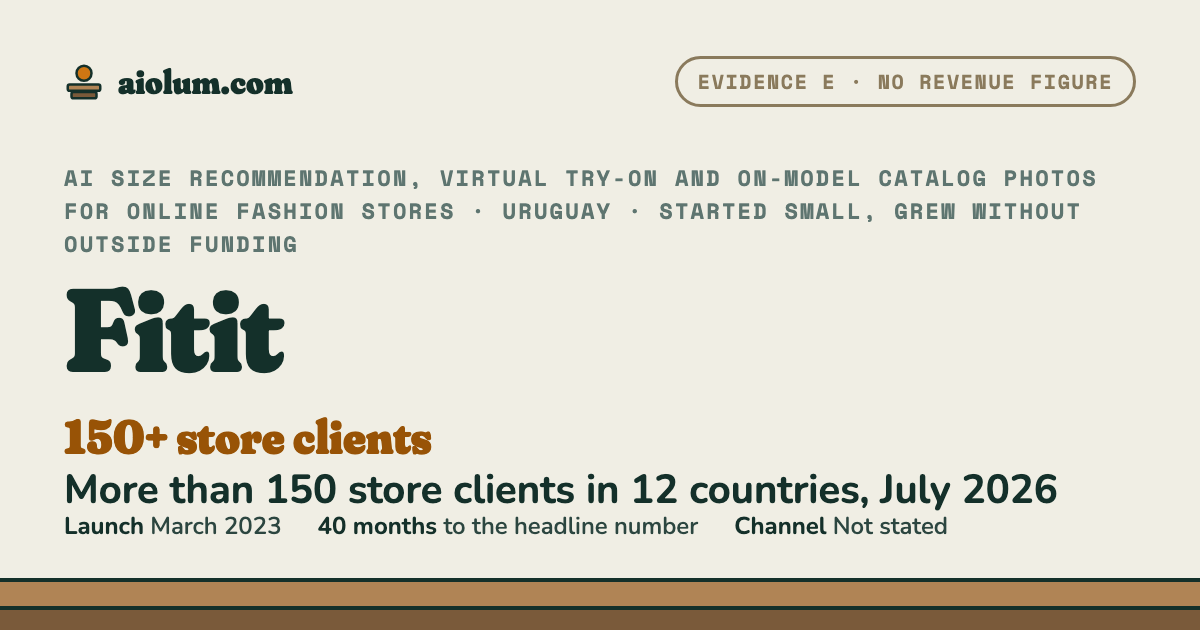
Fitit (AI size recommendation, virtual try-on and on-model catalog photos for online fashion stores, Uruguay): More than 150 store clients in 12 countries, July 2026. Evidence grade E: no revenue figure was checked. Team: 3 co-founders (Alan Rytt, Dan Bzurovski, Daniel Bella) in March 2023; 8 people by June 2023; 11 employees on the company's about page, November 2026. Launched March 2023; still running.Added 6 November 2026
- Outcome
- More than 150 store clients in 12 countries, July 2026
- Evidence
- E no revenue figure was checked
- Launch
- March 2023
- Status
- Still running
- Team
- 3 co-founders (Alan Rytt, Dan Bzurovski, Daniel Bella) in March 2023; 8 people by June 2023; 11 employees on the company's about page, November 2026
- Outside funding
- No outside capital (bootstrapped, per El Observador, July 2026); won the ANII Innovative Entrepreneurs award
- Main channel
- Not stated
What is not verified
No revenue figure was found. The headline (more than 150 clients, more than 1 million users, July 2026) is what the founders told El Observador; El Ecosistema Startup repeats it from that article and calls the clients paying. No payment-processor profile, filing or founder revenue statement was found, and the prices are not published. A reader could look for a revenue figure in a later interview or in an Endeavor or ANII report. This story is grade E: the business is real and its product, price and customers are described from public pages, but no revenue figure was checked. Aiolum shows it as an idea worth studying, not as proof that it makes money.
Fitit sells size recommendation to online fashion stores: software on the product page that tells the shopper which size to buy, to reduce returns. Its method is computer vision, programs that extract measurements and shapes from photos. The shopper photographs a garment that already fits, the model finds the measuring points on it, and the measurements are matched with the product's size chart. It also sells a virtual try-on, an image model that shows the product on the shopper's own photo, and generated catalog photos.
Alan Rytt, Dan Bzurovski and Daniel Bella founded it in Montevideo in March 2023, according to El Observador; the company's own about page says 2022. In June 2023 Rytt told Universidad ORT Uruguay that the three had worked on it on Monday evenings next to other jobs and that the company had eight people. In July 2026 El Observador reported more than 150 clients, more than 1 million users and 12 countries, with growth "sin levantar capital externo" (translation: without raising outside capital). The about page lists 11 employees in November 2026.
No revenue figure was found. The headline is a client count that the founders gave to a newspaper. The company does not publish prices: every plan is a custom quote.
How much revenue does Fitit make?
Each row shows the evidence grade and the source numbers from the list at the end of this page. The grades are explained in How Aiolum verifies.
| Fact | Value | Grade | How we know | Sources |
|---|---|---|---|---|
| Founded | March 2023, Montevideo | C | El Observador: "En marzo de 2023, los uruguayos Alan Rytt, Dan Bzurovski y Daniel Bella fundaron Fitit" (translation: in March 2023 the Uruguayans Alan Rytt, Dan Bzurovski and Daniel Bella founded Fitit). The company's about page says "Fitit started in 2022 in Montevideo". | [1, 5] |
| Founding team | 3 co-founders, part-time at first | C | Rytt to Universidad ORT, June 2023: "los tres trabajábamos en otra cosa y nos juntábamos los lunes de noche" (translation: the three of us worked at something else and met on Monday evenings). | [3] |
| Team, June 2023 | 8 people | C | Rytt to Universidad ORT: "la empresa ya cuenta con ocho integrantes" (translation: the company already has eight members). | [3] |
| Team, November 2026 | 11 employees | C | Company about page: "Today 11 people run sizing for 120+ stores in 12 markets". | [5] |
| Clients, July 2026 | more than 150 | C | El Observador, from the founders: "Fitit ya trabaja con más de 150 clientes y supera el millón de usuarios" (translation: Fitit already works with more than 150 clients and passes 1 million users). The home page says 120+ stores and the about page counts 100 stores. | [1, 4, 5] |
| Users, July 2026 | more than 1 million | C | El Observador, from the founders. The home page in November 2026 shows "150K+ Shopper wardrobes" and "1 M+ Size recommendations delivered to date". | [1, 4] |
| Countries | 12 | C | El Observador lists Uruguay, Argentina, Chile, Colombia, Peru, Honduras, Panama, Ecuador, Guatemala, Paraguay, Spain and the United States. The home page lists Mexico instead of Guatemala. | [1, 4] |
| Named clients | Adidas (Uruguay and Paraguay), Crocs, Nike (Chile) | C | Named by the founders to El Observador; not confirmed by the brands. | [1] |
| Outside funding | none | C | El Observador: "estrategia de crecimiento bootstrapped -sin levantar capital externo-". The company was incubated at the Centro de Emprendimientos of Udelar and won the ANII Innovative Entrepreneurs award (ANII is Uruguay's national research and innovation agency). | [1, 3] |
| Prices | not published; custom quote | C | Pricing section of the home page: "Custom plan", "Let's talk". | [4] |
| Installation | one script, about 15 minutes, no API | C | Home page and founders to El Observador. A Shopify block is also offered. | [1, 4, 6] |
| Time from founding to the July 2026 figures | 40 months | calc | Calculated: March 2023 to July 2026. | [1] |
How to read this table: grade C here means a statement by the founders to the press or on the company's own site. A "calc" value was computed on this page. No value is grade A or B, and no revenue figure was found.
| Plan | Per month, billed yearly (US$) | Per month, billed monthly (US$) | Limit |
|---|---|---|---|
| Custom plan | quote from sales; size recommendation, size charts, analytics, VTEX, Magento and custom integrations |
The company publishes no prices. Its single plan is a custom quote after a demo call, with an account manager who builds the size charts. The Shopify page says the app installs in minutes, but the Shopify App Store link on it returned "That page doesn't exist" on 6 November 2026.
When did Fitit launch, and how did it grow?
From Monday-evening meetings of three people with other jobs to a sizing engine in 12 countries, in about three and a half years. Each entry carries its grade.
- March 2023CAlan Rytt, Dan Bzurovski and Daniel Bella found Fitit in Montevideo, after returns for the wrong size at one partner's clothing store. [1, 3]
- 29 June 2023CUniversidad ORT reports eight people, the first live stores in Uruguay and the ANII Innovative Entrepreneurs award. [3]
- 2026CA factory tool measures garments from one photo for quality control against the specification. [1, 2]
- 29 July 2026CEl Observador reports more than 150 clients, more than 1 million users, 12 countries, no outside capital, and a new AI try-on. [1]
- November 2026CThe site lists 11 employees, 120+ stores, catalog-photo generation, and marketplace tools in early access. [4, 5]
Why did Fitit work?
Four causes, in the order they mattered. Each one is a reusable lesson.
Garment against garment
Instead of asking for height and weight, the shopper photographs a garment that fits. The founders told El Observador that some people wear clothes tight and others loose, so a garment that already fits is a better reference than the body.
One wardrobe for every store
The garment photos stay in a shared wardrobe. A shopper who added a T-shirt in one store gets a size in the next store without uploading again. Each new store adds shoppers that the other stores can use.
AI does the onboarding
The founders said that a model reads each product's photos and description, decides the category and picks the measurement table, work that people used to do by hand. That is why installation takes minutes and needs no API work.
More products for the same buyer
Size charts, try-on, catalog photos and factory quality control are sold to the same fashion companies, using the same measurement engine.
How it was built
These details come from the founders' statements to El Observador and Universidad ORT, and from the company's site. They are grade C. [1, 3, 4]
- Alan Rytt, who studied big data analytics at Universidad ORT, leads the AI; he told ORT that the master's degree gave him the base for it.
- Several AI models work together: some built by the company, others third-party models that the team combines and trains, according to the founders. No provider is named.
- The widget mounts inside a Shadow DOM from one script tag, so it does not change the store's checkout.
- Catalog photos are made from photos of real models that the brand already has, with the clothes replaced; the catalog version is generated in 4K.
- Incubated at the Centro de Emprendimientos of Udelar, with support from ANII.
Tools named in the sources
Each one opens its page in the Tools tab, with every story that uses it.
Who tried this before Fitit, and why did they fail?
Two companies in our database of failed startups used software to help people choose clothes online and failed on cost or competition. The values below are from that database and are not independently verified.
Thread
The promiseAlgorithms plus human stylists choose clothes for each customer.
Why it diedThe human stylists cost too much, and the algorithms were slower than fast-fashion rivals.
Looklive
The promiseImage recognition links fans to the clothes celebrities wear.
Why it diedA crowded fashion market, no new money, and dependence on celebrity trends.
The failed startups come from our database of 1,749 dead startups, retold here in our own words. Its entries are AI-assisted summaries of public sources, so these cards carry no evidence grade.
What changed
Thread and Looklive sold to shoppers and had to win each shopper with marketing or with human labour. Fitit sells to the store, which already has the shoppers and pays to lower its returns.
Image models are now good enough to measure a garment from a phone photo and to draw clothes on a shopper's photo, and the founders say that a model also does the product setup that people once did by hand. That keeps a team of about ten able to serve more than 100 stores.
Can one person copy Fitit now?
The idea, yes. The network, slowly.
Measuring garments from a photo is within reach of a small team with image models. The advantage Fitit claims, a shared wardrobe across 120+ stores, came from three years of store-by-store sales in one region.
Where it is still open: Sizing for regions and languages where the large fit-tech vendors do not sell, and measurement tools for marketplace sellers and factories.
- 1Start with one store that has a measurable problem; Fitit started with a founder's own clothing store.
- 2Make installation one script, so that a store can try it without a project.
- 3Keep each shopper's data useful in the next store, so that every new client makes the product better.
- 4Add products for the same buyer only after the first one sells.
What could go wrong for Fitit?
The risks are the mirror image of the causes above.
What is not verified
No revenue figure was found. The headline (more than 150 clients, more than 1 million users, July 2026) is what the founders told El Observador; El Ecosistema Startup repeats it from that article and calls the clients paying. No payment-processor profile, filing or founder revenue statement was found, and the prices are not published. A reader could look for a revenue figure in a later interview or in an Endeavor or ANII report.
The company's numbers do not agree
The founding year is March 2023 in El Observador and 2022 on the about page. The client count is more than 150 in El Observador, 120+ stores on the home page and 100 stores on the about page. The press says 1 million users; the home page says 150K+ wardrobes and 1 million size recommendations. The home page also shows a client logo strip under "Trusted by" that could not be checked.
Generated photos of real models
The catalog tool takes photos of real models that a brand already owns and replaces the clothes with AI, according to the founders. The sources do not say how the models' consent for this use is handled. The try-on uses the shopper's own photo. The Shopify App Store link on the company's Shopify page returned a missing page on 6 November 2026.
Competition and model providers
El Ecosistema Startup names True Fit, 3DLOOK, Vue.ai, Syte and Walmart's Zeekit as competitors; on this site Genlook sells a similar AI try-on to Shopify stores, as a solo founder. The founders say some of their models are third-party models that they combine and train, but name no provider, so the dependence on any one provider cannot be judged.
Sources
The grade next to each source is the best grade that the source can support. "Read in full" means that the text of the page was downloaded and the numbers were checked in it.
- C El Observador, 29 July 2026: La startup uruguaya que busca ser el aliado global de la industria de la moda, superó el millón de usuarios y lanzó ahora un 'probador' online con IARead in full (Spanish). Interview with the founders. Source for the founding date, clients, users, countries, named brands, bootstrapping and how the models work.
- C El Ecosistema Startup, 29 July 2026: Fitit: 1 millón de usuarios en 12 países sin inversión externaRead in full (Spanish). A rewrite of the El Observador article with a list of competitors; it calls the 150+ clients paying.
- C Universidad ORT Uruguay, 29 June 2023: El talle ideal con inteligencia artificialRead in full (Spanish). Interview with Alan Rytt. Source for the founding team, the eight people in 2023 and the ANII award.
- C Fitit home page, read 6 November 2026Read in full. Source for the products, the install script, the site counters and the custom-plan pricing.
- C Fitit about page, read 6 November 2026Read in full. Source for the 2022 start, 11 employees and the store count.
- C Fitit Shopify page, and the Shopify App Store link on it, read 6 November 2026Read in full. The linked apps.shopify.com/fitit page returned "That page doesn't exist".
- C Database of failed startups, local exportLocal export. AI-written summaries, not independently verified. Source for the failed predecessors.
Run this company? Send corrections or a verified figure to aiolum@livyden.com