Indilingo: Revenue, team and how it was built
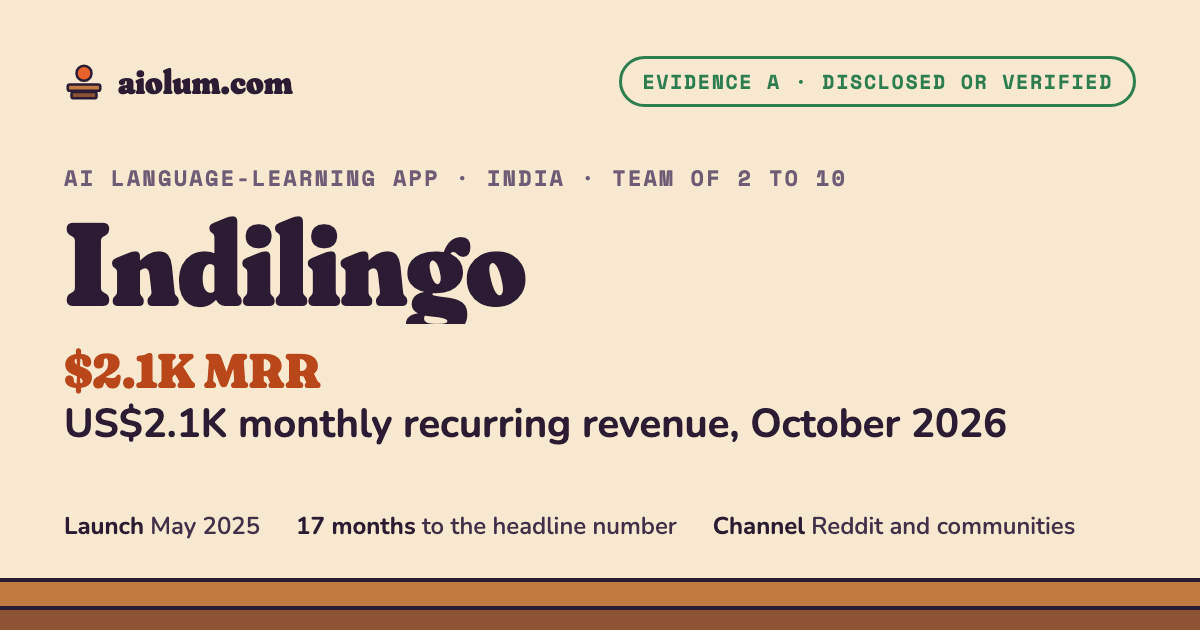
Indilingo (AI language-learning app, India): US$2.1K monthly recurring revenue, October 2026. Evidence grade A: disclosed by a company or a filing, or verified by a payment processor. Team: Co-founders, among them Jay Gala, and a small team; headcount not published. Launched May 2025; still running, revenue growing.Added 25 October 2026
- Outcome
- US$2.1K monthly recurring revenue, October 2026Revenue growing
- Evidence
- A disclosed by a company or a filing, or verified by a payment processor
- Launch
- May 2025
- Status
- Still running
- Team
- Co-founders, among them Jay Gala, and a small team; headcount not published
- Outside funding
- None (bootstrapped); free AI model access from AI Grants India
- Group
- Learning and study
- Main channel
- Reddit and communities
Indilingo is a language-learning app from Indilingo Labs LLP, a company registered in Mumbai. Its idea is "learn any language from any language": the lessons, the explanations and the AI tutor use the language the learner already knows, not English. The tutor is a large language model, an AI system trained on very large amounts of text that can hold a conversation, here in the role of a patient teacher. The app also has a speaking mode in which the learner talks out loud and gets feedback on pronunciation.
The company was built by co-founders and a small team. Dodo Payments, its payment processor, names one of them as "Jay, Co-Founder", and the company blog gives his full name, Jay Gala. The Android app was live by May 2025 and the iPhone app followed in January 2026. TrustMRR, a site that reads revenue directly from a startup's payment provider, shows US$2,139 in monthly recurring revenue on 25 October 2026 from 1,223 active subscriptions. Monthly recurring revenue (MRR) is the subscription revenue that repeats every month; a yearly plan counts as one twelfth of its price. Verified revenue was US$745 in June 2026 and US$3,207 in September 2026.
The figures are small, but they are verified by the payment provider and they are subscriptions, not one-time sales. In India the PRO plan costs ₹99 a month, so the business needs many paying learners: the average is about US$1.75 a month per subscription. Indian users could pay only after the company added UPI, the Unified Payments Interface, India's instant bank-to-bank payment system that most people pay with from their phone. This page grades every number and shows five failed companies that sold language learning before an AI tutor could speak dozens of languages.
How much revenue does Indilingo make?
Each row shows the evidence grade and the source numbers from the list at the end of this page. The grades are explained in How Aiolum verifies.
| Fact | Value | Grade | How we know | Sources |
|---|---|---|---|---|
| Monthly recurring revenue, 25 October 2026 | US$2,139 | A | TrustMRR snapshot, revenue last synced 25 October 2026 from Dodo Payments through an API key. This is the headline number. It is 7% above the site's floor of US$2,000 a month (calculated). | [1] |
| Active subscriptions, 25 October 2026 | 1,223 | A | TrustMRR snapshot from the payment records. | [1] |
| Average MRR per active subscription | about US$1.75 a month | calc | Calculated: 2,139 divided by 1,223 equals 1.749. Low because most paying users are in India, where PRO costs ₹99 a month or ₹399 a year. | [1, 7] |
| Run rate from the MRR | US$25,668 a year | calc | Calculated: 2,139 times 12. | [1] |
| MRR growth in the last 30 days | +13.5% | A | TrustMRR snapshot. | [1] |
| Verified revenue, June 2026 | US$745 | A | TrustMRR monthly timeline. Revenue counts all payments received in the month, so a yearly plan counts in full in the month it is paid. | [1] |
| Verified revenue, July 2026 | US$2,062 | A | 2.8 times June (calculated). The company launched Mira, a separate phone-call tutor, on 23 July 2026; no source says which product the payments came from. | [1, 13] |
| Verified revenue, August 2026 | US$2,907 | A | 41% more than July (calculated). | [1] |
| Verified revenue, September 2026 | US$3,207 | A | 10% more than August (calculated). The best full month so far. | [1] |
| Verified revenue, 1 to 25 October 2026 | US$2,923 | A | A partial month. At the same daily rate the full month would be about US$3,625 (calculated: 2,923 divided by 25, times 31). | [1] |
| Verified revenue, last 30 days to 25 October 2026 | US$3,475 | A | TrustMRR gives +5.3% against the 30 days before. A second snapshot on the same profile says US$3,512. | [1] |
| Verified revenue, all time | US$13,723 | A | The monthly timeline from November 2025 adds up to US$13,492 (calculated); the profile does not explain the difference of about US$231. | [1] |
| Share of all-time revenue earned in the last 3 months | 68% | calc | Calculated: US$9,297 in the last 3 months divided by US$13,723. | [1] |
| First month with verified revenue | November 2025, US$120 | A | TrustMRR monthly timeline. Revenue stayed below US$500 a month until June 2026. | [1] |
| Payment provider | Dodo Payments | A | TrustMRR reads the revenue from Dodo Payments and marks it "Merchant of record: No". The Dodo case study describes Dodo as the merchant of record for Indilingo. App Store purchases go through Apple and are not part of the TrustMRR figures. | [1, 2, 6] |
| Company behind the app | Indilingo Labs LLP, Mumbai | B | Named in the terms of service and as the provider on the App Store listing. An LLP is an Indian limited liability partnership. | [6, 7] |
| Founders | two or more co-founders, among them Jay Gala | B | Dodo Payments quotes "Jay, Co-Founder". The company blog names Jay Gala as the author of its first post, and his TrustMRR handle is jaygala223. No source names the other co-founder or co-founders. | [2, 10, 1] |
| Team size | not published; "a small team" | B | Dodo's words. Three different people sign the company blog posts, and the careers page offers one remote internship. | [2, 12, 16] |
| Outside funding | none stated | C | The founder-written TrustMRR profile says Bootstrapped. The home page says "Supported by AI Grants India, ElevenLabs"; AI Grants India gives builders free AI model access and voice credits, not money for shares. | [1, 3, 20] |
| Learners | more than 70,000 | C | Company home page. The founder-written TrustMRR profile estimates 85,029 users. Google Play shows more than 50,000 Android downloads (grade B). | [3, 1, 9] |
| Countries with users | more than 90 | B | Dodo case study. Paying customers include the US, UK, Singapore, France, Malaysia and Denmark; India became the largest paying market after UPI went live. | [2] |
| App ratings, October 2026 | 4.6 from 167 ratings (App Store India); 3.9 from about 1,170 reviews (Google Play) | B | Read on the store pages. | [7, 9] |
| Age rating | 4+ (App Store), Everyone (Google Play) | B | The terms of service require users to be at least 13 years old. No source shows homework or exam answers for sale; the related Mira product sells timed IELTS and TOEFL speaking mock tests with an estimated band, and says it is not affiliated with IELTS or ETS. | [7, 9, 6, 15] |
| Time from the Android app to the headline figure | 17 months | calc | Calculated: May 2025 to October 2026. | [18, 1] |
How to read this table: a grade A value was read by TrustMRR from the company's payment provider, Dodo Payments, or was stated by Dodo Payments itself. A grade B value comes from an app store listing or another independent party. A grade C value is a statement by the company or the founder. A "calc" value was computed on this page from the rows above it.
| Plan | Per month, billed yearly (US$) | Per month, billed monthly (US$) | Limit |
|---|---|---|---|
| Basic | 0 | 0 | all languages; 5 AI chat messages a day; 10 minutes of live speech |
| PRO, US App Store | 2.50 | 4.99 | US$29.99 billed yearly; unlimited AI chats and live sessions, progress analytics |
The company's pricing page lists the plan features but says that live prices load from the app, so the PRO prices come from the App Store. In the US store PRO costs US$4.99 a month or US$29.99 a year (US$2.50 a month, 50% less than twelve monthly payments, calculated). In the Indian store it costs ₹99 a month or ₹399 a year (₹33.25 a month, 66% less, calculated). Every PRO plan starts with a 7-day free trial. On the web and Android the company takes UPI and card payments through Dodo Payments; payments are not refunded, and a subscription is cancelled by email. The same company sells Mira, an AI tutor that calls the learner's phone, as a separate product at US$9.99, US$19.99 and US$39.99 a month for 60, 120 and 240 minutes of talk.
When did Indilingo launch, and how did it grow?
From a waitlist page in February 2025 to verified recurring revenue above US$2,000 a month in October 2026, 17 months after the Android app was live. Each entry carries its grade.
- 23 February 2025CThe site indilingo.in is a waitlist page: "Master any Indian language with AI", with personalized lessons and real-time feedback. [17]
- 14 May 2025CThe site links to the Android app on Google Play and offers 13 official Indian languages, with AI conversation practice and quizzes. [18]
- 29 May 2025CJay Gala's first blog post sets the mission: learn a language from your mother tongue, not through English. Live AI chat is available; speaking with pronunciation feedback is "coming soon". [10]
- November 2025AFirst month of verified revenue through Dodo Payments: US$120. The site still shows a waitlist for the iPhone app. [1, 19]
- January 2026BVersion 1.0 of the iPhone app appears on 8 January; the version of 16 January adds subscriptions for Indilingo PRO. [7]
- May to June 2026AThe App Store version history adds the Word Maze game in May and a new onboarding and dashboard in June. Verified revenue is US$436 in May and US$745 in June. [7, 1]
- July 2026AVerified revenue rises to US$2,062. On 23 July the company launches Mira, a separate AI tutor that calls the learner's phone. [1, 13]
- September 2026ABest full month so far: US$3,207 in verified revenue. [1]
- 1 October 2026CThe company blog reports that its paper on CIPHER, a method that teaches an AI model a language with very little digital text, was accepted at a workshop of the EMNLP 2026 conference. [11]
- 25 October 2026ATrustMRR shows US$2,139 in MRR from 1,223 active subscriptions and US$3,475 in revenue in the last 30 days. [1]
Why did Indilingo work?
Four causes, in the order they mattered. Each one is a reusable lesson.
A niche the large apps left open
Most language apps teach through English. Indilingo's first blog post names this as the main problem: many people in India who want to learn another language do not read English well. Making every one of 39 languages a possible starting language gives the app pairs such as Kannada from Hindi or Japanese from Tamil. A user review on the home page compares it favourably with TalkPal for Punjabi.
The model does the per-language work
A hand-written course for every pair of 39 languages would need more than 1,400 courses. A large language model can explain, quiz and converse in most of these languages, so a small team can offer all pairs and then improve the weak ones. The team's research on Tulu, a language with little digital text, shows where the model still fails: it drifts into a larger neighbouring language.
Prices and payment methods for India
The Indian App Store price is ₹99 a month or ₹399 a year. The Dodo case study says that most early paying users were outside India, and that India became the largest paying market only after UPI payments went live. The result is many very small subscriptions: about US$1.75 of MRR each on average.
Community launch
Dodo reports that a post in the Sanskrit community on Reddit became one of that subreddit's top posts ever, and a user review on the home page says the reviewer found the app on Reddit. Learners of Sanskrit form a small online group, so a single popular post can reach a large share of them.
How it was built
These details come from the company's blog and pages, the founder-written part of the TrustMRR profile and the Dodo Payments case study. Most are grade C; the Dodo statements are from the payment provider. [1, 2, 7, 11, 12, 3, 20]
- Android app in Kotlin, and a web app with React and Next.js, according to the founder-written tech stack on TrustMRR. An engineering post says the Android app uses a single-activity architecture and reports a 100% crash-free rate.
- Backend in Python: the Dodo case study says the team migrated it from Flask to FastAPI, and the blog describes indic-uid, an open-source Python library that makes unique identifiers in Indian scripts and runs in the app.
- Payments through Dodo Payments: subscriptions, webhooks, UPI for Indian users and cards for other countries. The co-founder told Dodo that the first test payment went through in one night and that he had not changed the payment code since the first version.
- iPhone subscriptions are sold as App Store in-app purchases.
- AI: an AI tutor for chat and live speech with pronunciation feedback. No source names the model provider. The home page lists AI Grants India, which gives free model access, and ElevenLabs as supporters.
- Research: the team's CIPHER method lets a model compare its translations with verified references, write rules from its mistakes and store them in a prompt that a person can read. In tests on Tulu it reduced mixing with Kannada words.
Tools named in the sources
Each one opens its page in the Tools tab, with every story that uses it.
Who tried this before Indilingo, and why did they fail?
Five companies in the Loot Drop database sold language learning, or apps for speakers of Indian languages, before an AI tutor could teach many language pairs at a very low cost. The values below are from that database and are not independently verified.
Teacher Finder
The promiseMatch language learners directly with tutors, without expensive language schools.
Why it diedAccording to the database, better-funded competitors won, and its MVP built on Zapier automation could not change fast enough. Every lesson still needed a paid human tutor.
TutorGroup (iTutor)
The promiseLive English lessons with Western teachers for students in Asia.
Why it diedChina's 2021 ban on foreign tutors removed most of its revenue, according to the database, while the cost of acquiring each student and tutor churn were already high.
Hujiang
The promiseOnline language learning and school courses for millions of users with a free tier.
Why it diedA failed stock market listing exposed a high cost per customer and negative margins in a market where many rivals sold the same content.
Wall Street English
The promisePremium English courses in learning centres, with multimedia lessons and teachers.
Why it diedThe database says it used new students' upfront payments to fund operations until regulators banned upfront payments. Its model depended on centres and staff.
Koo
The promiseA microblogging network for Indians who prefer to write in their own language, not English.
Why it diedPoliticians joined but ordinary users did not stay, and the company spent US$60 million chasing user numbers. It shows that the language need is real but must be paired with a reason to stay.
The failed startups come from Loot Drop, a free database of dead startups, retold here in our own words. Loot Drop describes its entries as AI-assisted summaries of public sources, so these cards carry no evidence grade.
What changed
Before language models, each language course was written by people, and the cheapest live practice was a human tutor. Teacher Finder, TutorGroup and Wall Street English all depended on paid teachers, so each learner cost money every week, and the courses that existed were mostly English or a few large languages taught through English.
A language model can explain grammar to a Hindi speaker in Hindi, quiz a learner of Kannada and then hold a spoken conversation, with no teacher paid per lesson. That made a learning app for small language pairs possible for a small team, at prices as low as ₹99 a month. The open problem is quality in languages with little text on the web, which is why Indilingo also publishes research on it.
Can one person copy Indilingo now?
The pattern, yes. The scale is still small.
Indilingo's verified revenue is about US$3,000 a month, with an average of US$1.75 of MRR per subscription. The niche is real, but the large apps can add more Indian languages, and every speaking minute has a model cost that a low price must cover.
Where it is still open: The same approach is open for other countries with many languages and weak English, such as Nigeria, Indonesia or the Philippines, and for heritage learners abroad who want to speak with their families. Speaking practice by ordinary phone call, as Mira does, also reaches users without a smartphone or mobile data.
- 1Find a group that the large apps serve badly because they assume English, and make the user's own language the language of the whole product.
- 2Let a language model cover the long tail of language pairs, then improve the weakest pairs with your own data and research.
- 3Price for the home market and accept its local payment method from the first day; for India that means UPI.
- 4Launch in the communities of small languages, such as a Sanskrit forum, where one good post reaches a large share of the possible users.
What could go wrong for Indilingo?
The risks are the mirror image of the causes above.
Just above the floor
The MRR of US$2,139 is only 7% above the site's floor of US$2,000 a month. Monthly revenue is higher, US$2,907 to US$3,207 in August and September 2026, probably because yearly plans are paid in full in one month. Revenue first passed US$2,000 a month in July 2026, so the record is four months long.
What the verified figures cover
TrustMRR reads only the Dodo Payments account. iPhone subscriptions sold as App Store in-app purchases are paid through Apple and are not in these figures. The company also sells Mira, launched in July 2026, and no source says whether Mira's payments go through the same account.
Very low price per subscriber
The average subscription brings about US$1.75 a month, while each AI chat and speaking minute costs the company money for the model. If heavy users speak a lot on a ₹99 plan, the margin can be thin. No source gives the company's model costs or profit.
Founder and source details
Dodo Payments names only "Jay, Co-Founder"; the full name Jay Gala comes from the company blog and his TrustMRR handle. The other co-founder or co-founders and the headcount are not published. The Dodo case study carries a publication date of 20 May 2025 in its page data, but it describes paying users and UPI payments, while TrustMRR shows the first Dodo revenue in November 2025, so that date is probably wrong. Dodo calls itself the merchant of record for Indilingo; TrustMRR says it is not.
Age rating and children
The app is rated 4+ on the App Store and Everyone on Google Play, while the terms of service require users to be at least 13. Children can download an app with open AI chat and voice conversation. The app sells language practice only; no source shows homework or exam answers for sale.
Sources
The grade next to each source is the best grade that the source can support. "Read in full" means that the text of the page was downloaded and the numbers were checked in it.
- A TrustMRR markdown profile: Indilingo, revenue last synced 25 October 2026Read the markdown profile live on 25 October 2026. The revenue, MRR and subscription figures in its Verification Sources and Revenue sections come from Dodo Payments through an API key (grade A). The description, funding, user estimate and tech stack are founder-written (grade C).
- A Dodo Payments case study: How Dodo Payments helped Indilingo scale a language app to 90+ countriesRead in full. The payment provider's account with quotations from "Jay, Co-Founder". No revenue figure. The page data gives 20 May 2025 as the publication date, which does not fit its content.
- C Indilingo home page (indilingo.in, now served from indilingo.ai), read 25 October 2026Read in full. Source for the learner count, the supporters and the product description; checked for the purpose gate.
- C Indilingo pricing page, read 25 October 2026Read in full. Gives the plan features and limits; the prices themselves load from the app.
- C Indilingo about page, read 25 October 2026Read in full. Source for the mission and the research work.
- C Indilingo terms of service, read 25 October 2026Read in full. Names Indilingo Labs LLP of Mumbai, the minimum age of 13, Dodo Payments as the payment provider and the no-refund rule.
- B App Store (India): Indilingo - Learn Any Language, by Indilingo LabsRead in full. Source for the provider name, the age rating, the Indian in-app prices, the rating and the version history.
- B App Store (US): Indilingo - Learn Any LanguageRead the information section. Source for the US prices of US$4.99 a month and US$29.99 a year.
- B Google Play: Indilingo: Learn Any Language, by Indilingo LabsRead in full. Source for the downloads, the rating, the content rating and the language list.
- C Indilingo blog, Jay Gala, 29 May 2025: Why We're Building IndilingoRead in full. The company's first post; ties Jay Gala to the company. The blog index dates it 25 May 2025.
- C Indilingo blog, 1 October 2026: Teaching AI to Speak Languages It Barely Knows: Inside CIPHERRead in full. Source for the research on Tulu and the workshop acceptance. Signed by Jay Gala and a second author.
- C Indilingo blog, 19 November 2025: How We Keep a 100% Crash-Free Rate at IndilingoRead in full. An engineer's post about the Android architecture.
- C Indilingo blog, 23 July 2026: Introducing Mira, Your AI Language Tutor That Calls You on the PhoneRead the first half. Source for the launch date of Mira.
- C Mira by Indilingo home page, read 25 October 2026Read in full. Source for Mira's prices; checked for the purpose gate as the company's other product.
- C Mira by Indilingo: IELTS and TOEFL speaking practice, read 25 October 2026Read in full. Checked that it sells timed speaking mock tests with feedback, not exam answers.
- C Indilingo careers page, read 25 October 2026Read in full. One open role, a remote social media marketing internship.
- C Wayback Machine: indilingo.in on 23 February 2025Read in full. The site was a waitlist page.
- C Wayback Machine: indilingo.in on 14 May 2025Read in full. The site linked to the Android app on Google Play.
- C Wayback Machine: indilingo.in on 24 November 2025Read in full. The site showed a waitlist for the iPhone app and named its supporters.
- C AI Grants India home page, read 25 October 2026Read the sections on who it is for and what it gives. Checked that its support is free AI model access, not an investment.
- B App Store (India): Studiofy: AI Product Photos, by Indilingo LabsRead the description. One of the company's other products, checked for the purpose gate.
- B App Store (India): SuperLazy, Your AI Second Brain, by Indilingo LabsRead the description. One of the company's other products, checked for the purpose gate.
- C Loot Drop database export, 1,749 failed startupsLocal export. AI-written summaries, not independently verified. Source for the failed predecessors.