Jungle
Jungle is a study app. A student uploads lecture slides, a PDF, notes, a video or a lecture recording, and the app turns it into multiple-choice questions, flashcards and clinical-case questions in the style of exams such as USMLE Step 1, the first United States medical licensing exam. The questions are written by a large language model (LLM), an AI program trained on large amounts of text that writes text from instructions. The app then schedules reviews by spaced repetition, a method that shows a question again just before you are likely to forget it. It runs on the web, iPhone and Android. The company behind it is Mindflow Inc. in California.
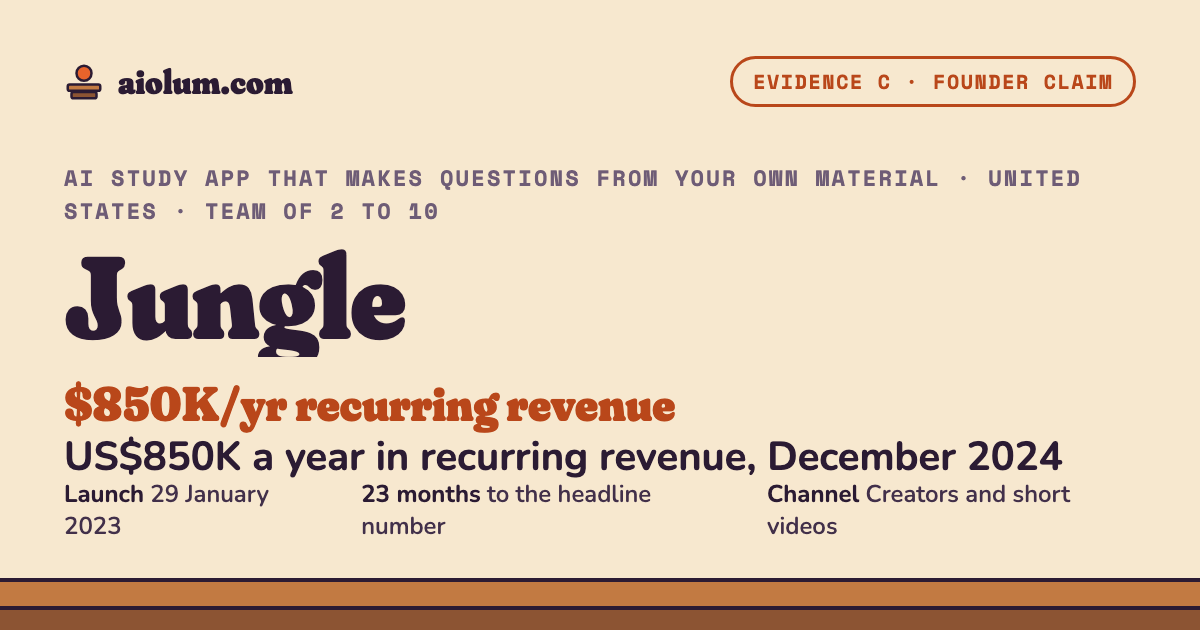
Julian Alvarez, a developer who grew up in a Texas border town and had worked at LinkedIn Learning and Meta, built the first version with his co-founder David Glass in one 21-hour coding session in January 2023, in reply to a viral post on X that asked for exactly this tool. It launched on 29 January 2023 under the name Wisdolia. By the end of 2023 it had US$300,000 in ARR, annual recurring revenue: the subscription revenue of a recent month counted for a full year. By the end of 2024 it had US$850,000 in ARR, 650,000 users and a profit, with two co-founders and two engineers plus contractors. In early 2025 the founder told investors on the podcast The Pitch that ARR was approaching US$1 million. Before that the company had raised a pre-seed round, a first small round of venture money, of about US$600,000.
Every revenue figure on this page is a statement by the founder, grade C. The only money confirmed by a second party is the US$150,000 that The Pitch Fund and Jesse Middleton of the venture firm Flybridge disclosed themselves in May 2025, invested as SAFEs, agreements that turn money into shares at a later funding round. In June 2025 the founder said growth had started to plateau and that the 2025 round raised about US$300,000 of the US$2 million he wanted. In July and August 2025 OpenAI and Google added study modes to ChatGPT and Gemini. The page also shows what happened to earlier companies that tried to make studying and quizzing more engaging.
The numbers, graded
Each row shows the evidence grade and the source numbers from the list at the end of this page. The grades are explained in How Aiolum verifies.
| Fact | Value | Grade | How we know | Sources |
|---|---|---|---|---|
| Annual recurring revenue, end of 2024 | US$850,000, up from US$300,000 a year earlier | C | The founder's end-of-year roundup, as reported by Gaps on 9 January 2025. Gaps adds that the company was profitable. Repeated by a second Gaps page and by a July 2026 newsletter. | [1, 6, 7] |
| Monthly equivalent of the end-2024 figure | about US$70,800 a month | calc | Calculated: US$850,000 divided by 12. | [1] |
| Growth during 2024 | 2.8 times | calc | Calculated: US$850,000 divided by US$300,000 is 2.83. | [1, 6] |
| Users, end of 2024 | 650,000, up from 200,000 | C | Founder, via Gaps. Calculated: 3.25 times in the year. | [1] |
| Annual recurring revenue, early 2025 | approaching US$1 million | C | Founder on The Pitch, recorded when December 2024 was the latest month, aired 7 May 2025. He said the company had been net profitable for the last four months and had 180,000 monthly active users. | [2] |
| Money received per month, late 2024 to early 2025 | over US$100,000 a month for three months | C | Founder on The Pitch, right after saying that 40% of subscribers buy a yearly plan, which brings revenue in up front. So this cash figure is higher than one twelfth of ARR. A July 2026 newsletter gives "$100K a month" without a date. | [2, 7] |
| Users and total revenue, April 2025 | 1 million users and US$1 million in lifetime revenue | C | Founder to Gaps, 17 April 2025, who also said the company was "on track to reach $1M in annual revenue". Lifetime revenue is the total since launch, a different measure from ARR. The July 2026 newsletter calls it "$1M ARR". | [5, 7] |
| Growth in June 2025 | "started to plateau a little bit" | C | Founder in The Pitch season finale, 26 June 2025. He said the next goal was to get back to profitability. | [3] |
| Eight weeks after launch, late March 2023 | 7,000 downloads, 2,500 weekly active users, US$800 spent on marketing | C | Founder's LinkedIn post, quoted in Yuma Ueno's newsletter. Users in more than 120 countries. | [7] |
| Total revenue by September 2023 | US$15,000, with 60,000 downloads | C | Founder's LinkedIn post, quoted in the same newsletter. | [7] |
| Google Ads, three months to early 2025 | US$105,000 spent, US$108,000 earned | C | Founder on The Pitch. Calculated: 1.03 dollars back for each dollar. Spend was about US$30,000 a month. Earlier, the ads contractor reported 5 times and then 3.5 times the spend in its first two months, and 20% of revenue from ads. | [2, 8] |
| Creator program, early 2025 | about 30 paid student creators, 12 videos a week each, 76 million views in three months | C | Founder on The Pitch. The program had doubled from 15 creators. Students run their own TikTok and Instagram accounts. | [2, 4] |
| Sign-ups in December 2024 | 144,000, of which 40% came by word of mouth | C | Founder on The Pitch. Calculated: about 57,600 people came through referrals. | [2, 4] |
| Paid churn | 12% a month during a semester, about 19% in summer | C | Founders on The Pitch. Churn is the share of paying subscribers who cancel. | [2] |
| Plan mix, early 2025 | 30% to 40% buy the top plan; 40% pay yearly | C | Founder on The Pitch. The middle plan was US$8 a month and the top plan US$20 a month then. | [2] |
| Time to make a deck | 30 seconds in Jungle, 1.5 to 3 hours in Anki | C | The company's own comparison page. The founder says medical students spend about 10 hours making 700 flashcards for one exam. | [17, 4] |
| Pre-seed round | about US$600,000 at an US$8 million post-money valuation | C | Founder on The Pitch. An investor on the show recalled it as "I believe, 800k". The company met its ads contractor through a venture investor at an incubator. | [2, 8] |
| Investments disclosed by The Pitch, May 2025 | US$150,000 in SAFEs at a US$12 million post-money cap | B | The investors' own disclosure: The Pitch Fund US$100,000 and Jesse Middleton of Flybridge US$50,000. A cap is the highest valuation at which the money turns into shares. | [2] |
| 2025 seed round, total | about US$300,000 of the US$2 million sought | C | Founder in the season finale, 26 June 2025. The venture firm Baukunst passed after diligence. | [3, 2] |
| Outside money raised in total | about US$900,000 | calc | Calculated: about US$600,000 pre-seed plus about US$300,000 in 2025, both founder figures. | [2, 3] |
| Team at the end-2024 figure | 2 co-founders and 2 engineers, plus contractors | C | Founder on The Pitch: "We have two other engineers", plus supporting roles such as a Google Ads person and an illustrator. The about page in December 2024 listed the two co-founders, one engineer and an advisor. | [2, 9] |
| Team from March 2025 | 7 people and an advisor | C | The about page in March 2025, August 2025, May 2026 and October 2026: the two co-founders, three engineers, a creator program lead and a creative lead. In June 2025 the founder named two key hires: a founding AI engineer and an illustrator and game designer. | [9, 3] |
| App Store rating, October 2026 | 4.6 from about 1,000 ratings | C | The listing says more than 1 million students use the app. Updated at least twice in October 2026. | [13] |
| Time from launch to the end-2024 figure | 23 months | calc | Calculated: January 2023 to December 2024. | [7, 1] |
How to read this table: a grade C value is a statement by the founder or the company, or a third party that repeats it. Grade B is an investor's own disclosure of its investment. A "calc" value was computed on this page from the rows above it. No revenue figure is grade A or B.
| Plan | Per month, billed yearly (US$) | Per month, billed monthly (US$) | Limit |
|---|---|---|---|
| Free | 0 | 0 | 2 generations a month, documents up to 30 pages |
| Mega Mind | 5.00 | 7.99 | App Store; US$59.99 a year |
| Super Learner | 6.00 | 15.00 | App Store; US$72.00 a year, or US$6.99 a week |
| Elite | 15.00 | 37.00 | App Store; US$179.99 a year; exam-style templates, AI voice tutor |
The web pricing page names its paid plans Pro and Elite but loads their prices by script, so they could not be read; this table uses the App Store's in-app purchase prices instead, and how the store's plan names match the web plans is not stated. Yearly prices are shown per month (calculated: the yearly price divided by 12). Super Learner is also sold weekly at US$6.99. In early 2025 the founder gave the prices as US$8 a month for the middle plan and US$20 a month for the top plan, and the free plan then allowed 15 generations a month.
The timeline
From a reply to a stranger's post on X to a million users, in about two years. Each entry carries its grade.
- 25 January 2023CA post on X asks for a GPT tool that makes Anki-style flashcards from books and articles. It gets 390,000 views. Alvarez and his co-founder David build the tool in one 21-hour session and reply to the post. [7]
- 29 January 2023CLaunch under the name Wisdolia. The founder messages every person who engaged with the post and gets his first 100 users; X suspends his account for the volume of messages. [7, 6]
- Early 2023CListed on every AI directory he can find. A Futurepedia video about AI tools reaches 1.58 million views. Monthly revenue rises to about US$2,000, then stops growing. [7]
- Late March 2023CEight weeks in: 7,000 downloads, 2,500 weekly active users in more than 120 countries, US$800 spent on marketing. [7]
- September 2023C60,000 downloads and US$15,000 in total revenue. [7]
- Undated, after the plateauCAll marketing aimed at medical students. One medical student's TikTok video reaches 2.5 million views, and monthly revenue goes from US$2,000 to US$15,000 within one to two weeks. [7]
- End of 2023CUS$300,000 in annual recurring revenue. [1, 6]
- By August 2024CRenamed Jungle: the about page archived on 19 August 2024 already uses the new name and lists two co-founders, one engineer and an advisor. [9, 6]
- Before the 2025 round, undatedCA Google Ads contractor sets up tracking. Returns of 5 times the spend in the first month and 3.5 times in the second; the company has its first profitable month and a revenue record. [8]
- December 2024CUS$850,000 in annual recurring revenue, 650,000 users, profitable. 144,000 sign-ups in the month, 40% by word of mouth. [1, 2]
- Early 2025CPitch on the podcast The Pitch: ARR approaching US$1 million, 180,000 monthly active users, net profitable for four months, raising US$2 million. [2]
- March 2025CThe about page lists 7 people: the co-founders, three engineers, a creator program lead and a creative lead. [9]
- 17 April 2025C1 million users and US$1 million in lifetime revenue, on track for US$1 million a year. [5]
- 7 May 2025BThe episode airs. Baukunst passes after diligence; The Pitch Fund and Jesse Middleton of Flybridge invest US$150,000 in SAFEs at a US$12 million cap. [2]
- 26 June 2025CIn the season finale the founder says the round raised about US$300,000, growth started to plateau, and the team will stop raising and work to get back to profitability. [3]
- 29 July and 6 August 2025COpenAI adds study mode to ChatGPT, including the free plan. Google launches Guided Learning in Gemini. [14, 15]
- October 2026CThe iPhone app is updated at least twice in the month and claims more than 1 million students. The privacy policy allows licensing user data to third parties for AI training. [13, 12]
Why it worked
Four causes, in the order they mattered. Each one is a reusable lesson.
Distribution
The product was simple to copy, so the founders put their effort into finding students: first AI directories and the video reviewers who read them, then one niche, then paid creators and ads that paid back. The founder says that in generative AI the main defense is to move fast and experiment more than others: 50 to 100 experiments a month, reviewed every Monday.
A fast reply to a public request
On 25 January 2023 a post on X asked for a GPT tool that makes Anki-style flashcards from what you read. The founders built it in one 21-hour session, replied to the post, and messaged every person who engaged with it, which brought the first 100 users. They talked to each of them and changed the product from their feedback.
One niche with the most need
Usage data showed that medical students used the app far more than anyone else. They are also the main users of Anki. For about a year all marketing aimed at them, and the product added clinical-case questions in the style of medical exams, which law and dental students then found useful too.
Paid student creators
One medical student's TikTok video reached 2.5 million views and lifted monthly revenue from about US$2,000 to US$15,000 within one to two weeks. The company turned this into a program: about 30 students paid to run their own accounts and post about 12 videos a week each, 76 million views in three months.
How it was built
These details come from the founder's statements, the company's own pages and its Google Ads contractor. They are grade C. [2, 11, 12, 8, 13, 10, 7]
- Prompts on top of large language models, plus "some fine tuned models", in the founder's words in early 2025. He said the prompt had been revised more than a hundred times. No source read for this page names the model provider.
- Question quality is tested with an LLM as the judge: each platform generated questions from the same 3 documents, and the questions were scored without showing which platform made them. The home page compares Jungle with Quizlet, Turbo, Gizmo and StudyFetch.
- Google Firebase for the backend database and login, Amplitude and Google Analytics for analytics, and Smashsend for email marketing, per the privacy policy.
- The website was built on Webflow, and the Google Ads campaigns were measured with Google Analytics 4, per the ads contractor's case study.
- A web app plus iPhone and Android apps from the developer Mindflow Inc. The iPhone app sells the paid plans as in-app purchases.
- Features beyond questions: image occlusion (labels hidden on a diagram for the student to name), lecture recordings, an AI voice tutor, spaced repetition, export to Anki, streaks, and a tree that grows as the student answers.
- An experiment hour every Monday, with 50 to 100 experiments a month on ads, pages, prices, onboarding and features.
Tools named in the sources
Each one opens its page in the Tools tab, with every story that uses it.
The dead that came before
Four companies in the Loot Drop database promised students or parents a better or more engaging way to study or quiz, and failed. The values below are from that database and are not independently verified.
Grockit
The promiseSocial, game-like test preparation for the SAT and GMAT.
Why it diedKaplan, a large test-prep company, bought it in 2013 and folded it into its own business, where the product did not survive.
QuizUp
The promiseReal-time quiz battles on thousands of topics.
Why it diedIt spread fast, but it never found a way to make money, lost players to live-hosted quiz games, and its buyer neglected it.
Airy Labs
The promiseLearning games for children, based on cognitive science.
Why it diedCostly content met free-to-download app store prices, and parents could not see the difference from free apps.
Xuebajun
The promisePhotograph a homework problem and get an AI solution.
Why it diedIt moved from homework help into an expensive live-tutoring marketplace, then a ban by the Chinese government ended its business.
What changed
Each of the four sold a better way to study or quiz, and none found revenue that covered its costs. QuizUp spread fast but never made money from its players, Airy Labs could not charge more than free apps, Grockit disappeared inside a test-prep company, and Xuebajun spent its money on tutors before a ban. Jungle sells to the same buyer, a student near an exam, and has the same weak point: students cancel in summer and leave after graduation.
Two things differ. First, the AI writes each new set of questions from the student's own slides, so the company does not pay people to write course content, as Grockit and Airy Labs had to. Second, it charged early, sold yearly plans to 40% of subscribers, and bought ads only while they paid back, so four people reached US$850,000 a year after a pre-seed round of about US$600,000. The new risk is one the predecessors did not face: the AI model makers now offer study features inside their own chat apps.
Can one person copy it now?
The method, yes. The early market, no.
A tool that writes study questions from a student's own files was new in January 2023, and Jungle shipped it within days of a public request. Since mid-2025 ChatGPT and Gemini have their own study modes. What can still be copied is the method: one group of users under exam pressure, paid creators from that group, ads that pay back, and many small experiments.
Where it is still open: Exam-heavy groups that general chat apps serve less well: nursing, law, licensing and certification exams, and language tests, with questions in the exact style of each exam.
- 1Build the tool that people ask for in public, ship it within days, and reply to the request yourself.
- 2Find the user group with the most urgent need in your usage data, and aim all marketing at it.
- 3Pay members of that group to post short videos from their own accounts, several a week each.
- 4Buy search ads only while the revenue they bring covers the spend, and sell yearly plans.
What to watch
The risks are the mirror image of the causes above.
Self-reported, and three different measures
Every revenue figure is the founder's own statement. The sources use three measures that are easy to mix up: ARR (US$850,000 at the end of 2024), lifetime revenue (US$1 million in total by April 2025) and money received per month (over US$100,000, which includes yearly plans paid in advance). The July 2026 newsletter repeats "$1M ARR" and "$100K a month" without new dates.
Growth stopped in 2025
In June 2025 the founder said growth "started to plateau a little bit", that the seed round raised about US$300,000 of the US$2 million sought, and that the goal was to get back to profitability. A venture firm passed after diligence, saying the product's maturity fitted a pre-seed round. No source gives a revenue figure after April 2025.
Students leave
Paid churn was 12% a month during a semester and about 19% in summer, by the founders' figures. Medical students use the app around exams and stop after graduation, which limits how much each customer pays over time.
The model makers now offer study modes
OpenAI added study mode to ChatGPT on 29 July 2025 for logged-in users on the Free, Plus, Pro and Team plans. Google launched Guided Learning in Gemini on 6 August 2025. Investors on The Pitch said they already upload PDFs to ChatGPT and ask it to quiz them.
Large study apps compete for the same students
Jungle's home page names Quizlet, Turbo, Gizmo and StudyFetch as competitors. Its ads contractor wrote that Quizlet and Anki dominated the same search ads. The founder said many of Jungle's users came from Anki or Quizlet.
School and exam rules on AI
Guidance from England's Department for Education, updated 12 August 2025, says schools may review homework and unsupervised-study policies because of generative AI, and need to keep taking reasonable steps to prevent malpractice involving generative AI in formal assessments. Practice questions made from a student's own slides are revision, not assessed work; the risk is that a school's general rules on AI tools cover them too.
Dependence on model providers
The product is prompts and some fine-tuned models on top of large language models from providers that the sources do not name. The founder said generative AI gives no strong protection against copies, and the host of The Pitch said everybody uses the same models. A price rise or a rule change by the provider affects the margin directly.
A larger team after the headline figure
The headline figure is from the end of 2024, when the team was two co-founders and two engineers. From March 2025 the about page lists 7 people and an advisor, plus about 30 paid student creators, so the 2025 figures come from a team of 7.
User data may be licensed for AI training
The privacy policy read in October 2026 says the company may license or sell data collected through the service, including personal data, to third parties, including for training AI models. Students who upload course material may object.
Sources
The grade next to each source is the best grade that the source can support. "Read in full" means that the text of the page was downloaded and the numbers were checked in it.
- C Gaps, Glen Allsopp, 9 January 2025: December 2024 income reportRead the section on Jungle (insight 3). Reports the founder's end-of-year roundup. Source for the US$850,000 and US$300,000 ARR, the users and the profit.
- C The Pitch, season 13 episode 9, 7 May 2025: Jungle: Your AI Study CoachRead the episode page in full, with its transcript and deal summary. Founder statements to investors, recorded when December 2024 was the latest month. Source for ARR, money per month, users, channels, prices, churn, team, the pre-seed and the 2025 investments.
- C The Pitch, season 13 finale, 26 June 2025: Founders Flip the ScriptRead the Jungle segment of the transcript. Source for the result of the 2025 round, the plateau and the new hires.
- C The Pitch blog, 7 May 2025: From Video Game Addict to $1M Revenue: How 1,000+ Experiments Grew a JungleRead in full. The show's summary of the pitch. Source for the creator program growth, the flashcard time claim and the founder's background.
- C Gaps, Glen Allsopp, 17 April 2025: March 2025 income reportRead the section on Jungle (insight 14). Source for 1 million users, US$1 million in lifetime revenue and the US$1 million annual target.
- C Gaps: online learning businesses, updated 12 May 2025Read the section on Jungle. Source for the two founders, the 2023 founding, the former name Wisdolia and the US$850,000 figure.
- C Yuma Ueno's newsletter, 7 July 2026: The Guy Who Built the MVP in a 21-hour and Grew an AI Flashcard App to $100K/MonthRead in full. A secondary account built on the founder's LinkedIn posts, which could not be fetched (LinkedIn may not be fetched). Source for the launch story, the early numbers and the creator strategy.
- C Profit Mill case study: Jungle AI, 5x ROI within 1 month of running Google AdsRead in full. The Google Ads contractor's own account, undated in its text. Source for the ad returns, the tools and the pre-seed status.
- C Jungle about page, live and five Wayback copiesRead in full on 16 October 2026, and the Wayback copies of 19 August 2024, 13 December 2024, 24 March 2025, 31 August 2025 and 15 May 2026. Source for the founders' roles and the team size at each date.
- C Jungle pricing page, read 16 October 2026Read in full. Source for the free plan and the features of each plan. The paid prices load by script and could not be read.
- C Jungle home page, read 16 October 2026Read in full. Source for the product, the named competitors and the LLM-scored question test.
- C Jungle privacy policy, read 16 October 2026Read in full. Source for the company name Mindflow Inc., its state, its service providers and the data licensing clause.
- C Apple App Store: Jungle: AI Flashcards & Quiz, read 16 October 2026Read in full. Source for the in-app purchase prices, the rating, the developer name and the update dates.
- C OpenAI, 29 July 2025: Introducing study modeRead in full. Source for the launch date and the plans that get study mode.
- C Google blog, 6 August 2025: Guided Learning in Gemini: From answers to understandingRead the announcement. Source for the launch date.
- C UK Department for Education: Generative artificial intelligence (AI) in education, updated 12 August 2025Read the sections on homework and formal assessments.
- C Jungle: Anki vs Jungle comparison pageRead in full. The company's own comparison of deck creation time.
- C Loot Drop database export, failed startupsLocal export. AI-written summaries, not independently verified. Source for the failed predecessors.