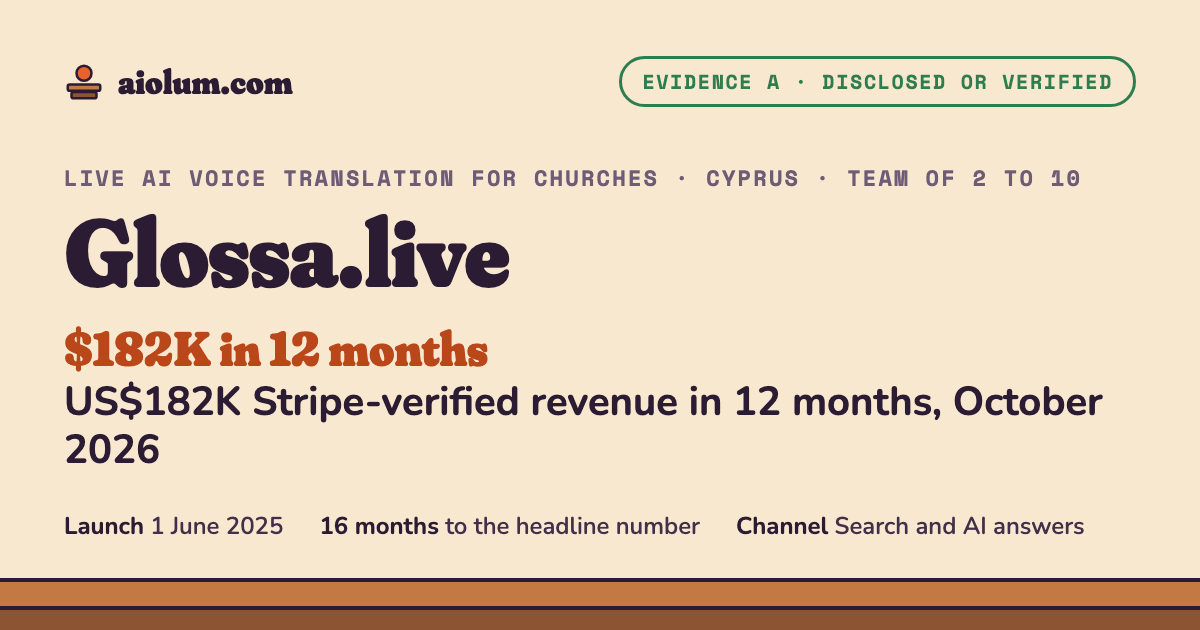
Glossa.live
Glossa.live translates a church service while it is being spoken. A church connects its microphone or sound desk to Glossa in a browser, and each visitor scans a QR code and hears or reads the service in another language on a phone. Three AI steps run in sequence. Speech recognition turns the speaker's audio into text. Machine translation turns that text into text in the listener's language. Text to speech reads the translated text aloud with a synthetic voice; with voice cloning, the synthetic voice is modelled on a 30-second recording of the pastor. The company's help center says to expect a delay of about 2 to 5 seconds, because the system waits for the end of a sentence before it translates. The text of the web app itself names Deepgram for speech recognition and ElevenLabs for voice cloning. No source names the translation model.
The founder appears on TrustMRR, a public database of startup revenue, as Anton K. LinkedIn's page for the company and a post that he wrote about the product give the full name, Anton Karbanovich. The company is INDX Ltd. in Limassol, Cyprus. The revenue on this page is not his statement. He connected the company's Stripe account to TrustMRR, and TrustMRR read the payment records through an API key: US$182,185 in the 12 months to 13 October 2026, US$31,434 of it in the last 30 days, and US$190,082 since the first payment. The monthly figures rise, but not evenly: US$7,040 in November 2025, US$4,052 in December, US$20,676 in April 2026, down to US$16,479 in June, and US$31,765 in September 2026, the highest month. The last three months brought 44.2% of the twelve-month total.
Two figures on the profile seem to disagree, and the pricing explains them. MRR, monthly recurring revenue, is US$14,505 from 99 subscriptions, but customers paid US$31,434 in the last 30 days, 2.17 times as much. Glossa sells three monthly plans, at US$99, US$299 and US$499, and only these count as MRR. It also sells pay as you go: no monthly fee, and US$5 for each language-hour, which is one hour of speech translated into one language, paid from a balance that the church fills in advance. Payments into that balance, hours above the allowance of a plan, and yearly plans paid in one payment are revenue but not MRR. The profile does not publish the split. The team size is not published either: LinkedIn lists three people, and no outside investment appears in any source. This page grades every number by its evidence, and it shows five failed startups that sold speech, listening or translation technology before such models could be rented.
The numbers, graded
Each row shows the evidence grade and the source numbers from the list at the end of this page. The grades are explained in How Aiolum verifies.
| Fact | Value | Grade | How we know | Sources |
|---|---|---|---|---|
| Revenue in the last 12 months, to 13 October 2026 | US$182,185 | A | Read by TrustMRR from the company's Stripe account through an API key, last synced on 13 October 2026 at 14:53 UTC. It is the money that customers paid, before Stripe's fees and before the cost of the AI services. The copy cached on 12 October showed US$181,280. | [1] |
| Revenue in the last 30 days | US$31,434 | A | Same profile and sync. The copy of 12 October showed US$33,641, mainly because one day with US$3,319 (13 September) then left the 30-day window. A second line of the same profile, called last 30 days revenue snapshot, says US$33,143; the profile does not explain the difference. | [1] |
| Revenue, all time | US$190,082 | A | The founder's page on TrustMRR, read a few minutes later, showed US$190,483. | [1, 2] |
| Revenue in the last 3 months and in the last 6 months | US$80,545 and US$136,629 | A | [1] | |
| Share of the 12-month revenue that came in the last 3 months | 44.2% | calc | Calculated: 80,545 divided by 182,185. | [1] |
| Last 6 months compared with the 6 months before | 3.0 times | calc | Calculated: 182,185 minus 136,629 equals 45,556 for the earlier half; 136,629 divided by 45,556 equals 3.00. | [1] |
| Monthly revenue, November 2025 to February 2026 | US$7,040, US$4,052, US$6,048, US$6,511 | A | The public monthly table starts in November 2025. December was 42.4% below November. | [1] |
| Monthly revenue, March to June 2026 | US$11,214, US$20,676, US$18,382, US$16,479 | A | April was 84.4% above March; Easter Sunday was 5 April 2026. May was 11.1% below April and June 10.4% below May. | [1] |
| Monthly revenue, July to September 2026 | US$21,970, US$22,783, US$31,765 | A | September was 39.4% above August and is the highest month. It is 4.51 times November 2025 (calculated: 31,765 divided by 7,040). | [1] |
| October 2026, first 13 days | US$13,753 | A | Calculated from it: US$1,058 a day, against US$1,059 a day in September (31,765 divided by 30). October is level with September so far, not above it. | [1] |
| Revenue before the monthly table starts | US$9,409 | calc | Calculated: 190,082 all time minus 180,673, the sum of the twelve monthly rows. Of this, US$7,897 came before 14 October 2025 (190,082 minus 182,185). The profile gives no monthly detail for that period. | [1] |
| MRR (monthly recurring revenue), 13 October 2026 | US$14,505 | A | Stripe subscriptions only, which are the Standard, Advanced and Premium plans. The profile says it grew 26.4% in 30 days. The copy of 12 October showed US$13,907 and 97 subscriptions. | [1] |
| Active subscriptions | 99 | A | [1] | |
| Average MRR per subscription | US$146.52 | calc | Calculated: 14,505 divided by 99. Standard costs US$99 and Advanced US$299, so most subscriptions must be Standard. If all 99 were Standard, MRR would be US$9,801. | [1, 6] |
| Revenue of the last 30 days that MRR does not explain | US$16,929, which is 53.9% | calc | Calculated: 31,434 minus 14,505. This part consists of payments into the prepaid balance for pay-as-you-go use, charges for hours above a plan's allowance, and yearly plans paid in one payment. The profile does not publish the split. | [1, 7, 8] |
| The last 30 days repeated for a year | about US$377,000 | calc | Calculated: 31,434 times 12 equals 377,208. This is a run rate, which is a multiplication and not a forecast. MRR times 12 is US$174,060. | [1] |
| Profit margin, last 30 days | 65% | C | Shown on the TrustMRR profile. The profile's list of verified metrics does not include it and does not say which costs are counted, so it is treated as a founder figure. | [1] |
| Founder | Anton Karbanovich | C | TrustMRR shows him as Anton K. with the X handle @karbanovich. His X profile gives Cyprus as location and links to glossa.live. LinkedIn's company page lists Anton Karbanovich among its people, and a post of 6 February 2026 on PromptZone under that name presents Glossa. | [2, 3, 11, 12] |
| People who work on it | 3 listed on LinkedIn; not published by the company | C | LinkedIn's public company page says 3 employees and gives the size band 2 to 10. LinkedIn counts people who name the company as employer in their own profiles. Company posts say we; the founder writes my startup. The blog is signed Glossa Team. No source lists roles or says who works full time. | [3, 5, 9, 11] |
| Outside funding | none reported | C | No investor and no funding round appear in any source that was read. On 18 February 2026 the company thanked ElevenLabs for a grant. ElevenLabs' grant page describes 33,000,000 characters of use over 12 months, which is credit for its service and not money. | [5, 27] |
| Legal entity | INDX Ltd., Limassol, Cyprus, registration number HE443934 | C | From the footer of the site. Apple's App Store names the same company as seller. The Cyprus company register was not read. | [6, 13] |
| Founding date | 1 June 2025 on TrustMRR; 2024 on LinkedIn | C | The company entered both dates. An archived copy of the site from 7 February 2025 already has the title Glossa and the description Real-time Translation Service for Churches. This page counts from June 2025. | [1, 11, 15] |
| Time from the founding date to the headline figure | 16 months | calc | Calculated: June 2025 to October 2026. Counted from the archived copy of February 2025 it is 20 months. | [1, 15] |
| Delay between the speaker and the translation | about 2 to 5 seconds | C | Help center: the system waits for the end of a sentence, translates it in a second or two, and then plays the audio. There is no button to skip to the live moment, by design. The app store descriptions say no delay. | [7, 13] |
| Languages | more than 100 advertised | C | The sitemap holds 92 language pages. The archived copy of 14 December 2025 said more than 80. | [6, 10, 15] |
| Services translated on one Sunday | more than 500, with 42,500 minutes | C | Company post of 7 September 2026 about the day before. 42,500 minutes are 708 hours. A post of 19 August 2026 reported more than 400 services on the Sunday before. The posts do not say whether a minute is counted once per language. | [5] |
| Minutes translated in one week | more than 65,000 | C | Company post of 5 August 2026. | [5] |
| Check of the reported use against the verified revenue | inside the possible range | calc | Calculated: 65,000 minutes are 1,083 hours; at US$2 to US$5 an hour that is US$2,167 to US$5,417 a week. Verified revenue was US$4,961 a week in July 2026 and US$5,145 a week in August (monthly figure divided by 31, times 7). | [1, 5] |
| Largest event that the company names | ARISE ASIA conference: more than 3,000 attendees, 10 languages | C | Company post of 5 August 2026. Not confirmed by the organizer in any source read. | [5] |
| Number of customers | not published | C | The site says hundreds of churches. The TrustMRR field estimated user count says 2,000. Neither is verified. The verified count is 99 active subscriptions; pay-as-you-go customers are not counted anywhere. | [1, 6] |
| Phone apps | iPhone app released 22 March 2026; Android app with more than 500 downloads | B | Apple's lookup record and the Google Play listing. The US App Store shows 2 ratings; an independent review notes that one of them appears to carry the founder's first name. Listeners do not need an app: a browser is enough. | [13, 14, 16] |
| Social media audience | 105 followers of the founder on X; 2 of the company on X; 12 on LinkedIn | B | Read on 13 October 2026. The company's X account was created on 6 September 2025. | [3, 5, 11] |
| List price of streaming speech recognition at Deepgram, Nova-3 model | US$0.0077 a minute | C | Deepgram's pricing page, pay-as-you-go column, read on 13 October 2026, with a promotional price of US$0.0048. Calculated: about US$0.46 an hour at the regular price. What Glossa pays is not published. | [8, 25] |
| List price of synthetic speech at ElevenLabs | US$0.04 to US$0.08 for 1,000 characters | C | ElevenLabs' API pricing page, read on 13 October 2026; the price depends on the model. Its startup grant gives 33,000,000 characters in 12 months. Which model Glossa uses, and for which voices, is not published. | [8, 26, 27] |
| Live translation in general products | Google Meet, Microsoft Teams, Apple AirPods | C | From the makers' own pages. Google Meet: six languages paired with English, 90 minutes for each meeting, not in live streams. Microsoft Teams: Interpreter agent announced on 19 November 2024. Apple: Live Translation in AirPods announced on 9 September 2025 for five languages. | [22, 23, 24] |
| Published prices of two competitors | Wordly: about US$1,500 for 10 hours. OneAccord: US$150 a month for 5 hours | C | From their own pages. Calculated: US$150 an hour at Wordly for all languages together, and US$30 an hour at OneAccord. Glossa charges US$5 an hour for each language. KUDO and Interprefy, which sell AI speech translation next to human interpreters, publish no prices on their home pages. | [18, 19, 20, 21] |
How to read this table: a grade A value was read by TrustMRR from the company's Stripe account through an API key; it is not a founder statement. A grade B value is a record kept by an outside platform: Apple, Google, X, LinkedIn's follower counter or the Internet Archive. A grade C value is a statement by the founder or the company, a profile field that the founder filled in, or another company's own page. A "calc" value was computed on this page from the rows named in its note.
| Plan | Per month, billed yearly (US$) | Per month, billed monthly (US$) | Limit |
|---|---|---|---|
| Free trial | 0 | 0 | 4 language-hours, no card needed |
| Pay As You Go | 5 per language-hour | No monthly fee; counted by the minute of speech; paid from a prepaid balance | |
| Standard | 82.50 | 99 | 25 language-hours a month, then US$4 per extra hour |
| Advanced | 249.17 | 299 | 100 language-hours a month, then US$3 per extra hour; voice cloning; phone support |
| Premium | 415.83 | 499 | 250 language-hours a month, then US$2 per extra hour; voice cloning; phone support |
A language-hour is one hour of speech translated into one language: a one-hour service in three languages uses three. Use is counted by the minute and only while someone speaks. Silence, songs and music are not counted, and the number of listeners does not change the price. Pay-as-you-go use is paid from a prepaid balance, which the customer fills manually or by automatic top-up. The yearly column is calculated from the saving printed under each plan (US$598 a year for Advanced, US$998 for Premium), which equals two free months, or 16.7%. The switch above the plans says 18% for yearly billing, so two statements in the same section differ. In the copy that was read, the saving for Standard is damaged and shows only the digits 98; US$198 follows the same rule. If a church uses all included hours, one hour costs US$3.96 on Standard, US$2.99 on Advanced and US$2.00 on Premium. A new customer and the customer who referred it each get US$20 of credit. The same four prices appear in the archived copy of 14 December 2025.
The timeline
From an archived church translation page in February 2025 to US$31,765 of verified revenue in September 2026. Each entry carries its grade.
- 7 February 2025BThe earliest archived copy of glossa.live with content has the title Glossa and the description Real-time Translation Service for Churches. [15]
- 1 June 2025CThe founding date on the TrustMRR profile; LinkedIn gives the year 2024. An archived copy of 10 June 2025 describes real-time AI translation for churches and events in more than 100 languages. [1, 11, 15]
- 6 September 2025BThe company's X account is created. [5]
- November 2025AThe first month in the public verified table: US$7,040. Customers had paid US$9,409 before it. December brings US$4,052, the lowest month in the table. [1]
- 14 December 2025BAn archived copy shows the four prices of today, four free hours, more than 80 languages and the sentence that hundreds of churches use it. [15]
- 6 February 2026CAnton Karbanovich presents Glossa in a post on PromptZone: translation for churches at US$5 for each language and hour. [12]
- 18 February 2026CThe company thanks ElevenLabs on X for a "33mln grant". ElevenLabs' grant page describes 33,000,000 characters of use in 12 months. Two days later the company announces captions inside ProPresenter through an API. [5, 27]
- 22 March 2026BThe iPhone app is released by INDX Ltd. [13]
- April 2026AUS$20,676, the first month above US$20,000 and 84.4% above March. Easter Sunday was 5 April. [1]
- 6 May 2026CThe founder posts on X: "My vibe-coded startup for churches just hit 20k+ Revenue", with a link to a Stripe profile. The verified April figure agrees with the post. [1, 3, 4]
- May and June 2026ARevenue falls to US$18,382 and then to US$16,479. [1]
- 5 August 2026CThe company reports more than 65,000 translated minutes in one week, and a conference, ARISE ASIA, with more than 3,000 attendees and 10 languages. [5]
- 6 September 2026CA Sunday with more than 500 services and 42,500 translated minutes, by the company's post of the next day. [5]
- September 2026AUS$31,765, the highest month, 39.4% above August. [1]
- 13 October 2026ATrustMRR reads US$182,185 for the last 12 months, US$31,434 for the last 30 days, MRR of US$14,505 and 99 subscriptions. The business is not listed for sale. [1]
Why it worked
Four causes, in the order they mattered. Each one is a reusable lesson.
A price that a small church can pay without a contract
Pay as you go costs US$5 for one hour of speech in one language, counted by the minute. Silence, songs and extra listeners cost nothing, and there is no hardware to buy. By the help center's own example, a 90-minute service with about 50 minutes of speech in two languages costs about US$8.30. Wordly, which sells to events and to churches, starts at about US$1,500 for a package of 10 hours. OneAccord, which sells only to churches, starts at US$150 a month for 5 hours.
One kind of customer with a weekly need
A church meets every Sunday, so use repeats every week without a new sale. The company reported more than 400 services on one Sunday in August 2026 and more than 500 on one Sunday in September. The product follows the way a service runs: a QR code that never changes, captions inside the presentation software, and written instructions for Bible quotations, names and church terms. The founder's X profile says: "I love my God and my family. I build AI startups."
Rented models, sold again by the minute
The costly parts are speech recognition and synthetic voices. The text of the web app names Deepgram and ElevenLabs for them, and both charge by use. The company does not train or host these models. Its own work is the connection between the steps, the meter that counts speech per language, the page for listeners and the links to church software. The help center says that when the models improve, the gain reaches customers with nothing to update.
Found by search, then shown to everyone in the room
The site publishes a page for each of 92 languages, each in 17 interface languages, and 34 blog posts that each explain how to reach one language community. One testimonial on the site describes finding Glossa during a weekend when a conference was short of interpreters. Every listener scans the product's QR code, so each service shows the product to everyone who listens. A referral gives US$20 of credit to both sides. The company's own social media accounts have almost no followers.
How it was built
These details come from the company's own pages, from the text of its web app, and from founder and company posts. They are grade C unless an item says otherwise. No interview with the founder was found. [3, 5, 6, 7, 8, 9, 10, 13, 17]
- Three AI steps in sequence, as the company's blog describes them: speech recognition, machine translation, text to speech. The system waits for a complete sentence before it translates, which is the main cause of the delay of 2 to 5 seconds.
- Speech recognition: the interface text of the web app offers a custom dictionary "supported on Nova-2 and Nova-3 general streaming models". Nova is the name of Deepgram's models, and the app handles messages that carry Deepgram's name. A church can add names and terms so that they are recognized.
- Voices: the interface text says that custom voices are made with ElevenLabs voice cloning. The help center asks for a 30-second sample of the speaker. The pricing section lists voice cloning under the Advanced and Premium plans.
- Translation: no source names the model. A church steers it with instructions in plain language, for example which Bible version to follow and how to translate an abbreviation. Large language models are steered in this way, so a language model is the likely translator. This is an inference from the help center, not a statement by the company.
- Web app: the page source shows a React app that loads Supabase (a hosted database with login), Stripe for payments and PostHog for usage analytics, and that keeps WebSocket connections open for the live text. The TrustMRR profile lists Next.js, React, Cloudflare and Stripe. The founder calls the product vibe-coded, a word for software whose code an AI coding tool wrote from descriptions in plain language.
- Billing: a prepaid balance with a top-up button and an optional automatic top-up for pay-as-you-go use, and three monthly plans in Stripe. The meter counts minutes of speech per language. The interface text says that streaming is disabled when the balance is critically low.
- Fit with church equipment: captions for ProPresenter, OBS, vMix and Proclaim, an RTMP input, a page to embed in the church website, webhooks and an API. Apps for iPhone and Android exist, and a browser is enough for listeners.
- How customers find it: 1,745 addresses in the sitemap, among them 52 blog posts; a help center with 35 articles; four free hours without a card; US$20 of credit for a referral; a presentation that a member can send to the church leadership; a listing in faith.tools, a directory of software for churches. Whether the company pays for advertising is not published.
Tools named in the sources
Each one opens its page in the Tools tab, with every story that uses it.
The dead that came before
Five companies in the Loot Drop database sold speech, listening or translation technology before AI models could be rented by the minute. None of them sold to churches; they are here for the technology and for the reason they closed. The values below are from that database and are not independently verified.
TurboTranslations
The promiseFaster and cheaper translation through a marketplace of freelance human translators.
Why it diedEvery text needed paid human work. Neural machine translation improved quickly from 2016, and with US$150,000 the company could not change its model.
Tellme
The promiseInformation and transactions over the telephone by voice, with automatic speech recognition.
Why it diedSmartphone apps replaced telephone voice services, and the voice assistants of Google and Amazon took the remaining users. Microsoft bought the company in 2007 and later ended the product.
VocalIQ
The promiseA voice interface that learns from context, so that speaking to a computer works like a conversation.
Why it diedAs an independent company it could not compete with Apple, Google and Amazon. Apple bought it in 2015 and put the technology into Siri.
Doppler Labs
The promiseSmart earphones that filter and change the sounds around the wearer in real time.
Why it diedThe Here One earphones worked, but too few people bought them. Manufacturing delays raised the costs, and Apple's AirPods showed that buyers wanted simple wireless earphones.
SoundFocus
The promiseA phone app that adjusts audio to a person's hearing, for people with mild hearing loss who do not want a hearing aid.
Why it diedThe market was smaller than expected. Users chose hearing aids or general products such as Apple's AirPods, and new customers cost too much to win in a small market.
What changed
Before AI models could be rented, a church had two ways to translate a service. It could seat a bilingual volunteer or a paid interpreter for each language. Or it could buy radio receivers: the company's own guide gives US$500 to US$3,000 for a starter kit with 10 to 20 receivers, and each language still needs an interpreter. Speech technology existed, but a company had to build it. Tellme raised US$238 million from 1999 for speech recognition over the telephone. Doppler Labs spent US$51 million on earphones that process sound in real time. TurboTranslations organized human translators in a marketplace and closed in 2023, after machine translation had become good enough for most text.
Now each step can be rented. Deepgram lists streaming speech recognition at less than one US cent a minute, and ElevenLabs lists synthetic speech at US$0.04 to US$0.08 for 1,000 characters. A very small company can connect the steps, add a meter and a QR code, and sell one hour of translation into one language for US$5. Glossa collected US$182,185 of verified revenue in twelve months with three people listed on LinkedIn and no reported investment. The same change removes the protection. Any competitor can rent the same models, and the owners of the largest platforms are building translation into meeting software and earphones.
Can one person copy it now?
The method, yes. The church market already has several sellers.
The parts are public and rented: speech recognition, translation and voices are sold by the minute or by the character. At least five companies already sell live translation to churches or events. What Glossa added is a price that a small church can pay without a committee decision, and a product shaped for one kind of customer. The same method fits other groups that meet regularly with listeners in several languages. Every copy carries the same risk: large platforms are adding translation to products that people already own.
Where it is still open: Groups outside churches that meet regularly with listeners in several languages: school meetings for parents, city council sessions, trade union meetings, residents' meetings of housing associations, and safety training in factories and on building sites. In each case the buyer has little money and no interpreter, which is the situation of a small church.
- 1Choose a customer group that has the same need every week, so that use repeats without new selling.
- 2Rent each model step and pay by use. Put your own work into setup, billing and the tools that the customer already runs.
- 3Charge by use with no minimum, count only what the customer values (speech, not silence), and give enough free hours for one real test.
- 4Let the customer correct the model in plain words: a list of names and terms for recognition, and written instructions for translation.
- 5Publish one page for each language and each community, and a help center that answers the questions of the volunteer who operates the system.
What to watch
The risks are the mirror image of the causes above.
Large platforms add live translation to products that people already have
Google Meet has Speech Translation, which speaks a participant's words in another language in a voice like the speaker's. Google's help page, read on 13 October 2026, lists six languages paired with English and a limit of 90 minutes for each meeting, and says that the feature does not work in live streams. Microsoft announced an Interpreter agent for Teams meetings on 19 November 2024: speech-to-speech interpretation that can imitate the speaker's voice. Apple announced Live Translation in AirPods on 9 September 2025 for face-to-face conversations in five languages, with four more promised by the end of 2025. None of these is built for a hall with one speaker and listeners in many languages, and their language lists are short. But a visitor who gets a usable translation from earphones that he or she already owns does not need the church to buy anything.
Dedicated competitors, some cheaper to start and some much larger
Wordly sells AI translation for events and has a page for churches. Its pricing page says that prices start at about US$1,500 for a package of 10 hours, which is US$150 an hour for all languages together. KUDO and Interprefy sell AI speech translation next to human interpreters for conferences. OneAccord sells live translation only to churches, says that more than 200 churches trust it, and starts at US$150 a month for 5 hours. In 2026 the Vatican began to offer the liturgy in St. Peter's Basilica in 60 languages through a QR code, built with the company Translated. For a church that needs one to three languages, Glossa's price of US$5 to US$15 an hour is far below the two published prices. A price is the easiest thing for a competitor to change, and all of them can rent the same models.
Accuracy for religious language is claimed, not measured
The site says that its AI is trained on biblical texts and handles theological terms correctly. The mechanisms that the help center documents are simpler: a dictionary of names and terms for the speech recognition, and written instructions for the translator, for example which Bible version to follow. No source gives an error rate. The company's blog says that modern systems are more than 95% accurate from English to Spanish, with no measurement behind the figure. An independent review by Jaeden Schafer of Learn of Christ, updated on 9 August 2026 and written from documents without a test, says that "biblically trained" does not guarantee theological fidelity, that names, negation and quotations need a check by a native speaker, and that a cloned voice makes a wrong translation sound like the pastor's own words. The help center itself says that accuracy depends on the audio, that some languages are stronger than others, and that sung words cannot be transcribed. The same review notes that one of the two App Store ratings appears to carry the founder's first name.
The models are rented, and their prices set the margin
Deepgram's list price for streaming speech recognition with the Nova-3 model is US$0.0077 a minute, about US$0.46 an hour; a promotional price of US$0.0048 a minute was shown on 13 October 2026. ElevenLabs' API list price for text to speech is US$0.04 to US$0.08 for 1,000 characters, depending on the model. An example with assumed values, 150 words a minute and 6 characters a word: one hour of continuous speech is 54,000 characters, which costs US$2.16 to US$4.32 for each language at list price. Glossa sells an extra hour for US$2 on its Premium plan. Volume contracts cost less than list prices, captions need no voice, and no source says which service produces the standard voice or the translation, so the real cost is not known. The TrustMRR profile shows a profit margin of 65% for the last 30 days without saying which costs it counts. The grant that ElevenLabs describes on its grant page covers 33,000,000 characters in 12 months. By the same assumed values that is about 611 hours of speech, less than the 708 hours that the company reported for one Sunday in September 2026. If a provider raises a price, changes its terms or retires a model, Glossa must follow.
Revenue follows the church calendar and single events
December 2025 was 42.4% below November. April 2026, the month of Easter, was 84.4% above March, and May and June were 11.1% and 10.4% below the month before. In the last 30 days the four Sundays brought US$1,838 on average, and all full days US$1,058. Use is concentrated in a few hours on Sunday: the company reported more than 500 services on one Sunday. A technical failure in those hours reaches most customers at the same time. One conference had more than 3,000 attendees in 10 languages according to the company; an event of that size adds revenue that does not repeat every month. The first 13 days of October 2026 average US$1,058 a day, the same as September, so the latest data show a level month and not further growth.
Twelve months of data and a team that is not described
The public monthly table starts in November 2025. Churn, the share of subscribers who cancel in a period, is visible on TrustMRR only after login and was not read. TrustMRR shows the founder as Anton K.; his full name comes from LinkedIn and from one post. LinkedIn lists 3 people, and the contact section of the site links a Telegram account under another person's name. No source says who writes the code, who answers customers, or whether anyone works full time. The founder calls the product vibe-coded. Hundreds of services run in the same hours on a Sunday, and keeping them running depends on a very small team.
Statements that differ or could not be checked
The founding date is 1 June 2025 on TrustMRR and 2024 on LinkedIn, and an archived copy shows the site in February 2025. The profile gives two figures for the last 30 days: US$31,434 in its table and US$33,143 in a snapshot line. The yearly discount is 18% on the switch of the pricing section and 16.7% by the printed amounts. The site says that hundreds of churches use it and shows the names SBC, Hillsong, PCA, CCA and UMC; no source confirms what relation these organizations have to Glossa, and the four testimonials give a first name and an organization only. The profile field for the estimated user count says 2,000. The app descriptions say no delay, and the help center says 2 to 5 seconds. The Stripe profile that the founder linked as proof loads by script, and its figures could not be read; the TrustMRR figures do not depend on it.
Sources
The grade next to each source is the best grade that the source can support. "Read in full" means that the text of the page was downloaded and the numbers were checked in it.
- A TrustMRR profile of Glossa.live, revenue read from Stripe by API keyRead the markdown profile (https://trustmrr.com/startup/glossa-live.md) live on 13 October 2026, and the cached copy of 12 October. Revenue, the monthly and daily tables, MRR and active subscriptions come from the Stripe API, last synced on 13 October 2026 at 14:53 UTC. The description, founding date, pricing model, user count, technology list and profit margin are entered by the founder, grade C.
- C TrustMRR founder page: Anton K. (@karbanovich)Read in full on 13 October 2026. It lists one startup, Glossa.live, a total revenue of US$190,483, and one product update by the founder.
- C Anton K. on X, 6 May 2026: My vibe-coded startup for churches just hit 20k+ RevenueRead in full through the fxtwitter API, with his profile and the 18 posts of his timeline that the API returned. Source for his words about the product, his location, his follower count and the link to the Stripe profile.
- C Stripe profile of Glossa.live, gross volumeCould not read the figures: the page loads by script. Only the page title was read, which names Glossa.live and gross volume. It shows that the profile exists. It is not used for any number.
- C Glossa on X (@glossa_ai), posts of February to October 2026Read 40 posts and the profile through the fxtwitter API. Used: 18 February 2026 (ElevenLabs grant, post 2024028403834212816), 20 February (ProPresenter), 5 August (65,000 minutes; ARISE ASIA), 19 August (400 services), 7 September (42,500 minutes and 500 services, post 2096932510340919750), 6 October (complete sentences).
- C Glossa.live home page, read 13 October 2026Read in full, as text and as page source. Source for the features, the pricing section, the testimonials, the FAQ, the company name and registration number in the footer, the contact links and the scripts that the page loads.
- C Glossa Help CenterRead the five category pages and 11 of the 35 articles in full: pricing, plans, what counts as use, the free trial, the delay, low accuracy, voice cloning, custom translation instructions, language limitation and the referral program.
- C Glossa web app, main script with the interface text, read 13 October 2026Downloaded and searched as text; not run. Source for the names Deepgram and ElevenLabs, the Nova model names, and the words for the balance, the top-up and the automatic top-up. No translation provider is named in it.
- C Glossa blog, 18 March 2026: How AI Translation Works for Church ServicesRead in full. Source for the three steps, the 95% accuracy claim and the statement on delay. Signed Glossa Team.
- C Glossa.live sitemap, with the blog post of 23 May 2026 on translation systems for churchesCounted the addresses with a script: 1,745 in total, 1,656 language pages (92 languages in 18 versions), 52 blog posts. Read the post https://glossa.live/blog/best-translation-systems-for-churches in full, for the cost of radio receivers.
- C LinkedIn company page: GlossaRead the public page without login on 13 October 2026. Source for the 3 employees, the size band, the founding year 2024, the 12 followers, and the founder's full name in the list of people. The founder's own LinkedIn profile could not be opened.
- C PromptZone, 6 February 2026, post by Anton Karbanovich: GlossaRead in full. A short presentation of the product by the founder under his full name.
- B Apple App Store listing: Glossa - AI Church Translation, with Apple's lookup recordRead the US listing and the lookup record on 13 October 2026. Source for the seller INDX Ltd., the release date, the number of ratings and the description text.
- B Google Play listing: Glossa - AI Church TranslationRead the listing on 13 October 2026. Source for the download count.
- B Internet Archive copies of glossa.live, 7 February 2025 to 16 April 2026Read the list of captures and five copies: 7 February, 10 June and 18 September 2025, 14 December 2025 and 16 April 2026. The archive proves the date of each text; the text itself is the company's. Source for the early descriptions and for the prices in December 2025.
- C Learn of Christ, updated 9 August 2026, review by Jaeden Schafer: Glossa Review 2026Read in full. The reviewer states that the review is based on published documents and store data, not on use of the product. Source for the risks of accuracy and voice cloning.
- C faith.tools directory entry for GlossaRead in full. A directory of software for churches. It repeats the claims of the company's site and cites that site.
- C Wordly pricing page and church translation page, read 13 October 2026Read the pricing text and the page https://www.wordly.ai/church-translation. Source for the starting price.
- C OneAccord home page, read 13 October 2026Read in full. Source for its starting price, its number of churches and its number of languages.
- C KUDO home page, read 13 October 2026Read the product descriptions. Not used for numbers.
- C Interprefy home page, read 13 October 2026Read the product descriptions. Not used for numbers.
- C Google Meet Help: Learn about Speech TranslationRead in full on 13 October 2026. Source for the languages, the limit of 90 minutes and the exclusion of live streams.
- C Microsoft, 19 November 2024: Introducing Copilot actions, new agents, and tools to empower ITRead the section on the Interpreter agent in Teams.
- C Apple Newsroom, 9 September 2025: Introducing AirPods Pro 3Read the section on Live Translation.
- C Deepgram pricing page, read 13 October 2026Read the table of streaming prices. Source for the Nova-3 list price and the promotional price.
- C ElevenLabs API pricing page, read 13 October 2026Read the text-to-speech prices for each model.
- C ElevenLabs startup grants page, read 13 October 2026Read the description of the grant and its questions and answers. Source for the 33,000,000 characters and the 12 months.
- C Mezha, 2026: Vatican to translate masses in real time using AIRead in full. A news report that cites Engadget. Source for the 60 languages and the company Translated.
- C Loot Drop database export, 1,749 failed startupsLocal export. AI-written summaries, not independently verified. Source for the failed predecessors.