Kimaru AI: Product, team and how it was built
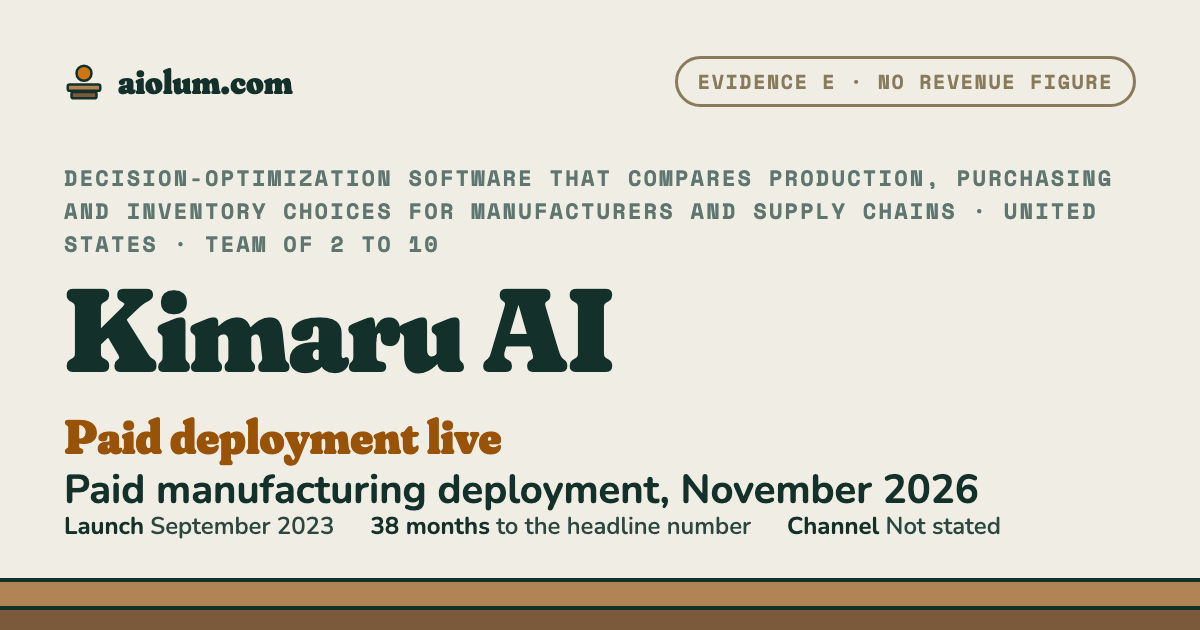
Kimaru AI (Decision-optimization software that compares production, purchasing and inventory choices for manufacturers and supply chains, United States): Paid manufacturing deployment, November 2026. Evidence grade E: no revenue figure was checked. Team: 2 co-founders (Evan Burkosky, CEO; Hareesh Nambiar, CTO); later headcount not published, with work across Chennai, Tokyo, Austin and San Francisco. Launched September 2023; still running.Added 6 November 2026
- Outcome
- Paid manufacturing deployment, November 2026
- Evidence
- E no revenue figure was checked
- Launch
- September 2023
- Status
- Still running
- Team
- 2 co-founders (Evan Burkosky, CEO; Hareesh Nambiar, CTO); later headcount not published, with work across Chennai, Tokyo, Austin and San Francisco
- Outside funding
- Equity accelerators Alchemist Japan and Alchemist Class 40; Alchemist lists a US$500K pre-seed, and the founder wrote of two more investments in October 2025
- Main channel
- Not stated
What is not verified
No revenue figure for Kimaru was found. What was looked for: a payment-processor profile, a founder interview with numbers, a filing and press figures. Alchemist's page says there is a paid manufacturing deployment but gives no amount; the US$500K pre-seed is funding, not revenue. A reader could look for a named customer or revenue in later press. This story is grade E: the business is real and its product, price and customers are described from public pages, but no revenue figure was checked. Aiolum shows it as an idea worth studying, not as proof that it makes money.
Kimaru AI sells decision intelligence software, a kind of software that models a business decision as actions, outside conditions and outcomes, compares options and tracks what happened after the choice. Its customers are manufacturers and supply-chain teams. The product sits above the ERP (enterprise resource planning, the system of record for orders, stock and production) and builds a Decision Model for one recurring choice, for example a weekly production plan. A causal AI model compares feasible plans, a named person approves one, and a Decision Receipt records what was known, chosen and expected.
Evan Burkosky (CEO) and Hareesh Nambiar (CTO) founded the company; they first worked together in Japan, the About page says. The site's first post is dated September 2023, and Kimaru AI, Inc. lists 15 November 2024 as its founding date. It went through the first Alchemist Japan class from October 2024 and Alchemist Class 40 in San Francisco, whose Demo Day was on 30 September 2025. Alchemist's Japan page lists a US$500K pre-seed and a paid manufacturing deployment for Kimaru.
No revenue figure was found, so the evidence grade is E. What is checked is the live product site, the two founders, the accelerator record, the license terms that sell the service under order forms with fees, and one anonymous customer case: an aircraft-carpet maker whose on-time production of new orders rose from 43% to 75%, as the vendor states.
How much revenue does Kimaru AI make?
Each row shows the evidence grade and the source numbers from the list at the end of this page. The grades are explained in How Aiolum verifies.
| Fact | Value | Grade | How we know | Sources |
|---|---|---|---|---|
| Status, November 2026 | live, sold to companies through walkthroughs and proofs of concept | C | Home page: "Decision Optimization Platform." with "Book a Decision Walkthrough"; Class 40 post: "please signup for a proof of concept". | [1, 5] |
| Founders | Evan Burkosky (CEO) and Hareesh Nambiar (CTO) | C | About page: "Kimaru was founded together by Evan Burkosky and Hareesh Nambiar, who first worked together in Japan." | [2] |
| Company | Kimaru AI, Inc., founded 15 November 2024, Austin, Texas | C | About page: "Founded: November 15, 2024". The CEO says in an interview "In 2024 I co-founded and serve as CEO of Kimaru AI". | [2, 7] |
| First post on the site | 9 September 2023 | C | The site's post list gives 2023-09-09 for "How to Make Better Decisions", the earliest post. | [11] |
| Team | 2 co-founders; later headcount not published | C | Interview: "We operate asynchronous-first across Chennai, Tokyo, Austin, and San Francisco" and "Forward-deployed engineers build connectors". No page gives a headcount. | [2, 7] |
| Funding | US$500K pre-seed, as Alchemist lists it | C | Alchemist Japan page: "$500K pre-seed raised". About page: "Capital: $500,000". The founder wrote after Demo Day that the company "within 48 hours had closed two additional investments"; amounts not given. | [4, 2, 5] |
| Paid customer | a paid manufacturing deployment | C | Alchemist Japan page, portfolio highlights for Kimaru.ai: "Paid manufacturing deployment". The customer is not named. | [4] |
| Customer result claimed | new-order on-time production 43% to 75% | C | Home page case of an "Aircraft Carpet Manufacturer"; also "96% to 100%" ERP-versus-plan pass rate, weeks 24 to 26. The page adds: "Results are not universal." | [1, 3] |
| Accelerators | Alchemist Japan Class 1 (from 1 October 2024); Alchemist Class 40 (Demo Day 30 September 2025); INTLOOP Ventures Accelerator Excellence Award (October 2025) | C | Mitsubishi Estate press release reposted on the site lists kimaru.ai among nine startups; Class 40 post; INTLOOP post. | [6, 5, 8] |
| AI model provider | OpenAI, among listed sub-processors | C | Data Processing Agreement, Exhibit D: AWS, Google Workspace, Microsoft Azure, "OpenAI – OpenAI, LLC" and HubSpot. | [10] |
| Time from the first post to the November 2026 facts | 38 months | calc | Calculated: September 2023 to November 2026. | [11, 4] |
How to read this table: a grade C value is what the company states on its own pages or what its accelerator lists. A "calc" value (grade X) was computed on this page. No value comes from a payment processor, a filing or an audited report.
| Plan | Per month, billed yearly (US$) | Per month, billed monthly (US$) | Limit |
|---|---|---|---|
| Decision Model deployment | price not published; proof of concept and order form |
The license terms say customers use the service "under an Order Form" and define "Fees" as the fees set out in it. No plan or price appears on any page read; the /pricing/ address returns an empty page. The table has one row.
When did Kimaru AI launch, and how did it grow?
From the first blog post in 2023 through two accelerators to a paid manufacturing deployment, read from the company's pages and the Alchemist Japan page. Each entry carries its grade.
- 9 September 2023CFirst post on kimaru.ai, "How to Make Better Decisions". [11]
- 4 October 2024CMitsubishi Estate announces the nine startups of the first Alchemist Japan class, including kimaru.ai; the class started on 1 October 2024. [6]
- 15 November 2024CFounding date of Kimaru AI, Inc., as the About page lists it. [2]
- 30 September 2025CAlchemist Class 40 Demo Day in San Francisco; the founder writes that two more investments closed within 48 hours. [5]
- October 2025CGraduates from the INTLOOP Ventures Accelerator in Japan with its Excellence Award, with plans for customer proofs of concept. [8]
- November 2026CThe site shows the aircraft-carpet case; Alchemist lists a paid manufacturing deployment. [1, 4]
Why did Kimaru AI work?
Four causes, in the order they mattered. Each one is a reusable lesson.
Two-founder enterprise sale through accelerators
Two founders, one for customers and one for the technology, used Alchemist Japan, Alchemist in San Francisco and a Japanese corporate accelerator to reach investors and enterprise pilots, the company's posts say.
Start with one decision
A first deployment covers one recurring decision and can begin with files or read-only database views, without writing back to the customer's ERP, the home page says. This lowers the risk for the buyer before a larger order.
A record of each decision
Each decision keeps its evidence, options, approver and measured outcome, so the vendor can show a before-and-after number, such as the on-time rate in the carpet case.
How it was built
These details come from the company's pages. They are grade C. [10, 1, 3, 7]
- Sub-processors: Amazon Web Services, Google Workspace, Microsoft Azure, OpenAI and HubSpot, the Data Processing Agreement lists.
- Deployment in a customer-managed AWS account, a private tenant run by Kimaru, or on premises, the home page says.
- The product passes approved actions to outside agents such as SAP Joule, Microsoft Copilot, Codex and Claude, the product page says.
- The team works asynchronously with Slack, Google Workspace, Asana and GitHub, the CEO said in an interview.
Tools named in the sources
Each one opens its page in the Tools tab, with every story that uses it.
Who tried this before Kimaru AI, and why did they fail?
Three companies in a database of failed startups promised to make inventory, procurement or the supply chain of a whole industry easier to manage. The values below are from that database and are not independently verified.
TradeGecko
The promiseInventory and order management for small and medium online sellers.
Why it diedAfter Intuit bought it, the focus moved to QuickBooks, and all-in-one commerce platforms covered the need.
Kinnek
The promiseA marketplace that made procurement and supplier comparison easier for small businesses.
Why it diedAmazon Business and Alibaba had larger supplier networks, and small buyers needed more tailored help than the platform gave.
Katerra
The promiseOne company for design, supply chain and construction to cut building costs and time.
Why it diedIt built factories before it had secured customers, and the costs of factories and supply chains were higher than planned.
The failed startups come from our database of 1,749 dead startups, retold here in our own words. Its entries are AI-assisted summaries of public sources, so these cards carry no evidence grade.
What changed
TradeGecko and Kinnek sold general tools for many small businesses and lost to larger platforms. Katerra tried to own the whole supply chain and needed billions of dollars. Kimaru sells one decision at a time to an existing manufacturer and keeps the customer's ERP in place, so a pilot is small and its result can be measured.
Two things are newer: language models and agents can now read messy spreadsheet and ERP data and act in other systems, and accelerators in Japan and the US pair small B2B teams with corporate customers for proofs of concept.
Can one person copy Kimaru AI now?
Hard for one person.
Enterprise supply-chain software needs long sales cycles, data connectors for each customer and engineers on site, and Kimaru used two founders, two accelerators and outside funding. The part one person can copy is the scope: pick one recurring decision in one industry, prove a before-and-after number in a pilot, and only then widen.
Where it is still open: Narrow versions for smaller manufacturers: one decision such as material reordering or machine scheduling, sold with a fixed monthly price instead of an enterprise order form.
- 1Choose one recurring operating decision where errors have a measurable cost.
- 2Start from read-only data exports so the customer's IT team does not have to approve write access.
- 3Record each recommendation, the approver and the result, and publish the measured change.
- 4Use accelerators with corporate partners to find the first pilot customers.
What could go wrong for Kimaru AI?
The risks are the mirror image of the causes above.
What is not verified
No revenue figure for Kimaru was found. What was looked for: a payment-processor profile, a founder interview with numbers, a filing and press figures. Alchemist's page says there is a paid manufacturing deployment but gives no amount; the US$500K pre-seed is funding, not revenue. A reader could look for a named customer or revenue in later press.
Customer results are the vendor's pages
The 43% to 75% on-time rate and the 96% to 100% ERP check come from an unnamed "Aircraft Carpet Manufacturer" on Kimaru's own site. In an interview the CEO describes Japanese retail and logistics results only within ranges that McKinsey reports, without own figures. Posts from early 2025 such as "Fashion Retailers Use Kimaru.ai" describe use cases and name no customer.
Dependence on model providers
The Data Processing Agreement lists OpenAI as a sub-processor, with AWS and Microsoft Azure for hosting. The product page says outside models and agents (SAP Joule, Copilot, Codex, Claude) may assist, and that Kimaru keeps the decision record separate from them.
Competition
The CEO names Aera and Blue Yonder as larger decision-intelligence and supply-chain vendors. On this site, LineSight (production planning for metal service centers) and Lark (purchasing and inventory agents for distributors) sell AI for similar operating decisions.
Team size
Two co-founders started the company, and it raised outside funding. The CEO's interview mentions work across Chennai, Tokyo, Austin and San Francisco and forward-deployed engineers, but no page gives a headcount.
Sources
The grade next to each source is the best grade that the source can support. "Read in full" means that the text of the page was downloaded and the numbers were checked in it.
- C Kimaru home page, read 6 November 2026Read in full. Source for the product, the deployment options and the aircraft-carpet case.
- C Kimaru: About UsRead in full. Source for the co-founders, the founding date and the company details.
- C Kimaru: ProductRead in full. Source for the Causal AI Modeler and the outside agents.
- C Alchemist Accelerator: Alchemist JapanRead the portfolio highlights and testimonials. The accelerator's own page about a company it invested in. Source for the pre-seed and the paid deployment.
- C Kimaru blog, 6 October 2025: Kimaru AI Graduates from Alchemist Class 40Read in full. Source for the Demo Day date and the two later investments.
- C Kimaru blog, 4 October 2024: Press release: kimaru.ai selected to join inaugural Alchemist Japan program (Mitsubishi Estate)Read in full. A Mitsubishi Estate press release reposted on the company's site. Source for the class and its dates.
- C Kimaru blog: IT Business Today - Interview with Evan Burkosky, CEO and Co-Founder @ kimaru.aiRead in full. Reposted interview. Source for the founder's background, team locations, tools and competitors.
- C Kimaru blog, 3 October 2025: Kimaru AI graduates from the INTLOOP Ventures Accelerator with the Excellence AwardRead in full. Source for the INTLOOP award.
- C Kimaru: License Agreement Terms, last updated 8 March 2025Read the opening and definitions. Source for sales under order forms with fees.
- C Kimaru: Data Processing AgreementRead Exhibit D. Source for the sub-processors, including OpenAI.
- C Kimaru site post list (WordPress posts API)Read in full. Source for the date of the first post.
- C Database of failed startups, local exportLocal export. AI-written summaries, not independently verified. Source for the failed predecessors.
Run this company? Send corrections or a verified figure to aiolum@livyden.com