Octave-X (ChromaFlow): Product, team and how it was built
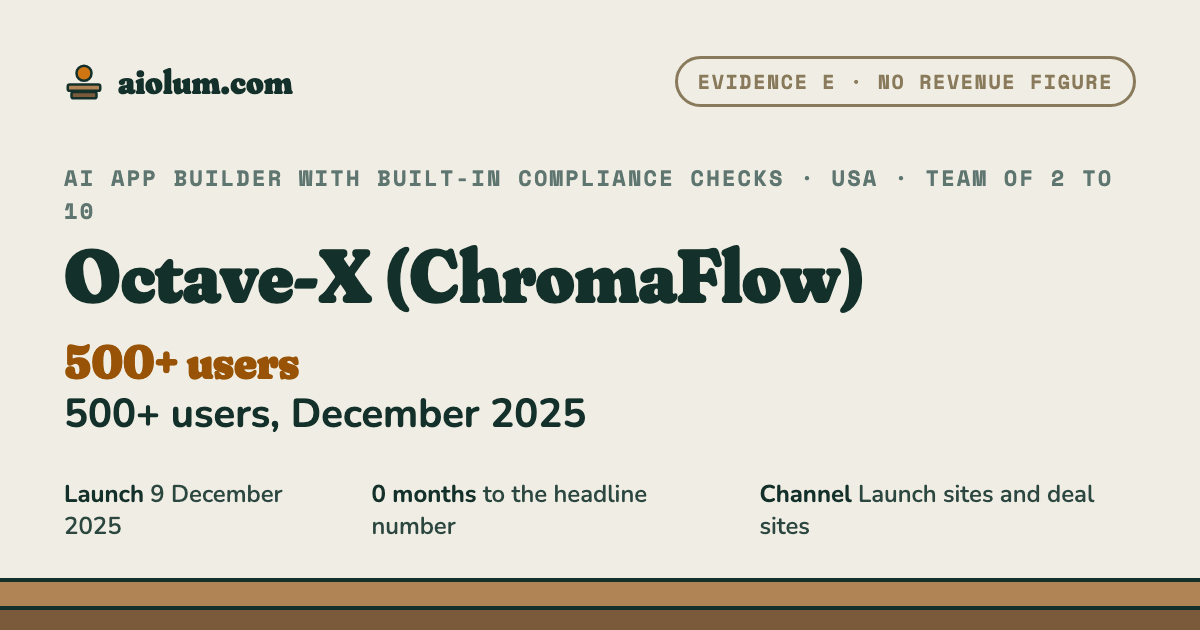
Octave-X (ChromaFlow) (AI app builder with built-in compliance checks, USA): 500+ users, December 2025. Evidence grade E: no revenue figure was checked. Team: 2 co-founders in a team of 4 full-time and part-time people, December 2025. Launched 9 December 2025; still running.Added 5 November 2026
- Outcome
- 500+ users, December 2025
- Evidence
- E no revenue figure was checked
- Launch
- 9 December 2025
- Status
- Still running
- Team
- 2 co-founders in a team of 4 full-time and part-time people, December 2025
- Outside funding
- Bootstrapped; the founder said in December 2025 that no round was raised, that it received a US$25K OpenAI credits grant and that it was talking with pre-seed investors
- Main channel
- Launch sites and deal sites
What is not verified
No revenue figure was found, and no count of paying customers. I looked for a payment-processor profile, revenue in the founder interview of 24 December 2025, and published prices; the interview says only that pilot users were being turned into paying customers, and the chromaflow.ai pricing page showed no plans on 5 November 2026. The company site octave-x.com answered with a Cloudflare bot challenge (HTTP 403), so its pages, including any Certus page, were not read. The user count of 500+ is the founders' own figure. A reader could look for a payment-processor profile or a later interview with a revenue figure. This story is grade E: the business is real and its product, price and customers are described from public pages, but no revenue figure was checked. Aiolum shows it as an idea worth studying, not as proof that it makes money.
ChromaFlow is an AI app builder: a service where you describe an application in plain language and AI models write the code and deploy it. It uses a multi-agent system, in which several AI programs, each with one job such as the user interface, the database or the tests, work on parts of the same build. Its difference from other builders is compliance checking, the test of whether software meets rules such as HIPAA (US health data), GDPR (EU personal data) and SOC 2 (a security audit standard).
Tarun Mittal, a software engineer, and Desmend Jetton, who met at a coding bootcamp, run it through Octave-X, Inc., based at the 1871 startup hub in Chicago. They formed the company in 2024 and launched ChromaFlow on Product Hunt on 9 December 2025, where it ranked 30th of the day. In December 2025 the founder said the team was four people, the company was bootstrapped, more than 500 people had used it and pilot users were being turned into paying customers.
No revenue figure was found. The evidence is grade E: a live product site, a Product Hunt launch and the founder's own interview.
How much revenue does Octave-X (ChromaFlow) make?
Each row shows the evidence grade and the source numbers from the list at the end of this page. The grades are explained in How Aiolum verifies.
| Fact | Value | Grade | How we know | Sources |
|---|---|---|---|---|
| Status, November 2026 | ChromaFlow site live; status page marks the website, app builder, documentation and deployment pipeline "Operational" | C | Status page read on 5 November 2026. "Agentic SDLC Runtime", "Certus Evidence Layer" and "Workflow Automation Demo" are marked "In Progress". | [5] |
| Product Hunt launch | 9 December 2025, ranked 30th of the day and 160th of the week | C | Product Hunt page data, read 5 November 2026: 56 followers and no reviews yet. | [2] |
| Users, December 2025 (headline) | more than 500, about 20% monthly active | C | Founder interview, 24 December 2025: "That strategy has led us to 500+ users". The co-founder wrote "500+ beta users" on Product Hunt. | [1, 2] |
| Paying customers | not published | C | Founder, December 2025: "We're turning our pilot users into paying customers". No count was given. | [1] |
| Team | 4 people, full-time and part-time, in different time zones | C | Founder interview: "We're a small group of four people". Mittal leads product and engineering; Jetton leads operations. | [1] |
| Company and place | Octave-X, Inc., at 1871, Chicago, Illinois | C | Interview and site footer: "ChromaFlow is a product of Octave-X, Inc." | [1, 3] |
| Company formed | 2024 | C | Founder interview. The interview also places the Product Hunt launch in 2024, but the Product Hunt page dates it 9 December 2025. | [1, 2] |
| Funding | bootstrapped; no round raised by December 2025 | C | Founder: "We have not raised any round up to this point". He said a US$25K OpenAI credits grant paid for AI use and that the company was talking with pre-seed investors. | [1] |
| AI models | OpenAI API and Claude | C | Founder's tool list, December 2025: "OpenAI API, Claude, Modal (for compute)". No source says which model runs which agent. | [1] |
| Prices given in December 2025 | ChromaFlow US$49 to US$499 a month; Certus US$299 a month | C | Founder interview. Not shown on the site in November 2026. | [1, 3] |
| Time from launch to the headline fact | 0 months | calc | Calculated: Product Hunt launch on 9 December 2025 to the interview of 24 December 2025. The founder did not say since when the 500+ users were counted. | [1, 2] |
How to read this table: a grade C value is a statement by the founders in an interview, on Product Hunt or on the company's own pages. A "calc" value was computed on this page. No value is grade A or B, and no money figure exists.
| Plan | Per month, billed yearly (US$) | Per month, billed monthly (US$) | Limit |
|---|---|---|---|
| ChromaFlow, solo developers | 49 | founder, December 2025 | |
| ChromaFlow, enterprise teams | 499 | founder, December 2025 | |
| Certus compliance monitoring | 299 | HIPAA, GDPR and SOC 2 monitoring; founder, December 2025 |
The founder said in December 2025 that ChromaFlow plans run from US$49 a month for solo developers to US$499 a month for enterprise teams, and that Certus costs US$299 a month. The names and limits of the plans in between were not given, and the pricing page of chromaflow.ai showed no plans when read on 5 November 2026. The founder also said use was free and unlimited without a credit card during the early phase.
When did Octave-X (ChromaFlow) launch, and how did it grow?
From a coding bootcamp friendship to a live app builder, with the compliance product still in progress. Each entry carries its grade.
- About 2022CMittal and Jetton meet at a coding bootcamp and ask why turning ideas into real apps is so hard. [1]
- 2024CThey form Octave-X. [1]
- May 2025CThe founder says ChromaFlow ranked 3rd on Tiny Startups. [1]
- 9 December 2025CProduct Hunt launch, 30th of the day. The co-founder writes of "500+ beta users". [2]
- 24 December 2025CFounder Reports interview: four people, bootstrapped, prices of US$49 to US$499 a month, pilot users turning into paying customers. [1]
- November 2026CThe site describes ChromaFlow as an SDLC build loop; the status page shows the app builder operational and Certus in progress. [3, 5]
Why did Octave-X (ChromaFlow) work?
Four causes, in the order they mattered. Each one is a reusable lesson.
Compliance as the selling point
General AI app builders sell speed. ChromaFlow chose buyers in regulated fields, such as health IT, finance and government contracting, and puts security and audit records into every build.
Show the work
Each build produces files a team can read: requirements, architecture, the code and acceptance tests. The aim is that a reviewer can check the plan before anything moves forward.
Free use to find the limits
The founder said the early phase gave unlimited free use without a credit card, so that builders would find what failed and report it.
Launch sites for the first users
The first users came from Product Hunt and Tiny Startups; after that, the founder said, growth came from word of mouth, with no advertising.
How it was built
These details come from the founder's interview and the company's own pages. They are grade C. [1, 4]
- Models from the OpenAI API and Claude; Modal for compute. A US$25K OpenAI credits grant, as the founder stated it, paid for model use in 2025.
- Separate agents for frontend, backend, infrastructure, AI model operations, QA and security, planned as a task graph by an orchestration layer.
- Generated apps use GitHub for code, Supabase for the Postgres database and login, and Cloudflare Pages and Workers for deployment, as the architecture page shows.
- The team's own tools: VS Code, GitHub, Cloudflare Pages, Supabase, Slack, Linear and Figma.
- The founders said they are building their own model, Tenzin, to produce formally verifiable code. No source shows it released.
Tools named in the sources
Each one opens its page in the Tools tab, with every story that uses it.
Who tried this before Octave-X (ChromaFlow), and why did they fail?
Four companies in our database of failed startups promised to let people build software without writing code. The values below are from that database and are not independently verified.
Builder.ai
The promiseCustom apps for non-technical customers, built by an AI-powered assembly line.
Why it diedIn the database's words, it sold apps for less than they cost to build, while human developers did work presented as AI.
Appcubator
The promiseA drag-and-drop tool to create apps with no coding.
Why it diedUsers were hard to turn into paying customers, and more flexible tools such as Bubble won.
Sosh
The promiseA visual website builder that would end the handoff between designer and developer.
Why it diedToo complex for beginners and too limited for professionals; its code was hard to work with.
Crejo.Fun
The promiseA no-code builder for creators in India to make their own apps and games.
Why it diedCreators needed more audience, not another app to manage and promote.
The failed startups come from our database of 1,749 dead startups, retold here in our own words. Its entries are AI-assisted summaries of public sources, so these cards carry no evidence grade.
What changed
The predecessors either hid human work behind an AI label, as the database says of Builder.ai, or sold drag-and-drop editors that were too limited for real apps. Language models now write the code itself, so a team of four can offer a builder that once needed a large funded company.
What has not changed is competition: well-funded builders sell the same promise. ChromaFlow's answer is a narrower buyer, teams that must pass audits. No source yet shows that those buyers pay.
Can one person copy Octave-X (ChromaFlow) now?
The product, hardly. The narrow buyer, yes.
A general AI app builder is a crowded market with large funded rivals, and the founder says so himself. The part a small team can copy is the choice of a buyer with a hard extra requirement, here audits and compliance, that general tools do not handle.
Where it is still open: Builders for other audited fields: medical device software, banking back offices, public-sector forms.
- 1Pick a requirement that general AI builders ignore, such as audit records for regulated industries.
- 2Launch on Product Hunt and small-startup lists to find the first testers.
- 3Give free use without a credit card while you learn what breaks.
- 4Apply for model-provider credit programs to keep model costs low at the start.
What could go wrong for Octave-X (ChromaFlow)?
The risks are the mirror image of the causes above.
What is not verified
No revenue figure was found, and no count of paying customers. I looked for a payment-processor profile, revenue in the founder interview of 24 December 2025, and published prices; the interview says only that pilot users were being turned into paying customers, and the chromaflow.ai pricing page showed no plans on 5 November 2026. The company site octave-x.com answered with a Cloudflare bot challenge (HTTP 403), so its pages, including any Certus page, were not read. The user count of 500+ is the founders' own figure. A reader could look for a payment-processor profile or a later interview with a revenue figure.
Compliance claims
The Product Hunt page says every output "is automatically secured and compliant with 260+ controls (HIPAA, SOC2, GDPR)", and the founder described the plan as "ChromaFlow creates it, Certus certifies it". SOC 2 is a report that an independent auditor writes about a company's controls, and HIPAA and GDPR compliance depends on how a business operates, not on code alone. No source shows an audit firm or a regulator involved. In November 2026 the status page lists the Certus Evidence Layer as "In Progress".
Partnership and accuracy claims
The NVIDIA, AWS, Azure, OpenAI and Auth0 "partnerships" are presented as logos: the founder said the company "linked arms" with them and that "the presence of these logos" shows users it is serious. No source says what any of these partnerships consists of. Only one has a stated form: a US$25K OpenAI credits grant, as the founder stated it. On Product Hunt the co-founder wrote that the multi-agent system "achieves 97.3% accuracy" against 23% for single-model systems, without naming the test. Neither claim was checked in a second source.
Competition and dependence on model providers
The founder named Lovable, which he said raised US$30M, and Bolt.new as well-funded rivals in AI app building. For Certus, established vendors such as Vanta sell automation for "SOC 2, HIPAA, ISO 27001, PCI, and GDPR Compliance". ChromaFlow runs on the OpenAI API and Claude, so a price or terms change at those providers reaches it directly; the founders plan their own model, Tenzin, which no source shows released.
Sources
The grade next to each source is the best grade that the source can support. "Read in full" means that the text of the page was downloaded and the numbers were checked in it.
- C Founder Reports, 24 December 2025: How Octave-X is Building Compliant AI Software Without Venture CapitalRead in full. Founder interview. Source for the founders, team, funding, prices, users, launch channels and tools.
- C Product Hunt: ChromaFlow, AI that turns natural language into production apps, launched 9 December 2025Read in full, with the launch data in the page source. Source for the launch date, rank, followers and the makers' comments.
- C ChromaFlow home page, read 5 November 2026Read in full. Source for the product description and the company name. The pricing page loads by script and showed no plans.
- C ChromaFlow: System Architecture, read 5 November 2026Read in full. Source for the agent layers and the GitHub, Supabase and Cloudflare deployment targets.
- C Octave-X Platform Status, ChromaFlow, read 5 November 2026Read in full as downloaded. Source for which parts are operational and which are in progress.
- C Vanta home page, read 5 November 2026Read the page title and the product list. Source for a competitor's compliance frameworks.
- C Database of failed startups, local exportLocal export. AI-written summaries, not independently verified. Source for the failed predecessors.
Run this company? Send corrections or a verified figure to aiolum@livyden.com