Draftly: Revenue, team and how it was built
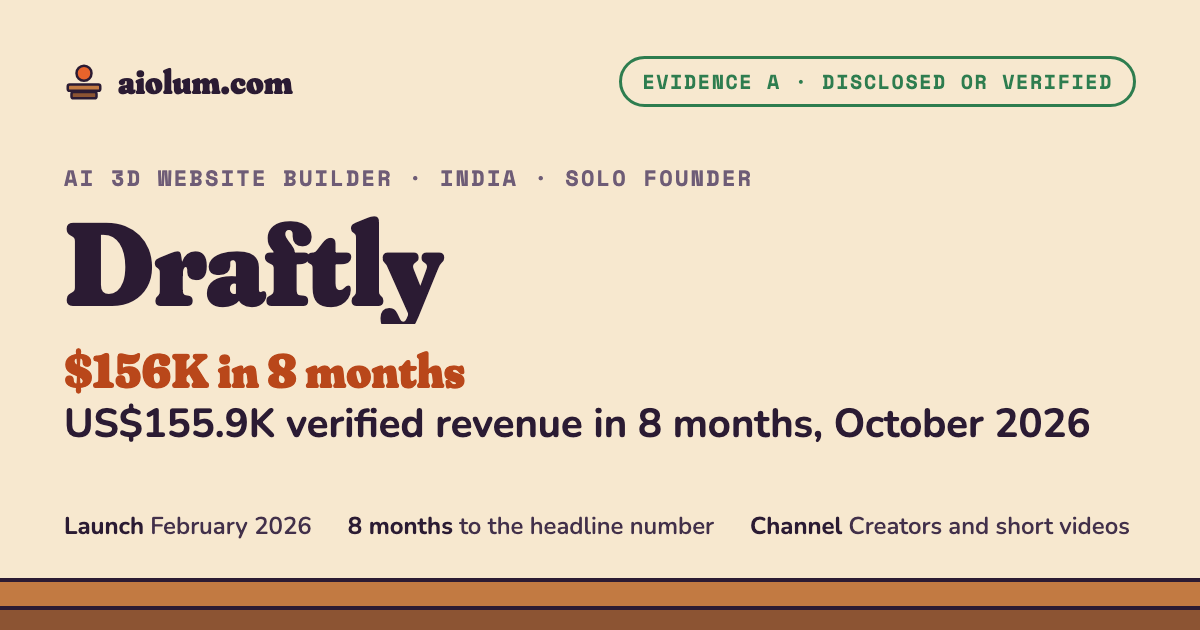
Draftly (AI 3D website builder, India): US$155.9K verified revenue in 8 months, October 2026. Evidence grade A: disclosed by a company or a filing, or verified by a payment processor. Team: 1 founder, a student; the site credits a Mumbai agency with management and marketing. Launched February 2026; still running, revenue falling.Added 25 October 2026
- Outcome
- US$155.9K verified revenue in 8 months, October 2026Revenue falling
- Evidence
- A disclosed by a company or a filing, or verified by a payment processor
- Launch
- February 2026
- Status
- Still running
- Team
- 1 founder, a student; the site credits a Mumbai agency with management and marketing
- Outside funding
- None (bootstrapped)
- Main channel
- Creators and short videos
Draftly is a web app that builds scroll-driven websites from one text prompt. A scroll-driven website changes as the visitor scrolls: here, the page plays a short video forward frame by frame, so a car or a planet seems to move in 3D. Draftly makes the video with Google's Veo 3.1 model and cuts it into about 200 still frames. No 3D engine such as WebGL runs in the browser. The company's own pages credit one founder, Piyush Singh. A case study by Dodo Payments describes him as a third-year engineering student in Surat, India.
Revenue is verified. TrustMRR, a site that reads revenue directly from a startup's payment provider, shows US$155,858 in payments from February 2026 to 25 October 2026, read from Dodo Payments. Part of that is recurring revenue, money from subscriptions that renew every month or year. TrustMRR measured it as US$22,472 of monthly recurring revenue (MRR) on 29 September 2026 and US$12,545 on 25 October 2026. The rest includes one-time payments: lifetime deals, a single payment that gives a monthly credit allowance with no renewals, plus credit top-ups. TrustMRR does not label each payment, but two single days, 17 September and 17 October 2026, brought US$31,208, or 20% of all revenue. Dodo Payments published on 31 May 2026, before the lifetime offer appeared on the pricing page, that Draftly had scaled to US$25,000 in monthly recurring revenue with 700 paying customers.
This page grades every number by its evidence and separates recurring from one-time money where the sources allow it. The trend is down: recurring revenue fell 44% in the four weeks to 25 October 2026, and the business was listed for sale on TrustMRR on 19 September 2026. The page also shows five failed startups that tried to make web design automatic or website animation smooth before video models existed.
How much revenue does Draftly make?
Each row shows the evidence grade and the source numbers from the list at the end of this page. The grades are explained in How Aiolum verifies.
| Fact | Value | Grade | How we know | Sources |
|---|---|---|---|---|
| Verified revenue, February to 25 October 2026 | US$155,858 | A | TrustMRR, read from Dodo Payments through an API key. The last-12-months figure equals the all-time figure because the first payments came in February 2026. It includes recurring and one-time payments. | [1] |
| Monthly recurring revenue, 25 October 2026 | US$12,545 | A | TrustMRR snapshot, with 381 active subscriptions. This is the recurring part of the revenue. | [1] |
| Monthly recurring revenue, 29 September 2026 | US$22,472 | A | Archived copy of the TrustMRR profile, with 667 active subscriptions. | [2] |
| Change in recurring revenue, 29 September to 25 October 2026 | minus 44% | calc | Calculated: 12,545 divided by 22,472 is 0.558. Active subscriptions fell from 667 to 381, minus 43%. | [1, 2] |
| Monthly recurring revenue, May 2026 | US$25,000 | A | Dodo Payments case study, published 31 May 2026: "Draftly scaled to $25,000 in monthly recurring revenue". No lifetime deal was on the pricing page then. | [3, 11] |
| Paying customers, May 2026 | 700 | A | Dodo Payments case study. The contact page said "Serving 1,000+ creators worldwide" in October 2026 (grade C). | [3, 7] |
| Verified revenue by month, March to August 2026 | US$18,842; 29,042; 23,964; 17,145; 13,295; 9,364 | A | TrustMRR monthly timeline. April 2026 is the highest month before the lifetime offer. August is 68% below April (calculated). | [1] |
| Verified revenue, September 2026 | US$29,924 | A | TrustMRR monthly timeline. One day, 17 September, brought US$22,715 of it. | [1, 2] |
| Share of September from one day | 76% | calc | Calculated: 22,715 divided by 29,924. The other 28 days of 1 to 29 September averaged about US$248 a day. | [2] |
| Verified revenue, 17 October 2026 | US$8,493 | A | TrustMRR daily table. It is 57% of the US$14,816 of the last 30 days (calculated). Without that day, the last 30 days brought US$6,323. | [1] |
| Revenue on the two largest days | US$31,208, 20% of all revenue | calc | Calculated: 22,715 plus 8,493, divided by 155,858. TrustMRR does not say which plan each payment bought. Lifetime deals, yearly plans and credit packs are all possible. | [1, 2] |
| First month with revenue | February 2026, US$149 | A | TrustMRR monthly timeline. The founder told Dodo Payments that before Dodo he had "literally zero paying customers". | [1, 3] |
| Team size | 1 person | C | TrustMRR listing, written by the founder. Dodo Payments calls him "a solo founder in college". The about page credits TechInfinity, a Mumbai digital agency, with "Managed & Marketed". | [1, 3, 6] |
| Outside funding | none | C | TrustMRR listing: "Funding: Bootstrapped". | [1] |
| Monthly visitors after a viral post | from 30,000 to 170,000 | B | Dodo Payments case study, figures from the founder. It also reports an Instagram post with 1.6 million views and 65,000 signups. The study calls this 4.5x growth; 170,000 divided by 30,000 is 5.7. | [3] |
| Profit margin, last 30 days to 25 October 2026 | 80% | C | TrustMRR snapshot. The cost side is not listed as verified. | [1] |
| Asking price on TrustMRR | US$870,000 | C | Listed for sale since 19 September 2026, 7 offers by 25 October 2026. A seller's price, not a sale. | [1, 2] |
| Asking price compared with revenue | 5.6 times the verified revenue to date | calc | Calculated: 870,000 divided by 155,858. TrustMRR shows 4.9x, computed on 12 times the last 30 days of revenue. | [1] |
| Basic plan price | US$25 a month | C | Pricing page; US$20 a month billed yearly. | [4] |
| Time from first revenue to the figure above | 8 months | calc | Calculated: February 2026 to October 2026. | [1] |
How to read this table: a grade A value was read by TrustMRR from the payment provider, or published by Dodo Payments, the payment provider itself. A grade B value is a supplier's description. A grade C value comes from the company's own pages or a founder-written listing. A "calc" value was computed on this page from the rows above it.
| Plan | Per month, billed yearly (US$) | Per month, billed monthly (US$) | Limit |
|---|---|---|---|
| Free trial | 0 | 0 | 1 complete build, 2 days, card required |
| Basic | 20 | 25 | 1,500 credits a month, about 3 full sites |
| Basic Plus | 32 | 40 | 2,500 credits a month, about 5 full sites |
| Pro | 48 | 60 | 6,000 credits a month, about 12 full sites, ZIP export |
| Premium | 160 | 200 | 25,000 credits a month, about 50 full sites, 4K upscale |
| Lifetime Starter, Growth, Pro | one-time | one-time | 650, 1,200 or 2,500 credits a month, no renewals |
| Credit top-up | 20 one-time | 1,000 credits; 3,000 for US$50; 7,000 for US$100 | |
| Enterprise | custom | custom | quote on request |
Credits pay for the AI work: a full first build costs about 593 credits (about 25 for the still image, about 340 for the motion video, about 228 for the site). Every paid plan includes 5 live sites and 25 GB of hosting a month; extra sites cost US$5 a month each. The free trial gives one complete build for two days and needs a card. Lifetime deals were offered as a launch offer at 45% to 70% off, for new customers only, and are not refundable. Archived copies of the pricing page from 15 May and 3 June 2026 show the same four subscription prices and no lifetime deal.
When did Draftly launch, and how did it grow?
From a first payment in February 2026 to a sale listing in September 2026, in 8 months. Each entry carries its grade.
- 31 October 2025CThe earliest archived copy of draftly.space shows a small web app titled draftly-react. [13]
- February 2026AFirst verified payments, US$149. The founder integrates Dodo Payments in one working session with Claude and Cursor; the first test payment goes through the same night. [1, 3]
- March 2026AUS$18,842 of verified revenue in the first full month. [1]
- April 2026AUS$29,042, the highest month before any lifetime deal. [1]
- 15 May 2026CThe pricing page shows four subscription plans at US$25, US$40, US$60 and US$200 a month and no lifetime deal. [11]
- 31 May 2026ADodo Payments publishes a case study: US$25,000 in monthly recurring revenue and 700 paying customers, growth almost entirely from Instagram. [3]
- June to August 2026AMonthly revenue falls each month, to US$9,364 in August. [1]
- 17 September 2026AOne day brings US$22,715, 76% of the month. [2]
- 19 September 2026CDraftly is listed for sale on TrustMRR with an asking price of US$870,000. [1, 2]
- 29 September 2026AMonthly recurring revenue US$22,472 with 667 active subscriptions. [2]
- 17 October 2026AOne day brings US$8,493, 57% of the last 30 days. [1]
- 25 October 2026AMonthly recurring revenue US$12,545 with 381 active subscriptions. The site shows a "Launch offer: lifetime plans 45–70% off" with a countdown. [1, 5]
Why did Draftly work?
Four causes, in the order they mattered. Each one is a reusable lesson.
A video instead of a 3D engine
A real 3D website needs a 3D artist and code for the browser's graphics engine. Draftly makes an 8-second video and plays its frames as the visitor scrolls, which looks similar. The home page says it plainly: "No WebGL, no Three.js, no code". Rented video models made this cheap enough to sell at US$25 a month.
Short videos as the sales channel
The product is visual, so a short screen recording explains it. The Dodo Payments case study says the founder grew the Instagram account to more than 30,000 followers by posting often, and that one creator with 750,000 followers shared it, which sent about 170,000 visits and 65,000 signups.
Credits as the unit of price
Each plan is a monthly pool of credits, and each AI step has a credit cost: the video costs the most, about 340 of the 593 credits of a first build. So the customer pays for each AI step that the founder pays a model provider for, and a heavy user buys more credits instead of costing more on a flat plan.
Global payments without a company abroad
Most customers were in the US, Germany and the UK, while the founder was a student in India. Dodo Payments collected the payments and handled sales tax in other countries. The founder told Dodo that he had not known about tax compliance before.
How it was built
These details come from the company's about page and documentation (grade C) and from the Dodo Payments case study (grade B). [3, 6, 9, 10, 14, 15]
- Next.js 14 for the web app and Firebase as the backend, according to the about page, which also lists Gemini 2.5 as the AI engine.
- Veo 3.1 from Google makes the motion video for every site. The documentation says about 200 WebP frames are then extracted at 25 frames per second, adjustable from 10 to 40, and loaded as the visitor scrolls.
- Still images come from several rented models: Seedream 4.5 through fal, Gemini 2.5 Flash Image and Gemini 3.1 Flash Image, and on higher plans Flux and Kling. Clip extension uses LTX 2.3 Fast through fal.ai, and upscaling uses Topaz.
- Payments and subscriptions run on Dodo Payments, integrated in one session with Claude, Cursor and Dodo's documentation.
- Search content at scale: the sitemap lists 2,250 addresses, 1,840 of them blog posts: 573 in an industry section and 240 in an India section, among others.
- An affiliate program pays 10% on every paying referral, with payouts by PayPal, UPI or bank.
Tools named in the sources
Each one opens its page in the Tools tab, with every story that uses it.
Who tried this before Draftly, and why did they fail?
Five companies in the Loot Drop database tried to make web design automatic or website animation smooth before video models existed. The values below are from that database and are not independently verified.
The Grid
The promiseWebsites designed by AI, without paying a designer.
Why it diedThe AI of the time produced designs below what a person or a template from Wix or Squarespace gave, and the platform could not deliver consistent quality.
Famo.us
The promiseA JavaScript framework for smooth, app-like animation in the browser.
Why it diedIts own rendering engine had to be updated for every browser change, and React won developers with a simpler model and a larger community.
Sosh
The promiseA drag-and-drop website builder that removes the handoff from designer to developer.
Why it diedIt was too complex for beginners and too limited for professionals, and the code it produced was hard to work with.
WebCake
The promiseAn all-in-one website maker for people without technical skills.
Why it diedWix and Squarespace offered more templates and features, and WebCake had no money to build something different.
NudgePad
The promiseA visual editor where designers and clients build a website together in real time.
Why it diedWix and WordPress offered more complete products with larger ecosystems, and NudgePad could not show why a customer should switch.
The failed startups come from Loot Drop, a free database of dead startups, retold here in our own words. Loot Drop describes its entries as AI-assisted summaries of public sources, so these cards carry no evidence grade.
What changed
Before video models, a website with film-like motion needed an animation engine and a designer. Famo.us spent US$31 million on such an engine and lost to simpler tools. The Grid tried to replace the designer with AI in 2014, and its designs were worse than templates. The Dodo Payments case study puts the price of a designed 3D website at US$5,000 to US$10,000.
By 2026, a model such as Veo 3.1 makes an 8-second cinematic clip from one still image, and a browser can play the frames of that clip as the visitor scrolls. That removes both the engine and most of the design work. One student assembled the pipeline from rented models and sold it from US$25 a month. What did not change is the old lesson of WebCake and NudgePad: when the effect is easy to copy, the larger website builders can add it.
Can one person copy Draftly now?
The technique, yes. The revenue pattern, with care.
Video frames played on scroll are a known web technique, and every step uses a model anyone can rent, so competitors can copy the product quickly. The revenue also shows a pattern to avoid: fast growth from one viral wave, then a fall, then one-time lifetime sales that make single months look large while recurring revenue drops.
Where it is still open: The same video-to-scroll method fits narrow markets that need product pages with motion: car dealers, real-estate developers, consumer hardware launches. A version that connects to an existing store or site builder, instead of hosting its own sites, is also open.
- 1Find an effect that used to need an agency and that a new model can now produce in one step.
- 2Wrap the model in a fixed pipeline (still image, video, frames, page) so the customer gives one prompt, not ten.
- 3Price in credits that follow the model costs, with the most expensive step clearly priced.
- 4Show the result in short videos, because a visual product sells itself on Instagram and TikTok.
- 5Report recurring and one-time revenue separately, to buyers and to yourself.
What could go wrong for Draftly?
The risks are the mirror image of the causes above.
One-time payments inside the monthly totals
Lifetime deals, credit top-ups and bandwidth packs are one-time payments, and yearly plans are paid in advance. TrustMRR shows only totals, but two days, 17 September (US$22,715) and 17 October 2026 (US$8,493), made 20% of all revenue. Outside those days, payments averaged about US$240 a day in September and October. The recurring part is the MRR figure: US$12,545 on 25 October 2026.
Recurring revenue is falling
MRR fell from US$22,472 on 29 September to US$12,545 on 25 October 2026, and active subscriptions from 667 to 381. Monthly revenue had already fallen from US$29,042 in April to US$9,364 in August. The Dodo case study credits one viral Instagram post with most of the early traffic.
Listed for sale
Draftly was listed for sale on TrustMRR on 19 September 2026, two days after its largest day, at US$870,000. A buyer would also take over the lifetime customers, who receive monthly credits "for as long as Draftly offers the plan" with no further payment, while each build calls paid video and image models.
Numbers that do not agree
The daily payments outside the two large days add up to about US$7,000 a month, well below the MRR figures; TrustMRR does not publish how it computes MRR, and yearly plans paid earlier are one possible reason. The Dodo study calls a rise from 30,000 to 170,000 visitors 4.5x growth; it is 5.7x. The study says Dodo acts as merchant of record; the TrustMRR profile says "Merchant of record: No".
Who does the work
TrustMRR lists a team of one, and Dodo calls the founder a solo founder in college. The about and contact pages also credit TechInfinity, a Mumbai digital agency, with "Managed & Marketed". How much of the marketing the agency does is not stated. The customer quotes on the home page could not be verified.
Easy to copy
The method uses public models (Veo, Gemini, Seedream, Flux) and a known browser technique. Large website builders can add a video-to-scroll section, as Wix and Squarespace outlasted WebCake and NudgePad.
Sources
The grade next to each source is the best grade that the source can support. "Read in full" means that the text of the page was downloaded and the numbers were checked in it.
- A TrustMRR, Draftly (draftly.space) markdown profile, synced 25 October 2026Read the markdown profile, live, on 25 October 2026. The revenue, MRR and subscription figures are read by TrustMRR from Dodo Payments through an API key (grade A); team, funding, profit and the sale listing are founder-written (grade C).
- A TrustMRR, Draftly markdown profile as archived on 29 September 2026Read the markdown profile in full from the Wayback Machine. Source for the MRR and subscriptions on 29 September 2026 and the daily payments of September.
- A Dodo Payments case study, 31 May 2026: How Draftly went from zero paying customers to $25K MRR with Dodo PaymentsRead in full. Dodo Payments is Draftly's payment provider. Source for the May 2026 MRR and customer count (grade A) and for the founder's story, traffic and tools (grade B).
- C Draftly pricing page, read 25 October 2026Read in full, including the questions section on lifetime deals. The lifetime prices load from the company's server, which robots.txt closes to crawlers, so they are not given.
- C Draftly home page, read 25 October 2026Read in full. Source for the product description, the lifetime launch banner and the purpose check.
- C Draftly about pageRead in full. Names the founder, the technology stack and the agency credited with management and marketing.
- C Draftly contact pageRead in full. Links the founder to the X handle that the TrustMRR profile also shows.
- C Draftly terms of service, last updated 22 October 2026Read the sections on refunds, lifetime deals and governing law (India). The terms name the operator only as Draftly.
- C Draftly documentation: video generationRead in full. Source for Veo 3.1, the frame extraction and the clip extension model.
- C Draftly documentation: image generationRead the model table.
- C Draftly pricing page as archived on 15 May 2026Read in full from the Wayback Machine. Four subscription plans, no lifetime deal.
- C Draftly pricing page as archived on 3 June 2026Read in full from the Wayback Machine. Same plans, no lifetime deal.
- C Draftly home page as archived on 31 October 2025Read the page shell only; the content loads by script. Shows that the site existed in October 2025.
- C Draftly sitemap, read 25 October 2026Counted the addresses: 2,250, of which 1,840 are blog posts.
- C Draftly affiliate program pageRead in full. Source for the 10% commission; no income promises seen.
- C TrustMRR, a different startup also named Draftly (draftly.live)Read the markdown profile only to rule out a mix-up. It is a separate product by a different founder in France; none of its figures are used on this page.
- C Loot Drop database export, 1,749 failed startupsLocal export. AI-written summaries, not independently verified. Source for the failed predecessors.