Presentia AI: Revenue, team and how it was built
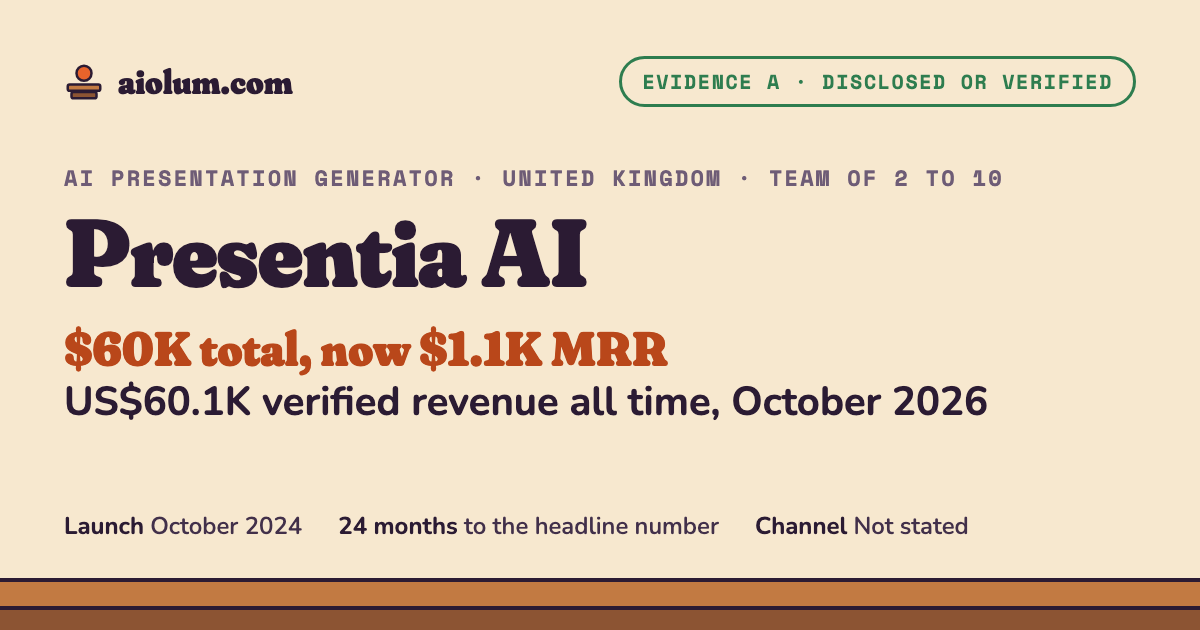
Presentia AI (AI presentation generator, United Kingdom): US$60.1K verified revenue all time, October 2026. Evidence grade A: disclosed by a company or a filing, or verified by a payment processor. Team: 2 co-founders plus an AI engineer and an SEO lead on the about page, October 2026; TrustMRR names one founder. Launched October 2024; still running, revenue falling.Added 25 October 2026
- Outcome
- US$60.1K verified revenue all time, October 2026Revenue falling
- Evidence
- A disclosed by a company or a filing, or verified by a payment processor
- Launch
- October 2024
- Status
- Still running
- Team
- 2 co-founders plus an AI engineer and an SEO lead on the about page, October 2026; TrustMRR names one founder
- Outside funding
- None reported; the company's AppSumo profile says bootstrapped
- Main channel
- Not stated
Presentia AI is a web application that turns a topic or a document into a PowerPoint presentation. A language model writes the slide text and structure, and an image model, an AI model that draws a picture from a text description, makes one picture for each slide. The user can then edit the deck in the browser and download it as a .pptx file. The company's terms are governed by the law of England and Wales, and TrustMRR lists the country as the United Kingdom.
The money figures on this page come from TrustMRR, a site that connects to a startup's payment account and publishes the revenue it reads there. Here the connection is a Stripe API key, a read credential for the Stripe payment account. On 25 October 2026 TrustMRR showed US$60,120 of revenue all time and US$26,792 in the last 12 months. The best month in the public table is November 2025, with US$4,126. Every month after it is lower: US$856 in September 2026, a fall of 79%. Monthly recurring revenue (MRR), the subscription revenue that repeats every month, was US$1,136 from 162 active subscriptions.
The founder named on TrustMRR is Jorge Alexander. The company's about page lists him and Khadin Akbar as co-founders, with a lead AI engineer and an SEO lead. Since 14 December 2025 the business has been listed for sale on TrustMRR at US$30,000. This page grades each number by its evidence and shows four failed startups that tried to automate or improve the making of presentations and visual stories before language models existed.
How much revenue does Presentia AI make?
Each row shows the evidence grade and the source numbers from the list at the end of this page. The grades are explained in How Aiolum verifies.
| Fact | Value | Grade | How we know | Sources |
|---|---|---|---|---|
| Verified revenue all time, to 25 October 2026 | US$60,120 | A | Read from the Stripe account by TrustMRR through an API key, last synced 25 October 2026. It is the sum of all payments, not a yearly rate and not profit. | [1] |
| Verified revenue in the last 12 months, to 25 October 2026 | US$26,792 | A | [1] | |
| Revenue before the last 12 months | US$33,328 | calc | Calculated: 60,120 minus 26,792. This money was paid before late October 2025. The public profile does not show those months, so the best month of the business may lie in that period. | [1] |
| Best month in the public table, November 2025 | US$4,126 | A | The public profile shows only the 12 months from November 2025 to October 2026. | [1] |
| Revenue, May 2026 | US$1,684 | A | Down from US$2,589 in April 2026, the largest drop between two months in the table. | [1] |
| Revenue, September 2026 | US$856 | A | [1] | |
| Fall from November 2025 to September 2026 | 79% | calc | Calculated: (856 minus 4,126) divided by 4,126 equals minus 0.79. | [1] |
| Revenue, 1 to 25 October 2026 | US$634 | A | A partial month. | [1] |
| Revenue in the last 30 days, to 25 October 2026 | US$729 | A | TrustMRR shows minus 17.9% against the 30 days before. | [1] |
| Monthly recurring revenue, 25 October 2026 | US$1,136 | A | TrustMRR shows minus 15.8% in the last 30 days. | [1] |
| Active subscriptions, 25 October 2026 | 162 | A | [1] | |
| Average MRR per active subscription | about US$7.01 | calc | Calculated: 1,136 divided by 162. It is below the US$9.99 Starter price, which suggests that some subscribers pay older, lower prices or yearly plans; that reading is not verified. | [1, 2] |
| Visitors in the last 30 days | 3,176 | B | From the Google Analytics account connected to TrustMRR. An analytics figure, not a payment figure. | [1] |
| Profit margin in the last 30 days | 80% | C | Shown in the TrustMRR snapshot. It is not part of the Stripe data, so it is treated as a founder figure. | [1] |
| Asking price on TrustMRR | US$30,000 | C | Set by the founder; first listed 14 December 2025; 7 offers received by 25 October 2026. TrustMRR states a revenue multiple of 3.4x. Calculated check: 30,000 divided by (729 times 12) equals 3.43. | [1] |
| People listed on the about page, October 2026 | 4 | C | Two co-founders (Jorge Alexander, product advisor; Khadin Akbar, sales and marketing), a lead AI engineer and an SEO and growth lead. The page does not say who works full time. The AppSumo company profile gives 1 to 10 employees. | [3, 6] |
| Outside funding | none reported | C | The company profile on AppSumo says bootstrapped. No source mentions an investor. | [6] |
| Domain presentia.ai registered | 3 October 2024 | B | Creation date in the registry record. The first archived copy of the site is from 6 October 2024. | [12, 7] |
| Founding date given by the company | 26 November 2021 on TrustMRR; 1 June 2025 on AppSumo | C | The two profiles disagree with each other and with the domain date. This page uses the first archived copy, October 2024, as the launch. | [1, 6] |
| Presentations generated, company claim | over 100 (October 2024); over 61,400 (April to November 2025) | C | Counters on the home page. The 61.4k figure did not change between April and November 2025. | [7, 8, 11] |
| Time from launch to the all-time figure | 24 months | calc | Calculated: October 2024 to October 2026. | [1, 7] |
How to read this table: a grade A value was read from the Stripe account by TrustMRR. A grade B value comes from an independent record, such as the domain registry, a marketplace's deal data or a connected analytics account. A grade C value is stated by the company or the founder. A "calc" value was computed on this page from the rows above it.
| Plan | Per month, billed yearly (US$) | Per month, billed monthly (US$) | Limit |
|---|---|---|---|
| Starter | 9.99 | up to 50 slides a month | |
| Pro | 20 | up to 110 slides a month | |
| Max Yearly | 16.58 | up to 1,500 slides a year, priority support, commercial use | |
| AppSumo License Tier 1 (ended) | 49 one-time | 25 credits a month plus 300 one-time credits | |
| AppSumo License Tier 2 (ended) | 99 one-time | 50 credits a month plus 800 one-time credits | |
| AppSumo License Tier 3 (ended) | 149 one-time | 100 credits a month plus 1,500 one-time credits |
The site has no separate pricing page; the plans are shown on the home page. Starter and Pro have a 7-day free trial. Pro is shown as reduced from US$29 and Max Yearly as reduced from US$600. Only Max Yearly lists commercial use. Extra credits can be bought at any time. One credit is one slide with standard images and two credits are one slide with premium images, according to the founder's note on AppSumo. Calculated: Max Yearly at US$199 a year is US$16.58 a month. Earlier prices from archived copies of the home page: unlimited decks for US$9.99 a month, US$29.99 a year or US$99.99 one time (October 2024 and April 2025); Basic US$4.99, Pro US$9.99 and Business US$49.99 a month with slide limits (September 2025); Pro US$9.99 a month and Max Yearly US$199 (23 October 2025); Pro US$20 a month (11 November 2025).
When did Presentia AI launch, and how did it grow?
From a new domain in October 2024 to a business listed for sale, in 24 months. Each entry carries its grade.
- 3 October 2024BThe domain presentia.ai is registered. [12]
- 6 October 2024CFirst archived copy of the site: a PowerPoint generator with unlimited decks for US$9.99 a month, US$29.99 a year or US$99.99 one time, and a counter of over 100 presentations generated. [7]
- 16 April 2025CSame unlimited prices. The counter shows over 61,400 presentations generated. [8]
- 2 September 2025CUnlimited use is gone. The plans now cap slides: Basic US$4.99 for 50 slides, Pro US$9.99 for 110 slides and Business US$49.99 for 600 slides a month, with AI-generated images. [9]
- 23 to 25 October 2025CThe home page shows Pro at US$9.99 a month and a new Max Yearly plan at US$199 for 1,500 slides. The terms, revised on 25 October 2025, allow usage caps on lifetime plans because AI images "incur variable costs". [10, 4]
- 11 November 2025CPro costs US$20 a month. Refunds are now limited to subscribers who have not yet created a presentation. [11]
- November 2025AUS$4,126 of verified revenue, the best month in the public 12-month table. [1]
- 14 December 2025AThe founder lists the business for sale on TrustMRR at US$30,000, with the message "Looking to sell for a cash injection to be able to prioritise other startups." [1]
- February 2026CThe company's blog describes the current workflow: choose a template, a theme and an image model, including Nano Banana Pro, then refine in an edit mode and export. [13]
- May 2026AVerified revenue drops to US$1,684 from US$2,589 in April. [1]
- 27 July to 22 September 2026BA lifetime deal named Presentia Slides runs on AppSumo at US$49, US$99 and US$149, and is marked sold out. [6]
- 25 October 2026AUS$60,120 verified revenue all time, MRR of US$1,136 from 162 subscriptions, and US$634 in the first 25 days of October. [1]
Why did Presentia AI work?
Four causes, in the order they mattered. Each one is a reusable lesson.
One input, one finished file
The product does one job: it turns a topic, an outline or an uploaded document into a downloadable PowerPoint file with a picture on every slide. The company's site has 22 landing pages, most of them for one input type, such as PDF to PPT, Word to PPT, YouTube to PPT and lesson plan to PPT, and one page in Hindi written in Latin letters. No source says how many customers came through these pages, so the channel on this page is unknown.
A low price, then credits
From October 2024 to at least April 2025 the archived home page offered unlimited decks for US$9.99 a month or US$99.99 one time. Each picture costs the company money at the image model provider, and the refund rule on the current home page says that "costs incurred for generative AI are extremely high". By September 2025 the plans counted slides, and in November 2025 the most popular plan cost US$20 a month. The public figures start in November 2025, so they cannot show how revenue moved before and after the change.
A falling subscription base
The verified monthly revenue fell in 10 of the 11 steps from November 2025 to October 2026. The current MRR of US$1,136 is far below the US$4,126 collected in November 2025, so the remaining subscribers pay much less in total than the customers of a year earlier.
A lifetime deal on a marketplace
From July to September 2026 the company sold lifetime licenses on AppSumo, a marketplace for one-time software deals, and the deal was marked sold out. AppSumo collects that money itself, so it is probably not in the Stripe figures; this page could not verify whether it is.
How it was built
These details come from the company's own pages, its blog, the AppSumo listing and the public page source. They are grade C unless marked. [3, 2, 13, 6, 1, 5, 17]
- The about page says the product is built with Next.js, TypeScript and Google Cloud AI services.
- Images come from a choice of image models. The home page offers a Nano Banana model in its generator, and the blog of February 2026 describes Nano Banana Pro as the model for charts, diagrams and infographics. Nano Banana is the name of Google's Gemini image models.
- Credits are counted per slide: 1 credit for a slide with standard images and 2 credits with premium images, according to the founder's note on AppSumo.
- The home page says that exported PowerPoint slides are high-resolution graphics, so they look the same on every computer, and that an export with editable text is on the roadmap. The AppSumo listing describes the exports as fully editable .pptx files. The two pages disagree.
- Payments run through Stripe (grade A, from the TrustMRR connection). The privacy policy names Stripe, and Google Analytics or Plausible for analytics; the page source loads the Plausible script (grade B).
- An affiliate program pays 20% commission on each paid subscription; the page source loads the script of Tolt, an affiliate tracking service (grade B).
Tools named in the sources
Each one opens its page in the Tools tab, with every story that uses it.
Who tried this before Presentia AI, and why did they fail?
Four companies in the Loot Drop database tried to change how people make presentations or visual stories, before language and image models could write and draw the content. The values below are from that database and are not independently verified.
LiveLoop
The promiseReal-time collaboration on PowerPoint files, so a team edits one shared deck instead of mailing versions.
Why it diedMicrosoft bought it in 2015 and built the same features into Office. Its dependence on PowerPoint limited it to people who already used Microsoft's tools.
Qwiki
The promiseAutomatically generated, narrated multimedia presentations for any search topic, made from images, video and voice.
Why it diedThe generation was expensive to run, users kept reading text results, and it had no lasting revenue model. Yahoo bought it in 2013 and later shut it down.
Lightwell
The promiseA no-code tool for designers to build interactive stories without developers.
Why it diedAdobe and Canva already offered complete design environments, and Lightwell did not grow beyond a small group of early users.
WebCake
The promiseAn all-in-one tool for small businesses to design and publish websites without technical skills.
Why it diedWix and Squarespace offered more templates and features, and WebCake raised no money after its seed round.
The failed startups come from Loot Drop, a free database of dead startups, retold here in our own words. Loot Drop describes its entries as AI-assisted summaries of public sources, so these cards carry no evidence grade.
What changed
Before 2023, a tool could help with the layout of slides, but a person still had to write the words and find the pictures. Qwiki tried to generate whole presentations automatically from 2010, and the Loot Drop record says the generation was too expensive to run and found no lasting revenue. LiveLoop, Lightwell and WebCake made the editing easier, but competed with Microsoft, Adobe, Canva, Wix and Squarespace, which had more features.
Rented language and image models removed the writing and the picture search. Presentia AI is a thin product on top of them: an input box, templates, a browser editor and a PowerPoint export, built by a team of four people or fewer. The same low cost of entry lets many others build the same product; the company's own blog compares it with Gamma, Canva, Beautiful.ai, Tome, Prezi and seven other presentation tools. The cost of the models also stayed: each generated picture is paid for, which is why the plans moved from unlimited use to slide credits.
Can one person copy Presentia AI now?
The product, not easily. The cost lesson, yes.
An AI presentation generator is one of the most crowded AI product types, and Presentia AI's verified revenue has fallen by 79% in ten months. What a reader can take from it is the unit cost problem: when each output calls a paid image model, an unlimited plan at US$9.99 a month carries a risk, and changing the plans later is visible to every customer.
Where it is still open: Generators for one kind of deck with its own data are less crowded than general slide makers, for example decks built from a company's sales figures, or lesson decks that follow one country's school curriculum. A real editable-text PowerPoint export is still a gap: Presentia's own home page lists it as a roadmap item.
- 1Price by the unit that costs you money (here: slides with images) from the first day, instead of moving from unlimited plans to credits later.
- 2Make one landing page for each input that people search for (PDF to slides, Word to slides, lesson plan to slides).
- 3Connect the payment account to a public revenue profile, so a buyer can check the numbers if you sell.
- 4Read the monthly figures as a trend: the verified table shows the fall month by month, long before the total stops growing.
What could go wrong for Presentia AI?
The risks are the mirror image of the causes above.
Revenue is falling
Verified monthly revenue went from US$4,126 in November 2025 to US$856 in September 2026, and MRR was US$1,136 on 25 October 2026. The all-time total of US$60,120 grows by only about US$700 a month now.
The business is for sale
The founder listed it on TrustMRR on 14 December 2025 at US$30,000 and wrote that he wants to prioritise other startups. A new owner may change the product, the prices and the team.
Founding dates that do not agree
TrustMRR gives 26 November 2021, AppSumo gives 1 June 2025, and the domain was registered on 3 October 2024. If the Stripe account is older than this product, the all-time total could include payments for something else. The public profile does not show the months before November 2025, so this page could not check it.
Export format
The home page says exported slides are images and that editable text is a roadmap item; the AppSumo listing says the exports are fully editable. A buyer of the product should test the export before paying.
Students as a target
The home page lists "Educators & Students" and "thesis defense decks", and the research paper page says "Students : Defend your thesis with confidence." The product turns a user's own paper or notes into slides; none of the pages read for this story sells essay writing or homework answers.
Team size
TrustMRR names one founder, the about page shows four people, and AppSumo gives 1 to 10 employees. No source says how many of them work full time on Presentia AI.
Sources
The grade next to each source is the best grade that the source can support. "Read in full" means that the text of the page was downloaded and the numbers were checked in it.
- A TrustMRR profile of Presentia AI, revenue read from Stripe by API keyRead the markdown profile on 25 October 2026 (revenue last synced 25 October 2026 at 20:36 UTC). It matched a copy downloaded earlier the same day. The revenue, monthly table, MRR and subscription figures come from the Stripe account; the visitor figure comes from the connected Google Analytics account. The founding date, profit margin, description and sale listing are written by the founder and are grade C.
- C Presentia AI home page with the pricing panel, read 25 October 2026Read in full. Source for the product description, the current plans and prices, the refund rule, the export format and the use cases. Compared with a copy downloaded earlier the same day; the text was the same.
- C Presentia AI, About Us pageRead in full. Source for the team list and the technology stack.
- C Presentia AI, Terms and Conditions, last revised 25 October 2025Read in full. Source for the governing law, the usage limits and the lifetime-plan caps. No company number or street address is given.
- C Presentia AI, Privacy Policy, last revised 25 October 2025Read in full. Source for the payment and analytics providers it names.
- B AppSumo deal page: Presentia SlidesRead in full, including the deal data in the page source (start 27 July 2026, end 22 September 2026). The deal tiers and dates are AppSumo's data (grade B). The company profile (founding date, employee range, bootstrapped) and the founder's message about credits are written by the company (grade C).
- C Wayback Machine copy of presentia.ai, 6 October 2024Read in full. First archived copy. Source for the first prices and the counter of over 100 presentations.
- C Wayback Machine copy of presentia.ai, 16 April 2025Read in full. Source for the unlimited plans and the counter of over 61,400 presentations.
- C Wayback Machine copy of presentia.ai, 2 September 2025Read in full. Source for the first slide-limited plans.
- C Wayback Machine copy of presentia.ai, 23 October 2025Read in full. Source for the Pro and Max Yearly plans before the price rise.
- C Wayback Machine copy of presentia.ai, 11 November 2025Read in full. Source for the US$20 Pro plan and the new refund rule.
- B WHOIS registry record for presentia.aiRead the record with the whois command-line tool on 25 October 2026 (registrar Namecheap, creation date 3 October 2024). The link is the public ICANN lookup for the same domain; this page did not read it there.
- C Presentia AI blog, 23 February 2026, updated 2 March 2026: How to Create AI Presentations with Nano Banana ProRead in full. Source for the current workflow and the image model choice.
- C Presentia AI, Convert Research Papers to PowerPoint with AIRead in full for the check of what the product is sold for. Source for the thesis-defense wording.
- C Presentia AI, AI presentation maker for teachersRead in full for the check of what the product is sold for. It is written for teachers who prepare lessons.
- C Loot Drop database export, 1,749 failed startupsLocal export. AI-written summaries, not independently verified. Source for the failed predecessors.
- C Presentia AI, Affiliate Program pageRead in full. Source for the 20% commission. It makes no income promises beyond the commission rate.