QA.tech: Product, team and how it was built
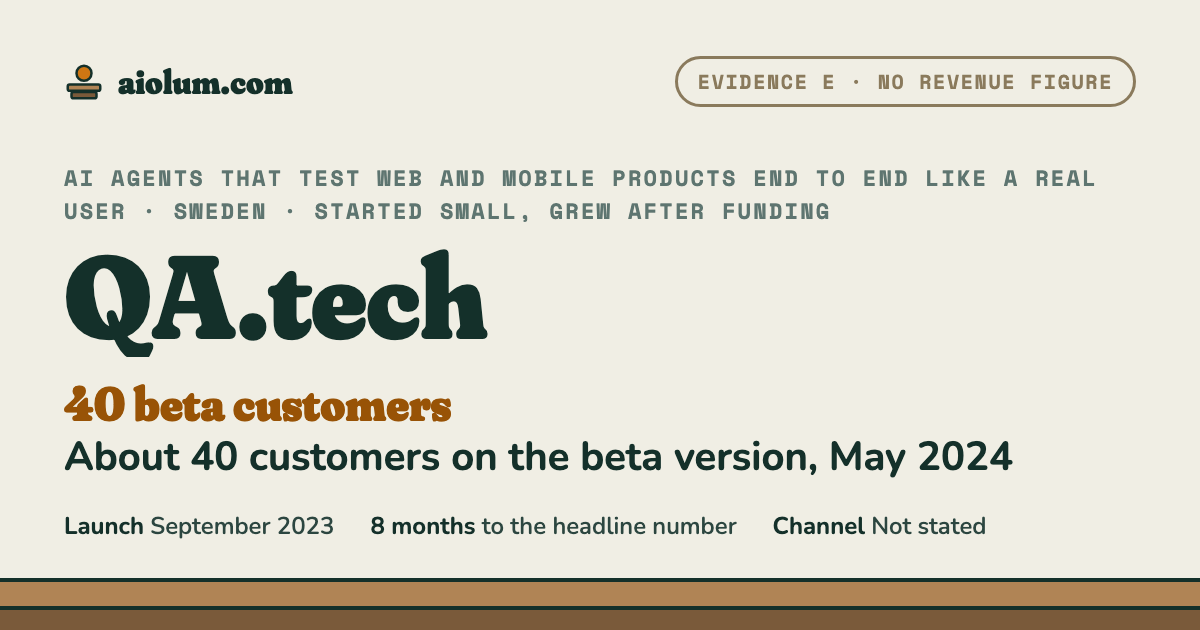
QA.tech (AI agents that test web and mobile products end to end like a real user, Sweden): About 40 customers on the beta version, May 2024. Evidence grade E: no revenue figure was checked. Team: 3 founders at the pre-seed round in September 2023; 11 people in May 2024 after a seed round; headcount today not published. Launched September 2023; still running.Added 5 November 2026 · updated 6 November 2026
- Outcome
- About 40 customers on the beta version, May 2024
- Evidence
- E no revenue figure was checked
- Launch
- September 2023
- Status
- Still running
- Team
- 3 founders at the pre-seed round in September 2023; 11 people in May 2024 after a seed round; headcount today not published
- Outside funding
- Pre-seed of US$1 million (September 2023) and seed of €3 million (May 2024), by the company's press releases
- Main channel
- Not stated
What is not verified
No revenue figure was found. The headline, about 40 customers on the beta version in May 2024, rests on the company's own seed press release and does not say whether those customers paid. No payment-processor profile, company filing or interview with revenue was found; the Swedish company registers allabolag.se and proff.se block ClaudeBot and were not read. A reader could look for QA.tech's annual report (årsredovisning) at Bolagsverket, which states net sales. This story is grade E: the business is real and its product, price and customers are described from public pages, but no revenue figure was checked. Aiolum shows it as an idea worth studying, not as proof that it makes money.
QA.tech sells end-to-end testing, checks that run a whole user flow in a real app (sign up, log in, add an item to the cart) instead of testing one function of the code. Its AI agents, programs that use a language model to decide their next step, crawl the customer's app, write the tests, keep them working when the app changes, and report on each pull request, the request to merge a code change into the main code base.
Daniel Mauno Pettersson founded it in Stockholm in 2023 with Patrick Lef and Marcus Carloni, by the company's press release of 26 September 2023, which announced a pre-seed round of US$1 million led by byFounders and a beta program with about twenty interested customers. In May 2024 the company said it had raised a €3 million seed round led by PROfounders, that the team was eleven people, and that about 40 customers used the beta version.
This is a grade E story: no revenue figure was found. It is on the site under the rule for teams that started small and grew after funding: three founders at the start, more than ten people eight months later.
How much revenue does QA.tech make?
Each row shows the evidence grade and the source numbers from the list at the end of this page. The grades are explained in How Aiolum verifies.
| Fact | Value | Grade | How we know | Sources |
|---|---|---|---|---|
| Customers on the beta version, May 2024 | about 40 | C | Seed press release, 20 May 2024: "About 40 customers are using the company's beta version, including Leya, Upsales, Virtusize, and Shoplab." It does not say whether they paid. | [2] |
| Interested beta customers, September 2023 | about twenty | C | Pre-seed press release, 26 September 2023: "about twenty customers interested in participating in the company's beta program". | [1] |
| Founding team | 3 founders: Daniel Mauno Pettersson, Patrick Lef, Marcus Carloni | C | Pre-seed release, September 2023: Pettersson "founded the company together with Patrick Lef ... and Marcus Carloni". The May 2024 release names Vilhelm von Ehrenheim as a fourth founder; the press room lists his arrival on 10 November 2023. | [1, 2, 8] |
| Team, May 2024 | eleven people | C | Seed release: the funds will "expand the team, which currently consists of eleven people". No later headcount is published; the About page calls it "A small, exceptional team in Stockholm". | [2, 3] |
| Founded | 2023, Stockholm | C | Seed release: "QA.tech was founded in 2023". Techarena's write-up of February 2026 gives the same year. | [2, 6] |
| Pre-seed round, September 2023 | US$1 million, led by byFounders | C | Pre-seed release. The May 2024 release calls the same round "€1 million". | [1, 2] |
| Seed round, May 2024 | €3 million, led by PROfounders with Curiosity and byFounders | C | Seed release, 20 May 2024, "Just six months after the pre-seed round". | [2] |
| Total funding stated today | US$5 million | C | About page, read 5 November 2026: "Backed by $5 million in funding". Undated. The November 2026 release also says the company is "backed by Vercel" without details. | [3, 5] |
| Starter price | US$89 a month | C | Pricing page and press release of 2 November 2026, which launched the free trial and Starter plan. | [4, 5] |
| Named customer stories | Pricer, Airpelago, Upsales, 4C Strategies, Bizbrains, Crystal Intelligence, JOIN and others | C | Case studies page, read 5 November 2026. Each gives the customer's saved testing hours, not money paid to QA.tech. | [7] |
| Time from the September 2023 announcement to the May 2024 count | 8 months | calc | Calculated: September 2023 to May 2024. | [1, 2] |
How to read this table: a grade C value comes from the company's own press releases or pages, or from a third-party write-up that repeats them. A "calc" value was computed on this page. No value is grade A or B, and no revenue figure exists.
| Plan | Per month, billed yearly (US$) | Per month, billed monthly (US$) | Limit |
|---|---|---|---|
| Free Trial | 0 | 0 | 10 credits, 1 application, web and PR testing |
| Starter | 89 | 50 credits a month, up to 5 users, up to 2 applications | |
| Growth | custom | custom | custom credits, up to 50 users |
| Enterprise | custom | custom | custom credits and users, unlimited environments |
Plans are sold in credits: only test runs use credits, and creating and maintaining tests is free, by the pricing page. The page shows no yearly discount. Growth and Enterprise are priced on request and add mobile, API and voice testing; Enterprise adds single sign-on, SLA-backed support and a fine-tuned model option. The company's press release of 2 November 2026 calls the free trial and Starter plan new.
When did QA.tech launch, and how did it grow?
From a three-founder pre-seed round to self-serve paid plans, in about three years. Each entry carries its grade.
- 26 September 2023CThree founders announce a US$1 million pre-seed round led by byFounders for an AI tester that acts like a real user; about twenty companies want to join the beta. [1]
- 10 November 2023CThe AI specialist Vilhelm von Ehrenheim, an investor and adviser in the pre-seed round, joins the company. [8, 1]
- 20 May 2024C€3 million seed round led by PROfounders. The team is eleven people and about 40 customers use the beta version. [2]
- 14 February 2026CNamed among the TOP46 companies of the Techarena 2026 conference in Stockholm. [6]
- 2 November 2026CA free trial and a self-serve Starter plan at US$89 a month open the product to small teams; the company adds mobile, API and voice testing in higher plans. [5, 4]
Why did QA.tech work?
Four causes, in the order they mattered. Each one is a reusable lesson.
Tests that the agent writes and repairs
Script-based tests break when a button moves. QA.tech's agent explores the app, maps its features and rewrites tests when the app changes, so the customer pays for test runs and not for test maintenance, by the pricing page and the November 2026 release.
Testing from the outside
The agent tests the running product, not the source code, so a customer does not need to give repository access or pass a long security review to start, by the pricing page. Code access is optional and adds pull-request reviews.
Venture money to build the team
The founders raised twice in eight months and grew from three to eleven people, by the company's releases. The product was built by a funded team, not by one person.
How it was built
These details come from the company's press releases and pages. They are grade C. [5, 4, 3]
- The agent crawls the app, builds a map of its features, writes tests and runs an initial test before the repository is connected, by the November 2026 release.
- Pull-request testing reports back on GitHub, GitLab and Azure DevOps.
- Tests can be started and read from CI and from coding assistants through an MCP server, an API and a command-line tool.
- Plans mention "Standard model access" and, for Enterprise, a "Fine-tuned model option"; no source names the model provider.
- The company states SOC 2 Type 2 compliance and that customer data is never used to train models.
Tools named in the sources
Each one opens its page in the Tools tab, with every story that uses it.
Who tried this before QA.tech, and why did they fail?
Two companies in our database of failed startups promised to take manual quality checking off people's hands and failed. The values below are from that database and are not independently verified.
Testmunk
The promiseAutomated mobile app testing on real devices, to replace manual test work.
Why it diedBetter-funded competitors and constant operating-system updates that kept breaking the tests.
Movley
The promiseQuality control for manufacturers through human inspectors, reported in real time.
Why it diedIts human inspectors cost more than AI-based checking, and it did not change in time.
The failed startups come from our database of 1,749 dead startups, retold here in our own words. Its entries are AI-assisted summaries of public sources, so these cards carry no evidence grade.
What changed
Testmunk sold automated tests, and its tests broke every time the phone operating systems changed, so its money went into repairs. QA.tech's claim is that a language-model agent rewrites a broken test itself, which removes that repair cost; the sources read do not measure how often that works.
Movley shows the other side: a quality service built on people lost to cheaper automated checking. QA.tech sells exactly that automation to software teams, and its customer stories report hours of manual testing replaced. The open question is price competition, because many funded companies now sell AI testing agents.
Can one person copy QA.tech now?
Not as it was done.
QA.tech was built by three experienced founders and a team of eleven with two venture rounds, and it sells to engineering teams that need security certification. One person could build a narrow testing agent for one kind of app, but not this company's breadth.
Where it is still open: Narrow testing tools for one platform or one kind of flow (payments, sign-up, voice commands), where a general testing agent is weaker.
- 1Pick one repetitive check that teams do by hand, such as checkout flows in online shops.
- 2Let an agent explore the app and write the test, and charge only for runs.
- 3Test from the outside first, so customers can try it without giving code access.
- 4Report results where developers already work: on the pull request.
What could go wrong for QA.tech?
The risks are the mirror image of the causes above.
What is not verified
No revenue figure was found. The headline, about 40 customers on the beta version in May 2024, rests on the company's own seed press release and does not say whether those customers paid. No payment-processor profile, company filing or interview with revenue was found; the Swedish company registers allabolag.se and proff.se block ClaudeBot and were not read. A reader could look for QA.tech's annual report (årsredovisning) at Bolagsverket, which states net sales.
A funded team, not a solo business
Three founders started it, and by May 2024 it had eleven people and €3 million of new venture money, by its own release. Today's headcount is not published. The pre-seed round is called US$1 million in the 2023 release and €1 million in the 2024 release.
Competition
The company's own site links to comparison pages against Cypress, Mabl, Playwright and QA Wolf, and its blog lists 18 agentic QA tools. On this site, Lucent (AI that finds bugs in session replays) and Mendral (an AI agent for failed CI runs) are smaller grade E stories in the same area.
Dependence on model providers
The product runs on language models, and the pricing page mentions "Standard model access" and an Enterprise "Fine-tuned model option", but no source read names the provider. Model prices and quality changes therefore affect the cost per test run in a way the sources do not quantify.
Marketing wording and unlinked logos
The home page calls the product "The verification layer for QA declaring war on AI slop". The home and pricing pages show customer logo rows under "Trusted by high-performing engineering teams at"; the named case studies support some of them.
Sources
The grade next to each source is the best grade that the source can support. "Read in full" means that the text of the page was downloaded and the numbers were checked in it.
- C QA.tech press release, 26 September 2023: QA.tech raises $1 million to eliminate developers' biggest time stealer with AI-based toolRead in full (PDF, downloaded 5 November 2026). Source for the three founders, the pre-seed round and the twenty interested beta customers.
- C QA.tech press release, 20 May 2024: QA.tech raises €3 million: "Provides a glimpse into the future of programming"Read in full (PDF). Source for the founding year, the seed round, the team of eleven and the 40 beta customers.
- C QA.tech: About usRead in full, 5 November 2026. Source for the US$5 million funding statement, the leadership and the Stockholm team.
- C QA.tech: PricingRead in full, 5 November 2026. Source for the plans, credits and model options.
- C QA.tech press release, 2 November 2026: QA.tech brings verification to every engineering team with a free trial and pay-as-you-go pricingRead in full. Source for the self-serve plans and how the agent works.
- C Upnext, 14 February 2026: Techarena 2026: Epiminds Wins + TOP46 StandoutsRead the section on QA.tech. A third-party write-up; its funding line repeats the company's seed figure.
- C QA.tech: Customer storiesRead the list of case studies, 5 November 2026.
- C QA.tech: Press roomRead in full, 5 November 2026. Source for the release dates.
- C Database of failed startups, local exportLocal export. AI-written summaries, not independently verified. Source for the failed predecessors.
Run this company? Send corrections or a verified figure to aiolum@livyden.com