Rankability
What is not verified
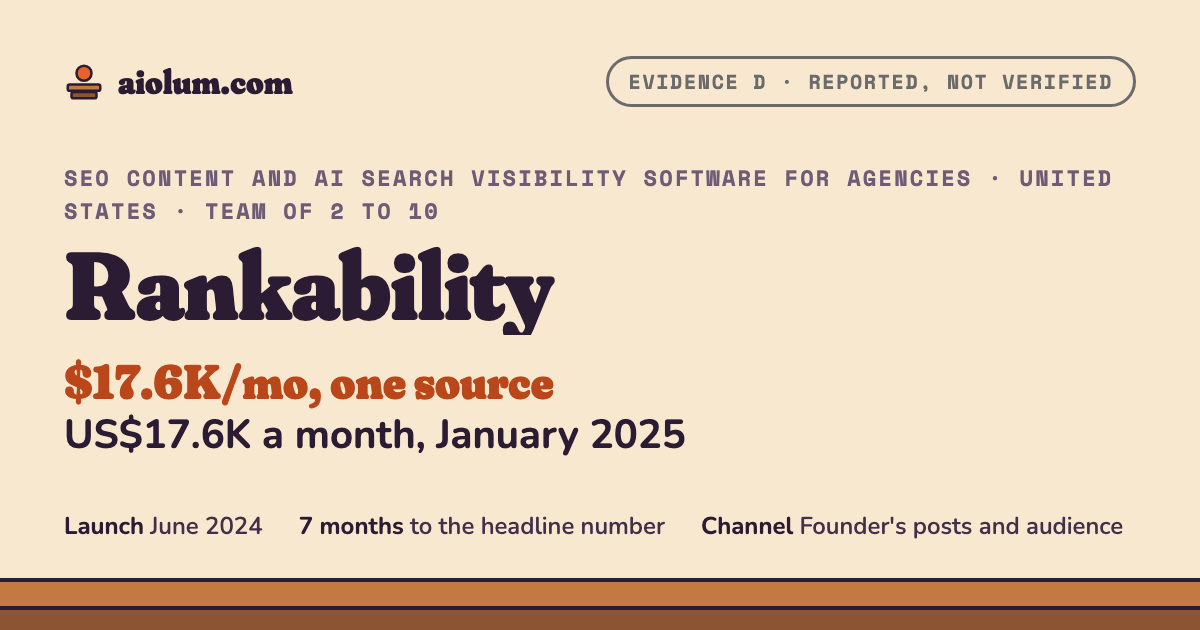
The headline figure, US$17,600 of monthly recurring revenue in January 2025, rests on one source: the gaps.com January 2025 income report by Glen Allsopp, published on 6 February 2025, whose headline states it and whose image shows a card reading "Current MRR $17.6k", 7% up on December. Allsopp writes that he asked for permission before sharing such figures, so they appear to come from the founder, but the report does not name the analytics service, link a public dashboard or date the total revenue and spend figures. No payment processor, buyer or second publication confirms them. A reader could look for a public subscription-analytics page for Rankability, a TrustMRR profile, or a dated statement by Nathan Gotch in an interview or his own newsletter. The headline number is grade D: one claim or one estimate, with no second source. Aiolum shows it because the story is useful, and marks it so that it is not mistaken for a verified figure.
Rankability is SEO software. SEO, search engine optimization, is the work of making a web page appear high in Google's results for the words that people search. Its first product was a content optimizer: a program that reads the pages that already rank for a keyword, extracts the topics and phrases they share with natural language processing (NLP, software that finds meaning in text), and scores a new draft against them. Rankability added AI-written content briefs, the plan a writer receives before writing, made with OpenAI's GPT models. Since 2025 it has moved to AI search visibility, also called AEO (answer engine optimization): it asks ChatGPT, Gemini, Perplexity and other assistants the questions that a client's buyers ask, every day, and reports whether the client is named or cited in the answers.
Nathan Gotch, an SEO consultant in St. Louis who started the agency Gotch SEO in 2013 and later the training program Gotch SEO Academy, founded Rankability, Inc. in 2024 with Simon L. Smith, the Academy's lead instructor and co-author of Gotch's book. The site showed a waitlist from October 2023 and a working product by June 2024. Glen Allsopp's gaps.com reported in its January 2025 income report, published on 6 February 2025, that Rankability made US$17,600 in monthly recurring revenue the month before, 7% more than in December, and that it had made US$87,296 in total revenue while Gotch had spent US$426,111 of his own money to build it. Rankability's own about page said in January 2025 that more than US$500,000 and 15,000 hours of development had gone into it.
The monthly revenue figure is graded D on this page: it was reported once, by one publication, from figures the founder shared, and no payment processor, buyer or second source confirms it. The page also shows the team behind it, why the build cost so much, and what happened to earlier companies that sold tools to content marketers.
The numbers, graded
Each row shows the evidence grade and the source numbers from the list at the end of this page. The grades are explained in How Aiolum verifies.
| Fact | Value | Grade | How we know | Sources |
|---|---|---|---|---|
| Monthly recurring revenue, January 2025 | US$17,600 | D | Gaps.com January 2025 income report by Glen Allsopp, published 6 February 2025. The headline says "$17,600 in MRR Last Month", and the report's image shows a card reading "Current MRR $17.6k", up 7% "vs. December". The report does not name the analytics service behind the card. | [1] |
| Run rate from the January 2025 figure | US$211,200 a year | calc | Calculated: US$17,600 times 12. This is the headline value on this page. | [1] |
| Monthly recurring revenue implied for December 2024 | about US$16,400 | calc | Calculated: US$17,600 divided by 1.07. The card's figure is rounded, so this is approximate. | [1] |
| Total revenue to the date of the report | US$87,296 | D | Gaps.com, as the "most recent numbers". The report does not give the date of this figure. | [1] |
| The founder's own money spent on the build | US$426,111 | D | Gaps.com: "spending $426,111 of his own money to build the platform". Undated in the report. | [1] |
| Money invested, as stated by the company in January 2025 | more than US$500,000, and more than 15,000 hours of development | C | Rankability's about page, archived 8 January 2025. It agrees in size with the gaps.com figure, which may be older. | [2] |
| Spend not yet covered by revenue | US$338,815 | calc | Calculated: US$426,111 minus US$87,296. Gaps.com rounded it to about US$338,000. | [1] |
| Revenue as a share of spend | 20.5% | calc | Calculated: US$87,296 divided by US$426,111. | [1] |
| Share of spend that went to outside APIs | 7%, about US$29,800 | D | Gaps.com: "only 7% of spend was for external APIs". The amount is calculated on this page: 7% of US$426,111. | [1] |
| Team at the January 2025 figure | 2 co-founders, with development contracted to an outside agency | C | The archived about page of January 2025 names Nathan Gotch and Simon L. Smith as co-founders, Smith as head of the development team. A podcast page of July 2026 says the platform had two years of outsourced development by an outside agency. No source gives the agency's headcount. | [2, 9] |
| Team in October 2026 | 3 people listed: 2 co-founders and 1 customer success person | C | Rankability's about page. The careers page calls it a small, remote-first team and lists no open roles. | [5, 7] |
| Profitability in October 2026 | the company says it is profitable | C | Careers page: "We're profitable, founder-led, and growing". No figure and no date. | [7] |
| Outside funding | none reported | D | Gaps.com describes the spend as the founder's own money. No funding round appears in any source read. | [1] |
| Founded | 2024, as Rankability, Inc., St. Louis, Missouri | C | Rankability's about page, key facts section. | [5] |
| First public product page | 12 June 2024 | C | First Wayback capture of the working site with sign-up; captures from October 2023 to February 2024 show a waitlist page, and 20 May 2024 returned an error. The product may have been sold earlier. | [13, 14] |
| Time from the first product page to the January 2025 figure | 7 months | calc | Calculated: June 2024 to January 2025. | [1, 13] |
| Entry price, January 2025 and October 2026 | US$149 a month, then US$97 a month | C | Archived pricing page of 21 January 2025 and the current pricing page. The plans and their limits changed between the two dates. | [4, 6] |
| Product changes after the in-house rebuild | 10,000 in five months | C | Chapter title of a podcast episode published 20 July 2026, in the founder's interview. | [9] |
How to read this table: a grade D value is reported, not verified: one publication's figure with one date and no second source. A grade C value is read directly from the company's current or archived pages, or from a podcast page. A "calc" value was computed on this page from the rows above it. No value is grade A or B.
| Plan | Per month, billed yearly (US$) | Per month, billed monthly (US$) | Limit |
|---|---|---|---|
| Starter | 80.83 | 97 | 20 content projects a month, 100 tracked AI queries, 50 Google keywords |
| Agency | 247.50 | 297 | 80 content projects, 300 tracked AI queries, 150 Google keywords |
| Agency Pro | 414.17 | 497 | 160 content projects, 500 tracked AI queries, 250 Google keywords, coaching with yearly plan |
| Enterprise | sales call, custom capacity |
Each plan includes unlimited client workspaces and team members; the plans differ in how much work they allow each month. One content project is one new page or one refresh of an existing page, with research, a brief, an outline, an AI-assisted draft and two AI revisions. The yearly plans cost ten months' price for twelve months (US$970, US$2,970 and US$4,970 a year). A 7-day trial needs a card. The Agency Pro yearly plan includes Nathan Gotch's weekly group coaching. In January 2025 the archived pricing page listed three different plans, SEO Specialist, SEO Expert and SEO Master, at US$149, US$249 and US$449 a month, with 2, 5 and 10 user seats.
The timeline
From a blog about baseball pitching to an AI search visibility platform for agencies, with one reported revenue figure in January 2025. Each entry carries its grade.
- 2011CNathan Gotch, a college student, starts a baseball pitching blog and learns SEO to get traffic to it. [11]
- 2013CHe starts his own SEO business, Gotch SEO, in St. Louis. [11]
- 2015CGoogle gives manual penalties to his own site and many client sites because of a blog network he built for links. He has the penalties removed and moves to content-based SEO. [10]
- 2016CHe sells his first SEO training. It later becomes Gotch SEO Academy, rebuilt with his business partner as a coaching program for agency owners. [10, 11]
- 3 October 2023Crankability.com shows a "coming soon" page with a waitlist. [13, 14]
- 12 June 2024CThe working site is live: keyword research, AI content briefs made with OpenAI, and a content optimizer with NLP from Google and IBM Watson. [13]
- 8 January 2025CThe about page names Gotch and Simon L. Smith as co-founders and says more than US$500,000 and 15,000 hours of development went into the tool. Plans cost US$149 to US$449 a month. [2, 4]
- January 2025DMonthly recurring revenue is US$17,600, up 7% from December, as reported by gaps.com. [1]
- 6 February 2025DGaps.com publishes the figure with total revenue of US$87,296 against US$426,111 of the founder's own money. [1]
- 2025 to 2026CAfter two years of outsourced development, Gotch replaces the platform with one rebuilt in-house with AI tools, after what he calls 1,400 hours spent in meetings. [9]
- 20 July 2026CPodcast episode on Serena, Rankability's AI agent built on a base language model plus five million tokens of transcribed coaching calls and about 300 standard operating procedures. [9]
- October 2026CRankability sells itself as an AI search visibility platform for agencies at US$97 to US$497 a month. gotchseo.com now redirects to rankability.com, and the careers page says the company is profitable. [5, 6, 7]
Why it worked
Four causes, in the order they mattered. Each one is a reusable lesson.
An audience before the product
Gotch had a YouTube channel, a book for agency founders and a paid coaching program before Rankability existed. Gaps.com wrote that he launched the software to that audience. In January 2025 every plan included weekly calls with the two co-founders and SEO training by Gotch, so the tool was sold as part of the method he already taught.
The tool is part of the training
The founder said in a 2024 podcast that Rankability is the tool he uses most, to write content and even YouTube scripts. In October 2026 the most expensive yearly plan includes his weekly group coaching. A customer who learns the method in the Academy meets the tool inside it, which lowers the cost of finding customers.
Paying for a long build from another business
Gaps.com reported that the founder spent US$426,111 of his own money, and that total revenue was a fifth of that at the time. The founder also ran an SEO agency and a coaching business, and he paid for about two years of contracted development before the product earned back its cost, with no investor in the company.
Following the search change
The company says Rankability started as a content optimization tool. When buyers began to ask ChatGPT and other assistants instead of Google, it added daily tracking of brand mentions in 11 AI assistants, audits for AI search and an AI agent, and changed its whole site to this message.
How it was built
These details come from the company's current and archived pages and from the founder's podcast interviews. They are grade C, except the page-source details, which anyone can see in the archived HTML. [4, 3, 13, 2, 9, 5, 6]
- Keyword research used Google search data; the content optimizer used NLP from Google and IBM Watson; the content briefs used OpenAI's GPT models, the archived pricing page stated in January 2025.
- The waitlist page of 2023 was built with ConvertKit. The marketing site of January 2025 was built on Webflow; the site of October 2026 is built with Astro and measured with PostHog and Google Tag Manager.
- For about two years an outside development agency built the platform, with Simon L. Smith as head of the development team. The founder then replaced it with a platform rebuilt in-house with AI tools.
- Serena, the AI agent, is a base language model given five million tokens of transcribed coaching calls and about 300 standard operating procedures from the founders' consulting work.
- The content pipeline identifies search intent, picks a template, researches 50 to 75 competing pages per topic and runs several editorial passes before a draft is ready.
- Customers can use the tools from their own AI assistants through an MCP server and an API, which share the plan's monthly limits.
Tools named in the sources
Each one opens its page in the Tools tab, with every story that uses it.
The dead that came before
Four companies in the Loot Drop database sold tools or content to people who depend on search engines and feeds, and died when a larger platform or an algorithm change took the value away. The values below are from that database and are not independently verified.
Trapit
The promiseAI-powered content curation for marketers and content creators.
Why it diedGoogle and Facebook improved their own content algorithms, free curation tools were easy to copy, and the paying customers were a narrow group of marketers.
Draft
The promiseA simple cloud writing and editing tool for bloggers, journalists and content writers.
Why it diedGoogle Docs added the same features inside a suite that people already used, and the freemium model never paid the costs.
Waterproof Digital Camera
The promiseAn affiliate review site that earned commissions from search traffic.
Why it diedIt was built on black-hat SEO, and Google's algorithm updates and penalties removed its traffic.
Mode Media
The promiseA network of 5,000 lifestyle blogs sold to advertisers as one premium audience.
Why it diedProgrammatic ad exchanges automated its middleman role, while it carried more than 230 employees and an expensive sales team.
What changed
Each of the four stood between content and a larger platform: Google, Facebook, the ad exchanges. When the platform changed its algorithm or built the feature itself, the middle position lost its value. Rankability stands in the same place. Its customers sell SEO to their own clients, and Google's updates and the move of buyers to AI assistants decide whether that work keeps its value. Gotch said that Google penalized his own site and many client sites in 2015 for a blog network built for links, the same kind of manipulation that the Waterproof Digital Camera record describes.
Two things differ. First, the costs are low compared with the founder's other income: gaps.com reported that only 7% of spend went to outside APIs, and the build was paid with the founder's own money, as gaps.com reported, not by investors who need fast growth. Second, Rankability followed the change instead of waiting for it: when assistants began to answer buyers' questions, it changed from a content optimizer into a tracker of AI answers, which is the new platform's problem for agencies.
Can one person copy it now?
The product, yes. The cost, not without an audience.
Content optimizers and AI visibility trackers are a crowded category, and gaps.com reported that this one cost its founder more than four times its total revenue to build. What made it work was an existing audience of agency owners who already paid the founder for training. The founder said in July 2026 that he replaced two years of contracted work with a platform rebuilt in-house with AI tools, and that the barrier to entry is dropping.
Where it is still open: Any field where a consultant already trains other practitioners: a tool that turns the consultant's method into software, sold inside the training.
- 1Build the tool for the method you already teach, so your students are the first customers.
- 2Include your coaching or calls in the higher plans, so the tool and the training sell each other.
- 3Keep model and API costs a small share of spend; gaps.com reported 7% for this business.
- 4When the platform your customers depend on changes, change the product's job with it.
What to watch
The risks are the mirror image of the causes above.
What is not verified
The headline figure, US$17,600 of monthly recurring revenue in January 2025, rests on one source: the gaps.com January 2025 income report by Glen Allsopp, published on 6 February 2025, whose headline states it and whose image shows a card reading "Current MRR $17.6k", 7% up on December. Allsopp writes that he asked for permission before sharing such figures, so they appear to come from the founder, but the report does not name the analytics service, link a public dashboard or date the total revenue and spend figures. No payment processor, buyer or second publication confirms them. A reader could look for a public subscription-analytics page for Rankability, a TrustMRR profile, or a dated statement by Nathan Gotch in an interview or his own newsletter.
The team size at the figure is not known
The company had two co-founders in January 2025, and the development was done by an outside agency for about two years. No source says how many people that agency put on the work, or how many people from Gotch's other company helped. The about page lists 3 people in October 2026.
A large loss at the time of the figure
Gaps.com reported total revenue of US$87,296 against US$426,111 of spend. The careers page says the company is profitable in October 2026 but gives no figure, so it is not known whether the spend was recovered.
The figure is 21 months old
No later revenue figure has been published that this page could find. The prices, the plans and the product's main job have all changed since January 2025.
Customers depend on Google and the AI assistants
Rankability sells to agencies whose work loses value when Google or an assistant changes how it chooses sources. The product also depends on outside services for search data, language models and NLP.
Sales depend on one person's audience
The tool is sold through the founder's training program, YouTube channel and coaching. If his audience shrinks or the Academy loses members, the main channel shrinks with it.
Sources
The grade next to each source is the best grade that the source can support. "Read in full" means that the text of the page was downloaded and the numbers were checked in it.
- D Gaps.com, Glen Allsopp: Gaps Income Report, January 2025, published 6 February 2025, insight #10: With $426,000 Invested, This SEO Content SaaS Generated $17,600 in MRR Last MonthRead the section on Rankability and viewed its image, which shows the MRR card. Source for the headline figure, the total revenue, the spend and the 7% API share.
- C Wayback copy of the Rankability about page, 8 January 2025: Our storyRead in full. Source for the two co-founders, Smith's role as head of development, the US$500,000 invested and the 15,000 hours.
- C Wayback copy of the Rankability home page, 15 January 2025Read in full, with the page source. Source for the features in January 2025, the weekly calls with the co-founders and the Webflow site.
- C Wayback copy of the Rankability pricing page, 21 January 2025: Become a Founding MemberRead in full. Source for the 2025 plans and the technology answer that names Google, IBM Watson and OpenAI.
- C Rankability about page, read 24 October 2026Read in full. Source for the team list, the founding year, the company name and city, and the move from content optimization to AI search. gotchseo.com redirected here on 24 October 2026.
- C Rankability pricing page, read 24 October 2026Read in full. Source for the pricing table. The purpose check found no humanizer, AI-detection bypass or parasite SEO offer.
- C Rankability careers page, read 24 October 2026Read in full. Source for the profitability statement and the small, remote-first team.
- C Rankability product page: Promote, read 24 October 2026Read in full. The link feature is research on existing backlinks and prospects for manual outreach; it does not buy or place links.
- C Hubhopper podcast page, 20 July 2026: Nathan Gotch on Building an AI Agent That Actually Knows SEORead the episode description and chapter list; the audio was not heard. Source for the outsourced development, the in-house rebuild, Serena and the content pipeline.
- C PageTraffic Agency Insider podcast, 2024: How AI is Transforming SEO With Nathan GotchRead the transcript on the page. Source for the 2015 penalty, the 2016 training launch and the founder's own use of Rankability.
- C Wayback copy of the Gotch SEO about page, 26 January 2025: The Gotch SEO StoryRead in full. Source for the founder's background, the 2013 start of Gotch SEO and how the Academy promoted Rankability.
- C Wayback copy of the Gotch SEO training page, 19 March 2025Read in full for the purpose check. The Academy teaches agency SEO and link building "that'll keep you safe"; no parasite SEO or link selling was found. The home page of 26 January 2025 and the services page of 5 August 2023 were also read.
- C Wayback copies of rankability.com, 3 October 2023 and 12 June 2024Read both. The 2023 copy is a waitlist page built with ConvertKit; the June 2024 copy is the first working product site.
- C Wayback Machine capture index for rankability.com, 2022 to 2024Read the index. Waitlist-sized captures until February 2024, an error on 20 May 2024, the working site from 12 June 2024.
- C Loot Drop database export, 1,749 failed startupsLocal export. AI-written summaries, not independently verified. Source for the failed predecessors.