Neural Frames
Neural Frames is an AI music-video generator, a web application that produces a video for a song. A musician uploads an audio file. A feature named Autopilot analyses the rhythm and the structure of the song, writes a storyboard, and sends each scene to a text-to-video model, a neural network that produces a short video clip from a written description. The result is audio-reactive, which means that cuts and effects follow the beat of the music. Customers pay a subscription from US$39 a month that includes credits, units that are spent for each rendered clip, and they can buy more credits at any time.
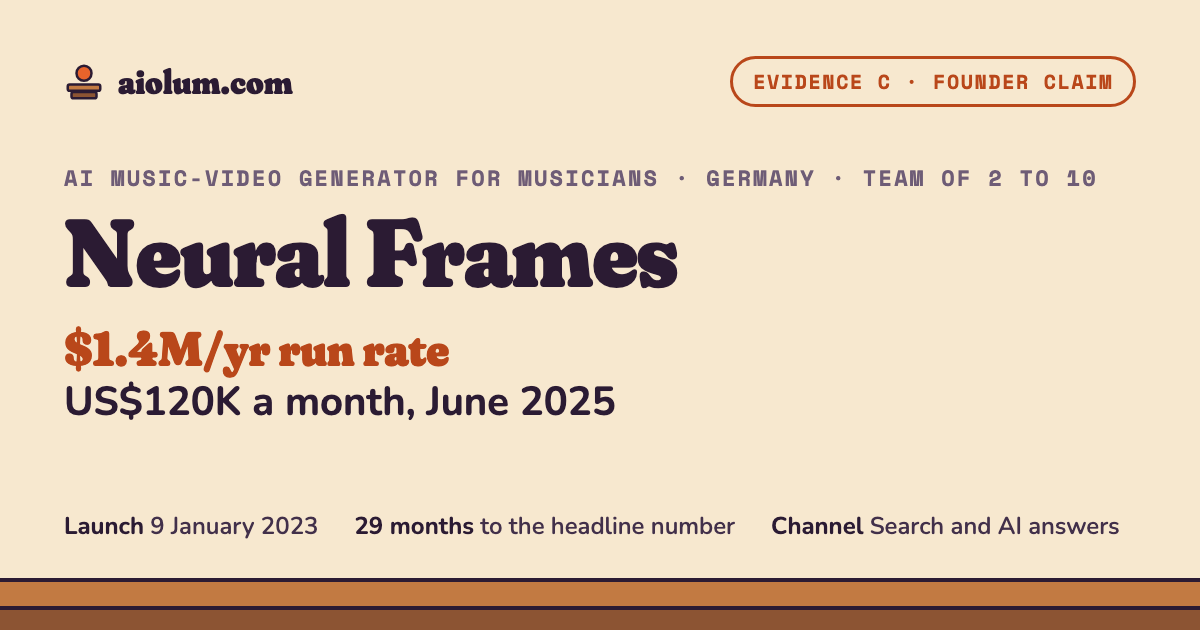
Nicolai Klemke, a German physicist who did his PhD at the DESY research centre in Hamburg, released the first version on 9 January 2023 as an easy interface for animation with the open-source image model Stable Diffusion. In April 2023 he rebuilt it for musicians. He worked alone for most of 2023 and reported US$17,000 of monthly recurring revenue at the end of October 2023. He then reported US$500,000 of revenue for the year 2024, nearly US$70,000 for the month of February 2025 with five people, and a Stripe total of US$1 million since launch on 28 April 2025. On 4 June 2025 he entered US$120,000 a month on his Indie Hackers page, which is a run rate of US$1.44 million a year. He says the company has never taken outside capital.
Every revenue number on this page is a founder statement, grade C: an interview, posts on X, a screenshot that he published, and a self-reported field. No payment processor or buyer has confirmed them, and the last public figure is from June 2025. Two other numbers circulate. Starter Story's US$204,000 a year is the October 2023 figure times 12. Latka's US$871,200 a year for October 2024 is an estimate, and it is higher than the founder's own total for 2024. In October 2026 the company's About page lists 17 people. The page also shows what happened to earlier companies with a similar promise.
The numbers, graded
Each row shows the evidence grade and the source numbers from the list at the end of this page. The grades are explained in How Aiolum verifies.
| Fact | Value | Grade | How we know | Sources |
|---|---|---|---|---|
| Revenue per month, 4 June 2025 | US$120,000 | C | The founder's own entry on the Indie Hackers product page. The page says that the figure was last updated on June 4, 2025 and has not been independently verified. The page calls it monthly revenue and does not say how much of it is recurring. | [1] |
| Run rate from the June 2025 figure | US$1.44 million a year | calc | Calculated: US$120,000 times 12. This is the headline figure on this page. | [1] |
| Revenue in the month of February 2025 | nearly US$70,000, profitable | C | Founder's post on X, 27 February 2025. In the same post: five people, no outside capital. | [2] |
| Total revenue from January 2023 to 28 April 2025 | €876,800, which was US$1,000,249 on that day | C | Founder's post on X with a screenshot of the Stripe "Gross volume" chart and a currency conversion. He wrote that this is revenue and that profit is much lower. The screenshot was published by the founder; nobody outside checked it. | [3] |
| Highest week on that Stripe chart | about €18,500 | C | Read from the screenshot: the top label of the weekly chart is €18,482.09, and the highest point is in April 2025. | [3] |
| Monthly rate at that highest week | about US$91,000 a month | calc | Calculated: €18,482.09 at the rate of 1.1408 from the same post is US$21,084 a week; times 52, divided by 12. It lies between the February figure and the June figure. | [3] |
| Revenue in the year 2024 | US$500,000 | C | Founder's post on X, 9 January 2025: "Last year, we hit $500k in revenue." Calculated: an average of about US$41,700 a month. | [4] |
| Monthly recurring revenue, end of October 2023 | US$17,000 | C | Founder interview with Starter Story, published 16 November 2023. More than 400 paying users, 1 founder, 0 employees. Starter Story's list of AI businesses shows the same figure as US$204,000 a year, which is US$17,000 times 12. | [5, 7] |
| Growth from October 2023 to June 2025 | 7.1 times in 20 months | calc | Calculated: US$120,000 divided by US$17,000. | [1, 5] |
| Revenue of the first version, early 2023 | about US$400 a month | C | Founder interview. | [5] |
| Latka's estimate for October 2024 | US$871,200 a year, 4 employees | C | A third-party estimate, marked EST. on Latka's page, which also says that the company has not published its revenue. It is 1.74 times the founder's own total for the whole of 2024. The headcount is from LinkedIn. | [6, 4] |
| An event organiser's figure, 1 May 2025 | more than US$1 million of yearly recurring revenue, without funding | C | Imagine AI Live, announcing his talk. A third party, not a founder figure. It agrees with the Stripe chart of three days earlier: US$21,084 a week times 52 is about US$1.10 million. | [12, 3] |
| Cloud cost, October 2023 | about US$7,000 a month | C | Founder interview: the main cost of the business. Calculated: 41% of the US$17,000 of monthly recurring revenue at that time. | [5] |
| Share of single credit purchases, August 2025 | almost 50% of revenue | C | Founder's post on X, 3 August 2025, with a weekly revenue chart whose amounts are hidden. About half of revenue is therefore not a subscription. | [19] |
| Weekly revenue, November 2025 | an all-time record, two weeks in a row; no amount published | C | Founder's post on X, 7 November 2025. This is the last public revenue statement that was found. | [18] |
| Team | 1 person in November 2023, 5 in February 2025, 17 names in October 2026 | C | Starter Story interview, founder's post, and the company's About page read on 13 October 2026. The About page says that he worked alone for a little under a year. | [5, 2, 8] |
| Outside funding | none | C | Founder's post, February 2025: "we've never raised outside capital". The site says "No VC money" in October 2026. The first version ran on AWS cloud credits. | [2, 8, 5] |
| Founder's background | PhD in physics at DESY in Hamburg, one year in a job, then the Entrepreneur First accelerator | C | Founder interview. A CrossRef record lists a 2020 conference paper under his name on high-harmonic generation from solids, which is the laser subject that he describes. He left the accelerator without a company. | [5, 41] |
| Videos made on the platform | 1 million by February 2025, more than 2 million by October 2026 | C | Founder's post of 12 February 2025 and the company's pricing page. | [24, 9] |
| Autopilot videos exported in one week, October 2026 | more than 3,000 | C | Founder's post on X, 12 October 2026. Calculated: one finished video about every 3.4 minutes. | [29] |
| Email list | 313,000 addresses in June 2025, 500,000 in June 2026 | C | Founder's posts on X about two newsletters. | [25, 26] |
| Revenue through affiliates, total by January 2025 | US$40,000 | C | Founder's post on X, 5 January 2025. | [32] |
| Taxes and social contributions, August 2026 | more than €800,000 a year | C | Founder's post in German, 13 August 2026, written in the second person. It does not name the company. Not verified as a company figure, and it is not a revenue figure. | [30] |
| Revenue goal | 10 times the February 2025 revenue by December 2027 | C | Founder's post of 27 February 2025. Calculated: about US$700,000 a month. | [2] |
| Time from launch to the June 2025 figure | 29 months | calc | Calculated: January 2023 to June 2025. | [4, 1] |
How to read this table: a grade C value is a founder statement, a value read from a screenshot that he published, a reviewer, or an estimate by a third party that says so. A "calc" value was computed on this page from the rows above it. No value is grade A or B.
| Plan | Per month, billed yearly (US$) | Per month, billed monthly (US$) | Limit |
|---|---|---|---|
| Neural Knight | 26 | 39 | 2,400 credits a month; 7 AI models; 1080p, no 4K |
| Neural Ninja | 66 | 99 | 7,200 credits a month; 10 AI models; 4K upscaling |
| Neural Nirvana | 199 | 299 | 24,000 credits a month; 10 AI models; priority upscaling |
Yearly billing is shown as 33% off: US$312, US$792 and US$2,388 a year. Credits arrive every month, also on yearly billing. Unused credits carry over while the subscription is active, up to 300% of one month's amount. More credits can be bought at any time as top-ups; the top-up prices and the cost calculator load by script and could not be read. The page says that the cost of an Autopilot video depends on its length and on the chosen model, and that the smallest plan is not recommended for Autopilot. Calculated at the monthly price: a credit costs about 1.6 US cents on the smallest plan and about 1.2 US cents on the largest.
The timeline
From a physics PhD and a first web project to US$120,000 a month, in 29 months, and then to a company with 17 names on its About page. Each entry carries its grade.
- 2019 to 2022CDuring a physics PhD at DESY in Hamburg, Klemke writes simulation code and decides that he wants to keep programming. After one year in a job he joins the Entrepreneur First accelerator and leaves it without a company. [5]
- Late 2022CHe starts an interface for Stable Diffusion animation, alone, in about seven weeks of programming with help from ChatGPT. It is his first web application. AWS cloud credits pay for the servers. [5, 8]
- 9 January 2023CThe first version is released. [4]
- 15 January 2023CHis Show HN post gets 247 points and 72 comments. This and a Reddit post overload the servers. The first version makes about US$400 a month. [11, 5]
- April 2023CHe takes the site offline, rewrites it for musicians with a timeline editor and custom models, and releases it again. [5, 35]
- End of October 2023CUS$17,000 of monthly recurring revenue, more than 400 paying users, 130,000 visitors since April. Cloud costs are about US$7,000 a month. He is still the only person. [5]
- 2024CUS$500,000 of revenue in the year. Latka counts 4 employees on LinkedIn in October. [4, 6]
- December 2024CHe writes that text-to-video rendering is still extremely expensive and that an unlimited plan at US$99 was hard to make profitable. He cuts AWS costs with reserved instances and spot GPUs. [13, 22]
- February 2025COne million videos created. Nearly US$70,000 of revenue in the month, profitable, five people, no outside capital. [24, 2]
- 28 April 2025CThe Stripe total since January 2023 passes US$1 million. [3]
- 7 to 15 May 2025CAutopilot: a full-length music video from a song in two clicks. A quiet release on 7 May, the public release on 15 May. One day later he writes that usage has moved to the new product, that revenue is up and that margins are down. [16, 15]
- 4 June 2025CHe enters US$120,000 a month on Indie Hackers. On the same day he writes that the company made more in one day than his monthly PhD salary, and that all of it goes to people and servers. [1, 17]
- June 2025CGoogle traffic falls. The company starts paid advertising and reports a conversion rate five times higher after tests. Some customers cost more to serve than they pay. [20, 14]
- November 2025CA weekly revenue record two weeks in a row. The company looks for a third engineer. [18, 31]
- June 2026CShort-Form Studio, templates for vertical clips, is announced to an email list of 500,000 addresses. [26]
- August 2026CInterview on the TBPN programme on 10 August. On 21 August the two original editors, frame-by-frame and text-to-video, are retired in favour of Autopilot and Short-Form Studio. [28, 27]
- October 2026C17 names on the About page, which still says "No VC money". More than 3,000 Autopilot videos are exported in one week. No revenue figure has been published since November 2025. [8, 29]
Why it worked
Four causes, in the order they mattered. Each one is a reusable lesson.
Timing
In January 2023 the open-source library Deforum could make these animations, but the user had to copy a code repository and run it. He put the same technique behind a web page. Later, AI music tools such as Suno made it easy to produce a song, and the founder sees each of these songs as one that needs a video; in February 2026 he wrote: "Audio supply is going through the roof, and we're here to visualize all of it!"
One customer group
The first tagline was "Text-to-video for everybody". Many early users were musicians and he had made music himself, so he rebuilt the product for music videos. He writes that this made the product easier to build and easier to sell.
Search traffic first, advertising later
Paid ads failed in 2023. Pages and blog posts written for search terms with little competition, free small tools and YouTube tutorials brought the customers, and Google was the source of a large part of revenue until 2025. When the ranking fell in 2025, the company started paid advertising and tested its sign-up pages.
Credits pass the rendering cost to the customer
A flat unlimited plan at US$99 was hard to make profitable. Plans now include a fixed number of credits, and each clip costs credits according to its length and model. By August 2025 single credit purchases were almost half of revenue.
Autopilot
The timeline editor gave control but took long to learn. Autopilot produces a full video from a song in two clicks and in less than 15 minutes. Within a week most usage had moved to it, and in August 2026 the old editors were retired.
How it was built
These details come from the founder's interview and posts and from the company's site. They are grade C. [5, 23, 10, 32, 25, 26]
- The first version used Stable Diffusion with the frame-by-frame animation technique of the open-source library Deforum. The April 2023 version added a timeline and custom models trained for each user.
- A React frontend and Python on the servers. The founder had not built a web application before; he wrote the first version in about seven weeks with help from ChatGPT.
- AWS, with GPU servers that scale up and down with demand. In March 2025 the main backend was still one EC2 instance that served 100,000 people a month, with about 20 requests a second at peak.
- In October 2026 the site names Kling, Seedance and Runway as the video models that it offers. These models belong to other companies; Neural Frames adds the song analysis, the storyboard, character consistency and the editing.
- Stripe for subscriptions and credits, PostHog for analytics, Rewardful for affiliates, who had brought US$40,000 of revenue by January 2025.
- Marketing through search pages, free tools, YouTube tutorials and an email list that grew from 313,000 to 500,000 addresses in one year.
Tools named in the sources
Each one opens its page in the Tools tab, with every story that uses it.
The dead that came before
Five companies in the Loot Drop database promised easy animation or video for people without film skills, rented GPUs to consumers for a flat monthly price, or built a creative tool on music that they did not own. The values below are from that database and are not independently verified.
Fuzzwich
The promiseAnimation for everyone: drag, drop and animate, with no training.
Why it diedIts desktop tool lost to Adobe and to mobile apps. It found no business model and no further funding.
Real Artists
The promiseA cloud animation studio for independent artists and small studios.
Why it diedLarger tool makers added the same collaboration features to products that the customers already used. Small customers could not pay enough to fund growth.
Viddy
The promiseFilters and effects that make amateur phone video look professional.
Why it diedInstagram added video in June 2013 for its existing users. People tried Viddy once and did not return.
Blade (Shadow)
The promiseA high-end gaming PC streamed from the cloud for about US$35 a month.
Why it diedEach subscriber needed about US$1,000 of GPU hardware, which became outdated before the subscription had paid for it.
Jamglue
The promiseMusic remixing in the browser for anyone, without studio equipment.
Why it diedAudio processing in a browser was too weak at the time, and permissions for remixed songs were costly and complicated. SoundCloud took the users.
What changed
Fuzzwich, Real Artists and Viddy gave people without training a way to make animation or polished video, and each lost when a larger company added the same function to a product that people already used. Blade rented GPUs to consumers for a flat monthly price, and the hardware cost more than the subscriptions returned. Jamglue let people remix music that belonged to others and could not afford the permissions.
Three things differ for Neural Frames. First, the customer has a repeating need: every released song needs a video for YouTube, TikTok and Instagram. Second, the company owns no GPUs. It rents servers, uses video models from other companies, and charges the customer credits for each clip; it had a flat unlimited plan and no longer offers one. Third, the customer uploads the song and stays responsible for the rights to it. The risks have not gone. The founder reports low or negative margins on some customers, and the makers of the video models sell video generation to the same musicians.
Can one person copy it now?
The method, yes. The January 2023 opening, no.
A web page in front of Stable Diffusion animation was new in January 2023 and is not new now. What can be repeated is the sequence: put a hard open-source technique behind a simple interface, watch who pays, rebuild the product for that one group, and charge per unit of rendering so that the model cost is the customer's cost. The founder had no web development experience and no funding.
Where it is still open: Other groups that need media for every item they publish and cannot pay a studio: podcasters, audiobook authors, game modders, teachers. The video-model makers serve everybody, so the opening is in the workflow of one group.
- 1Take an open-source AI technique that works but needs programming skill, and put it behind a web page.
- 2Release early, also to Hacker News and Reddit, and look at who the paying users are.
- 3Rebuild the product and every page of the site for that one group.
- 4Sell credits per rendered unit, not unlimited use, when each output costs GPU time.
- 5Write search pages and free small tools for the exact words that this group types.
What to watch
The risks are the mirror image of the causes above.
Self-reported, and the last figure is from June 2025
All revenue numbers are founder statements. The US$120,000 a month is a field that the founder filled in himself, and the Stripe total is a screenshot that he posted. Since June 2025 he has published records without amounts. Latka's estimate for October 2024 is 1.74 times his own total for 2024, so third-party estimates of this company are not reliable.
Rented GPUs and low margins
Cloud servers cost about US$7,000 a month when recurring revenue was US$17,000 a month, which is 41%. In December 2024 he wrote that text-to-video is still extremely expensive. After Autopilot he wrote "revenue is up, margins are down", and in June 2025 that margins are "so bad if not to say negative" on some customers. The company was profitable in February 2025; no profit statement was found after Autopilot.
The model makers sell to the same customers
Neural Frames offers the Kling, Seedance and Runway video models, which belong to other companies. Those companies, and Google and OpenAI, also sell video generation directly to anyone. Runway alone raised more than US$300 million in April 2025. A PCMag reviewer wrote in May 2026 that the available models are not the most advanced and that a video can also be made by prompting Google's Veo directly. The founder's answer is that the storyboard and image steps around the model matter as much as the model. He also writes of "the great commoditization of the late 2020's", and that competitors give away video generation with investors' money.
Music rights
The pricing page says that the customer is responsible for the rights to any music that is uploaded. Some customers bring songs made with AI music tools, and the site has a page for Suno songs. Such tools have been in dispute with record companies: Universal Music and Udio settled copyright litigation in October 2025. Warner Music and Suno announced in November 2025 that Suno will move to licensed models in 2026 and will limit downloads. A song that cannot be downloaded cannot be uploaded to another tool.
Search ranking
Google was the source of a large part of revenue. In 2025 the ranking began to move up and down, sometimes to the second page for important search terms, and the founder writes that AI search terms have become more competitive. The company now also pays for advertising.
A larger team with fixed costs
The headline figure was reached with about five people. The About page now lists 17, and in September 2026 the founder wrote that he wants to hire more. Salaries are fixed costs, and no revenue figure for 2026 is public, so revenue per person cannot be calculated today.
Sources
The grade next to each source is the best grade that the source can support. "Read in full" means that the text of the page was downloaded and the numbers were checked in it.
- C Indie Hackers product page: neural frames revenue, self-reported, last updated 4 June 2025Read in full. The page states the monthly revenue, the date of the last update and that the figure has not been independently verified.
- C Nicolai Klemke on X, 27 February 2025: reintroduction, nearly $70k this month, five people, never raised outside capitalRead the full text through api.fxtwitter.com. Source for the February 2025 revenue, the team size, the funding statement and the revenue goal.
- C Nicolai Klemke on X, 28 April 2025: crossed a nice milestone today, with a Stripe gross volume screenshotRead the text and both attached images: the Stripe chart with €876.8K since January 2023 and a conversion to US$1,000,249.06.
- C Nicolai Klemke on X, 9 January 2025: two years since the first version, $500k in revenue last yearRead the full text through api.fxtwitter.com. Source for the launch date and the 2024 revenue.
- C Starter Story, 16 November 2023: How A Doctorate In Physics Built An AI Video Generation Tool [$17K MRR]Read in full. Founder interview. Source for the background, the first version, the relaunch, the October 2023 figures, the cloud cost and the early marketing.
- C Latka company page: Neural Frames revenue, estimate for October 2024Read in full. A third-party estimate marked EST., and a headcount from LinkedIn.
- C Starter Story list: AI-based businesses and how much they makeRead the entry for neural frames: US$204,000 a year, from the US$17,000 of the interview.
- C Neural Frames About page, read 13 October 2026Read in full. Source for the 17 team names, the solo first year and the statement about VC money.
- C Neural Frames pricing page, read 13 October 2026Read in full. Source for the plans, the credit rules, the two million videos and the statement on music rights. The cost calculator loads by script and could not be read.
- C Neural Frames home page, read 13 October 2026Read in full. Source for the video models that are offered.
- C Hacker News, 15 January 2023: Show HN: Create your own video clips with Stable DiffusionRead the record through the Hacker News search API: title, date, points, number of comments and author. The comments were not read.
- C Imagine AI Live on X, 1 May 2025: Neural Frames powers $1M+ in ARR without fundingRead the full text in the founder's timeline, where he reposted it. A statement by an event organiser.
- C Nicolai Klemke on X, 10 December 2024: text2video is still extremely expensiveRead the full text through api.fxtwitter.com.
- C Nicolai Klemke on X, 12 June 2025: day 924, margins on some customersRead the full text through api.fxtwitter.com.
- C Nicolai Klemke on X, 16 May 2025: revenue is up, margins are downRead the full text and the quoted post through api.fxtwitter.com.
- C Nicolai Klemke on X, 15 May 2025: Today, we're releasing AutopilotRead the full text in the founder's timeline, with the post of 8 May 2025 about the quiet release.
- C Nicolai Klemke on X, 4 June 2025: more money in one day than a month of PhD salaryRead the full text through api.fxtwitter.com.
- C Nicolai Klemke on X, 7 November 2025: all-time weekly revenue record for the second week in a rowRead the text and the attached image, which shows customer ratings and no amounts.
- C Nicolai Klemke on X, 3 August 2025: single credit purchases are almost 50% of revenueRead the text and the attached chart. The amounts on the chart are hidden.
- C Nicolai Klemke on X, 25 June 2025: day 938, Google traffic, paid ads and conversion rateRead the full text in the founder's timeline.
- C Nicolai Klemke on X, 25 September 2025: Google rankings as a riskRead the full text in the founder's timeline.
- C Nicolai Klemke on X, 19 December 2024: cost cutting on AWSRead the full text in the founder's timeline.
- C Nicolai Klemke on X, 22 March 2025: the main backend is one EC2 instanceRead the full text in the founder's timeline.
- C Nicolai Klemke on X, 12 February 2025: one million videos createdRead the text in the founder's timeline.
- C Nicolai Klemke on X, 11 June 2025: day 923, newsletter to 313k peopleRead the text in the founder's timeline.
- C Nicolai Klemke on X, 10 June 2026: newsletter to 500k people, Short-Form StudioRead the full text and the quoted company post through api.fxtwitter.com.
- C Nicolai Klemke on X, 21 August 2026: goodbye to the frame-by-frame and text-to-video editorsRead the full text through api.fxtwitter.com.
- C Nicolai Klemke on X, 11 August 2026: on new video models and the TBPN interviewRead the full text through api.fxtwitter.com, with his post of 10 August 2026 that quotes the programme's guest list. The interview itself was not heard.
- C Nicolai Klemke on X, 12 October 2026: more than 3000 Autopilot videos exported last weekRead the full text through api.fxtwitter.com.
- C Nicolai Klemke on X, 13 August 2026, in German: more than 800,000€ a year in taxes and social contributionsRead the full text through api.fxtwitter.com. One sentence in the second person; it does not name the company.
- C Nicolai Klemke on X, 3 November 2025: We're hiring a third engineerRead the full text through api.fxtwitter.com.
- C Nicolai Klemke on X, 5 January 2025: affiliates have brought in $40k in revenueRead the full text in the founder's timeline.
- C Nicolai Klemke on X, 7 October 2025: on companies that offer free access to AI video modelsRead the full text through api.fxtwitter.com.
- C Nicolai Klemke on X, 25 September 2026: the great commoditization of the late 2020'sRead the full text through api.fxtwitter.com, with his post of 24 September 2026 about hiring.
- C Indie Hackers, 5 June 2025: Niching down, by nicollegahRead in full. The founder's short account of the first tagline and the move to music videos.
- C PCMag, 5 May 2026: I Made a Song and Music Video With AI. Can You Tell What's Wrong With Them?Read the sections on making the video. A reviewer who used Suno and Neural Frames.
- C Runway, 3 April 2025: Series D funding announcementRead in full. The company's own announcement of more than US$300 million.
- C Universal Music Group, 29 October 2025: UMG and Udio announce strategic agreements and settle copyright infringement litigationRead the headline and the first paragraphs of the press release.
- C Warner Music Group, 25 November 2025: Warner Music Group and Suno forge partnershipRead in full. Source for the licensed models planned for 2026 and the download limits.
- C Neural Frames page: Turn Your Suno Song into an AI Music Video, read 13 October 2026Read the first sections. Shows that the company addresses users of AI music tools.
- C CrossRef record: Role of intraband dynamics on circularly polarized high-harmonic generation from solids, Nicolai Klemke, 2020Read the metadata record only: title, author, conference and year. The paper itself was not read.
- C Nicolai Klemke on X, 26 February 2026: on Robert Scoble's Unaligned podcastRead the full text through api.fxtwitter.com. The podcast itself was not heard.
- C Loot Drop database export, 1,749 failed startupsLocal export. AI-written summaries, not independently verified. Source for the failed predecessors.