Road to Offer: Revenue, team and how it was built
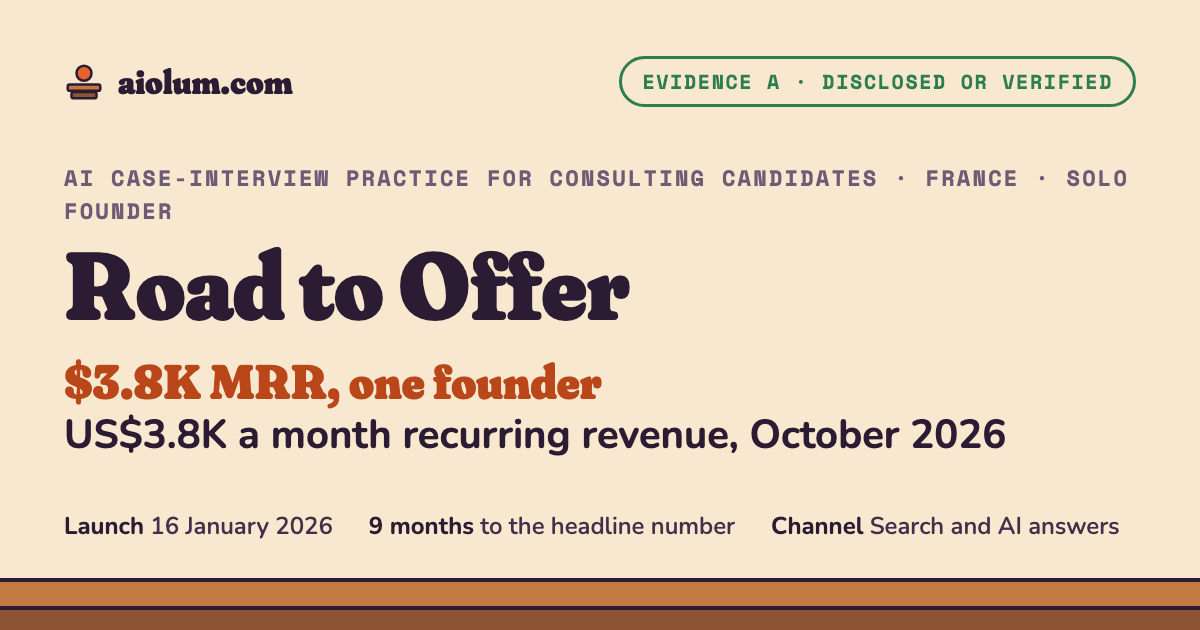
Road to Offer (AI case-interview practice for consulting candidates, France): US$3.8K a month recurring revenue, October 2026. Evidence grade A: disclosed by a company or a filing, or verified by a payment processor. Team: 1 founder, who wrote that he works full time elsewhere, with former consultants reviewing the content. Launched 16 January 2026; still running, revenue growing.Added 25 October 2026
- Outcome
- US$3.8K a month recurring revenue, October 2026Revenue growing
- Evidence
- A disclosed by a company or a filing, or verified by a payment processor
- Launch
- 16 January 2026
- Status
- Still running
- Team
- 1 founder, who wrote that he works full time elsewhere, with former consultants reviewing the content
- Outside funding
- None reported
- Group
- Learning and study
- Main channel
- Search and AI answers
Road to Offer sells practice for the case interview, the interview format of strategy consulting firms: the interviewer describes a business problem, for example a falling profit, and the candidate must structure it, ask for data, do the calculations out loud and give a recommendation. On Road to Offer an AI interviewer, a language model that is instructed to act like a consulting interviewer, asks the questions, shows charts and tables, pushes back and then writes a debrief that scores 7 skills. The site has 71 practice cases, more than 550 short drills and practice versions of 8 online assessments, the tests and games that firms send before the first interview.
The founder is Esteban Ronsin. The company's pages say that he worked at Deloitte and then in strategy consulting at Accenture, and that former McKinsey, BCG and Bain consultants review the cases and the grading. TrustMRR gives 16 January 2026 as the founding date. TrustMRR is a site that reads a startup's revenue directly from its payment provider; here the provider is Stripe, connected with an API key. On 25 October 2026 it showed US$3,758 of monthly recurring revenue (MRR, the subscription revenue that repeats every month) from 85 active subscriptions, US$5,575 of revenue in the last 30 days and US$18,436 in total. Monthly revenue rose from US$79 in February 2026 to US$4,524 in August and US$4,923 in October up to the 25th.
The revenue figures on this page are grade A because they come from the payment provider through TrustMRR. The team, the founder's background and the user counts are the company's own statements. The business has been listed for sale on TrustMRR since 13 May 2026 at US$100,000. The page also shows five failed companies that sold test preparation, tutoring or job-seeker tools before a model could play the examiner.
How much revenue does Road to Offer make?
Each row shows the evidence grade and the source numbers from the list at the end of this page. The grades are explained in How Aiolum verifies.
| Fact | Value | Grade | How we know | Sources |
|---|---|---|---|---|
| Monthly recurring revenue, 25 October 2026 | US$3,758 | A | TrustMRR, read from Stripe through an API key. Revenue last synced 25 October 2026. MRR growth over the last 30 days: +33.5%. | [1] |
| Active subscriptions, 25 October 2026 | 85 | A | TrustMRR, from the same Stripe connection. | [1] |
| Average MRR per subscription | about US$44 | calc | Calculated: 3,758 divided by 85 equals 44.2. Close to the US$49 monthly price; yearly plans count as US$20.75 a month. | [1, 3] |
| Revenue run rate | about US$45,000 a year | calc | Calculated: 3,758 times 12 equals 45,096. This counts only subscriptions. One-time packs and sprints come on top. | [1] |
| Revenue, last 30 days to 25 October 2026 | US$5,575 | A | TrustMRR. Growth over the previous 30 days: +58.5%. It includes one-time purchases, so it is higher than the MRR. | [1] |
| Monthly revenue, February to June 2026 | US$79, US$256, US$971, US$526, US$1,389 | A | TrustMRR monthly timeline. | [1] |
| Monthly revenue, July to October 2026 | US$2,246, US$4,524, US$3,523, US$4,923 | A | TrustMRR monthly timeline. The October value covers 1 to 25 October only. | [1] |
| Revenue, all time to 25 October 2026 | US$18,436 | A | TrustMRR. The last 12 months and all time are the same figure, so all revenue is from 2026. | [1] |
| Share of all revenue earned in the last 3 months | 71% | calc | Calculated: 13,088 (last 3 months on TrustMRR) divided by 18,436 equals 0.71. | [1] |
| September compared with August 2026 | 22% lower | calc | Calculated: 3,523 divided by 4,524 equals 0.78. October passed August within 25 days. | [1] |
| Founding date | 16 January 2026 | C | Entered by the founder on TrustMRR. The first verified revenue is in February 2026. | [1] |
| Team | 1 founder | C | The about page names Esteban Ronsin as founder and the only member of the team section; former consultants build and review the cases and the grading. TrustMRR gives no team size. | [4, 5] |
| Outside funding | none reported | C | No source mentions investors or a funding round. The seller wrote on TrustMRR that he is working full time and has no time to grow the business. | [1, 4] |
| Profit margin, last 30 days | 90% | C | A TrustMRR snapshot. TrustMRR lists revenue, MRR, customers, subscriptions and churn as payment-verified; costs are not in that list, so this page grades the margin C. | [1] |
| Visitors, last 30 days | 8,937 | B | TrustMRR, from the DataFast analytics API. The profile shows US$0.10 of revenue per visitor, but 5,575 divided by 8,937 equals 0.62, so the two figures do not agree. | [1] |
| Asking price | US$100,000 | C | Listed for sale on TrustMRR since 13 May 2026. TrustMRR shows 12 offers received. | [1] |
| Asking price as a multiple of yearly revenue | 1.5 times | calc | Calculated: 100,000 divided by (5,575 times 12, which is 66,900) equals 1.49. TrustMRR shows the same 1.5x. | [1] |
| Practice content | 71 cases, 550+ drills, 8 test formats | C | Home page. The stats page counts 631 drill records, 540 of them active, and 61 cases that work in voice mode. | [2, 6] |
| Candidates reached and practice sessions | 14,000+ candidates, 30,000+ sessions | C | Company stats page, updated 9 June 2026. TrustMRR's own field for estimated users shows 0. | [6, 1] |
| Blog pages in the sitemap | 596 | calc | Calculated: count of the /blog/ addresses among 693 addresses in sitemap.xml, read 25 October 2026. | [11] |
| In-app rating | 4.5 out of 5 from 242 ratings | C | Ratings in the 90 days before 20 September 2026, as stated by the company. It says this is not a Trustpilot score. | [15] |
| Months from founding date to the headline figure | 9 | calc | Calculated: January 2026 to October 2026. | [1] |
How to read this table: a grade A value was read from the company's Stripe account by TrustMRR. A grade B value is visible in a public file or a public register. A grade C value is a statement by the founder or by the company's own pages. A "calc" value was computed on this page from the rows above it.
| Plan | Per month, billed yearly (US$) | Per month, billed monthly (US$) | Limit |
|---|---|---|---|
| Free | 0 | 0 | One full case with a scored debrief, daily drills, one resume review, one run in each test simulator |
| Monthly Pro | 49 | Unlimited cases, drills, voice practice and Coach chat | |
| 90-Day Sprint | 120 one-time | 90 days of Pro, with the Casey, CCA and SOVA test practice included | |
| Annual Pro | 20.75 | US$249 a year, all test practice included, even McKinsey Solve | |
| Behavioral Unlimited | 39 | Behavioral and fit interview practice | |
| Solve Pack | 79 one-time | Every McKinsey Solve practice game | |
| Casey, BCG | 69 one-time | Chatbot case simulations | |
| CCA, BCG | 49 one-time | Six timed numerical simulations | |
| Bain prep | 49 one-time | SOVA-style and TestGorilla-style practice, 238 original questions |
Every paid plan includes unlimited cases, drills, voice practice and Coach chat. The 90-Day Sprint showed a recruiting-season offer: US$120 instead of US$199. The test packs are one-time purchases with lifetime access; the Casey pack carries a refund of 50% if the candidate does not pass BCG's Casey test, under conditions in the terms. Subscriptions without a free trial can be refunded within 7 days if fewer than 2 full cases and 10 drills were used.
When did Road to Offer launch, and how did it grow?
From the founding date to US$3,758 of monthly recurring revenue in 9 months. Each entry carries its grade.
- 16 January 2026CFounding date entered on TrustMRR. The company's pages say the founder came from Deloitte and from strategy consulting at Accenture. [1, 4]
- February 2026AFirst verified revenue: US$79. The sitemap's oldest last-changed dates are from 5 February 2026. [1, 11]
- April 2026AUS$971 of revenue in the month. [1]
- 13 May 2026CThe founder lists the business for sale on TrustMRR. The asking price on 25 October is US$100,000. [1]
- 9 June 2026CThe company's stats page claims more than 14,000 candidates reached and more than 30,000 practice sessions. [6]
- July 2026AUS$2,246 of revenue, the first month above US$2,000. [1]
- August 2026AUS$4,524 of revenue. From 11 August the Casey test pack carries a guarantee: pass BCG's Casey test or get 50% back. [1, 7]
- September 2026AUS$3,523 of revenue. The terms and the privacy policy are updated on 27 and 25 September. [1, 7, 8]
- 25 October 2026AUS$3,758 of MRR from 85 subscriptions, US$5,575 in the last 30 days, US$4,923 in October so far. [1]
Why did Road to Offer work?
Four causes, in the order they mattered. Each one is a reusable lesson.
A narrow interview with a high price of failure
The product serves one kind of interview at one kind of employer. The about page compares it with private coaches who charge US$100 to US$300 an hour; the home page frames the price against a consulting salary. The home page says candidates need dozens of repetitions, which would cost hundreds or thousands with live coaching.
The model plays the interviewer
A case interview needs a second person who knows the case, asks follow-up questions and judges the answer. Peer platforms match two candidates, and the feedback depends on the partner. Here a language model takes that role and scores every case on the same 7 skills. The privacy policy names OpenRouter and Groq for AI processing and voice transcription, and OpenAI for fallback and voice audio.
Search pages as the sales channel
The seller's message on TrustMRR describes the business as "SEO driven automatic marketing" and claims a number 1 ranking in AI assistants. The sitemap lists 596 blog pages about firms, frameworks and tests, plus free drills, calculators and one free run of each test simulator. The home page even asks visitors to ask ChatGPT, Claude or Perplexity whether the product is worth it.
Prices shaped by the recruiting season
Candidates prepare for a few months and then stop. Next to the monthly plan, the site sells a 90-day sprint, a yearly plan and one-time packs for each firm's online test, so a candidate can pay once for one season. In the last 30 days the revenue was US$5,575 while the MRR was US$3,758. The difference comes from payments that are not monthly, such as sprints, packs and yearly plans paid in advance; this is this page's reading, not a TrustMRR figure.
How it was built
These details come from the TrustMRR profile, the company's privacy policy and its public pages. They are grade C, except the payment provider, which TrustMRR confirms. [1, 8, 9, 10, 11]
- Next.js for the web app, according to the TrustMRR technology list, which also names React Native. The privacy policy names Vercel for hosting; TrustMRR also lists Railway.
- Supabase for the database and login, Stripe for payments, Sentry for error monitoring, PostHog for product analytics and session replay, Resend for email and Crisp for support chat.
- OpenRouter and Groq for the model calls and voice transcription, and OpenAI for fallback paths and voice audio. The voice mode lets the candidate speak the case out loud; the Casey practice records a 60-second spoken recommendation and scores it from a transcript.
- The cases and test simulations are original content. The McKinsey Sea Wolf page says it is built from public information about the format and does not reproduce confidential McKinsey questions.
- About 600 blog pages in English, plus French, Spanish and German home pages, for search engines and AI assistants. Ahrefs, Google Ads and Microsoft Advertising appear in the privacy policy for analytics and advertising measurement.
- Self-serve only: support by email and a contact form, with no scheduled calls.
Tools named in the sources
Each one opens its page in the Tools tab, with every story that uses it.
Who tried this before Road to Offer, and why did they fail?
Five companies in the Loot Drop database sold test preparation, tutoring or tools for job seekers before a language model could act as the examiner. The values below are from that database and are not independently verified.
Grockit
The promiseSocial, game-like preparation for the SAT, GMAT and other standardized tests, where students study together and get personalized feedback.
Why it diedThe database says Kaplan bought it in 2013 and the product faded inside the larger company. The database lists competition as the cause.
Tutorspree
The promiseAn online marketplace that matched students with good tutors.
Why it diedIt never reached enough tutors and students for the matching to work, and it faced many competitors.
TutorCloud
The promiseOn-demand online tutoring, one student and one tutor at a time.
Why it diedIt could not keep tutors or students and did not grow. The database describes the service as an expensive video call with homework help.
LearnUp
The promiseShort training modules that prepared job seekers for specific employers and connected them to those employers.
Why it diedLinkedIn Learning and Coursera offered more content to the same people with much more money.
Jobspice
The promiseA tool that made professional-looking resumes quickly for job seekers who are not designers.
Why it diedIt sold one narrow feature, and LinkedIn and free resume tools offered the same thing.
The failed startups come from Loot Drop, a free database of dead startups, retold here in our own words. Loot Drop describes its entries as AI-assisted summaries of public sources, so these cards carry no evidence grade.
What changed
Before language models, interview and test practice needed a second human. Grockit put students together online, Tutorspree and TutorCloud matched each student with a paid tutor, and peer platforms for consulting cases still match two candidates who grade each other. Each practice session cost a person's time, so the business either charged coach prices or depended on enough users being online together.
A language model can now read a case, play the interviewer, check the arithmetic and write a debrief at almost no cost per session. That lets one founder sell unlimited practice for US$49 a month and still report a 90% margin to TrustMRR. What the founder still has to supply is the domain knowledge: original cases, a grading scale that matches real interviewers, and hundreds of guide pages that bring candidates in from search.
Can one person copy Road to Offer now?
The pattern, yes. This exact market is crowded.
The Casey page alone compares Road to Offer with five other paid Casey simulators, and the about page names PrepLounge, RocketBlocks and Management Consulted as alternatives. The copyable part is the shape: an AI examiner for one high-stakes interview or exam, original content written by someone from that field, one-time season packs, and a large set of search pages.
Where it is still open: Similar case-style interviews exist outside the big three firms: product manager interviews, investment banking technical interviews, medical school multiple mini interviews and civil service assessment centres. Most of them still rely on human coaches and peer practice.
- 1Pick one interview or exam where candidates already pay coaches by the hour, and where you know the format from the inside.
- 2Let the model play the examiner and score every attempt on a fixed scale; write the cases and the scale yourself, with people from the field.
- 3Give one full attempt free, then sell monthly access plus one-time packs that match the length of the season.
- 4Write a guide page for every firm, test and question type that candidates search for, and put free tools on them.
- 5Keep practice clearly separate from the real test: the terms here forbid using the service to break exam or recruiting rules.
What could go wrong for Road to Offer?
The risks are the mirror image of the causes above.
No legal entity on the legal pages
The terms say the service is operated by "Road to Offer" and give no legal form. The privacy policy, last updated 25 September 2026, still shows "[ENTITY-TODO: legal entity name + form]" in place of the data controller. The site has no French legal notice (mentions légales) page, and a search of the French company register for "Road to Offer" returned no company. The founder is named on the about page, the founder page and the TrustMRR profile.
For sale
The founder has listed the business on TrustMRR since 13 May 2026, now at US$100,000, and wrote that he works full time and lacks time to grow it. A buyer may change the prices, the content or the people behind the grading.
Salary framing
The home page headline says "Prep for your $150K+ consulting career", and a calculator titled "See how much you'll earn" shows first-year pay at each firm (for example US$134,500 total for a McKinsey Business Analyst) against the cost of preparation, ending with "One offer and it pays for itself on day one." These are salary figures for the consulting jobs, not income from the product, but no product can promise an offer.
Formats owned by others
The simulators copy the format of tests that McKinsey, BCG and Bain run. The site says it is not affiliated with these firms and that formats change between offices and recruiting cycles, so each change requires new work.
A short and seasonal history
There are nine months of revenue. September 2026 was 22% below August before October recovered, and consulting recruiting has seasons. One strong season does not show what a full year looks like.
Numbers that do not agree
TrustMRR shows US$0.10 of revenue per visitor, but its own revenue and visitor figures give US$0.62. The seller's message gives a domain rating of 26; the profile's synced value is 32. TrustMRR's estimated user count is 0, while the company claims 14,000 candidates. The company gives 400+, 500+ and 590 for its number of guides on different pages.
Sources
The grade next to each source is the best grade that the source can support. "Read in full" means that the text of the page was downloaded and the numbers were checked in it.
- A TrustMRR markdown profile: Road to offer, revenue synced 25 October 2026Read the markdown profile, live on 25 October 2026. Revenue, MRR and subscriptions are read from Stripe through an API key (grade A). The description, founding date, seller message, asking price and technology list are entered by the founder (grade C).
- C Road to Offer home pageRead in full, 25 October 2026. Source for the product, the plan prices, the FAQ that names the founder, and the salary headline.
- C Road to Offer pricing pageRead in full. The monthly price loads by script; the page text gives US$120 for 90 days and US$249 a year.
- C Road to Offer about pageRead in full. Source for the team section, the content reviewers, the alternatives, the Behavioral Unlimited price and the refund terms.
- C Founder page: Esteban Ronsin, Founder of Road to OfferRead in full. The founder's own account of his background and of who reviews the content.
- C Road to Offer stats page, updated 9 June 2026Read in full. Company claims on candidates, practice sessions, drills and guides.
- C Road to Offer Terms and Conditions, last updated 27 September 2026Read in full. Source for the operator name, the ban on cheating (section 6.2) and the Casey guarantee (section 10.3).
- C Road to Offer Privacy Policy, last updated 25 September 2026Read in full. Source for the processor list (Stripe, Supabase, Vercel, OpenRouter, Groq, OpenAI and others) and for the missing legal entity name.
- C Road to Offer BCG Casey simulator pageRead in full. Source for how the Casey practice is scored, the competitor comparison and the guarantee conditions.
- C Road to Offer McKinsey Sea Wolf simulator pageRead in full. Source for the statement that the simulations are original and do not reproduce confidential McKinsey questions.
- B Road to Offer sitemap.xmlRead in full on 25 October 2026 and counted: 693 addresses, 596 of them under /blog/.
- C Road to Offer home page script with the salary calculatorRead the calculator text and its salary table as plain text, not run. The calculator is hidden in a collapsed section of the home page.
- B French company register search (recherche-entreprises.api.gouv.fr) for "road to offer"Read the result on 25 October 2026: 0 companies found under that name.
- C Loot Drop database export, 1,749 failed startupsLocal export. AI-written summaries, not independently verified. Source for the failed predecessors.
- C Road to Offer candidate reviews pageRead in full. Source for the 4.5 rating and how the company says it was counted.