Specific: Product, team and how it was built
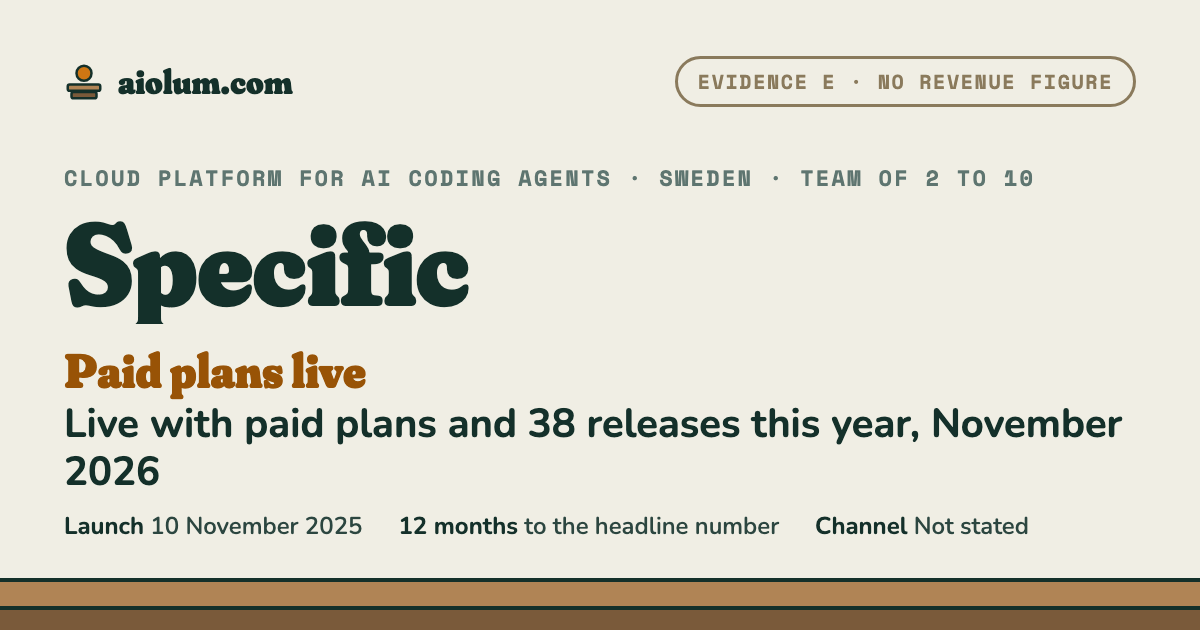
Specific (Cloud platform for AI coding agents, Sweden): Live with paid plans and 38 releases this year, November 2026. Evidence grade E: no revenue figure was checked. Team: 2 founders; Y Combinator lists a team size of 2 in November 2026. Launched 10 November 2025; still running.Added 6 November 2026
- Outcome
- Live with paid plans and 38 releases this year, November 2026
- Evidence
- E no revenue figure was checked
- Launch
- 10 November 2025
- Status
- Still running
- Team
- 2 founders; Y Combinator lists a team size of 2 in November 2026
- Outside funding
- Y Combinator (Fall 2025), 20VC, BLAST and other investors named by the company; amount not published
- Main channel
- Not stated
What is not verified
No revenue figure was found. This page looked for a payment-processor profile, a founder interview with numbers and a press report of the funding round, and found none; the Y Combinator page and the company site give no customer count. A reader could look for a funding announcement or a later founder post with usage or revenue figures. This story is grade E: the business is real and its product, price and customers are described from public pages, but no revenue figure was checked. Aiolum shows it as an idea worth studying, not as proof that it makes money.
Specific is a platform as a service, a cloud service that runs a customer's code and database so the customer does not manage servers. It is built for coding agents, AI programs such as Claude Code that write and run code in a terminal on a developer's request. The agent describes the infrastructure in a file called specific.hcl, tests it with specific dev and ships it with specific deploy.
Fabian Lindfors, who was a tech lead at Stripe for three years, and Iman Radjavi founded it in Stockholm in 2025 and went through Y Combinator's Fall 2025 batch. Their launch post of 10 November 2025 described a different first product: their own agent that generates a backend from a natural-language prompt, offered to AI app builders such as Natively, with a waitlist for a private beta. On 31 March 2026 the changelog says the CLI was rebuilt so that the customer's own agent can use it end to end, and that is the product sold today.
No revenue figure was found. The evidence is that the product is live, that the pricing page lists paid plans, and that the changelog shows 38 dated releases from February to November 2026. Y Combinator lists 2 people.
How much revenue does Specific make?
Each row shows the evidence grade and the source numbers from the list at the end of this page. The grades are explained in How Aiolum verifies.
| Fact | Value | Grade | How we know | Sources |
|---|---|---|---|---|
| Status, November 2026 | live, with self-serve paid plans | C | Pricing page and changelog read on 6 November 2026. The latest changelog entry, 5 November 2026, adds projected bills and usage email alerts for paid plans. | [2, 4] |
| Revenue | not published | E | No payment-processor profile, founder statement or filing with a revenue figure was found. | [5] |
| Founded | 2025, Stockholm, Sweden | C | Y Combinator company page. | [5] |
| Founders | Fabian Lindfors and Iman Radjavi | C | About page and Y Combinator page. Lindfors spent three years at Stripe; Radjavi four years at startups including Fever and Braive. | [3, 5] |
| Team size, November 2026 | 2 | C | Y Combinator page: "Specific has 2 employees based in Stockholm, Sweden." The careers page says the company is looking for engineers. | [5] |
| Funding | Y Combinator Fall 2025, 20VC, BLAST, Inception Fund, Florent Venture Partners, Amino Capital and angels | C | Investors as listed on the about page. No amount is published in a downloaded source. | [3] |
| Launch post | 10 November 2025, 155 votes on Y Combinator Launches | C | The post offered a private beta from a waitlist. The vote count was read on 6 November 2026. | [6] |
| Change of product | 31 March 2026: CLI rebuilt for coding agents | C | Changelog entry "Built for coding agents". The 2025 launch post described Specific's own backend-building agent reached through an MCP server. | [4, 6] |
| Releases in the changelog, 2026 | 38 dated entries, 18 February to 5 November 2026 | C | Counted on this page from the changelog. | [4] |
| Paid plan prices | Pro US$25 a month, Scale US$299 a month, plus usage | C | Pricing page. Each fee includes the same amount of usage credits. | [2] |
| Agent sign-up without a human | since 21 September 2026 | C | An agent can register with specific login --agent, deploy one free project, and a person must claim it within 48 hours or it is deleted. The blog says this uses WorkOS agent registration. | [4, 7] |
| Time from launch post to the November 2026 status | 12 months | calc | Calculated: 10 November 2025 to November 2026. | [4, 6] |
How to read this table: grade C is the company's own statement on its site or on its Y Combinator pages. A "calc" value was computed on this page from rows above it. No revenue figure exists, so the story is grade E.
| Plan | Per month, billed yearly (US$) | Per month, billed monthly (US$) | Limit |
|---|---|---|---|
| Free | 0 | 3 projects, 0.25 vCPU and 512 MB per service, 512 MB database | |
| Pro | 25 | includes US$25 usage credits; unlimited projects, preview environments, custom domains | |
| Scale | 299 | includes US$299 usage credits; SSO membership, protected internal apps, 30-day retention | |
| Enterprise | custom | custom | bring your own cloud, on-premises, SAML and OIDC |
Each paid plan fee includes the same amount in usage credits; usage beyond that is billed by the hour or by the gigabyte (for example US$0.025 an hour for a service with 1 vCPU and 2 GB of memory, US$0.15 per database compute unit and hour). No yearly price is shown. The page offers funded startups up to US$10,000 in credits.
When did Specific launch, and how did it grow?
From a waitlist for a backend-generating agent to a hosting platform that agents use by themselves, in 12 months. Each entry carries its grade.
- 2025CFabian Lindfors and Iman Radjavi found Specific in Stockholm and join Y Combinator's Fall 2025 batch. [5]
- 10 November 2025CLaunch post: an agent that builds and deploys backends from natural language, first for AI app builders such as Natively. A waitlist for a private beta. [6]
- 18 February 2026CFirst dated changelog entry: string interpolation in the specific.hcl config file. [4]
- 31 March 2026CThe CLI is rebuilt so that a coding agent can sign in, run a local environment and deploy by itself. [4]
- 1 April and 4 May 2026CTemporal workflow inspector and billing upgrades, then a usage section and protected environments for internal apps. [4]
- 21 September 2026CAgents can deploy without a human account, and a referral program gives usage credits. [4, 7]
- 5 November 2026CProjected bills and usage email alerts for paid plans. [4]
Why did Specific work?
Four causes, in the order they mattered. Each one is a reusable lesson.
The agent is the user
Every step is a terminal command with text output, so an agent can do it without a browser. The blog shows a Claude Code session that goes from an empty folder to a public URL; the CLI writes instructions into CLAUDE.md, Cursor rules or AGENTS.md so the agent knows the tool.
Documentation inside the binary
The specific docs command prints documentation that matches the installed version, so the agent does not have to guess the config format from its training data.
Building blocks, not a framework
There is no SDK. The app reads plain environment variables, and the config file declares Postgres, storage, services and Temporal workflows. The home page says this avoids platform lock-in.
A free tier the agent can open
An unclaimed agent account can hold one free project for 48 hours. A person who wants to keep it claims it and later pays for usage.
How it was built
These details come from the company's own pages. They are grade C. [1, 4, 7, 2]
- A CLI installed with a shell script, with the commands init, dev, check, deploy, status and login --agent.
- Infrastructure is declared in one HCL configuration file, specific.hcl, which the agent writes.
- Managed Postgres with pgvector, real-time sync, branching for preview environments and Reshape for zero-downtime migrations.
- S3-compatible object storage, and durable workflows powered by Temporal.
- Agent registration through WorkOS. The company's own website runs on Specific.
Who tried this before Specific, and why did they fail?
Four companies in our database of failed startups sold developers a way to skip server work. The values below are from that database and are not independently verified.
Parse
The promiseA cloud backend for mobile and web apps: database, server logic, push notifications and login.
Why it diedFacebook bought it in 2013 and later shut it down, while Firebase grew with Google behind it.
DotCloud
The promiseA platform as a service that handled infrastructure so developers could write code.
Why it diedIts internal container tool became Docker, which made the original hosting business irrelevant.
AppHarbor
The promiseDeploy .NET apps from GitHub without DevOps work.
Why it diedAWS and Azure offered broader platforms, and it was tied to one language stack.
Flotype
The promiseA simple API for real-time messaging in web and mobile apps.
Why it diedFirebase and similar services offered the same thing integrated and cheaper.
The failed startups come from our database of 1,749 dead startups, retold here in our own words. Its entries are AI-assisted summaries of public sources, so these cards carry no evidence grade.
What changed
All four sold a shortcut past server work to human developers, and lost to large cloud providers or to their own better idea. Specific sells the same shortcut, so it meets the same giants: the home page quotes a customer who replaced Vercel, Supabase and Google Cloud with it.
The difference is the user. A coding agent reads text, runs commands and does not want a dashboard, and the large platforms were built for people. Specific bets that the tool an agent finds easiest will win the deploy, and it makes the first deploy possible before any human signs up.
Can one person copy Specific now?
Hard for one person.
A hosting platform needs managed databases, storage, builds, security and on-call operations, and Specific has outside investors to pay for that. The idea that one person can copy is smaller: make an existing developer tool usable by coding agents, with text output, docs in the CLI and agent sign-up.
Where it is still open: Agent-first versions of monitoring, email sending, domain setup, payments setup and database migration tools.
- 1Pick a tool that developers set up by clicking through a dashboard.
- 2Give it a CLI with plain text output and a check command for config mistakes.
- 3Ship the docs inside the CLI and write the agent instruction files for Claude Code, Cursor and Codex.
- 4Let an agent start a free trial without a human, with limits and an expiry.
What could go wrong for Specific?
The risks are the mirror image of the causes above.
What is not verified
No revenue figure was found. This page looked for a payment-processor profile, a founder interview with numbers and a press report of the funding round, and found none; the Y Combinator page and the company site give no customer count. A reader could look for a funding announcement or a later founder post with usage or revenue figures.
The first product changed
The November 2025 launch post described Specific's own agent that generates backends from prompts. Since March 2026 the product is infrastructure that the customer's agent drives. The pages read for this story do not say whether Specific still runs its own AI model.
Testimonials not checked
The home page quotes named founders and engineers, one of whom says Specific powers tens of thousands of backends for his users' apps. These quotes were not checked with the people named.
Competition and dependence on agent makers
Specific competes with Vercel, Supabase and Google Cloud, which its own testimonials name, and on this site it is closest to Metorial, another infrastructure layer for AI agents. Its demand depends on coding agents from Anthropic, Cursor and OpenAI, whose makers could ship their own hosting; the blog walks through Claude Code, Cursor and Codex.
Sources
The grade next to each source is the best grade that the source can support. "Read in full" means that the text of the page was downloaded and the numbers were checked in it.
- C Specific home page: The cloud platform built for coding agents, read 6 November 2026Read in full. Source for the product, the building blocks and the testimonials.
- C Specific pricing page, read 6 November 2026Read in full. Source for the plans and usage prices.
- C Specific about page: Why we're building SpecificRead in full. Source for the founders' background and the investors.
- C Specific changelog, 18 February to 5 November 2026Read in full. Source for the release dates, the agent CLI change and the billing features.
- C Y Combinator company page: SpecificRead in full, including the page description. Source for the founding year, location, batch and team size of 2.
- C Y Combinator Launches, 10 November 2025: Specific: production-ready backends from natural languageRead in full. The founders' launch post. Source for the first product, the waitlist and the vote count.
- C Specific blog, Iman Radjavi, 26 September 2026: Let Your Coding Agent Deploy Without Creating an Account FirstRead in full. Source for the CLI commands, the agent instruction files and WorkOS agent registration.
- C Database of failed startups, local exportLocal export. AI-written summaries, not independently verified. Source for the failed predecessors.
Run this company? Send corrections or a verified figure to aiolum@livyden.com