Vid.AI
Vid.AI makes faceless videos: videos in which no person appears on camera. The customer types an idea or pastes a script. A language model writes the script, a text to speech model, which is software that turns text into a human-sounding voice, reads it, stock footage or AI images fill the screen, and the service adds captions and music and renders a vertical short or a horizontal video of up to 20 minutes. Plans cost US$39, US$99 or US$199 a month and include credits, units that are used up as videos are made. There is no free plan.
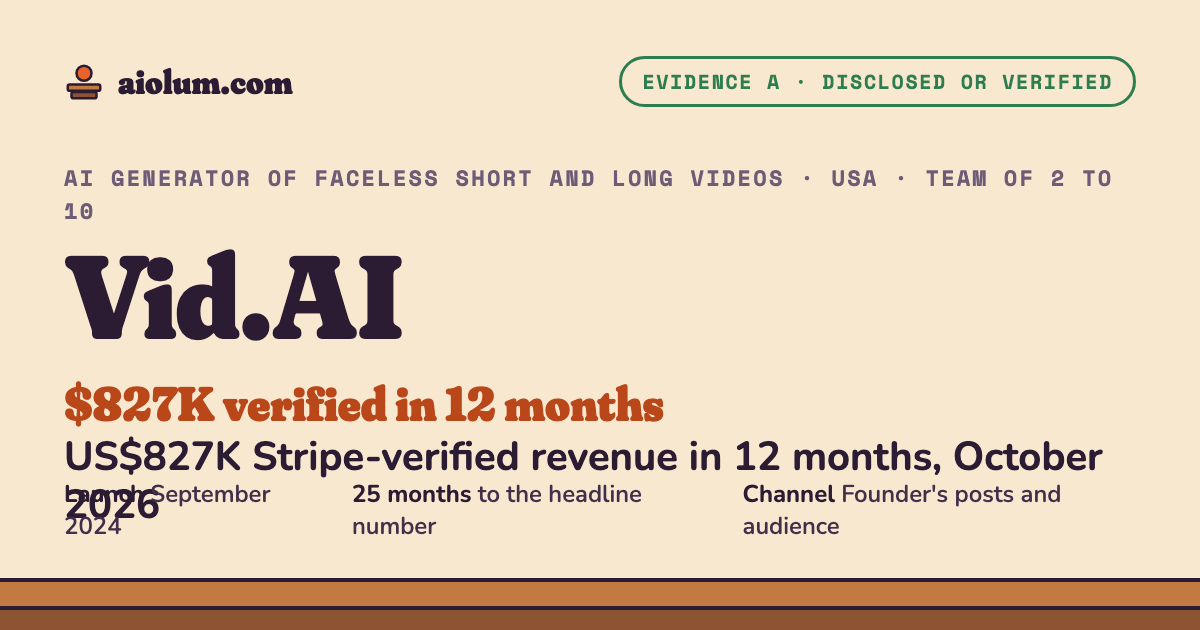
Priyam Raj, an engineer in Bangalore who sold two earlier products while he was a student, runs the product. His co-founder Matt Par, an American YouTuber, is the chief executive. Paid plans began on 27 September 2024, and the founder writes that the first day brought US$14,000 and the first month US$90,000. TrustMRR, a site that reads revenue from a company's payment processor, shows US$826,663 received through Stripe in the 12 months to 13 October 2026 and US$1,632,538 since the first payment. The same data shows a fall: US$89,846 in January 2026, US$41,609 in September 2026 and US$39,028 in the last 30 days. MRR, monthly recurring revenue, the value of all active subscriptions for one month, is US$47,175 from 715 subscriptions. The founders have offered the company for sale since August 2025, and it is listed on TrustMRR for US$1,500,000.
The revenue figures on this page are grade A: TrustMRR read them from the Stripe account through an API key. The team, the costs, the marketing and the price of the domain are founder statements, grade C. Three similar products are already on this site, Faceless.video, AutoShorts.ai and Revid.ai, and all three rest on figures reported by their founders. This page adds monthly revenue verified by the payment processor for the same category, including the months in which it fell.
The numbers, graded
Each row shows the evidence grade and the source numbers from the list at the end of this page. The grades are explained in How Aiolum verifies.
| Fact | Value | Grade | How we know | Sources |
|---|---|---|---|---|
| Revenue in the 12 months to 13 October 2026 | US$826,663 | A | TrustMRR, read from the Stripe account by API key, synced 13 October 2026 at 14:07 UTC. The copy cached one day earlier showed US$826,218 for its own 12 months. This is the headline figure on this page. | [1] |
| Revenue since the first payment | US$1,632,538 | A | The all-time line of the profile. The profile gives 24 September 2024 as the founding date. | [1] |
| Revenue in the last 30 days, at 13 October 2026 | US$39,028 | A | Same profile. Change against the 30 days before: minus 15.2%. Last 7 days: US$9,573. The best day of the 30 was US$2,312 and the worst US$406. | [1] |
| Revenue in the last 3 months and the last 6 months | US$137,504 and US$347,623 | A | Same profile. | [1] |
| Revenue by month, November 2025 to September 2026 | Nov US$53,970; Dec US$84,294; Jan US$89,846; Feb US$89,123; Mar US$84,934; Apr US$82,626; May US$83,979; Jun US$61,905; Jul US$54,471; Aug US$52,082; Sep US$41,609 | A | TrustMRR monthly table. October 2026 to the 13th: US$14,922. Months before November 2025 are not public. | [1] |
| MRR and active subscriptions | US$47,175 a month; 715 subscriptions | A | TrustMRR snapshot at the same sync. The profile reports the MRR change over 30 days as minus 27.3% and does not publish how it calculates MRR or that change. | [1] |
| Average month, by period | US$68,889 over 12 months; US$57,937 over 6 months; US$45,835 over 3 months | calc | Calculated: 826,663 divided by 12; 347,623 divided by 6; 137,504 divided by 3. | [1] |
| Last 30 days against the average month of the last twelve | 43.3% lower | calc | Calculated: US$39,028 against US$68,889. | [1] |
| Best month against the last full month | minus 53.7%, from US$89,846 in January 2026 to US$41,609 in September 2026 | calc | Calculated. The largest fall in one month was June 2026: minus 26.3% from May. The six months from December 2025 to May 2026 average US$85,800; the four months from June to September 2026 average US$52,517. | [1] |
| The two halves of the last 12 months | US$479,040, then US$347,623: minus 27.4% | calc | Calculated: 826,663 minus 347,623 gives the first six months. | [1] |
| Revenue before the last 12 months | US$805,875, about US$64,000 a month | calc | Calculated: 1,632,538 minus 826,663, over the 384 days from 24 September 2024 to 13 October 2025. The business was therefore about as large in its first year as in its second. | [1] |
| MRR against the cash of the last 30 days | MRR is US$8,147 higher, 20.9% | calc | Calculated: 47,175 minus 39,028. Both figures carry the same sync time, and the copy of the day before shows the same gap, so a sync difference does not explain it. The sources support three causes and give no size for any of them. Yearly plans exist, and MRR in its usual definition counts one twelfth of a yearly plan each month while the cash arrives once a year. New monthly subscribers can pay half price in the first month. The privacy policy names a service that pauses subscriptions and sends reminders for failed payments, and a paused or unpaid subscription brings no cash. | [1, 12, 14] |
| MRR per active subscription | US$65.98 | calc | Calculated: 47,175 divided by 715. It lies between the Starter price of US$39 and the Plus price of US$99. | [1, 12] |
| Stripe gross volume by year, founder's image | US$823,000 from 21 July 2025 to 21 July 2026; US$729,000 in the 12 months before | C | Image of his Stripe dashboard in the post of 21 July 2026. The earlier period starts before the launch, so its US$729,000 was collected in about ten months. Together with TrustMRR's later months, these gross figures are about 3% above TrustMRR's all-time total; gross volume is counted before refunds. | [2, 1] |
| First day and first month, by the founder | US$14,000 on the first day; US$90,000 in the first month | C | Founder's post of 21 July 2026, written 22 months after the launch. No post from the launch weeks could be read. The chart in the same image shows a first peak of about US$12,000 in one day. | [2] |
| Gross volume from 1 January to 9 July 2025 | US$438,222.29 | C | Image of his Stripe dashboard in the post of 9 July 2025, which gives the amount as 3.4 crore rupees (34 million rupees) and adds "zero investors". | [5] |
| MRR in the founder's Stripe images | US$44,003.77 on 17 August 2025; US$42,361.49 on 4 September 2025; US$52,254.92 on 4 September 2026 | C | Images in the posts of 19 August 2025 and 4 September 2026. The second chart shows two highs close to US$80,000: one about three months after the launch and one early in 2026. The values of the highs were read from the chart and are approximate. From 4 September 2026 to the TrustMRR figure of 13 October 2026, MRR fell 9.7%. | [3, 4, 1] |
| Subscriber churn rate, 27 July to 17 August 2025 | 22.31%; 27.53% in the period before | C | Stripe image in the post of 19 August 2025. Churn is the share of subscribers who cancel in a period. The image does not state the length of that period. | [4] |
| Revenue that came through affiliates | US$175,029.94 by 22 September 2026 | C | Image of the affiliate dashboard (Tolt) in the founder's post. On 12 November 2025 he wrote that affiliates had brought more than US$100,000 in 12 months. The program pays 33% of every payment for as long as the customer stays, with a 60-day tracking period. | [6, 15] |
| Affiliate share of all revenue | about 10.7% | calc | Calculated: 175,029.94 divided by 1,632,538, if both figures cover the whole life of the product. Checkouts outside Stripe would change this share. | [1, 6] |
| Paid advertising | Meta ads; spending not published | C | Founder's reply of 4 September 2026: "Currently we've just been doing Meta Ads". The TrustMRR profile lists Meta Ads and Influencers as marketing channels. No source gives the ad budget or the cost of winning one customer. | [3, 1] |
| Price of the domain vid.ai | US$47,000 | C | Founder's posts of 24 October 2025 and 21 July 2026. No source names the seller. A capture of 13 July 2022 in the Internet Archive reads "vid.ai is for sale". The October 2025 post says he bought the domain "this year", but the archive lists captures that answered normally at vid.ai from October 2024, and the company's changelog dates the product from July 2024. The purchase date is not verified. | [2, 9, 19] |
| Asking price and offers | US$1,500,000; 38 offers received; not sold | C | TrustMRR listing, first listed 15 September 2026. The seller sets the price. On 16 September the founder posted an image of an offer notice for US$1,500,000, and on 7 October an image of a payment page that reads US$2,500,000. | [1, 7] |
| Asking price against revenue | 1.8 times the last 12 months; 3.2 times the last 30 days taken for a year | calc | Calculated: 1,500,000 divided by 826,663, and by 39,028 times 12 (468,336). The profile shows the second figure as its revenue multiple. | [1] |
| Profit margin, last 30 days | 69.0% | C | TrustMRR snapshot. Profit margin is not among the metrics that the profile says it reads from the payment provider, and the seller's note on the listing says "Excludes owner distributions". At that margin the last 30 days would leave about US$26,900. | [1] |
| Hosting bills | US$998.00, US$968.00 and US$1,002.64 for June, July and August 2026; about US$120 expected for September | C | Images in the founder's posts of 4 and 26 September 2026, after a move from Render to Railway. These are server bills only. The cost of the AI models is not published. | [10] |
| Visitors in the last 30 days | 46,286; US$0.84 of revenue per visitor | A | TrustMRR snapshot; the profile marks the Google Analytics API as connected. | [1] |
| Sign-ups against paying subscriptions | more than 226,000 sign-ups; 715 active subscriptions, about 0.3% | calc | Calculated from the founder's post of 26 September 2026 (grade C) and the TrustMRR subscription count (grade A). The company's site says 100K+ creators. | [1, 7, 12] |
| Price per video inside a plan | US$0.98 per one-minute short on Starter; US$1.24 on Plus; US$0.66 on Pro | calc | Calculated: the monthly price divided by 40, 80 and 300 shorts. A ten-minute video costs US$9.75, US$12.38 or US$6.63 in the same way. | [12] |
| List prices of the rented models | Veo 3.1 Fast: US$0.10 per second of 720p video; ElevenLabs speech: US$0.08 per 1,000 characters | C | The providers' own price pages, read 13 October 2026. Vid.AI does not publish what it pays, and it may buy the models through another provider at another price. | [22, 23] |
| Model cost of one minute at list prices | US$6.00 for 60 seconds of generated video; about US$0.07 for one minute of narration | calc | Calculated: 60 times 0.10; and 900 characters times 0.08 divided by 1,000, if one minute is 150 words of 6 characters. A one-minute short sells for US$0.98 on Starter, so a plan cannot pay for videos generated entirely by a video model. | [12, 22, 23] |
| The founder's public figures against the verified ones | "around $90k a month" on 9 July 2026, when June was US$61,905; "$70k/mo" in his profile on 13 October 2026, when the last 30 days were US$39,028 | C | The post and the profile text are his own. The comparison uses the TrustMRR figures. Sales through Digistore24 or Lemon Squeezy are not in the Stripe figure, and their size is not published. | [11, 1] |
| Team | 2 co-founders and a development team of unstated size | C | The founder's site names "my co-founder Matt". Matt Par's profile on X reads CEO of TubeMagic and VidAI. LinkedIn lists 2 employees, Priyam Raj and Matt Par. The TrustMRR profile says 2 to 5 people. On 1 October 2026 the founder wrote "My entire dev team", and from January to March 2026 he looked for one more developer at 80,000 to 90,000 rupees a month. | [1, 10, 16, 17, 18] |
| Legal entity | VidAI LLC | C | Named in the terms and the privacy policy, last updated 27 September 2026. Neither page gives a state of registration or an address. TrustMRR shows the country as US. The founder's site says that his own holding company, Priyam Ventures, is in India. | [1, 14, 16] |
| Outside funding | none | C | "zero investors" in the post of 9 July 2025; "Bootstrapped" on the TrustMRR profile, which the founder writes. | [1, 5] |
| Time from the first paid plans to the October 2026 figure | 25 months | calc | Calculated: September 2024 to October 2026. | [1, 13] |
How to read this table: a grade A value was read by TrustMRR from the company's Stripe account through an API key, or from its Google Analytics account, last synced on 13 October 2026 at 14:07 UTC. A grade C value is a statement by a founder, an image of his own dashboard, or a page of the company. A "calc" value was computed on this page from the rows above it. Grade A covers money received in that Stripe account. It does not cover sales through Digistore24 or Lemon Squeezy, which the privacy policy also names, and it does not cover costs, margin or profit.
| Plan | Per month, billed yearly (US$) | Per month, billed monthly (US$) | Limit |
|---|---|---|---|
| Starter | 30.75 | 39 | 40 one-minute shorts or 4 ten-minute videos; video models Seedance 1 Pro Fast and Wan 2.2 |
| Plus | 78.92 | 99 | 80 shorts or 8 ten-minute videos; adds Veo 3.1 Fast, Seedance 2.5, Kling 2.5 Turbo Pro and HD images |
| Pro | 159.92 | 199 | 300 shorts or 30 ten-minute videos; priority support; shown next to a crossed-out US$299 |
A yearly plan costs US$369, US$947 or US$1,919, which is 20% to 21% less than twelve monthly payments, and the whole year of credits is given at the start. The page says plans carry 200 to 1,500 credits a month, and it states each allowance two ways: as one-minute shorts or as ten-minute videos, drawn from the same credits. All plans allow videos of up to 20 minutes. New subscribers on monthly plans can get 50% off the first month. Extra credits can be bought. Unused credits are refunded within 30 days of a payment. There is no free plan and no free trial; the page gives the reason: "Every video costs us real compute to generate". Checkout runs through Stripe, and the privacy policy also names Lemon Squeezy and Digistore24.
The timeline
From the first paid plans to about US$85,000 a month, then four monthly falls in a row and a listing for sale, in 25 months. Each entry carries its grade.
- 2019 to January 2024CPriyam Raj builds Timenite, a website, in 2019, and then Morise.ai, AI software for YouTube creators, while he studies computer science. His site says both were acquired, Timenite in 2023 and Morise.ai in January 2024, when he was 21. [16]
- 13 July 2022CA capture of vid.ai in the Internet Archive reads "vid.ai is for sale". [19]
- 31 July to 18 September 2024CThe changelog begins on 31 July with captions timed to the narration. The editor for faceless shorts arrives on 9 September, a home page with prices on 13 September, and gameplay backgrounds on 18 September. [13]
- 24 to 27 September 2024CTrustMRR gives 24 September as the founding date. On 27 September the changelog records subscription plans with monthly credits. The founder later writes that the first day brought US$14,000 and the first month US$90,000. [1, 2, 13]
- January and February 2025CTubeMagic, the pair's other product for YouTubers, is at more than US$1 million of annual recurring revenue on 10 January and US$1.5 million on 15 February, by the founder's posts. The first post excludes US$200,000 to US$300,000 a year sold through Digistore24. [11]
- June 2025CThe Vid.AI editor appears on screen in the segment "AI Slop" of Last Week Tonight with John Oliver on HBO. The founder posts a screenshot of the segment and his Stripe chart of that day. [8]
- 9 July 2025CThe founder posts US$438,222.29 of gross volume since 1 January, with "zero investors". [5]
- 15 July 2025CYouTube renames its rule on repetitious content to inauthentic content and states that it covers content that is repetitive or mass-produced, which cannot earn ad money. [20]
- 19 August 2025CFirst public offer to sell: "We're looking to sell Vid.AI". The attached Stripe images show MRR of US$44,003.77 and a subscriber churn rate of 22.31%. [4]
- 2 November 2025AThe founder announces the listing on TrustMRR, with the Stripe account connected. Revenue of November, read from Stripe: US$53,970. [1, 11]
- December 2025 to May 2026ASix months between US$82,626 and US$89,846. January 2026 is the best month in the public data. [1]
- 28 January to 11 March 2026CThe founder looks for a developer for the video rendering code, at 80,000 to 90,000 rupees a month, remote. [10]
- June 2026ARevenue falls 26.3% in one month, to US$61,905. No source states the cause. [1]
- 21 July 2026CThe founder writes that the company is "formally open to acquisition conversations" and gives MRR of about US$65,000. His Stripe image shows US$823,000 of gross volume in 12 months. July revenue on TrustMRR is US$54,471. [1, 2]
- 4 September 2026CHe looks for an agency or operator to "turn around a ~$50k MRR AI SaaS" and writes that the only marketing at that time is Meta ads. Hosting moves from Render to Railway. [3, 10]
- 15 to 30 September 2026CListed for sale on TrustMRR at US$1,500,000 on 15 September. The changelog records 20 releases in the month, against 2 in August: animated avatars, a connection that lets Claude or ChatGPT make videos, more languages. The terms and the privacy policy are updated on 27 September. September revenue is US$41,609. [1, 7, 13, 14]
- 7 October 2026C"vid.ai is for sale", with an image of a payment page that reads US$2,500,000. [7]
- 13 October 2026ATrustMRR sync: US$39,028 in the last 30 days, MRR US$47,175, 715 subscriptions, 38 offers received, still listed. The site is online and its changelog has an entry for this day. [1, 13]
Why it worked
Four causes, in the order they mattered. Each one is a reusable lesson.
A developer and a creator with an audience
The founder writes that he "partnered with a creator" and ran the product from Bangalore. The creator is Matt Par, whose profile says he runs more than 12 YouTube channels and helps people with YouTube, and whose channel the home page shows with "1 Billion+ Views". By the founder's account, customers paid on the first day. The privacy policy shows the sales tools of a creator: a webinar service, the Digistore24 checkout, course access and partner communities.
A third of every payment to affiliates, for life
The affiliate program pays 33% of each payment for as long as the customer stays, tracks a referral for 60 days and pays monthly through Tolt. By 22 September 2026 it had brought US$175,029.94 of revenue, about a tenth of the total. The buyers are people who publish videos, so many of them have an audience to which they can recommend the tool.
Paid Meta ads
In September 2026 the founder wrote that Meta ads were the only marketing in use at that time, and the privacy policy lists the Meta Pixel and Google Ads tags. He has not published the budget or the cost of winning a customer, so this page cannot say whether the ads pay for themselves.
No free use
Every video uses paid AI models and paid stock footage, and the site gives this as the reason for having no free trial. A new subscriber on a monthly plan can get 50% off the first month, and unused credits are refunded within 30 days. The founder of AutoShorts.ai, a similar product on this site, reported that free users cost him about US$13,000 a month; Vid.AI never had that cost.
A short name, and verified revenue used as publicity
The founder paid US$47,000 for vid.ai and names the domain first when he describes what a buyer would get. He connected Stripe to TrustMRR in November 2025 and posted the company's rank there in November and December 2025. His post of 16 September 2026 about an offer received through TrustMRR had more than 770,000 views.
How it was built
These details come from the company's privacy policy, pricing page and changelog and from the founder's posts on X. They are grade C. [10, 11, 12, 13, 14]
- A Next.js web application. The founder's hiring post names Remotion, a library that builds video from program code, for the rendering, and the privacy policy says Amazon Web Services stores the media and renders the videos.
- Scripts and images come through OpenRouter, a service that passes requests to models from OpenAI, Anthropic, Google and xAI. Replicate supplies image generation and the animated avatar videos.
- Voices come from ElevenLabs: the home page offers 33 narrators on the v4 or v2 voice models, and any voice from the ElevenLabs library.
- Moving images use rented video models: Seedance 1 Pro Fast and Wan 2.2 on Starter, and Veo 3.1 Fast, Seedance 2.5 and Kling 2.5 Turbo Pro on Plus and Pro. They make a 5-second intro and, as an option that uses more credits, turn the still images of the scenes into moving ones.
- Stock footage and music come from Storyblocks, photos from Pexels.
- Payments go through Stripe, with Lemon Squeezy and Digistore24 as other checkouts. Churnkey handles cancelling, pausing and failed-payment reminders. Tolt tracks affiliates.
- Hosting cost about US$1,000 a month on Render until August 2026 and about US$120 a month on Railway after that.
- Since September 2026 an MCP server, a standard connection for AI assistants, lets Claude or ChatGPT create a video from a chat with the customer's credits.
- The founder wrote that the team works without daily meetings, through voice notes and recorded videos, and that the developers use AI coding tools on a team plan.
Tools named in the sources
Each one opens its page in the Tools tab, with every story that uses it.
The dead that came before
Five companies in the Loot Drop database promised video without skill or staff, or built their product on a platform that another company controlled. The values below are from that database and are not independently verified.
Qwiki
The promiseStories with pictures, sound and narration, generated automatically from information that people usually read as text.
Why it diedThe platform was expensive to run, users did not change their habits, and it had no lasting revenue model. Yahoo bought it in 2013 and later closed it.
HighlightCam
The promiseAn algorithm that finds the best moments in raw footage and edits the video for you.
Why it diedOperating costs were high, and phones and consumer editing programs offered easier alternatives and then added similar functions.
Fuzzwich
The promiseAnimated videos by drag and drop, for people without animation skill.
Why it diedIt found no lasting business model, did not grow beyond its early users, and stayed on the desktop while viewers moved to phones and social media.
ClearMix
The promiseProfessional marketing videos at low cost, made by freelance videographers on demand.
Why it diedCanva and Adobe added video, and AI editing tools automated the manual work that ClearMix sold.
PostRocket
The promiseMore reach for Facebook pages, by choosing the time and form of each post from data.
Why it diedFacebook changed its API and its ranking rules, which removed the value of the product, and larger tools covered several platforms.
What changed
Four of the five sold easier video, and they failed because the technology was too costly to run, or because a larger company added the same function, or because the manual work behind the service could be automated. Vid.AI stands on the other side of that change: every step that needed people or expensive computing in 2010 can now be rented per use, and two founders with a small development team joined the steps into one product. The site sells a one-minute short for about US$1.
What did not change is the dependence. PostRocket lost its value when Facebook changed its rules. A customer of Vid.AI needs YouTube, TikTok and Instagram to show the videos and, for many customers, to pay for them, and since July 2025 YouTube states that mass-produced content cannot earn ad money. The verified data on this page shows a second thing that did not change: a tool that many competitors can build keeps its customers only for a short time. Revenue was halved in eight months while the product stayed online and kept improving.
Can one person copy it now?
The partnership, yes. The same product, not now.
The repeatable part is the structure: one person builds, one person already has the audience that needs the tool, and affiliates are paid a share for life. The product itself is a weak choice today. The category is crowded, Vid.AI's own verified revenue fell by more than half between January and September 2026, the founders have tried to sell it for 14 months, and YouTube's rules now exclude the automated channels that this kind of tool was first sold for.
Where it is still open: Tools for an audience that an existing creator already teaches, in a field where the result does not depend on one platform's rule about automated content.
- 1If you can build but have no audience, find a creator whose followers already ask for the tool, and make that person a co-founder.
- 2Charge from the first day and offer no free plan when every use costs you money at a model provider.
- 3Pay affiliates a recurring share, and recruit first the customers who publish to an audience.
- 4Connect your payment account to a public verification service early. It gives you publicity while you grow and a record that buyers trust when you sell.
- 5Read your churn rate every month. If about a fifth of subscribers leave in a period, as this founder's own chart showed in August 2025, growth must come from new customers every month, and it stops when marketing stops.
What to watch
The risks are the mirror image of the causes above.
Verified revenue fell by more than half in eight months
The Stripe data shows US$89,846 in January 2026 and US$41,609 in September 2026, a fall of 53.7%, with the largest step in June 2026. The last 30 days, US$39,028, are 43.3% below the average month of the last twelve. The headline figure of this page describes the past year and not the present rate. No source states why June fell; the founder's request of 4 September 2026 names retention, affiliates and paid growth as the things to repair.
The founder's own figures are higher than the verified ones
On 9 July 2026 he wrote that the product "does around $90k a month"; the verified figure for June was US$61,905. His profile still read "$70k/mo" on 13 October 2026, when the last 30 days were US$39,028. MRR, US$47,175, is also 20.9% above the cash of the last 30 days, which the sources explain only in part: yearly plans, half-price first months, and paused or unpaid subscriptions. Sales through Digistore24 and Lemon Squeezy are outside the Stripe figure and are not published.
For sale since August 2025, and not sold
The first public offer to sell is dated 19 August 2025, when MRR was US$44,004. The listing on TrustMRR asks US$1,500,000 and shows 38 offers, and the company was still listed on 13 October 2026. The asking price is 1.8 times the revenue of the last 12 months but 3.2 times the present yearly rate. The profit margin of 69% on the listing is not read from the payment processor, and the seller's note says it excludes owner distributions.
YouTube does not pay for mass-produced videos
YouTube's monetization policy page, read 13 October 2026, says that since 15 July 2025 the rule once named "repetitious content" is named "inauthentic content" and covers content that is "repetitive or mass-produced". Its list of what cannot earn money includes "AI-generated content made with generic or unoriginal templates giving the impression of mass production" and image slideshows with little narrative. The TrustMRR profile of Vid.AI promises "monetizable AI videos on Autopilot", which is the case this rule describes, and in June 2025 the product appeared in a television segment named "AI Slop". The revenue data does not show an immediate effect: the best months came five to ten months after the rule.
TikTok requires labels and treats repetitive automation as spam
TikTok's Community Guidelines, effective 24 September 2026, require creators "to label AI-generated or significantly edited content that shows realistic-looking scenes or people", list "Using automation to run many accounts or send repetitive content" as spam, and keep "Low-quality or minimally edited content" out of the For You feed. On 22 April and 8 October 2026 the founder asked his followers how to create and upload TikTok accounts for the United States from another country; the posts do not say for which product.
The video models cost more than a video sells for
Google's price list, read 13 October 2026, gives Veo 3.1 Fast at US$0.10 per second at 720p. Sixty seconds generated entirely by that model would cost US$6.00, while a one-minute short sells for US$0.98 on Starter and US$1.24 on Plus. A subscription at these prices could not pay for videos generated entirely by such a model. The product builds its videos from still images and stock footage, and uses video models for a 5-second intro and, for more credits, for motion in the scene images. ElevenLabs lists speech at US$0.08 per 1,000 characters, about US$0.07 for one minute of narration if a minute is 150 words of 6 characters. The company publishes none of its model costs, and a price change at a provider goes directly to its margin.
A crowded category with high churn
The site carries comparison pages against Crayo, SendShort, AutoShorts and Short.ai, and three similar products are already on this site. The founder's Stripe image of August 2025 showed a subscriber churn rate of 22.31%, after 27.53% in the period before. Of more than 226,000 people who signed up, 715 held an active subscription on 13 October 2026. The founder also runs a studio with several other products, so his attention is divided.
Sources
The grade next to each source is the best grade that the source can support. "Read in full" means that the text of the page was downloaded and the numbers were checked in it.
- A TrustMRR profile of Vid.AI, revenue read from Stripe by API keyRead the markdown profile on 13 October 2026 (revenue last synced 13 October 2026 at 14:07 UTC) and compared it with a copy cached one day earlier. The revenue, MRR and subscription figures come from the Stripe account, and the visitor count from Google Analytics. The profile text, the team size, the funding line, the profit margin and the sale listing are written or set by the founder and are grade C.
- C X post by Priyam Raj, 21 July 2026: launch figures, the domain price, and open to acquisitionRead in full through the fxtwitter API, with his reply that links the TrustMRR profile, and viewed the attached Stripe image: gross volume of US$823K from 21 July 2025 to 21 July 2026, US$729K in the previous period.
- C X posts by Priyam Raj, 4 September 2026: looking for someone to turn around a US$50,000 MRR productRead the post and three replies in full through the fxtwitter API and viewed the Stripe MRR chart: US$52,254.92, against US$42,361.49 one year earlier. Source for the Meta ads statement.
- C X post by Priyam Raj, 19 August 2025: We're looking to sell Vid.AIRead in full through the fxtwitter API and viewed both Stripe images: MRR of US$44,003.77 and a subscriber churn rate of 22.31% for 27 July to 17 August.
- C X post by Priyam Raj, 9 July 2025: 3.4 crore rupees halfway through the year, zero investorsRead in full through the fxtwitter API and viewed the Stripe image: gross volume of US$438,222.29 since 1 January 2025, written with Indian digit grouping.
- C X posts by Priyam Raj on affiliates: 12 and 18 November 2025 and 22 September 2026Read the three posts in full through the fxtwitter API and viewed the affiliate dashboard image of 22 September 2026: revenue of US$175,029.94.
- C X posts by Priyam Raj on the sale: 16, 26 and 30 September and 7 October 2026Read the four posts in full through the fxtwitter API and viewed two images: a TrustMRR notice of an offer of US$1,500,000 and a payment page that reads US$2,500,000. Source for the 226,000 sign-ups.
- C X posts by Priyam Raj, 30 June 2025: Vid.AI on Last Week TonightRead the post and his reply in full through the fxtwitter API and viewed the screenshot: a YouTube page titled "AI Slop: Last Week Tonight with John Oliver (HBO)" with the Vid.AI editor on screen. The reply names Matt Par's account.
- C X post by Priyam Raj, 24 October 2025: bought vid.ai for US$47,000Read in full through the fxtwitter API. The post says "this year"; see the Internet Archive source for the conflict with the 2024 captures.
- C X posts by Priyam Raj on the team, hiring and hosting: 28 January, 11 March, 8 July, 4 and 26 September and 1 October 2026Read in full through the fxtwitter API and viewed the image of three Render invoices. Source for Remotion, the developer budget, the development team and the hosting bills.
- C X profile and timeline of Priyam Raj, @priymrj, read 13 October 2026Read the profile and 43 pages of the timeline through the fxtwitter API, from 13 October 2026 back to November 2024, where the API stops. Source for the profile text, the posts of 9 July 2026, 2 November 2025, 10 January and 15 February 2025, and the two questions about TikTok accounts. No post from the launch weeks of 2024 could be read.
- C Vid.AI pricing page and home page, read 13 October 2026Read both pages in full. Source for the three plans, the yearly prices, the video allowances, the model names, the first-month discount, the refund rule and the absence of a free trial.
- C Vid.AI changelog, July 2024 to 13 October 2026Read the entries of 2024 in full and the later entries by search, and counted the releases per month from the page's own headings. Source for the dates of the first features and of the subscription plans.
- C Vid.AI privacy policy and terms, last updated 27 September 2026Read both in full. The contracting company is VidAI LLC; the pages give no state of registration and no address. Source for the list of service providers, the three checkouts and the YouTube upload permission.
- C Vid.AI affiliate program page, read 13 October 2026Read in full. Source for the 33% recurring commission, the 60-day tracking period and the payout rules.
- C Priyam Raj's personal site, read 13 October 2026Read the home page in full. His own account of his earlier products, the two acquisitions, his studies and "my co-founder Matt".
- C LinkedIn company page: Vid AIRead the public page without signing in: company size 2 to 10, 2 employees listed, Priyam Raj and Matt Par.
- C X profile of Matt Par, @MattParOfficial, read 13 October 2026Read the profile through the fxtwitter API. It reads: 12+ YouTube channels, helping you with YouTube, CEO of TubeMagic and VidAI.
- C Internet Archive, captures of vid.ai from 2022 to 2025Read the capture list and the capture of 13 July 2022, which reads "vid.ai is for sale". The list shows working captures from October 2024. The capture of 9 October 2024 loads its text by script and could not be read.
- C YouTube Help: YouTube channel monetization policies, read 13 October 2026Read the sections on the 15 July 2025 update, on generic or repetitive content and on what is allowed to earn money. The platform's own rule page.
- C TikTok Community Guidelines, Integrity and Authenticity, effective 24 September 2026The page loads by script; decoded and read the text inside the page code. Sections on AI-generated content, spam and For You feed eligibility.
- C Google Gemini API pricing, read 13 October 2026Read the Veo 3.1 section: US$0.40 per second for Standard, US$0.10 for Fast and US$0.05 for Lite at 720p. This is Google's own list price. Vid.AI may buy the model through another provider at another price.
- C ElevenLabs API pricing, read 13 October 2026Read the text to speech prices: US$0.08 per 1,000 characters for the v4, v3 and multilingual models, US$0.04 for the fast models. List prices; a large customer may pay less.
- C Aiolum stories of Faceless.video, AutoShorts.ai and Revid.aiRead the three story files in full. All three use founder-reported revenue, grade C. Source for the comparison and for the cost of free users at AutoShorts.ai.
- C Loot Drop database export, 1,749 failed startupsLocal export. AI-written summaries, not independently verified. Source for the failed predecessors.