Stomach Book (胃之书, Bellybook)
What is not verified
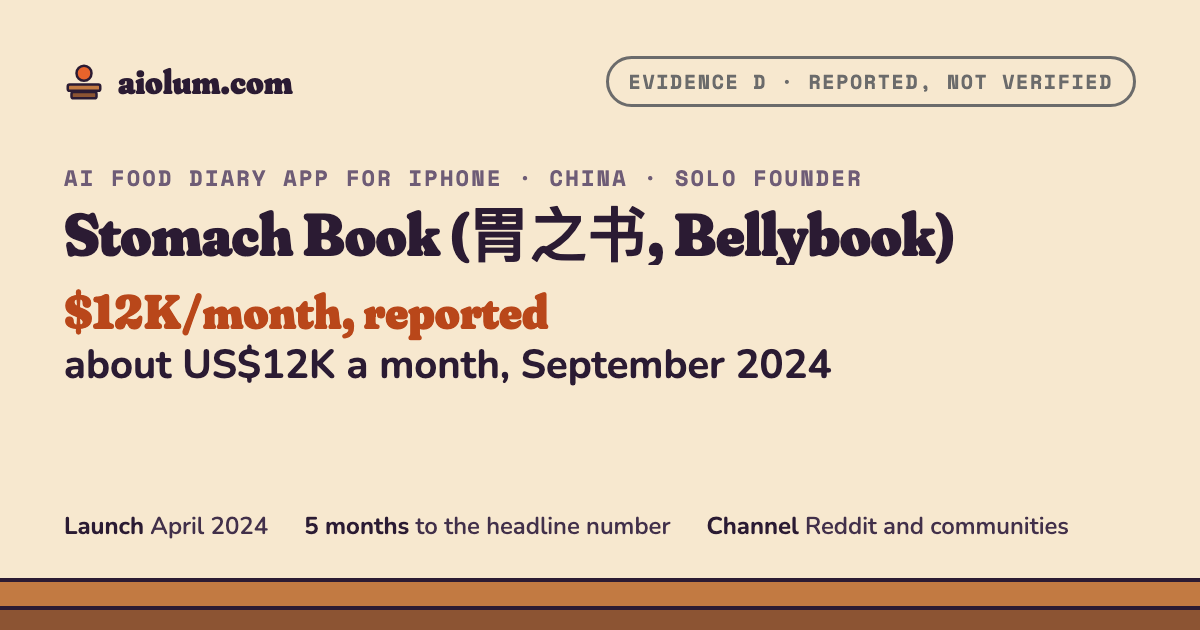
The headline figure, about US$12,000 a month, rests on one source: the founder's statement to Huxiu's journalist Wang Qin, published on 29 September 2024. Silicon Star (republished 5 November 2024) gives the same US$12,000 as the first month's in-app purchase revenue, and The Paper's self-media account (2 January 2025) gives it as the revenue five months after launch; the number is the same but the period differs in each telling. No payment processor, app-store revenue statement, buyer or second interview confirms the monthly figure. A reader could look for an App Store Connect screenshot shared by the founder, a later interview with a dated figure, or a verified revenue profile. The headline number is grade D: one claim or one estimate, with no second source. Aiolum shows it because the story is useful, and marks it so that it is not mistaken for a verified figure.
Stomach Book (胃之书, now also sold in English as Bellybook) is a food diary, an app in which a person records every meal, built on a large language model, a program trained on text that can read a short description and complete it. The user writes one sentence or takes one photo; the model names the dish, assigns it to one of the eight Chinese cuisines, writes a note about it, and cuts the food out of the photo for a collection. The founder, Zhao Chunxiang (赵纯想), told the Chinese tech site Huxiu in September 2024 that the app uses the model's ability to summarize, not to generate, and that he removed the letters AI from its original name.
Zhao is a former novelist and screenwriter from China who had built more than twenty apps before this one, of which, he told Huxiu, only five made money. The app was live on the Chinese App Store by 23 April 2024 (the date of its earliest review). The interview site Silicon Star reported in November 2024 that in-app purchases brought US$12,000 in the first month, that Apple's editors recommended the app within 15 days, and that it reached the top three of the paid chart. Huxiu reported on 29 September 2024 that monthly revenue was stable at about US$12,000 from paid subscriptions, that the app had 60,000 users 100 days after launch, and that the founder had turned down two investment offers.
Every money figure on this page is the founder's own statement, reported once by a journalist, and no payment processor or buyer has confirmed it; the evidence grade is D, reported, not verified. Three articles repeat the same figure of US$12,000 for three different periods (the first month, a stable month, and five months after launch), so the page treats it as one reported number. Prices in Chinese yuan are converted at 6.6743 CNY per US dollar, the European Central Bank reference rate for 22 October 2026, and the original yuan figure is shown next to each conversion.
The numbers, graded
Each row shows the evidence grade and the source numbers from the list at the end of this page. The grades are explained in How Aiolum verifies.
| Fact | Value | Grade | How we know | Sources |
|---|---|---|---|---|
| Revenue per month, September 2024 | about US$12,000 (about CNY 80,092 at the October 2026 rate) | D | Huxiu, 29 September 2024, journalist Wang Qin reporting the founder's figure: monthly revenue from paid subscriptions is stable at about US$12,000. The article gives the figure in US dollars. One source. | [1] |
| Run rate from the September 2024 figure | about US$144,000 a year | calc | Calculated: US$12,000 times 12. | [1] |
| In-app purchase revenue in the first month after launch | US$12,000 | D | Silicon Star interview, republished by Woshipm on 5 November 2024. The same number as the monthly figure above, stated for a different period. One source. | [2] |
| Revenue five months after launch | US$12,000 | D | The Paper, 2 January 2025, a self-media account (鲸选AI) on the site's Paike platform, not a staff journalist. It says revenue reached US$12,000 five months after launch and the app reached third place in Apple's Food and Drink category. The period does not match the other two sources. | [3] |
| Users | 10,000 registrations on the first day; 60,000 users at 100 days; 90,000 users by January 2025 | D | First day: Silicon Star. 100 days: Huxiu, with 21 versions released in that time. 90,000: The Paper. Each figure appears in one source. | [2, 1, 3] |
| Chart position, May 2024 | third in the top-grossing chart of Apple's Food and Drink category in China | C | Huxiu says third in the category's top-grossing chart in May. Silicon Star says the app reached the top three of the paid chart and was recommended by Apple's editors within 15 days of launch. The Paper says third, behind the recipe app Xiachufang. | [1, 2, 3] |
| Team at the September 2024 figure | the founder and one other programmer | C | Huxiu: the app's developers are the founder and one other programmer. Silicon Star: the founder found a partner who writes the Android version while he writes the iOS version; the rest is him alone. | [1, 2] |
| Outside funding | none; two investment offers of CNY 1.5 million and CNY 2 million (about US$224,743 and US$299,657) not taken | C | Huxiu: the founder missed two investment intentions after a June 2024 roadshow and set investment aside. Silicon Star: he does not want investment. The Paper says an investor gave him a term sheet. | [1, 2, 3] |
| Advertising spend | zero | C | Silicon Star: one person, zero advertising, tens of thousands of downloads. The Paper: zero advertising and zero marketing cost. | [2, 3] |
| Developer of record on the App Store | Shanghai Diyu Network Technology Co., Ltd | C | Apple's page for the app in the Chinese and US stores. The founder's interviews do not name the company. | [4, 5] |
| App Store ratings, October 2026 | 1,878 ratings, 4.7 of 5, on the Chinese store; 111 ratings on the US store | C | Read on Apple's pages on 23 October 2026. | [4, 5] |
| Earlier products | more than twenty apps, about a dozen on the store, five made money | C | Huxiu. The founder's 2019 startup Space Chat raised CNY 1 million (about US$149,828) and spent it in six months. | [1] |
| Time from launch to the September 2024 figure | 5 months | calc | Calculated: April 2024 to September 2024. | [4, 1] |
How to read this table: a grade D value is a founder statement that appears in one source only, usually a journalist's interview, and that no payment processor, buyer or second interview confirms. A grade C value is a founder statement that two sources agree on, or a fact read on the company's App Store page. A "calc" value was computed on this page from the rows above it. No value is grade A or B.
| Plan | Per month, billed yearly (US$) | Per month, billed monthly (US$) | Limit |
|---|---|---|---|
| Monthly membership (月会员) | 1.80 (CNY 12) | China store; US store US$9.99 | |
| Monthly membership (月度会员) | 2.70 (CNY 18) | China store, second monthly listing | |
| Yearly membership (年会员) | 1.60 (CNY 128 a year) | China store | |
| Gourmet yearly membership (美食家年度会员) | 2.47 (CNY 198 a year) | China store | |
| Lifetime membership (胃之书永久会员) | 29.67 one-time (CNY 198) | China store | |
| Gourmet lifetime membership (美食家永久会员) | 100.24 one-time (CNY 669) | China store |
The app is free to download. The Chinese store lists six in-app purchases: two monthly memberships (CNY 12 and CNY 18), a yearly membership at CNY 128, a Gourmet yearly membership at CNY 198, and two lifetime memberships at CNY 198 and CNY 669. The monthly-billed column shows the yuan price converted to US dollars; the yearly column shows the yearly price divided by 12. The US store page, read on the same day, shows a monthly membership at US$9.99, about four times the Chinese monthly price. The yuan prices were converted with the European Central Bank reference rate for 22 October 2026.
The timeline
From a failed 2019 startup to a paid app in Apple's top three for food in China, with every figure a founder statement and its grade shown.
- 2019CZhao Chunxiang, a screenwriter and novelist, raises CNY 1 million for a startup called Space Chat. The money is spent in six months and the company fails. [1]
- 2019 to 2023CHe builds more than twenty apps alone, about a dozen of them released, five profitable. He learns to write server code only in 2023. [1]
- 23 April 2024CStomach Book is live on the Chinese App Store: the earliest user review on Apple's page carries this date. The app is paid from the first day. [4, 2]
- May 2024DApple's editors recommend the app within 15 days of launch, and it reaches third place in the top-grossing chart of the Food and Drink category in China. Silicon Star reported that the first month brought US$12,000 in in-app purchases and 10,000 registrations on the first day. [1, 2]
- June 2024CA roadshow talk brings investors and press. Two investment offers, CNY 1.5 million and CNY 2 million, are not taken; the founder says he needs to think about the next step first. [1]
- August 2024DAbout 100 days after launch: 60,000 users and 21 versions released, as the founder told Huxiu. [1]
- 29 September 2024DHuxiu publishes its interview: monthly revenue stable at about US$12,000 from subscriptions, two developers, a plan to add a review platform for snacks and drinks, and a card game in development. [1]
- 5 November 2024CSilicon Star's interview, republished by Woshipm: a second app, Stranger Alarm Clock, is out, and the founder says nobody could afford to buy Stomach Book. [2]
- 2 January 2025DThe Paper's self-media account writes that the app reached 90,000 users and that the founder's products run on StepFun's Yuewen model platform. [3]
- 15 April 2025CVersion 2.0.0 on the App Store. [4]
- October 2026CVersion 2.3.0, released in the week before this page was written. The app is also listed in the US store under the English name Bellybook, with a monthly membership at US$9.99. [4, 5]
Why it worked
Four causes, in the order they mattered. Each one is a reusable lesson.
Design as the product
The founder told Huxiu that the app does not have much AI in it and that what sells is the experience: black-and-white ink paintings, a sesame grinder that vibrates in your hand when the app opens, and three plain screens followed by a fourth on which the model's result suddenly animates. He said that this moment of emotion is what makes people pay, and that he proved it so that he can reuse it in other products.
A diary, not a calorie counter
The App Store description says the app rejects the lies and anxiety of calorie tracking and is made for people who love food. The user writes one sentence or takes a photo; the model does the filing. The competitor the founder named to Huxiu is Cal AI, a calorie-counting app abroad that he said made US$400,000 a month, and he said that selling his own app abroad in dollars would multiply its revenue.
Paid from day one, no advertising
The founder said in his Silicon Star interview that an app must charge from the first day, because switching from free to paid later makes users leave. He said that he spent nothing on advertising, and that all the subscription fees had to feed only one person, so it was hard to lose money.
Posts for a free month
Huxiu reported that any user who posted a recommendation of the app on Xiaohongshu, the Chinese photo-sharing community, received a month of membership, and that Xiaohongshu attention plus press coverage drove the growth. The App Store's featured review says the reviewer found the app through a recommendation there. The Paper's account adds that perhaps half of the users were other developers who came after reading the press.
How it was built
These details come from the founder's interviews with Huxiu and Silicon Star, from Apple's pages for the app and from The Paper's self-media account. They are grade C or D. [1, 2, 3, 4, 5]
- A native iPhone app; the founder said he writes the iOS version himself and a partner later wrote an Android version.
- A large language model reads the one-sentence meal entry or the photo, names the dish, assigns a cuisine and writes the background; the founder said it uses the model's summarizing ability, not its generating ability. The Paper's account says his products run on StepFun's Yuewen model platform under its developer program; no other source confirms the provider.
- Hand-drawn ink illustrations by the founder, including a noodle master taken from one of his own novels.
- Free download with in-app memberships through Apple's App Store, monthly, yearly and lifetime; Apple's pages list them from CNY 12 a month in China and US$9.99 a month in the US store.
- 21 versions in the first 100 days; version 2.3.0 by October 2026.
- Distribution by user posts on Xiaohongshu rewarded with a free month, Apple's editorial recommendation and press interviews; the founder said advertising spend was zero.
Tools named in the sources
Each one opens its page in the Tools tab, with every story that uses it.
The dead that came before
Four companies in the Loot Drop database sold the organization of what people eat, or the tracking of their health, and failed. The values below are from that database and are not independently verified.
Springpad
The promiseCollect and organize recipes, articles and videos in a personal digital library.
Why it diedA loved free product whose makers never found what users would pay for before the money ran out.
Refolo
The promiseA meal planner with personal recipes to move people to a plant-based diet.
Why it diedCharged for meal plans while free alternatives existed, and larger wellness apps absorbed the feature.
Qraved
The promiseRestaurant discovery and booking with editorial reviews for Jakarta's food lovers.
Why it diedGoogle Maps took discovery, super-apps took bookings, and the pandemic ended dining out.
Arivale
The promiseTrack your body's data with tests and a coach to improve your health before illness.
Why it diedIt cost far more to serve each customer than the customer paid, and customers lost interest once the novelty of the data passed.
What changed
Springpad and Refolo asked people to organize what they ate and could not get paid for it: one stayed free, the other charged for plans that free sites gave away. Qraved and Arivale paid staff, editors and coaches to produce the content and the data, and the cost per customer stayed above the revenue per customer. Stomach Book has one person and no staff cost, and the model does the filing that Springpad's users had to do by hand. The founder said that the app charged from its first day, so the question that killed Springpad was answered before launch.
What has not changed is the size of the market. The founder told Huxiu that some investors considered the ceiling of a food diary low, and his own next step, a review platform for snacks and drinks, is the same move toward reviews and discovery that Qraved made with venture money. The monthly figure he reported, about US$12,000 in September 2024, feeds one or two people and would not have covered any of the four predecessors' payrolls.
Can one person copy it now?
The structure, yes; the design, only if you can draw.
A one-person paid app in a category that the large companies treat as a free feature, with a model doing the data entry and no advertising budget, is repeatable, and the founder said the economics work because the subscriptions only have to feed one person. The part that is hard to copy is the founder's own illustration and screenwriting, which he said is the reason people pay.
Where it is still open: Any diary-like habit with a visual result: wardrobes, coffee, books read, places visited, plants grown, each in a market the large apps serve only as a free side feature.
- 1Pick a daily habit that people already record by hand, and let a language model do the filing from one sentence or one photo.
- 2Charge from the first day through the app store, with monthly, yearly and lifetime options.
- 3Spend the design effort on one moment of surprise after the model returns its result, rather than on more features.
- 4Reward users who post about the app on the community where your customers already are, instead of buying advertising.
What to watch
The risks are the mirror image of the causes above.
What is not verified
The headline figure, about US$12,000 a month, rests on one source: the founder's statement to Huxiu's journalist Wang Qin, published on 29 September 2024. Silicon Star (republished 5 November 2024) gives the same US$12,000 as the first month's in-app purchase revenue, and The Paper's self-media account (2 January 2025) gives it as the revenue five months after launch; the number is the same but the period differs in each telling. No payment processor, app-store revenue statement, buyer or second interview confirms the monthly figure. A reader could look for an App Store Connect screenshot shared by the founder, a later interview with a dated figure, or a verified revenue profile.
The app's charts and downloads are in China
All the chart positions, user counts and prices are from the Chinese App Store. The US listing under the name Bellybook has 111 ratings against 1,878 in China, and no source gives revenue outside China.
The founder's attention is elsewhere
By November 2024 he had released a second app and was preparing a third, and told Huxiu that a card game was the thing he wanted to make, with Stomach Book feeding it. Huxiu's interview quotes investors' concern that he does not focus on one product.
Small market, free competition
Apple, WeChat and the large Chinese platforms can add a photo meal diary as a free feature, as the predecessors on this page found with their own categories. The founder's answer is design and emotion, which a large company can also hire.
No figures after September 2024
The app is still updated in October 2026, but no source gives revenue or users after January 2025, so the trend is unknown.
Sources
The grade next to each source is the best grade that the source can support. "Read in full" means that the text of the page was downloaded and the numbers were checked in it.
- C Huxiu, 29 September 2024, by Wang Qin: When a screenwriter turns to AI startups (当一位编剧转行搞AI创业)Read in full after extracting the article text from the page. A staff journalist's profile with the founder's figures: the monthly revenue, the May chart position, the 60,000 users, the two investment offers, the team of two and the Xiaohongshu reward. The money figures are the founder's statements and are graded D where no second source gives the same period.
- C Silicon Star (硅星人), republished by Woshipm on 5 November 2024: A conversation with Zhao Chunxiang: AI finally lets me work alone (对话赵纯想:AI终让我能单枪匹马)Read in full. A question-and-answer interview by the tech publication Silicon Star, republished on the product-manager site Woshipm. Source for the first-month revenue, the first-day registrations, the editorial recommendation, the paid-from-day-one rule, the zero advertising and the Android partner.
- D The Paper (澎湃新闻), Paike self-media account 鲸选AI, 2 January 2025: This group makes AI hits, one person earns a million a year (这个群体,AI捏爆款,1人年入百万)Read in full. A self-media article on The Paper's platform, not by a staff journalist; it summarizes other reports. Source for the 90,000 users, the five-month revenue statement, the Jike promotion and the Yuewen platform claim.
- C Apple App Store, China: 胃之书 - 人生美食收纳手册, read 23 October 2026Read in full. Source for the developer name, the in-app purchase prices, the ratings, the version history and the earliest review date.
- C Apple App Store, United States: Bellybook, read 23 October 2026Read in full. Source for the English name, the US monthly price and the US ratings count.
- C Bellybook website, read 23 October 2026Read the page source; the page loads its content by script and shows only a title and description. Used for the purpose check and the privacy and user-agreement links.
- A Frankfurter exchange-rate API, European Central Bank reference rate, 22 October 2026: 1 US dollar = 6.6743 CNYRead in full. The rate used for every conversion from Chinese yuan on this page.
- C Loot Drop database export, 1,749 failed startupsLocal export. AI-written summaries, not independently verified. Source for the failed predecessors.