TextWork: Revenue, team and how it was built
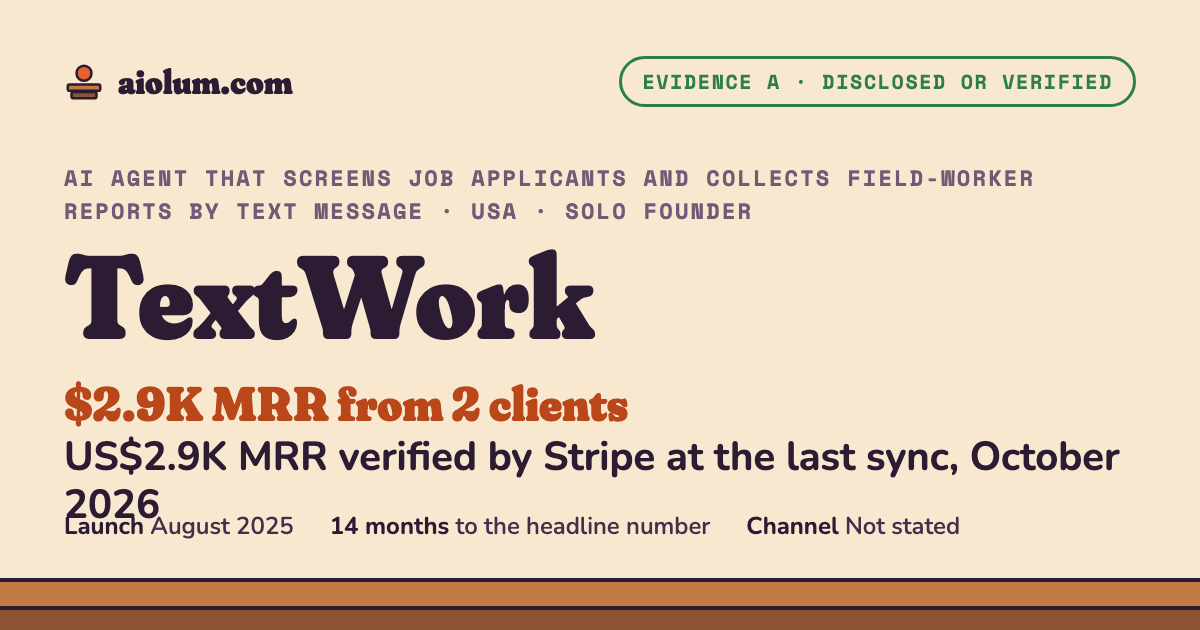
TextWork (AI agent that screens job applicants and collects field-worker reports by text message, USA): US$2.9K MRR verified by Stripe at the last sync, October 2026. Evidence grade A: disclosed by a company or a filing, or verified by a payment processor. Team: 1 founder, Brian, who writes "I'm Brian, the creator of TextWork"; no other staff named and no open roles. Launched August 2025; still running, revenue growing.Added 27 October 2026
- Outcome
- US$2.9K MRR verified by Stripe at the last sync, October 2026Revenue growing
- Evidence
- A disclosed by a company or a filing, or verified by a payment processor
- Launch
- August 2025
- Status
- Still running
- Team
- 1 founder, Brian, who writes "I'm Brian, the creator of TextWork"; no other staff named and no open roles
- Outside funding
- None stated (TrustMRR: bootstrapped); the site has a page that invites investors
- Main channel
- Not stated
TextWork is a text-to-apply service: a job applicant applies by sending a text message, or gets a text the moment they apply on a job board, and the hiring conversation happens by SMS instead of a web form. TextWork runs that conversation with an AI agent, a program built on a large language model that follows the employer's script, asks one question at a time, asks again when an answer is incomplete, and writes a structured report. The site's FAQ says: "TextWork is a text-to-apply AI agent." The report has a score, the transcript and a recommended next step, and the FAQ adds that "A person still decides who moves forward." The same engine collects daily reports from field workers in facility services and property maintenance, which is how the terms of service describe the service.
The founder is named only as Brian. The about page says: "I'm Brian, the creator of TextWork. As an engineer I built systems for big business." The oldest archived copy of textwork.co, from 6 August 2025, sold one plan for US$1,500 a month, reduced to US$1,080 with a summer code. TrustMRR, a site that reads a company's revenue from its payment provider through an API key, shows TextWork's Stripe revenue: US$34,772 since the account started, US$29,372 in the last twelve months, and monthly recurring revenue (MRR, the monthly value of all active subscriptions) of US$2,919 from 2 active subscriptions at the last sync on 26 October 2026. The public price list now starts at US$99 a month.
The revenue figures are grade A because TrustMRR reads them from Stripe. Everything else, including the founder's first name, the usage counts and the customer story, comes from the company's own pages and is grade C. The page also shows earlier recruiting and frontline-worker software companies that raised millions of dollars and closed, and the risk that comes with having two customers.
How much revenue does TextWork make?
Each row shows the evidence grade and the source numbers from the list at the end of this page. The grades are explained in How Aiolum verifies.
| Fact | Value | Grade | How we know | Sources |
|---|---|---|---|---|
| Monthly recurring revenue, 26 October 2026 | US$2,919 from 2 active subscriptions | A | TrustMRR metric snapshot, Stripe through an API key, revenue last synced 26 October 2026 at 14:07 UTC. MRR growth over the last 30 days: +45.7%. | [1] |
| Monthly recurring revenue about 30 days earlier | about US$2,003 | calc | Calculated: 2,919 divided by 1.457. This is close to the US$2,004 of revenue in August 2026. | [1] |
| Revenue, last 30 days to 26 October 2026 | US$2,919, down 48.9% | A | TrustMRR. The daily table shows two payments: US$99 on 28 September and US$2,820 on 19 October 2026. Their sum equals the MRR (calculated). The fall is against a September with US$5,712. | [1] |
| Verified revenue, last 12 months | US$29,372 | A | TrustMRR. The twelve monthly values on the same profile add up to US$29,370; the US$2 difference is rounding. | [1] |
| Verified revenue since the Stripe account started | US$34,772 | A | TrustMRR, all time. | [1] |
| Revenue before November 2025 | US$5,400 | calc | Calculated: all-time revenue minus the last twelve months. The public profile has no monthly values before November 2025. | [1] |
| Monthly revenue, November 2025 to February 2026 | US$1,080, then US$6,069 in January, then US$1,080 | A | TrustMRR monthly timeline. US$1,080 is also the August 2025 plan price with the summer code; no source says that this is the same customer. | [1, 10] |
| Monthly revenue, March to July 2026 | US$1,905 each month | A | TrustMRR monthly timeline. August 2026: US$2,004. September 2026: US$5,712. October 2026 to the 26th: US$2,820. | [1] |
| Yearly value of the October 2026 MRR | US$35,028 | calc | Calculated: US$2,919 times 12. | [1] |
| Average MRR per subscription | about US$1,460 | calc | Calculated: 2,919 divided by 2. The list price of the Starter plan is US$99 a month. | [1, 3] |
| Visitors, last 30 days | 826, about US$3.53 of revenue per visitor | B | TrustMRR, read from DataFast, a web analytics service, through an API key. Not a payment figure. | [1] |
| Founder | Brian | C | About page: "I'm Brian, the creator of TextWork." TrustMRR names the founder as Brian, with the founder handle brianlesko. No source gives a full name. | [4, 1] |
| Founded date on TrustMRR | 22 January 2018 | C | Founder-entered. The oldest archived copy of textwork.co is from 6 August 2025, and no downloaded source says what the business sold before 2025. | [1, 10] |
| Outside funding | none stated | C | TrustMRR lists Funding: Bootstrapped (founder-entered). The site's investors page invites investors to get in touch and does not mention a round. | [1, 5] |
| Usage claims on the home page | 145+ jobsites, 17,000+ text messages, 180+ applicants screened | C | Company figures, not verified. The investors page gives 3.4k+ structured reports, 17k+ SMS messages, 180+ AI conversations and 50+ active field workers. | [2, 5] |
| Customer story | a facility services owner in Akron, Ohio, with 18 field workers across 81 jobsites | C | Company's field-reporting page; the customer is not named. The hiring testimonial on the home page is also from a "Service business owner, Akron, OH". | [6, 2] |
| Code activity | 203 contributions in the last year, 31 in the last 30 days | B | TrustMRR, from a connected GitHub repository whose name is not shown. | [1] |
| Time from the first archived site to the October 2026 figure | 14 months | calc | Calculated: August 2025 to October 2026. | [10, 1] |
How to read this table: a grade A value was read by TrustMRR from the company's Stripe account. A grade B value was read by TrustMRR from another connected service (web analytics or GitHub), not from payments. A grade C value is what the founder or the company's pages say. A "calc" value was computed on this page from the rows above it.
| Plan | Per month, billed yearly (US$) | Per month, billed monthly (US$) | Limit |
|---|---|---|---|
| Starter | 99 | Limited usage capacity and model access, custom instructions, report history | |
| Growth | 199 | Marked "Coming soon"; advanced model access | |
| Enterprise | custom | custom | End of the usage slider; price not shown in the downloaded page |
| TextWork Subscription (August 2025) | 1500 | The only plan in the archived page; US$1,080 a month with the summer code |
The pricing page has a usage slider with six positions, from Starter usage to Enterprise; only the default position was readable in the downloaded page, and the other positions load by script. The Starter checkout button's page code records 50 conversations. The Growth button is disabled and marked "Coming soon". The footer also links checkout pages for plans called Hobby, Pro, Premium and Ultra without prices. In August 2025 the only plan cost US$1,500 a month, or US$1,080 with the code SUMMER (28% off). The current MRR of US$2,919 from two subscriptions shows that at least one customer pays far more than the list prices.
When did TextWork launch, and how did it grow?
From an archived single-plan page in August 2025 to US$2,919 of monthly recurring revenue 14 months later. Each entry carries its grade.
- 22 January 2018CThe founded date that TrustMRR shows for the business. No downloaded source says what it did before 2025. [1]
- 6 August 2025COldest archived copy of textwork.co: "Ditch Forms Collect Data Over Text", for work reports, property maintenance and job applications. One plan at US$1,500 a month, US$1,080 with a summer code, and a 14-day refund rule. [10]
- Before November 2025calcUS$5,400 of Stripe revenue in total, according to the difference between the all-time and the twelve-month figures. [1]
- November and December 2025AUS$1,080 of verified revenue in each month. [1]
- January 2026AUS$6,069 in the month, the best month on the public profile. [1]
- March 2026ADashboard filters by person, script, city or report field. Monthly revenue rises to US$1,905 and stays there until July. [7, 1]
- 10 April 2026CPeople can message a company's number over iMessage; voice memos follow on 17 April. [7]
- 21 to 23 April 2026CThe subprocessor list and the terms of service are updated. The terms describe an "AI-powered workforce reporting and data collection platform". [8, 9]
- June 2026CDocument signing by text link and inbound email that becomes a conversation and a report. [7]
- September 2026AUS$5,712 in the month. New features: reply from the transcript, call links, meeting pages and reply alerts. [1, 7]
- 19 October 2026AOne payment of US$2,820, the largest single day in the last 30 days. [1]
- 26 October 2026AMRR of US$2,919 from 2 active subscriptions at the last Stripe sync; US$29,372 in the last twelve months. [1]
Why did TextWork work?
Four causes, in the order they mattered. Each one is a reusable lesson.
Answer in the first minute
The home page's argument is that the best time to screen an applicant is immediately, and that applicants are lost in the first hour. A text that arrives the minute someone applies gets answered, also at night and on weekends, when no recruiter is working. The AI agent covers exactly those hours.
SMS instead of an app or a form
Field workers and hourly applicants already text. TextWork needs no app, no login and no training on the worker's side: the worker texts a number, and the agent asks the questions the business wrote. The terms and the investors page describe the result as structured data taken from a normal conversation.
One engine, several uses
The same script-driven conversation is sold for hiring, daily field reports, leasing enquiries and customer feedback. The investors page says that the paying customers are small businesses "in facility services and field operations", so the field-reporting use may matter as much as hiring.
Few customers at a high price
In August 2025 the single plan cost US$1,500 a month. In October 2026 two subscriptions bring in US$2,919 a month, while the public Starter plan costs US$99. The business looks like a product sold with close help to a few customers, which the founder's own words support: "I'm building TextWork for my own projects and alongside business owners."
How it was built
These details come from the founder's TrustMRR profile, the company's subprocessor list and the page source of textwork.co. They are grade C, except the Stripe connection, which TrustMRR confirms, and the Next.js and DataFast code visible in the page source. [1, 8, 7, 2]
- Tech stack on the TrustMRR profile, written by the founder: Next.js for the front end, and Python, SQLite, Redis, GraphQL and Stripe on the back end. The page source loads Next.js files.
- Language models from several providers, according to the subprocessor list dated 21 April 2026: OpenAI, Anthropic and xAI for language models, and NVIDIA for hosted model inference. ElevenLabs turns speech into text and text into speech, for voice memos.
- Messages: Twilio for SMS and MMS, and Sendblue for iMessage and SMS. Tavily and Brave give the agent web search. Resend sends email, Cloudflare stores media, and CARTO draws the map tiles in the dashboard.
- Payments through Stripe, which TrustMRR reads through an API key. DataFast measures site visits and the clicks on pricing buttons, and Google Search Console is connected on TrustMRR.
- Integrations for customers: SmartRecruiters, Indeed, Zillow leads, Microsoft Teams and Google Meet, and calendar connections to Google, Microsoft and Apple.
- The changelog lists ten feature releases between March and September 2026, and TrustMRR shows 203 GitHub contributions in the last year from one connected repository.
Tools named in the sources
Each one opens its page in the Tools tab, with every story that uses it.
Who tried this before TextWork, and why did they fail?
Four companies in the Loot Drop database tried to automate hiring or to bring software to frontline workers, and closed. The values below are from that database and are not independently verified.
Gogohire
The promiseRecruiting automation for small and medium-sized businesses: candidate sourcing, screening and workflow.
Why it diedJob posting, resume parsing and interview scheduling became standard features of every applicant tracking system by 2018, and it could not show a return against established products.
Ansaro
The promiseAn AI platform that automates the whole recruiting cycle, from resume parsing to interview scheduling.
Why it diedRecruiters saw it as a nice-to-have, and the change it asked of a cautious industry was too large to win enough sales.
Flip
The promiseA mobile app for frontline workers in retail, hospitality and logistics: shifts, team chat, news and training.
Why it diedIt raised US$200 million on the thesis that deskless workers lack software, but customers had free alternatives and it never proved the unit economics.
Jobr
The promiseA mobile-first job app where applicants swipe on jobs, to make applying faster.
Why it diedLinkedIn and Indeed added similar mobile features to much larger audiences, and the swiping idea did not become a lasting advantage or a way to earn money.
The failed startups come from Loot Drop, a free database of dead startups, retold here in our own words. Loot Drop describes its entries as AI-assisted summaries of public sources, so these cards carry no evidence grade.
What changed
Gogohire and Ansaro sold automation of the recruiter's work: parsing, tracking and scheduling. Those features became standard in every applicant tracking system, and the database records that recruiters did not see enough value in more. Before language models, a program could not hold an open conversation with an applicant; it could only send a form. TextWork's investors page names this change directly: "Conversation became a data API in 2024."
Flip had the same thesis as TextWork's investors page, that about 80% of workers are deskless and lack software, and it spent US$200 million on an app. TextWork uses the channel that those workers already have, the text message, and rents its models from several providers, so one founder can run it. The predecessors' lesson still applies: the verified revenue comes from two subscriptions, and a larger hiring platform can add an SMS agent of its own.
Can one person copy TextWork now?
Yes, for a narrow group of employers, with direct sales.
An SMS agent that asks fixed screening questions is not hard to build with today's language models and an SMS provider. What is hard is finding businesses that hire at volume and will pay for it. TrustMRR shows that TextWork earns most of its revenue from very few customers, and no source says how they were found.
Where it is still open: The same agent for other conversations that start with a text: tenant maintenance requests, job-site incident reports, or appointment intake in languages other than English.
- 1Pick one kind of employer that hires hourly workers all the time and loses applicants at night and on weekends.
- 2Connect to the places where their applicants already apply, such as Indeed or their applicant tracking system, and reply by text within a minute.
- 3Let the business write the questions, and hand back a short report with the transcript, so a person still makes the decision.
- 4Sell to a few customers at a price that pays for close support, before publishing a cheap self-serve plan.
What could go wrong for TextWork?
The risks are the mirror image of the causes above.
Two customers
TrustMRR shows 2 active subscriptions for US$2,919 of MRR on 26 October 2026, and one payment of US$2,820 on 19 October. Losing one customer would remove most of the revenue.
What happened before 2025
TrustMRR shows a founded date of 22 January 2018, while the oldest archived copy of textwork.co is from August 2025. The demo form in that copy asked visitors to agree to be contacted about "Smerp products". No downloaded source explains the earlier business or the name Smerp, and US$5,400 of the all-time revenue came before November 2025.
Usage numbers that do not agree
The home page says "145+ Jobsites" and "180+ Applicants screened"; the pricing page says "Used by 180+ people"; the investors page says "180+ AI conversations completed", "50+ Field workers active" and "80+ active jobsites". These are company figures and are not verified.
Rules for business texting
Texting applicants in the United States needs their consent, and US carriers ask businesses that text from ordinary 10-digit numbers to register under A2P 10DLC (application-to-person messaging over 10-digit long codes). TextWork's terms put the duty to have "the legal basis (such as consent, legitimate interest, or contractual necessity)" on the customer. iMessage runs through Sendblue, a third-party messaging service.
Worker monitoring
The field-reporting page sells location check-in by text and says "AI flags flight risk before they quit". Scoring employees for the chance that they leave is a sensitive use of their messages; no downloaded page explains how the score is made.
First name only
The founder appears as Brian on the about page and on TrustMRR. No source gives a full name, a company register entry or a headcount. The careers page says "No open roles right now".
Sources
The grade next to each source is the best grade that the source can support. "Read in full" means that the text of the page was downloaded and the numbers were checked in it.
- A TrustMRR profile of Textwork, as read on 27 October 2026Read the markdown profile in full, live on 27 October 2026 (revenue last synced 26 October 2026). Revenue, monthly timeline, daily revenue, MRR and subscription count are read from Stripe through an API key and are grade A. Visitors come from DataFast and code activity from GitHub through connected APIs. The description, founded date, funding, tech stack and user estimate are founder-written, grade C.
- C TextWork home page, Text-to-Apply Software for HiringRead in full on 27 October 2026. Source for the product description, the FAQ, the usage claims, the testimonial and the integrations.
- C TextWork pricing pageRead in full on 27 October 2026, including the page code of the plan buttons. The usage slider's other positions load by script and were not read.
- C TextWork about pageRead in full. Source for the founder's first name and the founder's reasons for building the product.
- C TextWork investors page: Redefining ERP for the deskless workforceRead in full. Source for the company's thesis, the traction claims and the statement about paying customers.
- C TextWork field-reporting page (served at /compliance): Scale your workforce with text message AIRead in full. Source for the field-reporting product, the customer story from Akron, Ohio, the turnover feature and the refund rule.
- C TextWork changelog and the iMessage entryRead the changelog index and the iMessage entry (https://textwork.co/changelog/imessage) in full. Source for the feature dates from March to September 2026.
- C TextWork subprocessors, current as of 21 April 2026Read in full. Source for the model providers, the messaging services and the other suppliers.
- C TextWork terms of service, last updated 23 April 2026Read the overview, billing, service and data-protection sections. Source for the service description and the customer's duty to obtain consent.
- C Wayback Machine copy of textwork.co, 6 August 2025Read in full. The oldest archived copy. Source for the first product description, the US$1,500 plan with the summer price, and the Smerp consent line.
- C TextWork careers pageRead in full on 27 October 2026. It shows no open roles.
- C Agent Money List entry: TextWork, $2.9K verified MRRRead in full (downloaded 27 October 2026). Where this lead was found. It copies the TrustMRR figures (data CC BY 4.0), so it is not a second source, and no fact on this page rests on it.
- C Loot Drop database export, 1,749 failed startupsLocal export. AI-written summaries, not independently verified. Source for the failed predecessors.