Vizologi
What is not verified
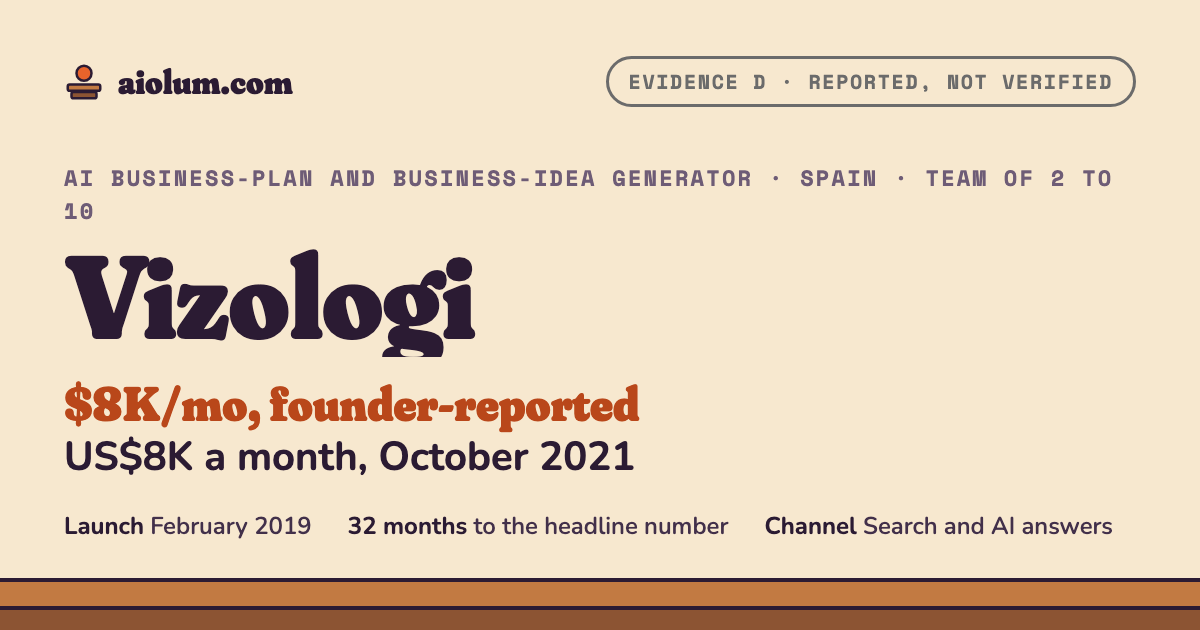
The headline figure, about US$8,000 a month, rests on one source: the founder, Pedro Trillo, in his Starter Story interview of 29 October 2021. No payment processor, buyer or second interview confirms it, and no founder figure for any later year was found. The only later number is GetLatka's estimate of US$220,000 a year for July 2025, which Latka marks as an estimate and which it also shows for many other small companies in the same category. There is no TrustMRR profile for the company as of 23 October 2026. A reader could look for a payment-processor-verified profile, a second interview with figures, or a Spanish company register filing. The headline number is grade D: one claim or one estimate, with no second source. Aiolum shows it because the story is useful, and marks it so that it is not mistaken for a verified figure.
Vizologi is a business model generator, a program that writes the parts of a business plan (customers, revenue, costs, partners) from a short description of an idea. It runs on a large language model, a neural network trained on large amounts of text that writes new text from a prompt, supplied by OpenAI, and on a database of more than 4,000 business model canvases, one-page summaries of how a known company makes money, that the company compiled by crawling public sources. The paid plans are measured in credits, which the pricing page defines as AI-generated words.
Pedro Trillo, a telecommunications engineer from Alicante who had worked as a project manager at Orange and Telefónica, started it in February 2019 and published the canvases first, as free pages. Alicante Plaza reported in May 2019 that the site had 30,000 unique visitors a month after three months and had reached break-even. In October 2020 he said the company got access to OpenAI's GPT-3, and in April 2021 he told Alicante Plaza that sales had grown 200% in six to seven months, that a business angel had invested, and that the company would become a fully AI-based firm by October 2021. In the Starter Story interview of 29 October 2021 he stated a gross income of about US$8,000 a month in recurring revenue, 50,000 visits a month, one founder and three employees.
No figure on this page comes from a payment processor or a buyer. The headline is one founder statement with one date, so the page carries the grade "Reported, not verified". The only later figure is an estimate by the directory GetLatka, US$220,000 a year in July 2025, with two people listed on LinkedIn. The page also shows earlier companies that sold company data, answers from a curated database or AI advice to small businesses, and failed.
The numbers, graded
Each row shows the evidence grade and the source numbers from the list at the end of this page. The grades are explained in How Aiolum verifies.
| Fact | Value | Grade | How we know | Sources |
|---|---|---|---|---|
| Revenue per month, October 2021 | about US$8,000 in recurring revenue | D | Founder's words in the Starter Story interview of 29 October 2021: a gross income of around US$8,000 MRR. One statement, one date. The page is not marked as an estimate. | [1] |
| Run rate from the October 2021 figure | about US$96,000 a year | calc | Calculated: US$8,000 times 12. | [1] |
| GetLatka revenue estimate, July 2025 | US$220,000 a year | D | A directory estimate, marked as such by Latka, which says the company has not published its revenue. Latka shows the same US$220,000 for many other small companies in its generative AI category, so the figure may be a formula, not a measurement. | [6] |
| Visits per month | 30,000 unique visitors in May 2019; 50,000 in December 2020 and October 2021 | C | Alicante Plaza quoting the founder in May 2019; the founder's blog in late 2020; Starter Story in October 2021. The founder's own site said more than 5 million visitors in total by 2026. | [3, 16, 1, 14] |
| Users, October 2021 | more than 1,500 users served since launch; about 550 users a month | D | Founder's statement in Starter Story. The same interview gives a customer acquisition cost of US$50 and a lifetime value of US$100 per customer. | [1] |
| Team, October 2021 | 1 founder and 3 employees | C | Starter Story profile box, October 2021. Alicante Plaza wrote in April 2021 that three people were employed directly and three or four more worked as suppliers. The Blasting News interview of June 2021 says the developers were in Goa, India, and operations in Valencia. | [1, 2, 4] |
| Team, July 2025 | 2 people listed on LinkedIn | D | Latka's count of people who list Vizologi as their employer. The founder's own site also names a second company of his, Xendai, an AI engineering studio. | [6, 14] |
| Outside funding | one business angel, by April 2021; amount not disclosed | C | Alicante Plaza, April 2021: Tomás Guillén of Big Ban Angels became a partner. The founder said a Series A was planned for late 2021 or early 2022; no source shows that it happened. | [2, 4] |
| Early traction, May 2019 | about 80 recurring users and break-even after 3 months in the market | C | Alicante Plaza, 31 May 2019, quoting the founder. Free access to the business models of 1,500 companies; the paid plan gave access to the data. | [3] |
| AppSumo lifetime deal, October 2021 | US$69 one-time, listed against US$900 | C | Archived AppSumo page of 6 October 2021: lifetime access with 20,000 AI credits a month, an 'Infinite ideAI generator' and product naming. The founder said in Starter Story that lifetime plans raised revenue considerably. | [5, 1] |
| Price history | US$9 a month yearly or US$19 monthly in 2019; three credit-based tiers from US$19 to US$49 monthly by September 2022 | C | Wayback copies of the home and pricing pages: June 2019, August 2020 (US$15 yearly), September 2021 (unchanged), September 2022 (credits), June 2023, April 2024, April 2025. The credit allowance of the lowest tier went from 4,000 in 2022 to 6,000 in 2023, 8,000 in 2025 and 15,000 in 2026. | [10, 9] |
| Content and data | about 1,000 canvases at launch, more than 1,500 pieces of content by 2021, more than 4,000 business models in 2026 | C | Starter Story for the 2021 counts; the home page in October 2026 for the 4,000 figure. The company's AI page describes crawling, entity extraction by its own models and manual checking by data analysts. | [1, 9, 11] |
| Time from launch to the October 2021 figure | 32 months | calc | Calculated: February 2019 to October 2021. | [1] |
How to read this table: a grade D value is a single founder statement with one date, or a third-party estimate, with nothing else confirming it. A grade C value was stated by the founder on more than one date or was reported by a journalist who spoke to him. A "calc" value was computed on this page from the rows above it. No value is grade A or B.
| Plan | Per month, billed yearly (US$) | Per month, billed monthly (US$) | Limit |
|---|---|---|---|
| Lowest tier | 9 | 19 | 15,000 credits a month, 1 list, 1 project |
| Middle tier, most popular | 19 | 29 | 50,000 credits a month yearly, 20,000 monthly; 5 lists, 5 projects |
| Highest tier | 39 | 49 | unlimited credits, lists and projects |
| AppSumo lifetime deal, October 2021 | 69 one-time | 20,000 AI credits a month, 5 lists, 5 projects |
The pricing page shows three unnamed tiers, with a yearly price 30% below the monthly one and shown per user per month. A credit is 5 characters of input plus output text; the page translates the lowest tier to about 4,500 AI-generated words a month. The middle tier gives 20,000 credits a month when billed monthly and 50,000 when billed yearly. A 7-day free trial needs a credit card. The AppSumo deal of October 2021 was a one-time purchase, listed as US$69 against a list price of US$900, for the middle tier.
The timeline
From 1,000 free business model canvases to a text generator sold by the word, in 32 months to the only dated revenue figure. Each entry carries its grade.
- Summer 2016CTrillo, then a project manager in large companies, writes down the idea: a combinatorial system that generates a business model for every person on earth. The project is first called Compass. [16, 17, 1]
- February 2019CStart of Vizologi in Alicante. About 1,000 business model canvases are published as free pages first, to build search traffic before any paid product. [1, 3]
- 31 May 2019CAlicante Plaza reports 30,000 unique visitors a month, about 80 recurring users and break-even after three months. The paid plan gives access to the data behind the canvases. [3]
- 12 June 2019CVizologi wins the Wonderful innovation contest of the Alicante local development agency. [13]
- June 2019CThe archived home page sells one plan: US$9 a month billed yearly or US$19 monthly, with premium data, search, canvas design and SWOT analysis. [10]
- October 2020CThe founder says the company got access to OpenAI's GPT-3. His site later calls Vizologi the first Spanish start-up licensed to use OpenAI's technology. [1, 4, 14]
- 14 April 2021CAlicante Plaza: sales up 200% in six to seven months, partners reselling in the United States and India, a business angel as partner, and a plan to become a fully AI-based company by October 2021. [2]
- 10 June 2021CIn a Blasting News interview the founder describes the current AI as text classification of crawled pages into canvas categories, and announces a generative business model builder for the winter. [4]
- 6 October 2021CThe archived AppSumo page sells lifetime access for US$69 one-time with 20,000 AI credits a month and an 'Infinite ideAI generator'. [5]
- 29 October 2021DStarter Story interview: about US$8,000 a month in recurring revenue, 50,000 visits a month, 1 founder and 3 employees. The main channel is search, then LinkedIn and AppSumo. [1]
- September 2022CThe archived home page shows three plans priced by credits, from US$19 to US$49 a month, and the slogan 'Get AI-generated answers to all your business questions'. [10]
- 21 March 2023CInnoleaps, an innovation agency, announces a partnership to use Vizologi for consumer-goods clients. [15]
- 4 July 2023CIn a Distrito Digital interview the founder says the company is growing a lot since ChatGPT appeared in November 2022, after two years of early adopters, and that team collaboration would arrive by the end of the year. [7]
- 24 October 2023CA SafetyDetectives interview, republished by the company, describes a business plan presentation generated in about one minute from a short questionnaire. [8]
- July 2025DGetLatka estimates US$220,000 a year and counts 2 people on LinkedIn. [6]
- October 2026CThe pricing page sells the same three tiers, now with 15,000 to unlimited credits; the AI page says the product runs on OpenAI's GPT-5.5. [9, 11]
Why it worked
Four causes, in the order they mattered. Each one is a reusable lesson.
Free content first, paid tool second
The founder published about 1,000 business model canvases as free pages before selling anything, and told Starter Story that search brought more than 50,000 visits a month by 2021. His advice in that interview: if you have no way to create helpful content for your business, you have nothing. The paid product was then sold to visitors who were already on the site.
Early access to a text model
The founder said he obtained access to OpenAI's GPT-3 in October 2020, two years before ChatGPT. The product changed from a database with search and canvas tools into a generator sold by the word; the archived pricing page of September 2022 lists credits defined as AI-generated words. He told Distrito Digital in 2023 to build on third-party APIs rather than train models in Spain.
Lifetime deals and resellers
The founder said in Starter Story that the sale of lifetime plans on AppSumo raised revenue considerably, used as a slow channel that adds recurring revenue each month rather than a single spike. Alicante Plaza reported in April 2021 that partners reselling in the United States and India were a main cause of the 200% growth.
Low cost of operation
Developers in Goa, operations in Valencia and a remote team from the start, according to the Blasting News interview. The founder said in that interview that a well-configured AI would do four or five activities that three people would otherwise do, at a low cost in API payments.
How it was built
These details come from the founder's interviews, the Starter Story tools list and the company's own pages. They are grade C. [1, 4, 11, 9]
- Node.js on Heroku, with Stripe for payments and Cloudflare in front, according to the Starter Story tools list and the founder's answer on platforms.
- Text generation by OpenAI models: GPT-3 from the October 2020 access the founder described; the company's AI page in 2026 says GPT-5.5, with its own data about business models added.
- A data pipeline described on the AI page since 2020: crawl business news and company sites, extract sectors, patterns and companies with the company's own models, link each organization to a unique ID, and have data analysts check the data by hand.
- A content site on WordPress with Yoast for search optimization; more than 1,500 pages on how named companies work, in 14 languages today.
- Customer tools named by the founder: HubSpot for CRM, Freshdesk for support, Mailchimp and Sendfox for email, Google Analytics, Hotjar and Profitwell for measurement, Jira for tasks, Fiverr for freelance work.
- Sales channels: search, LinkedIn content with inbound requests after cold messages failed, and the AppSumo marketplace.
Tools named in the sources
Each one opens its page in the Tools tab, with every story that uses it.
The dead that came before
Four companies in the Loot Drop database sold company data, answers from a curated database, AI advice to small businesses or a brainstorming tool, and failed. The values below are from that database and are not independently verified.
Mattermark
The promisePrivate company data aggregated into insights for investors and sales teams.
Why it diedCB Insights and PitchBook had larger datasets; the data operation cost more than the revenue it produced.
Ask Jeeves
The promiseAsk a question in plain words and get one answer from a curated database.
Why it diedHuman editors curated the answers, so costs grew with every new question while Google answered from the whole web by algorithm.
Metigy
The promiseAn AI marketing brain for small businesses that could not afford a marketing team.
Why it diedThe machine-learning recommendations of 2016 to 2020 were too generic; small businesses wanted done-for-you services or very simple tools, and churned.
Thinkature
The promiseA shared online whiteboard for brainstorming and idea generation in remote teams.
Why it diedToo early for the infrastructure and users of its time; free users did not convert, and Google Docs added collaboration.
What changed
Mattermark and Ask Jeeves both sold access to a database that people had to curate by hand, and the cost of curation grew faster than revenue. Metigy sold AI advice to small businesses, and the advice of pre-2020 models was too generic to keep them. Vizologi started in 2019 with the same shape as the first two: a hand-checked database of business models sold by subscription.
Two things differ. First, the database was published as free pages before it was sold, so it paid for itself in search traffic, which the founder said reached 50,000 visits a month, instead of being a cost. Second, from late 2021 a large language model wrote the output, so the product no longer depended on the database alone, and the answers were specific to the user's input, which is what Metigy's models could not do. The risk that remains is the one Ask Jeeves faced: a general tool, ChatGPT today, can answer the same questions for free.
Can one person copy it now?
The content method, yes. The revenue, unverified.
Publishing a large set of useful reference pages first, then selling a tool to the visitors, is a method that any solo founder can repeat in a niche, and it does not depend on being early to a model. The founder said that the 2021 revenue was about US$8,000 a month, but nothing outside his own statement confirms it, and no later founder figure exists, so copy the method, not the number.
Where it is still open: Any field with a known one-page format that people search for: pitch decks, grant applications, job descriptions, lesson plans, compliance checklists.
- 1Pick a niche where people search for structured reference pages, and publish hundreds of them for free.
- 2Sell a paid tool only to visitors who already use the free pages; the founder said search was his main channel.
- 3Price generation by usage, as credits or words, so the model's API cost stays below the price.
- 4Use lifetime-deal marketplaces as a slow channel for revenue and feedback, and resellers in countries you cannot reach yourself.
What to watch
The risks are the mirror image of the causes above.
What is not verified
The headline figure, about US$8,000 a month, rests on one source: the founder, Pedro Trillo, in his Starter Story interview of 29 October 2021. No payment processor, buyer or second interview confirms it, and no founder figure for any later year was found. The only later number is GetLatka's estimate of US$220,000 a year for July 2025, which Latka marks as an estimate and which it also shows for many other small companies in the same category. There is no TrustMRR profile for the company as of 23 October 2026. A reader could look for a payment-processor-verified profile, a second interview with figures, or a Spanish company register filing.
Growth is unknown since 2021
The founder said in July 2023 that the company was growing a lot after ChatGPT appeared, but gave no number. Latka counted two people on LinkedIn in July 2025, down from four in 2021, and the founder's own site lists a second company, Xendai, an AI engineering studio.
The general tool answers the same questions
ChatGPT and similar assistants write business plans and canvases for free. The company's answer is its database of business models and its fixed output formats, which is the Ask Jeeves position: a curated database against a general engine.
One model supplier
Every version of the product has run on OpenAI's models, from GPT-3 in 2020 to the GPT-5.5 that the AI page names in 2026. A price or policy change at OpenAI changes the cost of every credit sold.
Marketing claims on the company's pages
The AI page gives parameter counts and training details for GPT-5.5 that OpenAI has not published, and the home page says every US$1 spent returns US$75 in new ideas. Neither claim could be checked, and the page's product descriptions use them as marketing.
Sources
The grade next to each source is the best grade that the source can support. "Read in full" means that the text of the page was downloaded and the numbers were checked in it.
- D Starter Story, 29 October 2021: Our $8K/Month AI-Powered SaaS Helps Businesses Find New OpportunitiesRead in full. Founder interview, not marked as estimated. Source for the US$8,000 monthly revenue, the visits, the user counts, the team of four, the start date and the tools list.
- C Alicante Plaza, 14 April 2021 (Sandra Murcia): La startup Vizologi crece un 200% en el último semestre y aumenta presencia en EE.UU. e IndiaRead in full. Journalist article quoting the founder. Source for the 200% growth, the business angel, the resellers, the three direct employees and the October 2021 AI pivot plan.
- C Alicante Plaza, 31 May 2019: Vizologi, la inteligencia artificial que compara tu modelo de negocio con otras 1.500 empresasRead in full. Journalist article quoting the founder. Source for the 2019 visitors, the 80 recurring users, break-even, the 1,500 companies and the founder's background.
- C Blasting News interview, 10 June 2021, republished on vizologi.com: Pedro Trillo, CEO of Vizologi: Artificial Intelligence reduces costs in new hiresRead in full on the company's blog. Source for how the AI worked in 2021, the OpenAI access of October 2020, the remote team in Goa and Valencia, and the generative version announced for the winter.
- C AppSumo deal page for Vizologi, archived by the Wayback Machine on 6 October 2021Read the deal terms and plan features. Source for the US$69 lifetime price, the 20,000 AI credits and the ideAI generator in October 2021.
- D GetLatka company page: Vizologi Revenue 2025: $220K Est.Read in full. A directory estimate dated July 2025 and a LinkedIn headcount of 2, both marked as such by Latka.
- C Distrito Digital Comunitat Valenciana, 4 July 2023: Entrevista a Pedro Trillo, fundador y CEO de VizologiRead in full. Founder interview. Source for the growth after ChatGPT, the customer profile and the advice to build on third-party APIs.
- C SafetyDetectives interview, 24 October 2023, republished on vizologi.com: From IT Consultancy to AI PioneerRead in full on the company's blog. Source for the one-minute business plan and the founder's description of the idea generator.
- C Vizologi pricing page, read 23 October 2026Read in full. Source for the current prices, credits, the trial terms and the feature list. The home page, read the same day, gives the 4,000 business models figure.
- C Vizologi pricing and home pages in the Wayback Machine, June 2019 to April 2025Read the home page of 20 June 2019, 30 May 2020, 17 May 2021 and 29 September 2022, and the pricing page of 15 August 2020, 21 September 2021, 6 June 2023, 16 April 2024 and 14 April 2025. Source for the price history and the change to credit pricing.
- C Vizologi: How Vizologi uses Artificial Intelligence, read 23 October 2026, and its Wayback copy of 15 August 2020Read in full, both versions. Source for the data pipeline, the OpenAI model named in 2026 and the 2020 roadmap.
- C Alicante Plaza, 11 July 2023: Desde la alicantina Mamby a E.ON, casos de uso de VizologiRead in full. Source for the corporate clients the company named in 2023.
- C Impulsa Alicante, 12 June 2019: Vizologi, una startup alicantina, gana el concurso de innovación WonderfulRead in full. The local development agency's own announcement of the prize.
- C Pedro Trillo's personal site, read 23 October 2026Read the home page. Source for the OpenAI license claim, the total visitor count and the founder's second company.
- C Innoleaps, 21 March 2023: How Innoleaps and Vizologi are partnering to bring generative AI to the FMCG sectorRead in full. The partner agency's announcement.
- C Pedro Trillo's blog, late 2020: Mind-blowing!!! GPT-3 lo cambia todoRead in full. Undated post whose images were uploaded in December 2020. Source for the 50,000 monthly visitors at that time and the plan to generate full business models with OpenAI.
- C Pedro Trillo's blog, 2020: La 3ª generación disruptiva ya es generativaRead in full. Source for the summer 2016 origin of the idea and the January 2020 decision to start generative AI development.
- C Loot Drop database export, 1,749 failed startupsLocal export. AI-written summaries, not independently verified. Source for the failed predecessors.