Baller AI: Revenue, team and how it was built
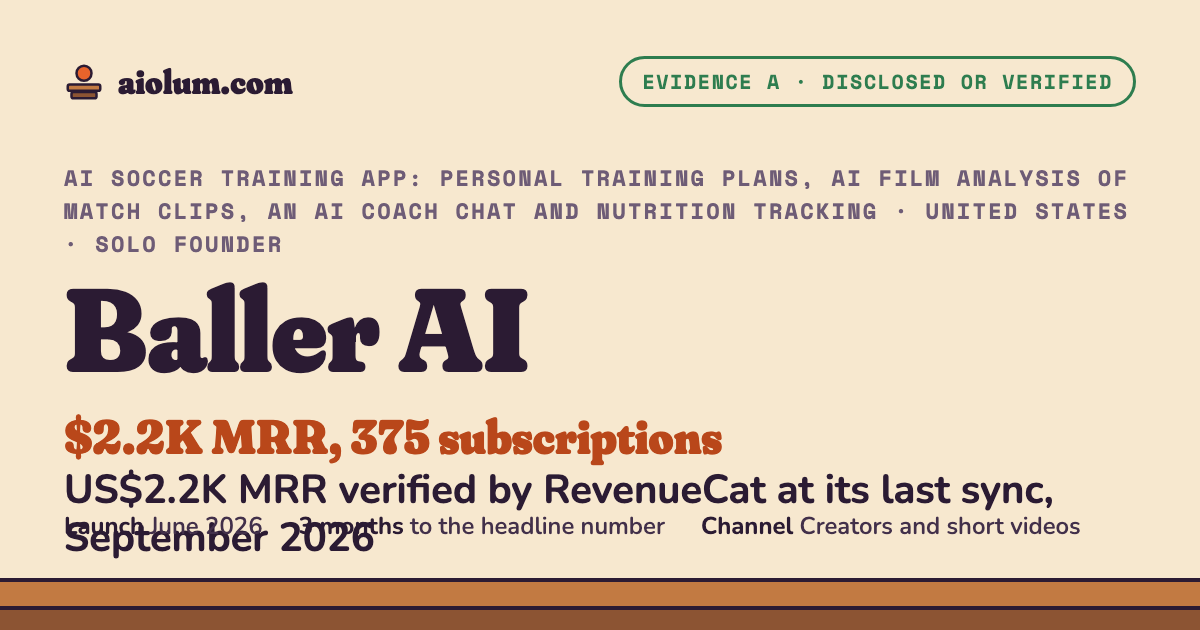
Baller AI (AI soccer training app: personal training plans, AI film analysis of match clips, an AI coach chat and nutrition tracking, United States): US$2.2K MRR verified by RevenueCat at its last sync, September 2026. Evidence grade A: disclosed by a company or a filing, or verified by a payment processor. Team: 1 founder, Lino Leighton, by the founder's own account ("Team size: 1 person"); the app is published by Renovait LLC. Launched June 2026; still running, revenue falling.Added 27 October 2026
- Outcome
- US$2.2K MRR verified by RevenueCat at its last sync, September 2026Revenue falling
- Evidence
- A disclosed by a company or a filing, or verified by a payment processor
- Launch
- June 2026
- Status
- Still running
- Team
- 1 founder, Lino Leighton, by the founder's own account ("Team size: 1 person"); the app is published by Renovait LLC
- Outside funding
- Bootstrapped, by the founder's own account
- Main channel
- Creators and short videos
Baller AI is an AI coach app for soccer (football) players. It builds a weekly training plan from the player's position and skill level, analyzes uploaded match clips with an AI model, which the App Store listing calls the "AI Film Room", and answers questions in an AI coach chat. It also tracks nutrition: calories, protein, carbohydrates, fats and water, with estimates from food photos and barcode scans. The training is wrapped in game mechanics, called gamification: XP (experience points earned per session), streaks of training days, ranks and badges. All of this sits behind a subscription paywall, a screen that unlocks the features only after the user starts a recurring payment, here through Apple's App Store.
The website says "Built by Lino Leighton", and the TrustMRR profile names the founder as Lino, with "Team size: 1 person" and "Funding: Bootstrapped". The App Store lists the developer as Renovait LLC and version 1.0.0 on 1 June; the TrustMRR founding date is 8 June 2026. TrustMRR, a service that reads revenue from a company's payment or subscription system through an API key, read the app's RevenueCat account, a service that many apps use to manage App Store subscriptions and report their revenue. It shows US$1,653 in June 2026, US$4,786 in July, US$5,569 in August and US$1,180 from 1 to 16 September, and, at the last sync on 16 September 2026, MRR (monthly recurring revenue, the monthly value of all active subscriptions) of US$2,246 from 375 active subscriptions. The RevenueCat key expired that day, so no later figures exist. Since 28 August 2026 the founder has listed the app for sale on TrustMRR at US$25,000.
The revenue figures are grade A: TrustMRR read them from RevenueCat, which receives them from Apple. They stop on 16 September 2026. Team, funding and marketing channel come from the founder-written part of the profile, grade C. The app is rated 4+ in the App Store and its terms admit players from 12 years old, so this page also notes what it collects from young users. It ends with earlier fitness and sports apps that failed.
How much revenue does Baller AI make?
Each row shows the evidence grade and the source numbers from the list at the end of this page. The grades are explained in How Aiolum verifies.
| Fact | Value | Grade | How we know | Sources |
|---|---|---|---|---|
| Monthly recurring revenue (MRR), 16 September 2026 | US$2,246 from 375 active subscriptions | A | TrustMRR, read from RevenueCat through an API key; last sync 16 September 2026 at 00:34 UTC. 30-day MRR change: +14.3%. TrustMRR still shows these values on 27 October 2026 because the key expired. | [1] |
| Revenue per subscription per month | about US$6 | calc | Calculated: 2,246 / 375 = 5.99. MRR times twelve is US$26,952 a year, the outcome amount stored for this page. | [1] |
| Verified revenue, all time, to 16 September 2026 | US$13,188 | A | TrustMRR. Last 30 days to 16 September: US$3,314, marked -42.2% against the 30 days before; last 3 months: US$6,946. The total is below US$25,000; the MRR is above this site's floor of US$2,000 a month. | [1] |
| Revenue by month | June 2026 US$1,653; July US$4,786; August US$5,569; September US$1,180 to 16 September | A | TrustMRR monthly table. The four values add up to US$13,188. The daily table after 16 September shows zeros because the data stopped, not because sales stopped. | [1] |
| Fall of the last 30 days against the best month | 40% | calc | Calculated: (5,569 - 3,314) / 5,569 = 40.5%. US$1,180 in the first 16 days of September equals about US$2,213 for 30 days. | [1] |
| Where the revenue figures come from | RevenueCat API key, expired 16 September 2026 at 06:34 UTC | A | TrustMRR's verification section: "RevenueCat API key expired at 2026-09-16T06:34:57.451Z". Payments are made through Apple: the privacy policy says "All payments are processed by Apple." | [1, 5] |
| Profit margin, last 30 days to 16 September 2026 | 90% | C | A snapshot on the TrustMRR profile. The costs behind it are not shown, so this page does not treat it as verified. | [1] |
| Founder and team | Lino Leighton, 1 person | C | Website footer: "Built by Lino Leighton". TrustMRR founder-written fields: "Team size: 1 person", "Funding: Bootstrapped". The App Store names the developer and seller as Renovait LLC. | [2, 1, 4] |
| App Store listing, 27 October 2026 | 4.8 out of 5 from 325 ratings; age rating 4+; version 2.27 | C | US App Store. Category Sports; iPhone, iPad, Mac with Apple silicon and Vision Pro. Version 1.0.0 is dated 1 June. The website still shows "4.7 out of 5 · 33 App Store ratings". | [4, 2] |
| Minimum age in the terms | 12 years; under 18 with a parent's or guardian's agreement | C | Terms of service, last updated May 2026: "You must be at least 12 years of age to use Baller." The privacy policy says 12 in one section and "intended for users aged 13 and older" in another. | [3, 5] |
| Marketing channel | TikTok, and creator codes in the app | C | TrustMRR founder-written field "Marketing channels: TikTok". App Store notes for version 2.27: "creator codes work in 'Have a code?'" (the listing writes the button name in double quotes). | [1, 4] |
| For sale | asking price US$25,000, listed since 28 August 2026 | C | TrustMRR listing: 21 offers received; seller message "Busy working on other projects." The asking price is the seller's figure. | [1] |
| Time from the first version to the last verified figure | about 3.5 months | calc | Calculated: 1 June 2026 to 16 September 2026 is 107 days. The year of version 1.0.0 is not printed on the App Store page; 2026 follows from the TrustMRR founding date and the first revenue month. | [1, 4] |
How to read this table: a grade A value was read by TrustMRR from the app's RevenueCat account through an API key. A grade C value is what the founder wrote on the TrustMRR profile or what the app's own pages and App Store listing state. A "calc" value was computed on this page from the rows above it.
| Plan | Per month, billed yearly (US$) | Per month, billed monthly (US$) | Limit |
|---|---|---|---|
| Baller AI Weekly | 6.99 a week | Baller Pro: plans, Practice Mode, Film Room, AI coach, nutrition | |
| Baller Weekly | 3.99 a week | Baller Pro | |
| Baller Monthly | 9.99 | Baller Pro | |
| Baller Yearly | 2.08 to 4.17 | Baller Pro; listed at US$24.99, US$39.99 and US$49.99 a year | |
| Ballerz Pro Yearly | 2.50 | listed at US$29.99 a year |
The App Store shows ten in-app purchases, including several yearly prices from US$24.99 to US$49.99, which suggests that the app tests different prices. The website FAQ says subscriptions start "at $9.99/month"; the App Store description says Baller Pro is "offered weekly or yearly depending on your region". Version 2.21 of 8 October 2026 added "a free 14-day trial, or 30 days for $2.99". A weekly price of US$6.99 equals about US$30 a month. The average active subscription in the verified data is about US$6 a month.
When did Baller AI launch, and how did it grow?
From version 1.0.0 in June 2026 to US$2,246 of verified monthly recurring revenue on 16 September 2026, then a for-sale listing. Each entry carries its grade.
- May 2026CDate of the terms of service and the privacy policy. [3, 5]
- 1 June 2026CVersion 1.0.0 in the App Store; the TrustMRR founding date is 8 June 2026. [4, 1]
- June 2026AFirst month of verified revenue: US$1,653. [1]
- 24 July 2026CVersion 1.7 adds meal plans, a strength and conditioning section and more drills. [4]
- August 2026ABest month in the data: US$5,569. [1]
- 28 August 2026CThe founder lists the app for sale on TrustMRR at US$25,000. [1]
- 16 September 2026ALast sync: US$2,246 MRR from 375 subscriptions, US$13,188 all time. The RevenueCat key expires the same day. [1]
- 26 September 2026CVersion 2.20: discounts are "now calculated from the real store price", and the leaderboard "now shows the all-time board only, so every ranking you see is built from real player data". [4]
- 8 October 2026CVersion 2.21: a free 14-day trial or 30 days for US$2.99, and a faster setup that gives a first rank in about thirty seconds. [4]
- October 2026CVersions 2.22 to 2.27 change the upgrade screen several times and make it "easier for a parent to get you Baller Pro". [4]
Why did Baller AI work?
Four causes, in the order they mattered. Each one is a reusable lesson.
One sport, one position at a time
Generic fitness apps do not know what a winger or a goalkeeper should practice. Baller builds plans around the player's position and weak points, and the App Store text speaks the players' language: first touch, weak foot, 1v1 moves, scanning. A narrow audience with its own vocabulary is easier to reach with short videos than a general one.
AI where a coach would be
The expensive parts of coaching are watching film and answering questions. A vision and language model does both on demand: the player uploads a clip and gets what to keep, what to fix and drills based on what happened. The privacy policy says the app sends selected frames to third-party AI providers and keeps the videos on the device.
A game around the training
XP, streaks, ranks, badges and a shareable player card turn daily practice into a score that rises. The October versions give a first rank within about thirty seconds of setup, so the player feels progress before the paywall.
Small weekly prices through Apple
The app sells weekly, monthly and yearly plans through the App Store, tests several prices, and adds trial offers and parent approval. The verified average is about US$6 a month per subscription, so the revenue depends on many young players subscribing and staying.
How it was built
These details come from the TrustMRR profile, the App Store listing and the app's privacy policy, read on 27 October 2026. They are grade C unless marked otherwise. [1, 3, 4, 5]
- A native Apple app written with SwiftUI, according to the founder-written tech stack on TrustMRR; it runs on iPhone, iPad, Mac with Apple silicon and Vision Pro.
- Supabase for the backend and RevenueCat for subscriptions, according to the same tech stack; RevenueCat is also the verified revenue source (grade A for that use).
- Third-party "large language model and vision model providers" process the film clips, food photos and coach questions; the privacy policy does not name them.
- Videos and food photos stay on the device, according to the privacy policy; only the frames chosen for analysis are sent.
- Nutrition data from barcodes comes from Open Food Facts, which the terms name.
- Payments go through the Apple App Store; the app reaches players through TikTok and creator codes, according to the founder.
- The App Store bundle identifier begins with "app.rork"; Rork is the name of an AI app-building service, but no source read here says whether the founder used it.
Tools named in the sources
Each one opens its page in the Tools tab, with every story that uses it.
Who tried this before Baller AI, and why did they fail?
Four companies in the Loot Drop database tried to coach people through training with an app, a device or live classes, and failed. The values below are from that database and are not independently verified.
FitFu
The promiseA phone app that turned exercise into a game, with motion tracking, rewards and competition with friends.
Why it diedUsers left after the novelty wore off, the phones of the time limited what it could track, and better devices and apps took the market.
Enflux
The promiseSmart clothing with sensors that tracked an athlete's movement in 3D and gave feedback on form.
Why it diedThe hardware was expensive to make, the niche was small, and Fitbit and Apple had the brands and the scale.
Charge Running
The promiseLive virtual running classes with a real coach in the runner's ear.
Why it diedFixed class times lost to on-demand apps, and AI coaching apps offered a personal touch without a schedule.
Fitmob
The promiseFlexible group workouts at many venues without a gym membership.
Why it diedOrganizing physical classes cost more than it earned, and ClassPass won the studio partnerships.
The failed startups come from Loot Drop, a free database of dead startups, retold here in our own words. Loot Drop describes its entries as AI-assisted summaries of public sources, so these cards carry no evidence grade.
What changed
FitFu and Enflux tried to measure movement with phone sensors or smart clothing and give feedback, and both needed hardware or sensors that were not good enough or cost too much. Charge Running and Fitmob used human coaches and fixed class times, which cost money for every session and did not fit a player who trains alone at night.
A vision model now gives feedback on a phone video that the player already films, with no special hardware and no coach's time per session. A language model writes the plan and answers questions at any hour. That lets one person sell coaching for a few dollars a week. FitFu's problem has not gone away: according to the verified data, revenue in the 30 days to 16 September 2026 was 42% below the 30 days before, and the founder put the app up for sale after three months.
Can one person copy Baller AI now?
Yes, and many already do it.
One person built a sport-specific AI coach, sold it through Apple and reached about US$2,000 a month of recurring revenue within three months, according to the verified data. The App Store already lists other AI soccer coaches next to it, and the revenue fell after August, so the hard part is keeping players subscribed, not building the app.
Where it is still open: Other sports with many young amateur players and few coaches: basketball shooting form, tennis serves, swimming technique, climbing. Coaches of youth teams who need plans for a whole squad are a second, paying audience.
- 1Pick one sport, or one position in a sport, and use its own words in every screen and listing.
- 2Let a vision model give feedback on videos the user already films, and keep the videos on the device.
- 3Wrap the training in streaks, points and ranks, and show progress before the paywall.
- 4Find users through short videos and creator codes, and measure revenue through the subscription service from the first day.
What could go wrong for Baller AI?
The risks are the mirror image of the causes above.
The figures stop on 16 September 2026
The RevenueCat API key expired at 06:34 UTC on 16 September 2026, so TrustMRR has no revenue data after that day; its daily table shows zeros that are missing data, not missing sales. The last verified MRR, US$2,246, is only a little above this site's floor of US$2,000 a month, and the revenue of the last 30 days was 42.2% below the 30 days before. The current revenue is not known.
Young users
The App Store rating is 4+ and the terms admit users "at least 12 years of age", with a parent's agreement under 18; the privacy policy says 12 in one place and 13 in another. The app collects age, height, weight, location and food photos, tracks calories and macros, and the App Store privacy section lists purchases, identifiers and usage data as "Data Used to Track You". The terms say it does not give nutrition or medical advice and "should not be used for extreme dieting, unsafe weight loss", and that no outcome, "including improved performance, recruitment, or injury prevention", is guaranteed. October updates make it "easier for a parent to get you Baller Pro". No promise of a health effect was found.
Release notes that admit earlier problems
Version 2.20 of 26 September 2026 says: "Every discount on the limited-time offer is now calculated from the real store price, so the number you see is always the true saving", and "The leaderboard now shows the all-time board only, so every ranking you see is built from real player data". The notes do not say what the earlier discounts and rankings showed. The website still shows "4.7 out of 5 · 33 App Store ratings" while the App Store shows 4.8 from 325, and the release notes call Baller "the #1 app" without a source.
For sale
The founder listed the app on TrustMRR on 28 August 2026 at US$25,000 with the message "Busy working on other projects." A new owner could change the product, the prices and the marketing.
The founder's other app
The App Store lists one more app by the same developer, Renovait LLC: "Reni AI - Renovation Assistant", a home design app. It is not linked from Baller's pages and was not reviewed here.
Sources
The grade next to each source is the best grade that the source can support. "Read in full" means that the text of the page was downloaded and the numbers were checked in it.
- A TrustMRR: Baller, markdown profile, last revenue sync 16 September 2026Read the markdown profile in full on 27 October 2026. The revenue, MRR and subscription figures come from RevenueCat through an API key; team, funding, tech stack, channels and the sale message are founder-written.
- C Baller AI website, read 27 October 2026Read in full. Source for the features, the FAQ prices and the founder's name.
- C Baller AI terms of service, last updated May 2026Read in full. Source for the minimum age, the disclaimers on health and nutrition, and Open Food Facts.
- C App Store: Baller AI: Elite Soccer Coach (US)Read in full on 27 October 2026, including the version history, the in-app purchases and the privacy section. Source for the rating, the age rating, the prices and the release notes.
- C Baller AI privacy policy, last updated May 2026Read in full. Source for the AI providers, the data collected, the age statements and Apple as payment processor.
- C oracis/ai-case-library, data/cases.json (GitHub), entry for BallerRead the entry, downloaded 27 October 2026. It relays the same TrustMRR data with the 16 September 2026 sync; it is not an independent source.
- C Loot Drop database export, 1,749 failed startupsLocal export. AI-written summaries, not independently verified. Source for the failed predecessors.